
Installation of a MIDEA EVOX G3 3-ton electric furnace with central Air Handler system in Rivière-des-Prairies–Pointe-aux-Trembles
AirGreen installs a MIDEA EVOX G3 3-ton electric furnace with central air handler system in Rivière-des-Prairies–Pointe-aux-Trembles: precision, comfort, and HVAC expertise in Montreal.
In summer, the outdoor unit rejects the house's heat outside.
Generic illustration of this type of installation, not a survey of this job site. Tap a number.
It captures or rejects heat outside. It sits on a level base, above the snow, with free space all around.
The insulated refrigerant lines enter the house through a sealed opening and run to the indoor coil.
A shut-off switch near the outdoor unit isolates it safely for service.
Sitting on the indoor module, it moves heat between the house air and the refrigerant.
Electric furnace or air handler: its fan pushes air through the ducts. The electric backup takes over in extreme cold.
Supply ducts bring air to the rooms; returns bring it back to the unit. Their condition matters as much as the unit's.
It protects the coil and the fan. A dirty filter cuts airflow, so it gets checked regularly.
It runs the heat pump and the backup heat. It must be compatible with the installed system.
A central MIDEA EVOX G3 installation designed for a narrow, technical and demanding mechanical space
In Rivière-des-Prairies–Pointe-aux-Trembles, in eastern Montreal, our AirGreen team recently completed the installation of a 3-ton MIDEA EVOX G3 electric furnace, integrated into a central system with an air handler. This type of project requires much more than a simple equipment replacement: it involves dealing with the available space, the condition of existing ducts, clearances around the unit, refrigerant connections, drainage, ventilation sealing, and secure integration into the electrical network.
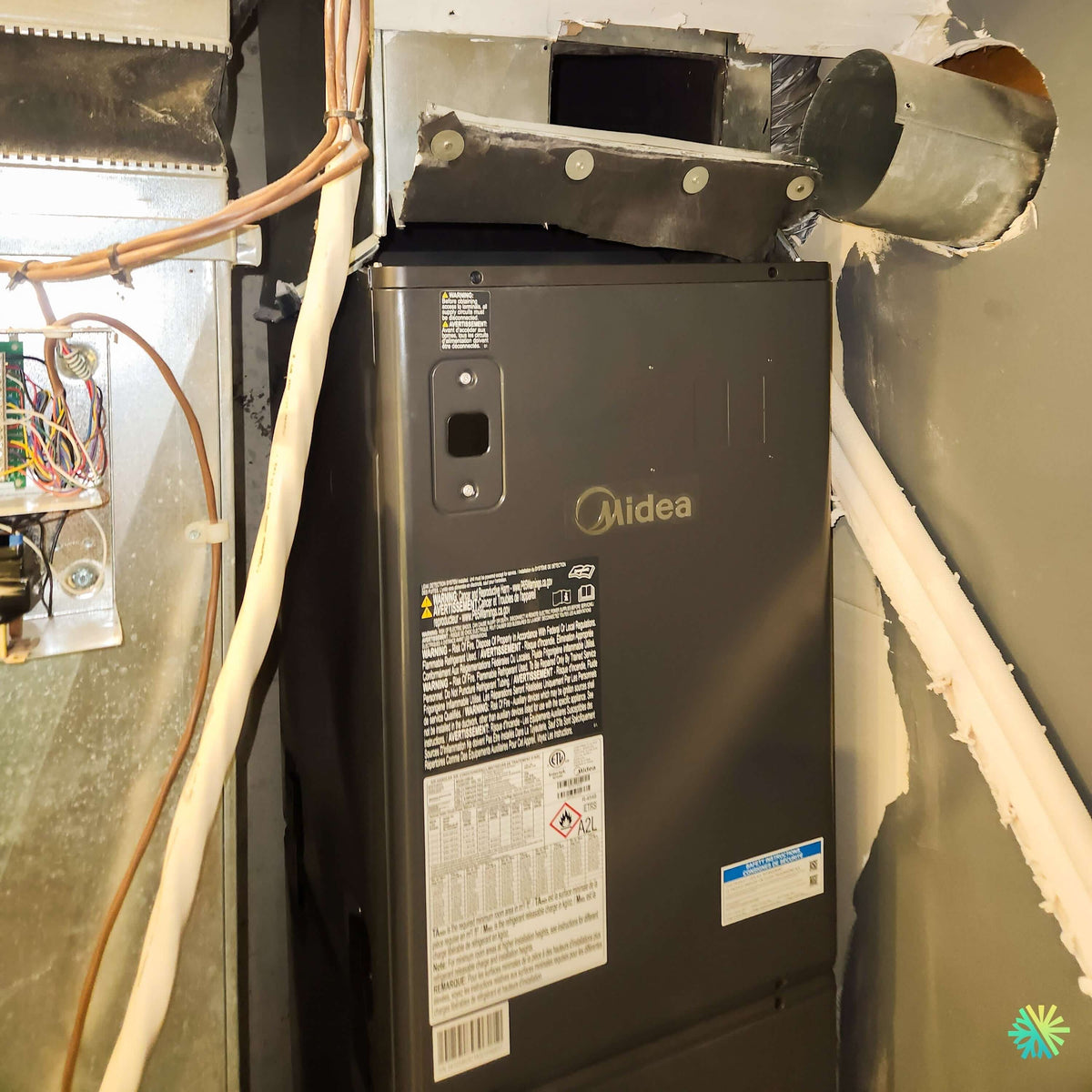
The photo immediately shows a compact mechanical environment, typical of many Montreal properties, where central units are installed in confined spaces, sometimes surrounded by existing ducts, open wall panels, copper piping, and ventilation sections already in place. It is precisely in this kind of context that the experience of a contractor specializing in HVAC installation becomes essential.
The MIDEA EVOX G3 3-ton unit is a particularly interesting choice for homeowners who want to improve the overall comfort of their home while modernizing their central heating and air conditioning system. As an electric furnace/air handler, it works with a central system to distribute conditioned air to different rooms through the duct network. When paired with a compatible central heat pump, it becomes a complete solution for heating and air conditioning, adapted to the climatic realities of the Montreal, Laval, Longueuil, North Shore, and South Shore regions.
A replacement that requires a real site assessment
Even before positioning the unit, our team had to analyze several visible and invisible elements of the existing installation. In a central system, every detail counts. Performance depends not only on the installed machine but also on the quality of its connection to the air distribution network.
In this project, the mechanical space presented several constraints:
- limited access around the unit;
- existing ducts to be precisely adapted;
- wall opening near the ventilation connection;
- copper piping already in vertical passage;
- control panel and wiring nearby;
- need to protect surrounding components during installation;
- importance of ensuring good sealing around air junctions.
This kind of environment requires meticulous coordination. A poorly adapted central HVAC installation can lead to air leaks, noise, inadequate static pressure, premature equipment wear, or uneven comfort between rooms. At AirGreen, we approach each central system replacement as a custom project, especially in more established neighborhoods like Rivière-des-Prairies–Pointe-aux-Trembles, where mechanical configurations vary greatly from one house to another.
Why the MIDEA EVOX G3 3-ton is suitable for this type of property
The 3-ton capacity typically corresponds to power used for properties requiring significant air distribution through a central network. In a residential context, this capacity must always be evaluated according to several criteria: area, insulation, house orientation, window quality, air volume to be treated, floor configuration, and duct condition.
The MIDEA EVOX G3 is appreciated for its modern approach to central comfort. It allows for efficient air management, clean integration into central installations, and compatibility with configurations designed to improve energy performance. For homeowners who want to replace an older system that is noisier, less efficient, or less adapted to current needs, this type of equipment represents a significant upgrade.
In this project, the client wanted a reliable solution, capable of supporting the comfort of the house without multiplying wall-mounted units in different rooms. The choice of a central air handler system allows for discreet, homogeneous, and integrated distribution within the building.
Key steps of our installation
An installation of a MIDEA EVOX G3 3-ton electric furnace is not limited to simply placing the unit in the right spot. It requires a rigorous work sequence, especially when space is tight and existing connections need to be adjusted.
1. Preparation of the mechanical space
We first secured the work area. In compact mechanical spaces, it's easy to damage a wire, pipe, insulation, or wall if the work site is not well organized. Our team therefore protected sensitive surfaces and cleared the necessary access to handle the unit.
The old layout included ventilation elements that needed to be re-routed to ensure a clean connection with the new electric furnace. The photo clearly shows the proximity between the unit, metal ducts, and the wall opening. This type of situation requires significant precision when aligning the unit.
2. Positioning of the air handler
The positioning of the unit is a crucial step. A misaligned unit can complicate future maintenance, reduce access to service panels, or create stress on connections. We installed the MIDEA EVOX G3 in a way that preserves access to main components, while respecting the required clearances for maintenance and inspection.
The objective was clear: to provide a clean, accessible, and functional installation, even in a restricted mechanical space.
3. Adaptation of existing ducts
Connecting to the ducts required adjustment work. Existing ventilation networks almost never perfectly match the dimensions and position of new equipment. Sometimes it is necessary to adapt a transition, reinforce a section, correct an opening, or improve the sealing around a connection.
In this case, the upper transition had to be carefully adjusted to avoid air leaks. A leak at this point could reduce system efficiency, increase noise, and impair air distribution in the house. We therefore paid particular attention to the continuity of airflow between the unit and the duct network.
4. Management of refrigerant lines and connections
The copper pipes visible near the unit confirm the importance of clean work around refrigerant connections. In a central installation, these lines must be protected, well-positioned, and properly insulated. Improper handling can cause vibrations, efficiency losses, or long-term service problems.
We checked the routing, protection, and alignment of the lines to ensure solid integration into the central system. The goal is always to facilitate equipment operation while reducing the risks of friction or mechanical stress.
5. Electrical checks and commissioning
An electric furnace requires particular attention to the electrical aspect. The available power, connections, safety features, and control compatibility must be validated before startup. Once the mechanical installation was complete, our team carried out the necessary checks to ensure that the system met operating requirements.
Commissioning includes several control points: thermostat response, start-up sequence, ventilation, auxiliary heating, air circulation, drainage, noise, unit stability, and general system behavior.
What this installation brings to client comfort
The main advantage of a MIDEA EVOX G3 3-ton central system is its ability to distribute air uniformly throughout the house. Unlike a wall-mounted solution that primarily treats one zone, a well-designed central system can improve overall comfort, especially when the ducts are in good condition and well-balanced.
For the client in Rivière-des-Prairies–Pointe-aux-Trembles, the expected benefits are concrete:
- better air circulation;
- more stable comfort between rooms;
- reduction of temperature differences;
- modernization of the central system;
- better compatibility with an efficient heating and air conditioning strategy;
- simpler access for maintenance thanks to a better organized installation;
- cleaner appearance in the mechanical space.
An installation like this can also help prepare the home for better energy management, especially when it's part of replacing aging equipment.
The details that make the difference in a central HVAC installation in Montreal
In Montreal, many homes have mechanical spaces that have been modified over the years. Sometimes, one finds added duct sections, damaged insulation, irregular openings, tight piping passages, and nearby electrical systems. Installing a MIDEA EVOX G3 electric furnace in this context requires a careful and methodical approach.
The importance of duct sealing
One of the most often overlooked points during a central system replacement is duct sealing. Even an excellent machine loses some of its efficiency if air escapes before reaching the rooms. The visible junctions around an air handler must be treated seriously.
At AirGreen, we pay particular attention to transitions, connections, and pressure zones. An air leak near the unit can have several consequences:
- loss of performance;
- higher energy consumption;
- discomfort in certain rooms;
- additional noise;
- dust aspirated from a mechanical space;
- unbalanced static pressure.
In this installation, adapting the upper section was an important element. The unit had to be connected to the existing network while limiting air losses and turbulence.
Access for future maintenance
A good installation should not only function on the day of commissioning. It must also remain easy to maintain. Filters, panels, connections, drains, and internal components must be inspectable without unnecessarily dismantling the environment around the unit.
In a tight space like the one shown in the photo, this consideration becomes essential. We installed the MIDEA EVOX G3 taking into account future access for maintenance, diagnostics, and adjustments. This approach reduces long-term service costs and facilitates quick interventions.
Mistakes to avoid when replacing a central electric furnace
Many homeowners only compare equipment price or tonnage capacity. However, in a central installation, the most costly mistakes often stem from poorly evaluated technical details.
Here are the mistakes we too often see in the field:
Choosing a capacity without building analysis
A 3-ton unit may be ideal in one house, but too large or too small in another. Sizing must be consistent with the actual needs of the building.
Neglecting the condition of the ducts
A central system depends on its distribution network. Poorly sealed, crushed, or undersized ducts can limit the performance of any appliance.
Installing the unit without service access
Equipment wedged against a wall or surrounded by obstacles becomes more difficult to maintain. This can complicate repairs and increase future costs.
Forgetting about drainage management
Condensation must be properly evacuated. Poor drainage can cause water damage, odors, or safety shutdowns.
Underestimating the electrical component
An electric furnace requires serious checks. Wiring, protection, and capacity must be compliant.
Useful local expertise from Montreal to the South Shore
Our central system installations in Montreal, Laval, Longueuil, on the North Shore and the South Shore allow us to quickly recognize the typical challenges of each type of property. In Rivière-des-Prairies–Pointe-aux-Trembles, we often find homes with compact mechanical spaces, successive renovations, and ducts that require careful adaptation when replacing central equipment.
This local expertise helps us anticipate problems before they become costly. In this project, success was not only based on the installation of the MIDEA EVOX G3 3-ton, but on the complete integration of the equipment into an existing environment.
Why choose AirGreen for a MIDEA EVOX G3 installation
At AirGreen, we combine technical expertise, equipment knowledge, and field experience. For a central HVAC installation, this combination is essential. Our role is to deliver a system that works well, remains accessible for maintenance, and offers the client lasting comfort.
We take the time to evaluate:
- the duct configuration;
- the required capacity;
- clearances around the unit;
- the condition of existing connections;
- electrical constraints;
- drainage quality;
- noise level;
- ease of maintenance;
- adaptation to the climate of the Greater Montreal area.
The MIDEA EVOX G3 3-ton electric furnace installed in Rivière-des-Prairies–Pointe-aux-Trembles perfectly illustrates our approach: a clean, thoughtful installation, adapted to the actual space, and geared towards long-term performance.
A Discreet, Solid, and Functional Final Result
The desired result in this type of project is not just aesthetic. It requires a stable, well-connected, accessible system ready to meet the home's heating and cooling needs. The photo shows modern central equipment integrated into a restricted technical space, with the typical constraints of a residential replacement.
For the client, the benefit is immediate: a modernized central system, a better foundation for indoor comfort, and a solution installed by a team accustomed to the realities of Montreal homes.
Practical Advice for Homeowners Considering a Central System
Before replacing an electric furnace or air handler, it is recommended to have the entire system inspected. The appliance is only one part of the installation. Ducts, electrical panel, refrigerant lines, thermostat, drainage, and mechanical space must all be evaluated.
A homeowner comparing quotes should ask specific questions:
- Will existing ducts be adapted or simply quickly connected?
- Will access for maintenance be maintained?
- Will the system be tested after installation?
- Will the drainage be checked?
- Is the 3-ton capacity truly suitable for the house?
- Is the contractor familiar with MIDEA central systems?
- Is the installation designed for the long term?
These questions help avoid a shoddy installation and choose a contractor who considers the entire project, not just the appliance box.
An Installation Representative of AirGreen's Expertise
This installation of a MIDEA EVOX G3 3-ton electric furnace in Rivière-des-Prairies–Pointe-aux-Trembles reflects the type of project we regularly undertake in the Greater Montreal area. Each site has its own constraints, but our method remains constant: analysis, precision, adaptation, and verification.
For homeowners wishing to modernize their central system in Montreal, Laval, Longueuil, on the North Shore or South Shore, equipment like the MIDEA EVOX G3 can represent a serious solution when the installation is done correctly. The quality of the result depends as much on the machine as on the work performed around it.
At AirGreen, we know that a good HVAC system must offer comfort, reliability, and lasting peace of mind. This is precisely what we aimed for in this project.
How it goes, from the first call to the end
The main steps of this kind of job at AirGreen. Every house has its quirks: the estimate brings them out.
We look at the ducts, the current indoor module, the electrical panel and the planned spot for the outdoor unit.
The equipment combination, capacity and price, in writing. We check whether the combination qualifies for assistance programs.
Access protected, old unit disconnected and removed when it is being replaced.
Electric furnace or air handler, with its coil, connected to the supply and return ducts.
On a level base, raised above the snow, with free space all around.
Insulated, they enter through a sealed opening and run to the indoor coil.
Dedicated circuits, accessible disconnect, a thermostat that works with the heat pump and the backup heat.
Leak test, vacuum, start-up, airflow check and a test of both modes.
Filter, thermostat, backup heat in extreme cold: what to know before winter.
- The on-site estimateWe look at the ducts, the current indoor module, the electrical panel and the planned spot for the outdoor unit.
- The quoteThe equipment combination, capacity and price, in writing. We check whether the combination qualifies for assistance programs.
- Getting readyAccess protected, old unit disconnected and removed when it is being replaced.
- The indoor moduleElectric furnace or air handler, with its coil, connected to the supply and return ducts.
- The outdoor unitOn a level base, raised above the snow, with free space all around.
- The refrigerant linesInsulated, they enter through a sealed opening and run to the indoor coil.
- Electrical and thermostatDedicated circuits, accessible disconnect, a thermostat that works with the heat pump and the backup heat.
- Tests and start-upLeak test, vacuum, start-up, airflow check and a test of both modes.
- The walkthroughFilter, thermostat, backup heat in extreme cold: what to know before winter.
And at your place?
Two quick checks with real numbers: what heat costs, and what your current heaters add up to in BTU/h.
Conversion: 1 W = 3.412 BTU/h. An indication, not a load calculation: baseboards and furnaces are often stronger than the real need, and they can stay as backup. AirGreen confirms the capacity on site.
What to do, season by season
Three habits per season for this unit. They take a few minutes and prevent many calls.
- Check the indoor module's filter.
- Clear winter debris from the outdoor unit.
- Test cooling before the heat arrives.
- Check the filter more often in peak season.
- Keep registers and returns clear.
- Watch condensate drainage near the coil.
- Change or clean the filter.
- Test heating and backup heat before the cold.
- Book periodic maintenance.
- Clear snow around the outdoor unit.
- Store nothing in front of the indoor module.
- Note any unusual noise or smell and call us.
Which type of equipment for your project?
Pick what looks like your need.
Four mistakes we do not make
Flip each card to see what we do instead.
What people ask us about this kind of work
Can I keep my current ducts?
What happens in extreme cold?
Furnace, air handler, ducted: what is the difference?
Are there grants?
Do I need a permit?
How much can I save?
How is the LogisVert assistance calculated?
Will my current thermostat work?
Central or wall units: which one?
Does AirGreen hold the required licences?
Is the estimate free?
No question matches. Write to us: we answer.
Useful pages for what comes next
More jobs to see, near you
By town, by equipment or by region: browse more than 4,700 published projects.
Each dot: a town where AirGreen has published projects. The glowing dot: this job.
Tell us about your house. We come and see it for free.
The on-site estimate is free and the quote follows within 24 hours.
Text and photo: a real AirGreen Climatisation & Chauffage job. The diagrams are generic illustrations of the type of installation, not a survey of this job site. Sources of the added figures: airgreen.ca product pages (NEEP / AHRI performance), Hydro-Québec (Heat pumps page, LogisVert, read on 13 October 2026), Régie de l’énergie (rate D as of 1 April 2026).