
Installation of a GREE CROSSOVER R32 Wall-Mounted Heat Pump - Air Conditioner - Mini Split in Îles-Laval
AirGreen installs a GREE CROSSOVER R32 in Îles-Laval: wall-mounted heat pump, mini-split air conditioner, clean installation on wall bracket and durable HVAC comfort.
Take a tour of the installation
Each number is a point we check on site. Switch between summer and winter to watch air and heat move.
In summer, the outdoor unit rejects the house's heat outside.
Generic illustration of this type of installation, not a survey of this job site. Tap a number.
Mounted level on a wall plate, high enough for the air to reach the whole room, with enough space around it to slide the filters out easily.
The refrigerant lines, the communication cable and the drain go through the wall in a single opening, sealed against water, cold air and insects.
Two insulated copper pipes connect the two units. Outside, a line cover can protect them from sun, knocks and weather.
A shut-off switch near the outdoor unit isolates it safely for service. It must stay accessible at all times.
The compressor and the fan. In heating mode it captures heat from the outdoor air, even in winter, and moves it inside.
On the ground or on the wall, it keeps the unit above accumulated snow. The unit stays clear and defrost water can drain away.
The fan needs to blow freely. Storage, a fence or a wall too close, and efficiency drops while noise goes up.
A GREE wall-mounted installation designed for the real comfort of a residence in Îles-Laval
In Îles-Laval, residences are often exposed to specific conditions: humidity from proximity to water, stronger winds depending on building orientation, rapid temperature changes between day and night, and exterior layout constraints unique to houses with balconies, backyards, side access, or elevated structures. For this installation, our AirGreen team installed a GREE CROSSOVER R32 wall-mounted heat pump, a mini split system designed to offer both a high-performance wall-mounted air conditioner in summer and efficient heating during cold periods.
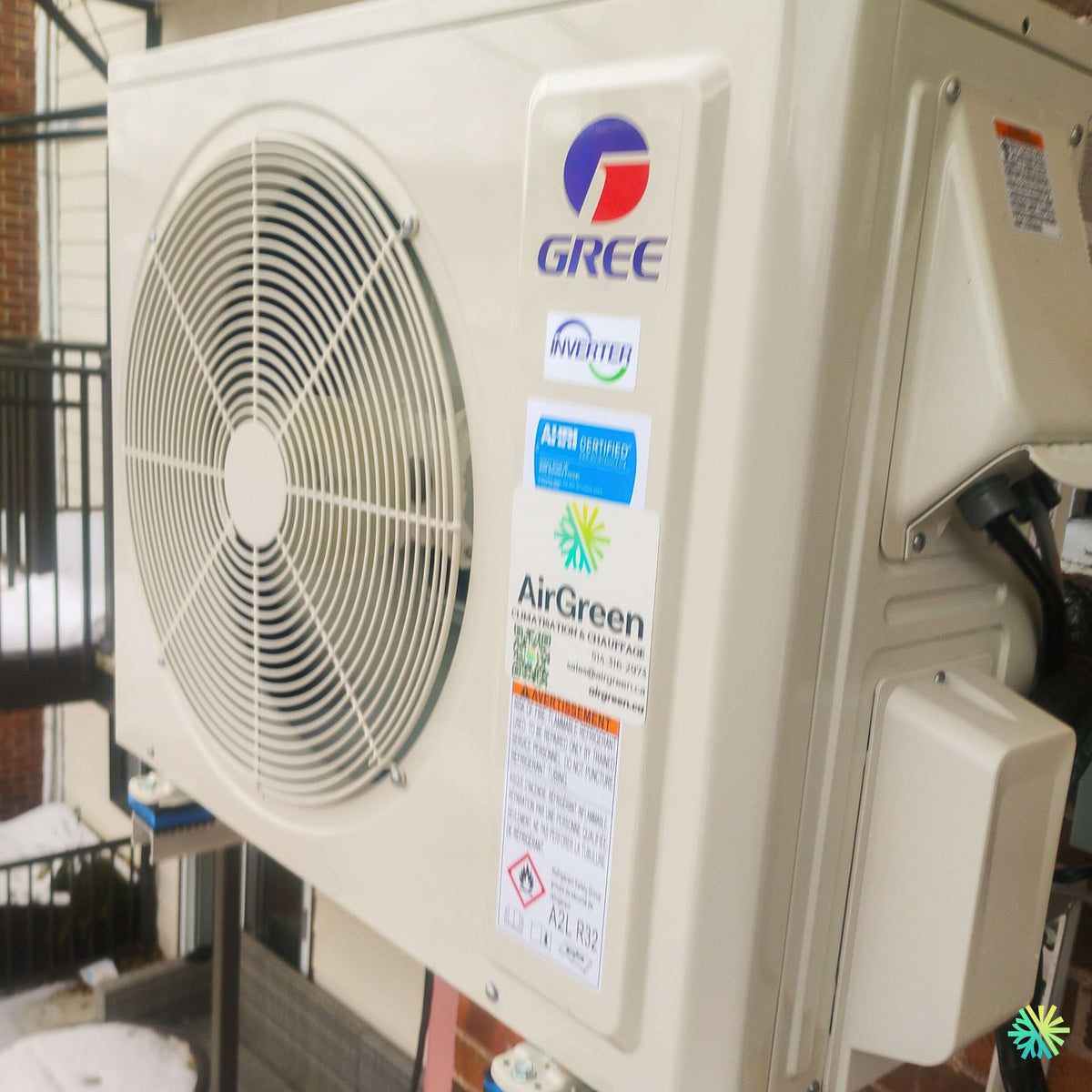
The project photo clearly shows the carefully installed GREE outdoor unit, mounted on a wall bracket, near a balcony structure. You can also see the AirGreen label affixed to the unit, the R32 refrigerant marking, and the clean, compact configuration of the installation. This type of installation perfectly illustrates our approach: maximizing system performance while respecting the architectural environment of the building, ensuring access for HVAC maintenance, safety, mechanical stability, and exterior aesthetics.
For homeowners seeking a reliable solution in Îles-Laval, Montreal, Laval, Longueuil, on the North Shore, or on the South Shore, this project demonstrates how a well-planned HVAC installation can transform a home's comfort without requiring major work or intrusive modifications.
A GREE CROSSOVER R32 well-suited to Laval's residential realities
The GREE CROSSOVER R32 is a particularly attractive solution for clients who wish to replace or supplement an existing system, reduce their reliance on electric baseboards, improve comfort during heatwaves, and enjoy more stable heating during intermediate seasons. In a residence in Îles-Laval, this choice makes even more sense when considering the importance of a device capable of managing frequent temperature swings and sometimes more pronounced humidity.
Why the CROSSOVER R32 model was chosen for this project
During our initial assessment, the client's objective was clear: to obtain a discreet, efficient, reliable wall-mounted system capable of meeting the primary comfort needs in the living areas. As in many residential heat pump projects we carry out in Laval and on the North Shore, it was not just about choosing a well-known brand, but about selecting a device consistent with:
- the area to be treated;
- the interior layout of the rooms;
- the orientation of the house;
- the possible location of the outdoor unit;
- the distance between the indoor evaporator and the condenser;
- access constraints for technicians;
- the desired sound level;
- the desired energy efficiency;
- the possibility of obtaining financial aid according to current programs.
The GREE CROSSOVER R32 proved to be an excellent choice thanks to its balance of performance, size, efficiency, and reliability. The R32 refrigerant also represents a significant advantage, as it is increasingly used in modern equipment for its thermodynamic characteristics and better environmental profile compared to older refrigerants.
An outdoor wall-mounted installation: precision, stability, and clearance
The installation image shows an outdoor unit mounted on a robust wall bracket. This method is often recommended when the device needs to be protected against snow accumulation, puddles, ground debris, or freeze-thaw related movements. In Îles-Laval, this detail is particularly important: winters can bring compact snow, persistent humidity, and freezing cycles that harm installations placed too close to the ground.
By installing the elevated unit, we were able to ensure:
- adequate clearance around the fan;
- improved air circulation;
- reduced risk of snow obstruction;
- a solid base to limit vibrations;
- more convenient access for inspection and HVAC maintenance;
- clean integration near the existing structure.
The positioning of an outdoor unit is never left to chance. A wall-mounted heat pump must be able to breathe properly. Poor air circulation can lead to decreased performance, premature wear, higher electricity consumption, and less effective defrost cycles. That's why our technicians always check lateral, frontal, and rear clearances before permanently fixing the unit.
R32 refrigerant management: a job reserved for qualified professionals
The presence of the R32 marking on the unit recalls an essential element: a mini split installation is not just a simple mechanical connection. The refrigeration circuit must be handled by qualified professionals, with appropriate tools, adequate vacuuming methods, and required leak checks.
At AirGreen, we strongly emphasize this point to our clients in Montreal, Laval, Longueuil, on the North Shore, and on the South Shore: a good machine installed incorrectly will never perform at its best. The quality of the installation directly influences the compressor's lifespan, temperature stability, energy consumption, and overall system reliability.
For this project in Îles-Laval, our technicians paid particular attention to:
- the quality of refrigeration connections;
- line protection;
- circuit vacuuming;
- fitting verification;
- condensate drainage;
- clean duct passage;
- secure condenser mounting;
- electrical compliance;
- complete system commissioning.
An intervention adapted to the building's architecture
The environment visible in the photo presents certain typical constraints of installations in dense residential areas: proximity to a balcony, railings, exterior wall with limited clearance, and the need to maintain safe access around the unit. In this type of context, experience makes a real difference.
A common mistake is to install the outdoor unit only where it is easiest to place, without considering its long-term operation. We instead chose a location that met several criteria: stability, ventilation, protection against snow accumulation, service access, and visual integration.
The goal was not simply to "make the heat pump work," but to create a durable, clean, and logical installation for years to come. This approach corresponds to how we work on all our HVAC installation projects, whether in Laval, Ahuntsic, Saint-Laurent, Boucherville, Terrebonne, or other residential areas of Greater Montreal.
Indoor comfort: a visible improvement from the first cycles
A well-sized GREE CROSSOVER R32 wall-mounted heat pump quickly improves indoor comfort. In cooling mode, it helps stabilize the temperature without creating a sensation of aggressive drafts when the indoor unit's location is well chosen. In heating mode, it reduces temperature differences between rooms and limits excessive use of electric baseboards for a good part of the year.
In this residence in Îles-Laval, the client primarily wanted to achieve a more consistent temperature in the living areas. Before the installation, the house experienced uncomfortable variations on very hot days and cool evenings. After commissioning, the system provided more regular distribution, with a quick response to temperature changes.
The performance of a wall-mounted air conditioner does not depend solely on the BTU number. It also depends on indoor circulation, insulation, sun exposure, ceiling height, openings between rooms, and daily use of the house. That's why our initial assessment is never limited to a quick estimate. We analyze the real context before proposing a solution.
The concrete advantages of a GREE CROSSOVER R32 wall-mounted heat pump
The GREE CROSSOVER R32 offers several advantages for homeowners who want a reliable wall-mounted system well-suited to the Quebec climate. Among the most relevant benefits for this type of installation are:
- inverter technology allowing for more precise modulation;
- improved temperature stability;
- optimized energy consumption compared to traditional on-off operation;
- superior comfort level in air conditioning;
- useful heating capacity during cold seasons;
- a compact format to facilitate outdoor integration;
- the use of R32 refrigerant;
- a design adapted to modern residential needs.
Inverter technology is particularly appreciated because it allows the unit to adjust its speed according to actual demand. Rather than constantly starting and stopping, the system can operate more gently, for longer periods, and more stably. The result: fewer abrupt variations, less discomfort, and often better overall efficiency.
Subsidies and eligibility: a point to check before purchasing
For many clients, financial aid programs play an important role in choosing a heat pump. Depending on the exact model, capacity, eligibility lists, and conditions in effect at the time of installation, some systems may be eligible for provincial subsidies or energy efficiency programs.
At AirGreen, we assist our clients in understanding the procedures. We provide the necessary documents after installation, including detailed invoices and relevant technical information. It remains important to verify the exact eligibility of the model at the time of the project, as programs can evolve and amounts may vary.
For homeowners in Montreal, Laval, Longueuil, on the North Shore, and on the South Shore, this step can represent significant savings. We always recommend choosing a device not only for its initial price but also for its performance, durability, operating costs, and potential for financial aid.
What this installation teaches homeowners in Îles-Laval
This project highlights several practical tips for anyone considering installing a mini split:
Do not choose the outdoor location solely for aesthetics
A condenser must be well ventilated, accessible, and protected. Aesthetics are important, but they should never compromise performance. A poorly placed unit can become noisy, less efficient, or more difficult to maintain.
Do not underestimate the importance of support
A properly installed wall bracket contributes to system stability. It also helps protect the unit against snow and water. In areas like Îles-Laval, where outdoor conditions can be humid and variable, this detail matters.
Do not buy a machine without professional installation
A wall-mounted heat pump requires a compliant installation, including refrigeration, electrical, and drainage connections. Work on refrigerants must be done by qualified professionals. A separate purchase without specialized installation can lead to warranty, performance, and safety problems.
Do not choose solely based on price
Price is important, but it should not be the only criterion. A cheaper but poorly executed installation can cost much more in the long run. At AirGreen, we favor a comprehensive approach: choosing the right device, careful installation, client explanations, clear documentation, and after-installation service.
Complete commissioning and clear explanations to the client
After installing the GREE CROSSOVER R32, our team proceeded with the complete system commissioning. This step includes testing operating modes, verifying the indoor unit's response, inspecting drainage, checking for abnormal noises, validating condenser operation, and explaining to the client.
We always take the time to explain:
- how to use the remote control correctly;
- how to choose heating, cooling, dehumidification, and ventilation modes;
- how to adjust the temperature without overconsuming;
- when to clean the filters;
- what signs to look for in case of an anomaly;
- why regular maintenance is important.
A good HVAC system must be well understood by its user. Even the best heat pump can be poorly utilized if the settings are not adapted. For example, constantly changing the temperature set point or using an inadequate mode can harm comfort and increase consumption. Our advice allows the client to fully enjoy their investment from day one.
The importance of HVAC maintenance to preserve performance
Once the wall-mounted heat pump is installed, maintenance becomes essential. The indoor unit's filters must be cleaned regularly, especially during periods of heavy use. The outdoor unit must also remain clear: leaves, snow, dust, pollen, and debris can hinder air circulation.
For a system like the GREE CROSSOVER R32, periodic HVAC maintenance helps to:
- maintain good airflow;
- reduce the risk of overconsumption;
- preserve heating and cooling capacity;
- extend the lifespan of the appliance;
- quickly identify potential problems;
- maintain a better level of indoor air quality.
In Îles-Laval, where humidity and seasonal variations are very present, outdoor maintenance should not be neglected. A cleanly installed unit, like the one shown in the photo, starts with a significant advantage, but it must remain clear and inspected throughout the seasons.
AirGreen: Local Expertise in Wall-Mounted Heat Pump Installation
This project is part of a long series of installations carried out by AirGreen in Greater Montreal. We regularly install wall-mounted heat pumps, wall-mounted air conditioners, mini-split systems, multi-zone systems, and HVAC solutions adapted for homes, condos, plexes, businesses, and small buildings.
Our local expertise allows us to understand the differences between sectors. An installation in Îles-Laval does not always present the same challenges as an installation in a condo in Griffintown, a single-family home in Blainville, a duplex in Rosemont, a bungalow in Brossard, or a residence in Terrebonne. Each building requires a precise assessment of the terrain, access, available electricity, structure, insulation, and client expectations.
This rigor is part of our method. We do not offer a generic solution. We seek the appliance and configuration that truly match the project.
A clean, durable, and future-proof installation
The photo of this GREE installation in Îles-Laval perfectly summarizes what we aim to deliver: a well-positioned appliance, a solid support, professional finishing, and functional integration. The result is understated, clean, and geared towards durability.
For the client, the benefits are tangible: better comfort, efficient air conditioning, powerful auxiliary heating, a modern R32 system, safe installation, and professional support. For us, it's another example of the value of an HVAC installation carried out with method, attention, and experience.
Homeowners considering a GREE CROSSOVER R32 wall-mounted heat pump in Montreal, Laval, Longueuil, on the North Shore or on the South Shore benefit from having their project evaluated by a team that understands local realities. The choice of appliance matters, but the quality of the installation matters just as much.
Why choose AirGreen for a GREE CROSSOVER R32
Choosing AirGreen means getting more than just equipment installation. It means benefiting from comprehensive support, from evaluation to commissioning, with particular attention to the system's actual performance.
Our clients choose AirGreen for:
- our knowledge of the residential HVAC market in Quebec;
- our experience with recognized brands like GREE;
- our ability to install cleanly in confined spaces;
- our transparency in recommendations;
- our attention to detail;
- our support for grant-related documents;
- our after-installation service;
- our understanding of the specific needs of Montreal, Laval, Longueuil, the North Shore, and the South Shore.
This installation in Îles-Laval demonstrates that a well-executed project can combine performance, aesthetics, safety, and comfort. The GREE CROSSOVER R32 installed here meets a very concrete need: to offer a more stable indoor climate while respecting building constraints and owner expectations.
Conclusion: A well-installed GREE wall-mounted heat pump makes all the difference
The installation of a GREE CROSSOVER R32 Wall-Mounted Heat Pump - Air Conditioner - Mini Split in Îles-Laval perfectly illustrates the importance of a professional approach to HVAC. The choice of model, the location of the outdoor unit, the quality of connections, commissioning, and usage advice are all elements that directly influence the comfort and durability of the system.
At AirGreen, we approach every project with the same priority: to deliver a reliable, clean, efficient, and client-tailored installation. In this specific case, the result is a modern, well-integrated solution, capable of improving daily comfort while offering an excellent basis for sustainable use.
The big day, step by step
The main steps of this kind of job at AirGreen. Every house has its quirks: the estimate brings them out.
We look at the room, the outside wall, the line route and where the outdoor unit will go. That is where the capacity gets chosen.
Model, capacity and price, in writing. We also check whether the model qualifies for assistance programs.
Floors and furniture protected, wall plate position marked level, wall opening located.
A single opening, with the slope the drain needs to flow outside.
Set on a stand raised above the snow, with the clearances the manufacturer requires.
Connected, insulated and protected. The opening is then sealed against water, cold air and insects.
A dedicated circuit and an accessible disconnect near the outdoor unit.
Leak test, vacuum, then start-up and a check of heating and cooling.
Remote, modes, filters: we show you the essentials before we leave.
- The on-site estimateWe look at the room, the outside wall, the line route and where the outdoor unit will go. That is where the capacity gets chosen.
- The quoteModel, capacity and price, in writing. We also check whether the model qualifies for assistance programs.
- Getting readyFloors and furniture protected, wall plate position marked level, wall opening located.
- The wall openingA single opening, with the slope the drain needs to flow outside.
- The outdoor unitSet on a stand raised above the snow, with the clearances the manufacturer requires.
- Lines, cable and drainConnected, insulated and protected. The opening is then sealed against water, cold air and insects.
- The electrical workA dedicated circuit and an accessible disconnect near the outdoor unit.
- Tests and start-upLeak test, vacuum, then start-up and a check of heating and cooling.
- The walkthroughRemote, modes, filters: we show you the essentials before we leave.
What would it look like at your place?
Two quick checks with real numbers: what heat costs, and what your current heaters add up to in BTU/h.
Conversion: 1 W = 3.412 BTU/h. An indication, not a load calculation: baseboards and furnaces are often stronger than the real need, and they can stay as backup. AirGreen confirms the capacity on site.
Four mistakes we do not make
Flip each card to see what we do instead.
Your own project, step by step
What to do, season by season
Three habits per season for this unit. They take a few minutes and prevent many calls.
- Clean the indoor unit's filters.
- Clear leaves and debris left on the outdoor unit by winter.
- Test cooling before the first hot days.
- Clean the filters more often when the unit runs a lot.
- Keep plants away from the outdoor unit.
- Check that no water drips from the indoor unit.
- Rake the leaves around the outdoor unit.
- Test heating before the first cold days.
- Book periodic maintenance before winter.
- Keep snow away from the stand and the front of the unit.
- Let the unit defrost: it is normal.
- Never hit the ice on the fins; call us if the unit stays iced up.
Is your home ready?
Check what applies at your place. A "no" is not a refusal: it is what we sort out during the estimate.
Four statements: true or false?
It all comes down to details you have just seen.
1. In heating mode, the outdoor unit can produce water.
During defrost cycles. That water must drain away without forming ice.
2. You pick the capacity with a simple square-footage rule.
Windows, insulation, orientation and how the room is used all count. Capacity is chosen on site.
3. A multi-zone connects several indoor heads to a single condenser.
One head per room, all on the same condenser. Each room keeps its own temperature.
4. The disconnect can sit behind the patio furniture.
It must stay accessible: it is what shuts the unit off for service.
0 / 4 right answers
What people ask us about this kind of work
Does a wall-mounted heat pump heat in winter?
Wall-mounted or multi-zone: how do I choose?
Where does the outdoor unit go?
Are there grants?
Do I need a permit?
How cold can it heat?
How much can I save?
How is the LogisVert assistance calculated?
Is it noisy?
The outdoor unit is covered in ice: is that normal?
Does AirGreen hold the required licences?
Is the estimate free?
No question matches. Write to us: we answer.
More jobs to see, near you
By town, by equipment or by region: browse more than 4,700 published projects.
Each dot: a town where AirGreen has published projects. The glowing dot: this job.
Every house has its constraints. We see them before we install.
The on-site estimate is free and the quote follows within 24 hours.
Text and photo: a real AirGreen Climatisation & Chauffage job. The diagrams are generic illustrations of the type of installation, not a survey of this job site. Sources of the added figures: airgreen.ca product pages (NEEP / AHRI performance), Hydro-Québec (Heat pumps page, LogisVert, read on 13 October 2026), Régie de l’énergie (rate D as of 1 April 2026).