
Installation of a GREE FreeMatch R32 MultiZone heat pump in Rosemont–La Petite-Patrie
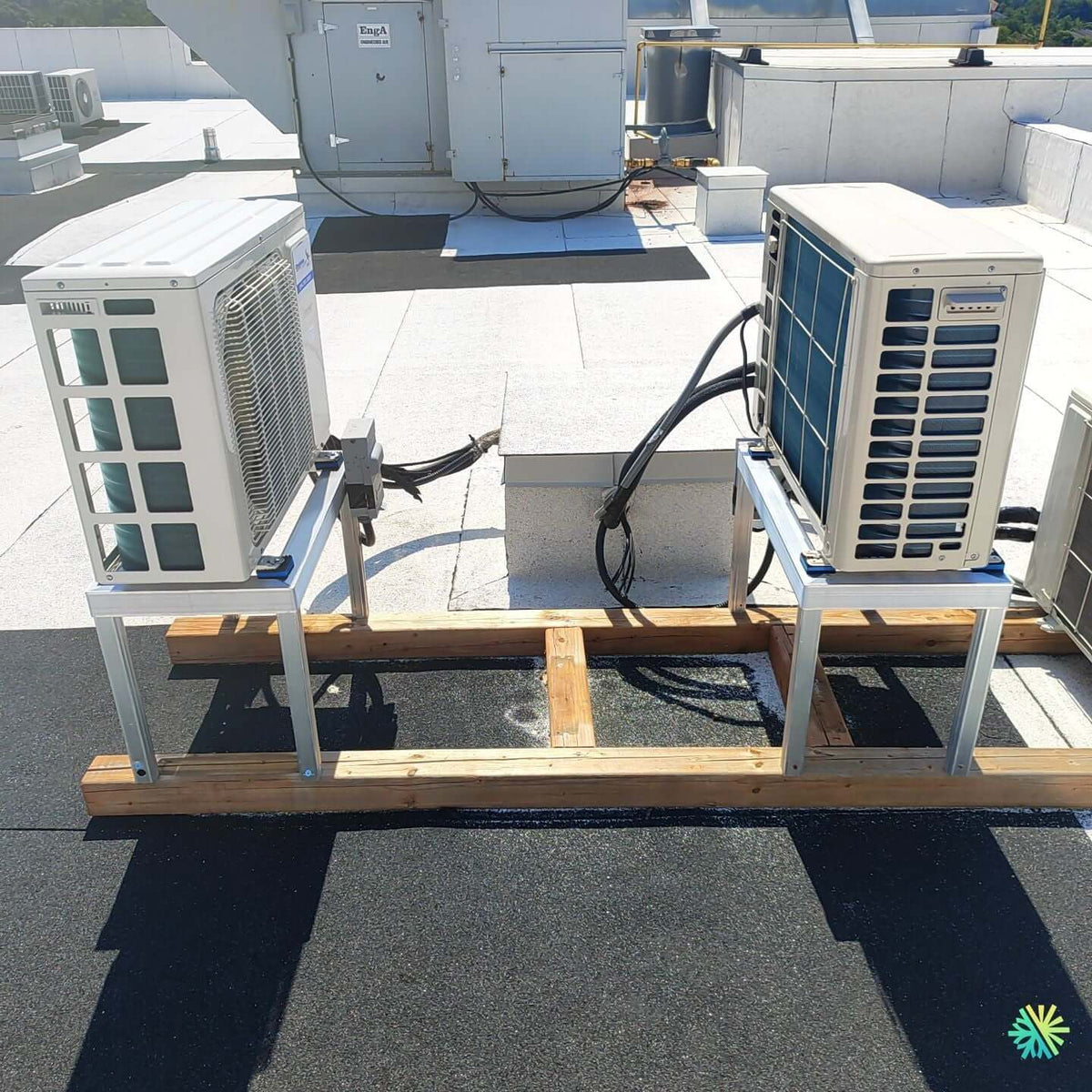
AirGreen installs two GREE FreeMatch R32 condensers on a flat roof in Rosemont–La Petite-Patrie: MultiZone configuration, high efficiency and careful integration for a Montreal plex, with HVAC maintenance and Greater Montreal service.
In summer, the outdoor unit rejects the house's heat outside.
Generic illustration of this type of installation, not a survey of this job site. Tap a number.
Mounted level on a wall plate, high enough for the air to reach the whole room, with enough space around it to slide the filters out easily.
The refrigerant lines, the communication cable and the drain go through the wall in a single opening, sealed against water, cold air and insects.
Two insulated copper pipes connect the two units. Outside, a line cover can protect them from sun, knocks and weather.
A shut-off switch near the outdoor unit isolates it safely for service. It must stay accessible at all times.
The compressor and the fan. In heating mode it captures heat from the outdoor air, even in winter, and moves it inside.
On the ground or on the wall, it keeps the unit above accumulated snow. The unit stays clear and defrost water can drain away.
The fan needs to blow freely. Storage, a fence or a wall too close, and efficiency drops while noise goes up.
Two condensers on a flat roof for 4-season comfort in a Montreal plex
At AirGreen , we are modernizing the comfort of a Rosemont–La Petite-Patrie plex with the installation of MultiZone GREE FreeMatch R32 heat pumps . The chosen configuration— two condensers installed on a flat roof , each serving several interior heads—meets a specific need: efficiently air conditioning and heating stacked dwellings, while freeing up the facades and preserving the roof membrane .
Context and objectives of the project
The building, typical of the area, has a masonry structure with a flat roof and technical access. The owners' priorities are clear:
-
Improve summer and winter comfort.
-
Reduce operating costs compared to electric supplementary heating.
-
Centralize outdoor equipment on the roof to avoid clutter on the ground and disturbances in the yard.
-
Guarantee a durable HVAC installation , compatible with Montreal winters.
Why the FreeMatch R32 range
The GREE FreeMatch R32 stands out for its MultiZone flexibility (2 to 5 zones) , its compatibility with wall-mounted, console or cassette heads, and the use of R-32 refrigerant , which is more efficient and has a lower GWP than R-410A. Main advantages for an urban plex:
-
High heating and air conditioning efficiency , adapted to the temperature variations of Greater Montreal.
-
Ability to power multiple rooms per system, ideal when each home has distinct requirements.
-
Intelligent defrost management and low temperature blowing stability.
-
Low noise levels, relevant for a dense residential environment.
Installation on a flat roof: method and precautions
We install the two condensers on an aluminum frame fixed to treated wood distribution soles placed on the membrane. This assembly:
-
Diffuses the loads so as not to puncture the roof.
-
Incorporates anti-vibration pads to absorb structural resonances.
-
Ensures compliant service clearances (clear suction/discharge, maintenance passages).
-
Facilitates snow removal and prevents ice buildup around appliances during defrosting periods.
An external disconnect switch is installed near each condenser for safety and maintenance. Refrigeration lines and communication cables run in a sealed technical box , with sealed and solidified penetrations to preserve the integrity of the membrane.
Refrigeration route and interior connections
From the roof, the connections descend into the technical columns to reach the interior wall heads . We favor:
-
Short, insulated lines (UV/ozone insulation on the roof side and continuous vapor barrier on the interior side).
-
A bending radius respected to avoid stress on copper.
-
Gravity condensate drainage for indoor units when configuration allows; otherwise, silent mini-pump with vapor barrier and service point.
Electricity and protections
Each condenser has a dedicated circuit from the main panel: circuit breaker size, conductor size and GFCI when required, in accordance with the Canadian Electrical Code . Communication links are separated from the power to limit interference. On the roof, the ducts are UV-resistant and sealed against penetrations.
Rigorous commissioning
Our standard procedures ensure performance and longevity:
-
Nitrogen leak tests (stabilized pressure, recorded readings).
-
Deep vacuum draw down to less than 500 microns, hold and lift test.
-
Fluid opening , load balancing according to actual lengths and number of evaporators.
-
Setting control modes (thermistors, speed balancing, defrost curves).
-
Reception with the owner : training in use, HVAC maintenance schedule, seasonal recommendations.
Winter management: details that make the difference
On a flat roof in Montreal, success depends on anticipation:
-
Sufficient elevation of the condensers to avoid snow suction.
-
Keep away from discharges from other appliances (hood, air exchanger, towers) in order to preserve air quality and avoid premature icing.
-
Wind deflectors if the site is very exposed.
-
Check defrost water drains to prevent ice patches from forming.
Concrete benefits for occupants
-
Uniform comfort in key rooms (living rooms/kitchens/bedrooms), with no marked differences between floors.
-
Silent operation : noise is relegated to the roof, the accommodation remains quiet.
-
Significant energy savings compared to electric baseboard heaters or window air conditioners.
-
Flexibility of use : each accommodation controls its own atmosphere room by room.
Preventive maintenance and durability
To maintain performance season after season, we recommend:
-
Clean the filters of the inner heads every 4–6 weeks during use.
-
Gentle washing of external batteries in spring (controlled pressure, counter-current).
-
Annual inspection : tightening of terminals, insulation check, verification of supports, condensate test, reading of operating parameters.
Our teams provide HVAC maintenance throughout Greater Montreal, avoiding performance losses linked to clogging or small undetected leaks.
Grants and Eligibility
High-efficiency, cold-efficient heat pumps may be eligible for assistance under current programs. We guide homeowners through the prequalification process , taking into account installed capacity, seasonal performance, and required documentation. Our team compiles the necessary documents to facilitate the process in Montreal, Laval, Longueuil, the North Shore, and the South Shore .
What to remember for a flat roof installation
-
Structure and membrane first : distribute loads, protect waterproofing, record interventions.
-
Access and service : provide clearances and passages that can be maintained all year round.
-
Clean paths : continuous insulation, anti-UV supports, controlled drainage slopes.
-
Quality control : nitrogen testing, vacuum draw and documented commissioning measurements.
Result
The building now benefits from a discreet, efficient MultiZone R-32 system designed for Montreal's climate. Occupants enjoy temperate air in both summer and winter, with better controlled energy bills and integration that respects the area's architecture.
AirGreen, your local HVAC partner
We carry out custom HVAC installations throughout Greater Montreal. Whether your project involves a plex, a condo, or a house, we combine careful sizing , technical execution , and maintenance monitoring for lasting performance. Let's discuss your building in Montreal, Laval, Longueuil, the North Shore, or the South Shore : we will propose the most appropriate configuration at the best operating cost.
How it goes, from the first call to the end
The main steps of this kind of job at AirGreen. Every house has its quirks: the estimate brings them out.
We look at the room, the outside wall, the line route and where the outdoor unit will go. That is where the capacity gets chosen.
Model, capacity and price, in writing. We also check whether the model qualifies for assistance programs.
Floors and furniture protected, wall plate position marked level, wall opening located.
A single opening, with the slope the drain needs to flow outside.
Set on a stand raised above the snow, with the clearances the manufacturer requires.
Connected, insulated and protected. The opening is then sealed against water, cold air and insects.
A dedicated circuit and an accessible disconnect near the outdoor unit.
Leak test, vacuum, then start-up and a check of heating and cooling.
Remote, modes, filters: we show you the essentials before we leave.
- The on-site estimateWe look at the room, the outside wall, the line route and where the outdoor unit will go. That is where the capacity gets chosen.
- The quoteModel, capacity and price, in writing. We also check whether the model qualifies for assistance programs.
- Getting readyFloors and furniture protected, wall plate position marked level, wall opening located.
- The wall openingA single opening, with the slope the drain needs to flow outside.
- The outdoor unitSet on a stand raised above the snow, with the clearances the manufacturer requires.
- Lines, cable and drainConnected, insulated and protected. The opening is then sealed against water, cold air and insects.
- The electrical workA dedicated circuit and an accessible disconnect near the outdoor unit.
- Tests and start-upLeak test, vacuum, then start-up and a check of heating and cooling.
- The walkthroughRemote, modes, filters: we show you the essentials before we leave.
And at your place?
Two quick checks with real numbers: what heat costs, and what your current heaters add up to in BTU/h.
Conversion: 1 W = 3.412 BTU/h. An indication, not a load calculation: baseboards and furnaces are often stronger than the real need, and they can stay as backup. AirGreen confirms the capacity on site.
What to do, season by season
Three habits per season for this unit. They take a few minutes and prevent many calls.
- Clean the indoor unit's filters.
- Clear leaves and debris left on the outdoor unit by winter.
- Test cooling before the first hot days.
- Clean the filters more often when the unit runs a lot.
- Keep plants away from the outdoor unit.
- Check that no water drips from the indoor unit.
- Rake the leaves around the outdoor unit.
- Test heating before the first cold days.
- Book periodic maintenance before winter.
- Keep snow away from the stand and the front of the unit.
- Let the unit defrost: it is normal.
- Never hit the ice on the fins; call us if the unit stays iced up.
Which type of equipment for your project?
Pick what looks like your need.
Four mistakes we do not make
Flip each card to see what we do instead.
What people ask us about this kind of work
Does a wall-mounted heat pump heat in winter?
Wall-mounted or multi-zone: how do I choose?
Where does the outdoor unit go?
Are there grants?
Do I need a permit?
How cold can it heat?
How much can I save?
How is the LogisVert assistance calculated?
Is it noisy?
The outdoor unit is covered in ice: is that normal?
Does AirGreen hold the required licences?
Is the estimate free?
No question matches. Write to us: we answer.
Useful pages for what comes next
More jobs to see, near you
By town, by equipment or by region: browse more than 4,700 published projects.
Each dot: a town where AirGreen has published projects. The glowing dot: this job.
Tell us about your house. We come and see it for free.
The on-site estimate is free and the quote follows within 24 hours.
Text and photo: a real AirGreen Climatisation & Chauffage job. The diagrams are generic illustrations of the type of installation, not a survey of this job site. Sources of the added figures: airgreen.ca product pages (NEEP / AHRI performance), Hydro-Québec (Heat pumps page, LogisVert, read on 13 October 2026), Régie de l’énergie (rate D as of 1 April 2026).