
Installation of a Gree (R-32) wall-mounted heat pump in Villeray–Saint-Michel–Parc-Extension
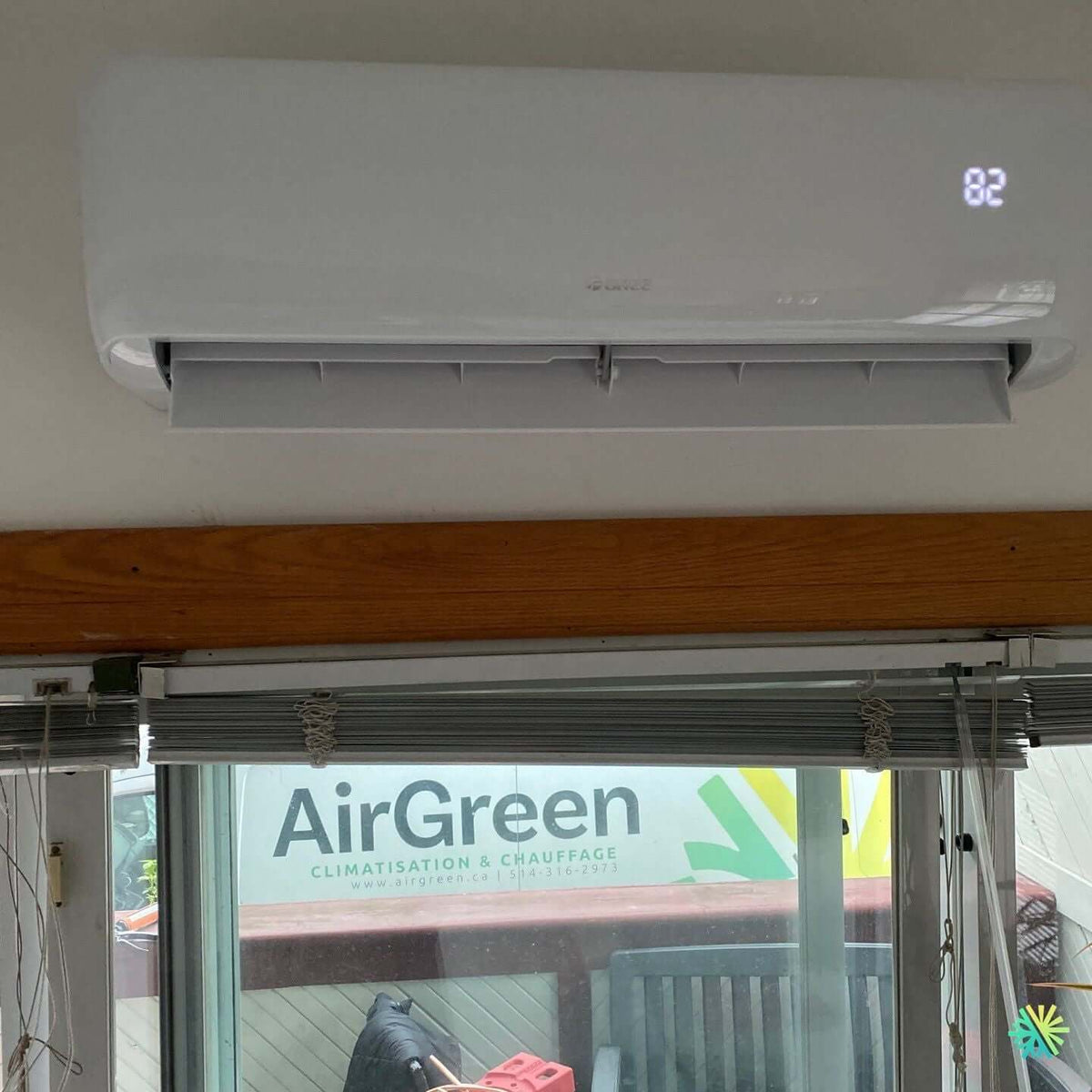
We are installing a Gree (R-32) wall-mounted heat pump in Villeray–Saint-Michel–Parc-Extension, aligned above the bay window: short refrigeration lines, four-season comfort and silence. AirGreen — HVAC installation and maintenance in Montreal and surrounding areas.
In summer, the outdoor unit rejects the house's heat outside.
Generic illustration of this type of installation, not a survey of this job site. Tap a number.
Mounted level on a wall plate, high enough for the air to reach the whole room, with enough space around it to slide the filters out easily.
The refrigerant lines, the communication cable and the drain go through the wall in a single opening, sealed against water, cold air and insects.
Two insulated copper pipes connect the two units. Outside, a line cover can protect them from sun, knocks and weather.
A shut-off switch near the outdoor unit isolates it safely for service. It must stay accessible at all times.
The compressor and the fan. In heating mode it captures heat from the outdoor air, even in winter, and moves it inside.
On the ground or on the wall, it keeps the unit above accumulated snow. The unit stays clear and defrost water can drain away.
The fan needs to blow freely. Storage, a fence or a wall too close, and efficiency drops while noise goes up.
An interior head perfectly aligned above the bay window: immediate comfort, silence and ultra-short refrigeration lines
Housing context and objectives
In a typical Villeray–Saint-Michel–Parc-Extension plex, the living room opens onto a large bay window overlooking a rear terrace. The owner was looking for a compact solution to cool in the summer , heat in mid-season , and stabilize humidity without weighing down the aesthetics of the room. We recommend and install a Gree (R-32) wall-mounted heat pump , a new generation with high efficiency , designed for Montreal homes where every centimeter counts.
Why a Gree (R-32) in this configuration
-
High air conditioning and heating efficiency thanks to R-32 refrigerant , more thermally efficient and with reduced GWP compared to R-410A.
-
Quiet operation : low speed modes suitable for living rooms and movie nights.
-
Cold stability : compatible with Montreal winters for reliable heating support down to typical negative temperatures.
-
Discreet display on the front indicating the instructions, useful from a distance without disturbing the decoration.
Placement logic: above the woodwork, in line with air circulation
We fix the head at the top , just above the wooden crosspiece and the slatted blinds . This positioning brings several benefits:
-
Maximum range : the flow runs along the ceiling then back down into the occupied area, which evens out the temperature in the living room.
-
No visual disturbance : the unit aligns with the joinery lines; curtains and blinds remain free.
-
Clear maintenance access : front cover and filters accessible without moving the furniture.
Refrigeration path and condensate management
-
Very short wall crossing to the outside (wall immediately behind the unit), which limits pressure losses and reduces line length .
-
Priority gravity drainage : continuous slope of the condensate pipe to avoid any backflow or odor.
-
Clear and discreet exterior capping , connections insulated against condensation and thermal bridges.
-
Brazing under nitrogen , deep vacuum and documented leak test before commissioning to guarantee the durability of the circuit.
Installation of the outdoor condenser
In this type of backyard, we favor:
-
Wall brackets or an anti-vibration slab near the crossing to keep refrigeration lines short ;
-
Regulatory clearances for air intake and maintenance;
-
Anti-vibration pads and spacers to prevent any resonance on the brick facade or balcony rail.
Electrical integration and compliance
-
Dedicated circuit with rated circuit breaker and disconnect box within easy reach near the condenser.
-
Protected cable routing ; watertight bulkheads; verified earthing.
-
Respect the distances to woodwork, blinds and combustible elements according to the manufacturer's instructions.
Commissioning: Settings for fine comfort
-
Calibrate the probe to match the temperature felt in the center of the living room.
-
Orientation of the shutters :
-
in air conditioning , tilt slightly above the horizontal to carry the air along the ceiling and avoid direct blowing on the sofa;
-
in heating , more closed angle to deposit the heat at human height.
-
-
Airflow : low to medium speed in the evening to maintain silence ; automatic mode during the day to monitor the solar gain from the bay window.
-
Gentle dehumidification : maintains a comfortable humidity level without overcooling.
Result obtained
The heat pump quickly stabilizes the room, eliminating the stratification caused by the glass wall. In summer, dehumidification eliminates the heaviness; in spring and fall, the additional heat limits the start-ups of the main system. The noise level remains very low, allowing continuous use, especially at night.
Tips for using the large bay window
-
Clear the blowing field : avoid high shelves or decorative covers directly under the unit.
-
Leave the blinds open around the mouth to avoid breaking the lamination .
-
In hot weather, aim for a set point of 23–24°C: the feeling of comfort comes mainly from the reduction in humidity .
-
When heating, favor a gradual increase in order to maintain quiet operation .
HVAC Maintenance: Maintaining Performance
-
Every 1–2 months in summer use: clean the filters to maintain airflow.
-
Annually : cleaning of the turbine and evaporator , condensate flow test, checking of tightening torques and line insulation.
-
Every 2–3 years : complete overhaul including condenser (coil, fan), setting and verification of seasonal performance.
These actions maintain performance and extend the life of the equipment.
Grants and Eligibility
Recent R-32 wall-mounted heat pumps , with high efficiency and capable of operating in extreme cold , are often eligible for programs available in Quebec. We assist our clients in verifying the criteria and preparing the file, throughout Montreal , Laval , Longueuil , as well as on the North Shore and South Shore .
Key technical points of this installation
-
Ultra-short refrigeration lines thanks to positioning just above the bay: minimized losses and preserved aesthetics.
-
Reliable gravity flow of condensates, tested in long cycles.
-
Acoustic management of the condenser by pads and spacers to prevent transmission into the balcony structure.
-
Finishes : unit perfectly level, clean capping , stainless steel screws, no visible wires.
Common Mistakes Avoided
-
Undersizing in very glazed rooms: we size the capacity taking into account solar gain and actual volume.
-
Poorly adjusted shutters generating drafts on the occupants: precise orientation set when put into service.
-
Poorly managed condensation : slope and anti-condensation insulation checked; no droplets on the woodwork.
-
Exposed wiring or leaky holes: clean , durable finishes that comply with codes.
Why AirGreen
-
Local expertise on plexes and condominiums in Greater Montreal: brick facades, narrow balconies, alley access.
-
Selection of proven brands (Gree, Sharp, Fujitsu, Midea, etc.) in R-32/R-454B for long-lasting performance.
-
Turnkey service : study, careful HVAC installation , instrumented commissioning , HVAC maintenance and support for subsidies . Our priority: stable comfort and controlled consumption , with integration that respects your decor.
How it goes, from the first call to the end
The main steps of this kind of job at AirGreen. Every house has its quirks: the estimate brings them out.
We look at the room, the outside wall, the line route and where the outdoor unit will go. That is where the capacity gets chosen.
Model, capacity and price, in writing. We also check whether the model qualifies for assistance programs.
Floors and furniture protected, wall plate position marked level, wall opening located.
A single opening, with the slope the drain needs to flow outside.
Set on a stand raised above the snow, with the clearances the manufacturer requires.
Connected, insulated and protected. The opening is then sealed against water, cold air and insects.
A dedicated circuit and an accessible disconnect near the outdoor unit.
Leak test, vacuum, then start-up and a check of heating and cooling.
Remote, modes, filters: we show you the essentials before we leave.
- The on-site estimateWe look at the room, the outside wall, the line route and where the outdoor unit will go. That is where the capacity gets chosen.
- The quoteModel, capacity and price, in writing. We also check whether the model qualifies for assistance programs.
- Getting readyFloors and furniture protected, wall plate position marked level, wall opening located.
- The wall openingA single opening, with the slope the drain needs to flow outside.
- The outdoor unitSet on a stand raised above the snow, with the clearances the manufacturer requires.
- Lines, cable and drainConnected, insulated and protected. The opening is then sealed against water, cold air and insects.
- The electrical workA dedicated circuit and an accessible disconnect near the outdoor unit.
- Tests and start-upLeak test, vacuum, then start-up and a check of heating and cooling.
- The walkthroughRemote, modes, filters: we show you the essentials before we leave.
And at your place?
Two quick checks with real numbers: what heat costs, and what your current heaters add up to in BTU/h.
Conversion: 1 W = 3.412 BTU/h. An indication, not a load calculation: baseboards and furnaces are often stronger than the real need, and they can stay as backup. AirGreen confirms the capacity on site.
What to do, season by season
Three habits per season for this unit. They take a few minutes and prevent many calls.
- Clean the indoor unit's filters.
- Clear leaves and debris left on the outdoor unit by winter.
- Test cooling before the first hot days.
- Clean the filters more often when the unit runs a lot.
- Keep plants away from the outdoor unit.
- Check that no water drips from the indoor unit.
- Rake the leaves around the outdoor unit.
- Test heating before the first cold days.
- Book periodic maintenance before winter.
- Keep snow away from the stand and the front of the unit.
- Let the unit defrost: it is normal.
- Never hit the ice on the fins; call us if the unit stays iced up.
Which type of equipment for your project?
Pick what looks like your need.
Four mistakes we do not make
Flip each card to see what we do instead.
What people ask us about this kind of work
Does a wall-mounted heat pump heat in winter?
Wall-mounted or multi-zone: how do I choose?
Where does the outdoor unit go?
Are there grants?
Do I need a permit?
How cold can it heat?
How much can I save?
How is the LogisVert assistance calculated?
Is it noisy?
The outdoor unit is covered in ice: is that normal?
Does AirGreen hold the required licences?
Is the estimate free?
No question matches. Write to us: we answer.
Useful pages for what comes next
More jobs to see, near you
By town, by equipment or by region: browse more than 4,700 published projects.
Each dot: a town where AirGreen has published projects. The glowing dot: this job.
Tell us about your house. We come and see it for free.
The on-site estimate is free and the quote follows within 24 hours.
Text and photo: a real AirGreen Climatisation & Chauffage job. The diagrams are generic illustrations of the type of installation, not a survey of this job site. Sources of the added figures: airgreen.ca product pages (NEEP / AHRI performance), Hydro-Québec (Heat pumps page, LogisVert, read on 13 October 2026), Régie de l’énergie (rate D as of 1 April 2026).