
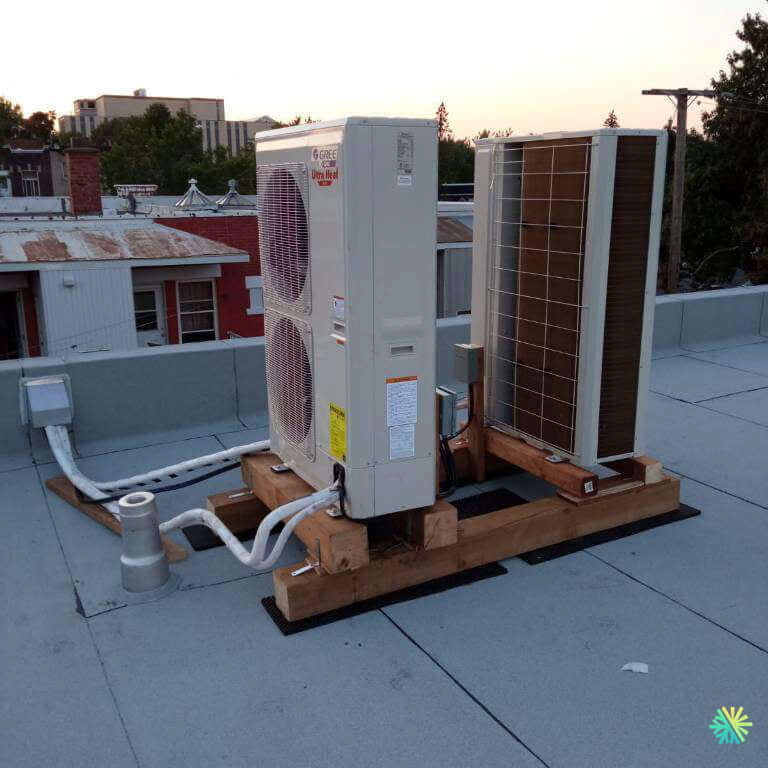
Installation of a Gree Ultra Heat MultiZone heat pump on a flat roof in Rosemont–La Petite-Patrie
AirGreen Project in Rosemont: installation of a Gree Ultra Heat MultiZone on a flat roof, anti-vibration support, watertight penetrations and winter performance. HVAC expertise for Montreal, Laval, Longueuil, North Shore and South Shore.
- City
- Region
- Equipment
- Brand
- Challenges
- Published
The job on one screen
The article, chapter by chapter
An HVAC modernization designed for Montreal plexes
At AirGreen , we design HVAC systems that meet the architectural constraints of Greater Montreal's plexes while delivering reliable, four-season comfort. This project in Rosemont–La Petite-Patrie demonstrates the careful integration of a Gree Ultra Heat MultiZone heat pump on an existing flat roof , providing optimal performance for multiple indoor zones, even in extreme cold.
Building context and performance objectives
The building is a typical urban plex with membrane roofs, surrounded by masonry chimneys, low parapets, and drainage accessories. The client's needs can be summarized in three points:
-
Stabilize the temperature in several interior areas, summer and winter, with minimal noise levels so as not to disturb nearby neighbors.
-
Choose a machine that is resistant to Montreal winters (guaranteed starts and useful heat at low temperatures).
-
Maintain the waterproofing and durability of the roof when drilling and passing conduits.
The Gree Ultra Heat meets these criteria perfectly: it is a multi-zone heat pump designed to maintain heating capacities at very low temperatures and provide efficient air conditioning during summer heat waves.
Design and execution of the installation: precision and durability
Support: a base that protects the membrane
We place the outdoor unit on a treated wooden structure resting on anti-vibration pads and distribution wedges to protect the roof membrane. This base:
-
Diffuses loads (static weight + wind forces) to avoid punching.
-
Reduces vibrations transmitted to the slab, limiting the propagation of noise towards the interior.
-
Facilitates periodic inspection of the membrane and snow removal around the equipment.
Good to know: On flat roofs, we avoid unnecessary structural drilling. Proper sizing of the base, load distribution, and elastomeric pads are generally sufficient to meet wind and frost constraints.
Implementation and clearances
The unit is oriented with its back to the parapet, with free clearance on the exchanger front. This configuration guarantees:
-
Smooth air circulation around the batteries.
-
Convenient access to service panels for maintenance.
-
Reduced risk of sucking in hot exhaust air (recirculation phenomenon).
Refrigeration and electrical routing
The refrigerant pipes follow a short, clear path on the roof, which is continuously insulated and sheathed for UV protection. Key points:
-
High-density cold insulation covered with a UV-resistant sheath to prevent premature aging.
-
Bend radius respected on elbows to preserve the flow of refrigerant.
-
Base-mounted disconnect box in close proximity to the condenser for quick disconnection during service operations.
On the power supply side, the circuit is dedicated, sized according to the nominal intensity of the Gree Ultra Heat, with sealed conduits and cable glands adapted to the thermal cycles of the roof.
Roof penetrations and waterproofing
The penetrations (refrigeration, drain, supply) pass through a sealed roof sleeve , with membrane-compatible flashing and mastic. Our methodology:
-
Controlled drilling at the shortest location from the inner heads.
-
Raised technical sleeve/chimney to prevent potential water ingress.
-
Cold waterproofing restoration according to the roofer's instructions.
-
Expansion joints provided on exposed ducts to absorb seasonal thermal movements.
Result: the integrity of the roof is preserved , and the risk of infiltration is minimized .
Condensation management
Condensation mainly affects indoor units in air conditioning mode. We favor gravity drainage where possible, otherwise we integrate a silent lift pump with a float switch. On the roof, we provide local slopes and clearance around the base to prevent ice in winter.
Advantages of Gree Ultra Heat for Montreal and its winters
Low temperature performance
The Ultra Heat Series is designed to maintain stable heating capabilities when the thermometer drops. For a plex building, this means:
-
Reliable starts in extreme cold.
-
Reduced electrical backup , therefore lower operating costs .
-
Consistent comfort in the areas served, with no cold spots near the windows.
Scalable multi-zone
The MultiZone configuration allows several indoor units (wall-mounted, console, cassette) to be powered with a single condenser. Advantages:
-
Modularity : addition of later zones possible if rooms are renovated.
-
Fine management : each zone has its own thermostat and setpoint , limiting waste.
-
Aesthetics : fewer exterior units on the facade or courtyard.
Silence and urban comfort
The outdoor unit is low-noise , a crucial point in dense areas like Rosemont. Anti-vibration pads and the distance to the parapet further reduce noise transmission to neighbors and the interior.
AirGreen Execution Quality: What Makes the Difference
Sizing and verifications
-
Linear length of lines marked from the design stage (roof route + downpipes). We aim for reasonable lengths to respect the refrigerant loads provided by the manufacturer and maintain nominal efficiency .
-
Nitrogen leak testing and deep vacuum with micron control before commissioning.
-
Setting up remote controls/controllers, synchronizing zones and checking defrosting in real conditions.
Durability and maintenance
-
Permanent markers (UV labels): circuit identification, serial numbers, nominal currents.
-
Optimized service access : the position of the condenser allows maintenance without scaffolding .
-
Recommended maintenance plan : cleaning of internal filters, rinsing of exchangers, checking of electrical tightening and drain crawl space.
Security and Compliance
-
Disconnect switch within easy reach, compliant wiring and rigorous earthing .
-
Compliance with standard clearances around the condenser and roof access routes .
-
Coordination with the roofer for all membrane repairs.
Concrete results for the client
-
Four-season comfort in all service areas, without overheating or feeling drafty.
-
Significant cost reduction compared to electric baseboards thanks to the high COP of the heat pump.
-
Visual discretion : no equipment on the facade, the roof remaining the main technical area.
-
Roof preservation : no unnecessary through-fixing, protected supports and anti-vibration device.
Grants and administrative support
In Greater Montreal (Montreal, Laval , Longueuil , North Shore , South Shore ), high-performance heat pumps may be eligible for assistance programs (e.g., LogisVert/energy efficiency based on certification criteria). Our team:
-
Checks the configuration eligibility (model, low temperature heating performance).
-
Prepares documentation (serial numbers, detailed invoices, installation photos).
-
Advises on additional work that could improve the request (waterproofing, checks).
AirGreen Tips for a Successful Flat Roof Project
To do
-
Provide access to the roof for maintenance (hatch, fixed ladder, safe schedule).
-
Clear snow around the unit after major storms to prevent air recirculation.
-
Plan annual maintenance before peak seasons (spring/fall).
To avoid
-
Installing the unit too close to a parapet or projection that obstructs heat exchange.
-
Undersizing lines or neglecting UV insulation: guaranteed performance losses.
-
Pierce the membrane without coordinating with a roofer: waterproofing is a priority.
Conclusion
This Gree Ultra Heat MultiZone heat pump installation in Rosemont–La Petite-Patrie demonstrates the balance we seek between performance , silence , durability and respect for the building . On a Montreal flat roof, the key lies in a suitable support base , perfectly sealed penetrations and an exemplary refrigeration path . At AirGreen , we support our customers from design to after-sales service, for controlled comfort year after year.
The job tools
Two quick checks with real numbers: what heat costs, and what your current heaters add up to in BTU/h.
Conversion: 1 W = 3.412 BTU/h. An indication, not a load calculation: baseboards and furnaces are often stronger than the real need, and they can stay as backup. AirGreen confirms the capacity on site.
How the job unfolds
The main steps of this kind of job at AirGreen. Every house has its quirks: the estimate brings them out.
We look at the room, the outside wall, the line route and where the outdoor unit will go. That is where the capacity gets chosen.
Model, capacity and price, in writing. We also check whether the model qualifies for assistance programs.
Floors and furniture protected, wall plate position marked level, wall opening located.
A single opening, with the slope the drain needs to flow outside.
Set on a stand raised above the snow, with the clearances the manufacturer requires.
Connected, insulated and protected. The opening is then sealed against water, cold air and insects.
A dedicated circuit and an accessible disconnect near the outdoor unit.
Leak test, vacuum, then start-up and a check of heating and cooling.
Remote, modes, filters: we show you the essentials before we leave.
- The on-site estimateWe look at the room, the outside wall, the line route and where the outdoor unit will go. That is where the capacity gets chosen.
- The quoteModel, capacity and price, in writing. We also check whether the model qualifies for assistance programs.
- Getting readyFloors and furniture protected, wall plate position marked level, wall opening located.
- The wall openingA single opening, with the slope the drain needs to flow outside.
- The outdoor unitSet on a stand raised above the snow, with the clearances the manufacturer requires.
- Lines, cable and drainConnected, insulated and protected. The opening is then sealed against water, cold air and insects.
- The electrical workA dedicated circuit and an accessible disconnect near the outdoor unit.
- Tests and start-upLeak test, vacuum, then start-up and a check of heating and cooling.
- The walkthroughRemote, modes, filters: we show you the essentials before we leave.
What we check on a job like this one
Each number is a point we check on site. Switch between summer and winter to watch air and heat move.
In summer, the outdoor unit rejects the house's heat outside.
Generic illustration of this type of installation, not a survey of this job site. Tap a number.
Mounted level on a wall plate, high enough for the air to reach the whole room, with enough space around it to slide the filters out easily.
The refrigerant lines, the communication cable and the drain go through the wall in a single opening, sealed against water, cold air and insects.
Two insulated copper pipes connect the two units. Outside, a line cover can protect them from sun, knocks and weather.
A shut-off switch near the outdoor unit isolates it safely for service. It must stay accessible at all times.
The compressor and the fan. In heating mode it captures heat from the outdoor air, even in winter, and moves it inside.
On the ground or on the wall, it keeps the unit above accumulated snow. The unit stays clear and defrost water can drain away.
The fan needs to blow freely. Storage, a fence or a wall too close, and efficiency drops while noise goes up.
Is your home ready?
Check what applies at your place. A "no" is not a refusal: it is what we sort out during the estimate.
Good habits, once the unit is in place
Six simple habits that keep the unit going. Your list stays on this device.
What to do, season by season
Three habits per season for this unit. They take a few minutes and prevent many calls.
- Clean the indoor unit's filters.
- Clear leaves and debris left on the outdoor unit by winter.
- Test cooling before the first hot days.
- Clean the filters more often when the unit runs a lot.
- Keep plants away from the outdoor unit.
- Check that no water drips from the indoor unit.
- Rake the leaves around the outdoor unit.
- Test heating before the first cold days.
- Book periodic maintenance before winter.
- Keep snow away from the stand and the front of the unit.
- Let the unit defrost: it is normal.
- Never hit the ice on the fins; call us if the unit stays iced up.
The right pages, at the right time
Four statements: true or false?
It all comes down to details you have just seen.
1. In heating mode, the outdoor unit can produce water.
During defrost cycles. That water must drain away without forming ice.
2. You pick the capacity with a simple square-footage rule.
Windows, insulation, orientation and how the room is used all count. Capacity is chosen on site.
3. A multi-zone connects several indoor heads to a single condenser.
One head per room, all on the same condenser. Each room keeps its own temperature.
4. The disconnect can sit behind the patio furniture.
It must stay accessible: it is what shuts the unit off for service.
0 / 4 right answers
What people ask us about this kind of work
Does a wall-mounted heat pump heat in winter?
Wall-mounted or multi-zone: how do I choose?
Where does the outdoor unit go?
Are there grants?
Do I need a permit?
How cold can it heat?
How much can I save?
How is the LogisVert assistance calculated?
Is it noisy?
The outdoor unit is covered in ice: is that normal?
Does AirGreen hold the required licences?
Is the estimate free?
No question matches. Write to us: we answer.
More jobs to see, near you
By town, by equipment or by region: browse more than 4,700 published projects.
Each dot: a town where AirGreen has published projects. The glowing dot: this job.
An on-site estimate, the right capacity, the right equipment.
The on-site estimate is free and the quote follows within 24 hours.
Text and photo: a real AirGreen Climatisation & Chauffage job. The diagrams are generic illustrations of the type of installation, not a survey of this job site. Sources of the added figures: airgreen.ca product pages (NEEP / AHRI performance), Hydro-Québec (Heat pumps page, LogisVert, read on 13 October 2026), Régie de l’énergie (rate D as of 1 April 2026).