
Installation of a MIDEA ATOM X Central Heat Pump in Saint-Lambert
AirGreen installs a MIDEA ATOM X central heat pump in Saint-Lambert: outdoor unit on wall brackets, neat integration, and centralized HVAC comfort.
In summer, the outdoor unit rejects the house's heat outside.
Generic illustration of this type of installation, not a survey of this job site. Tap a number.
It captures or rejects heat outside. It sits on a level base, above the snow, with free space all around.
The insulated refrigerant lines enter the house through a sealed opening and run to the indoor coil.
A shut-off switch near the outdoor unit isolates it safely for service.
Sitting on the indoor module, it moves heat between the house air and the refrigerant.
Electric furnace or air handler: its fan pushes air through the ducts. The electric backup takes over in extreme cold.
Supply ducts bring air to the rooms; returns bring it back to the unit. Their condition matters as much as the unit's.
It protects the coil and the fan. A dirty filter cuts airflow, so it gets checked regularly.
It runs the heat pump and the backup heat. It must be compatible with the installed system.
A MIDEA ATOM X central heat pump installed in Saint-Lambert in a demanding residential environment
In Saint-Lambert, the installation of central heat pumps often requires a particularly meticulous approach. Homes there are frequently located in dense residential areas, with landscaped backyards, sometimes narrow side access, low foundations, basement windows, outdoor stairs, patios, gardens, and very concrete aesthetic constraints. For this project, our AirGreen team installed a MIDEA ATOM X central heat pump, an HVAC solution designed to provide uniform comfort throughout the home, while seamlessly integrating into the existing outdoor environment.
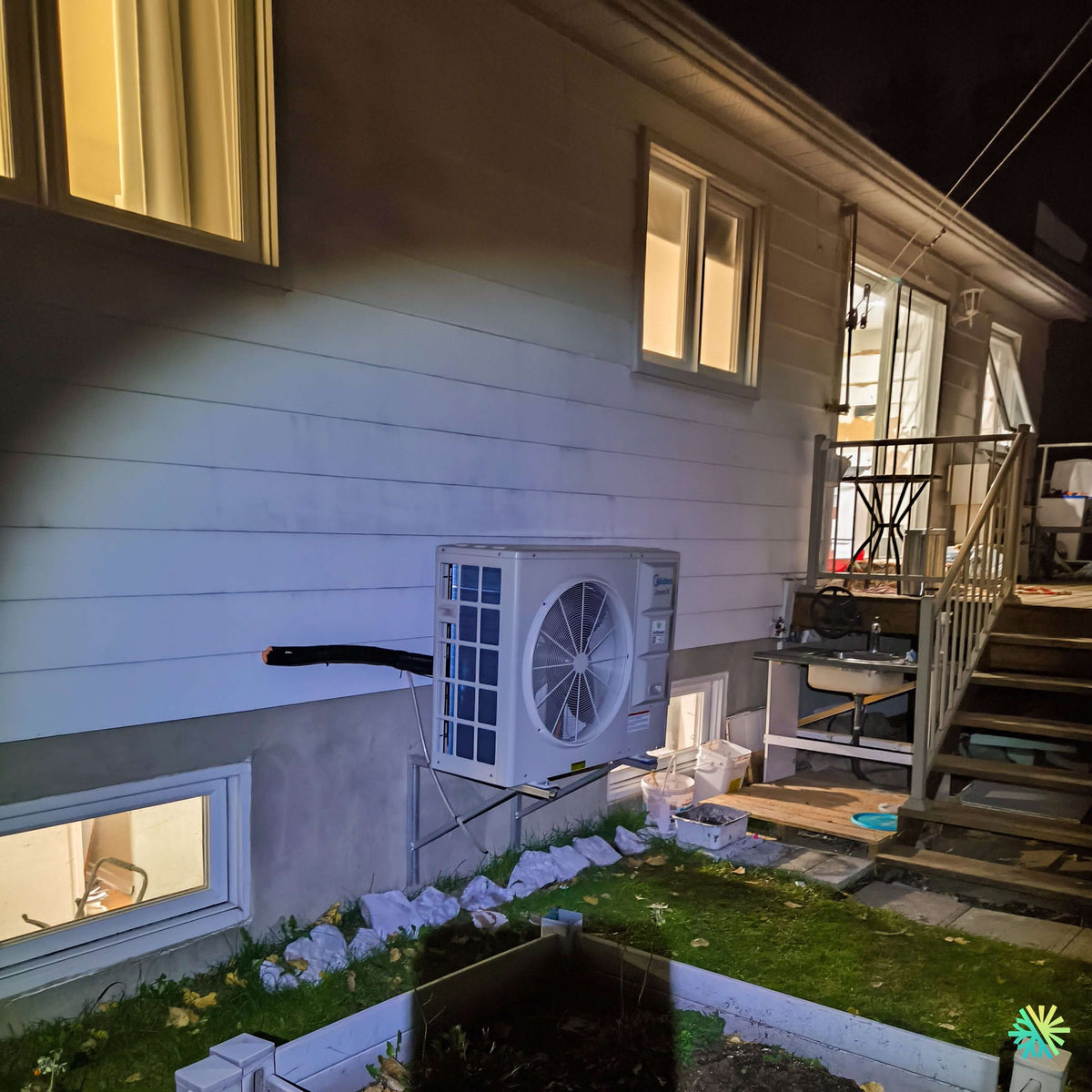
The photo of this installation is revealing: the MIDEA ATOM X outdoor unit was installed on wall brackets, near a walkway, an outdoor staircase, basement windows, and landscaping. The work was carried out in the evening, in a context where precision, work lighting, safety, and cleanliness had to be managed rigorously. This type of installation well represents the on-the-ground reality of several central heat pump projects in Saint-Lambert and on the South Shore: it's not enough to simply install a machine; you have to choose the right location, respect clearances, protect the building, preserve access, and ensure reliable operation.
At AirGreen, we approached this project as a complete integration into the home's comfort system. The MIDEA ATOM X is not just an outdoor unit: it is part of an HVAC system that must work with the indoor air distribution network, controls, refrigerant connections, and the actual needs of the occupants.
MIDEA ATOM X: a central solution for consistent comfort throughout the home
Why choose a central heat pump rather than a wall-mounted system?
A central heat pump is generally chosen when an owner wants to achieve more uniform comfort in several rooms, rather than treating a single area with a wall-mounted unit. In a Saint-Lambert home, where floors, bedrooms, living room, kitchen, and common areas may have different needs, a central solution allows conditioned or heated air to be distributed through an existing or adapted duct network.
The MIDEA ATOM X is particularly appealing to homeowners looking for:
- more uniform air conditioning during the summer;
- an efficient contribution to heating during cold seasons;
- better air distribution in multiple rooms;
- a discreet interior solution, without visible wall units;
- integration with an existing ventilation or distribution system;
- a more comprehensive HVAC approach for the home.
In this Saint-Lambert project, the client wanted to improve overall comfort without increasing the number of visible indoor units. The central heat pump was therefore a coherent solution, particularly suited to a residence where the existing air distribution could be leveraged.
Outdoor installation on wall brackets: a strategic choice
The photo clearly shows that the outdoor unit was not placed directly on the ground. It was installed on metal wall brackets, fixed to the foundation or appropriate structure, to elevate the unit. This choice is very relevant in Quebec, and even more so in a yard where space is shared between a lawn area, basement windows, a staircase, slabs, outdoor equipment, and landscaping.
Elevating a central heat pump better protects it against:
- snow accumulation;
- dead leaves;
- stagnant water;
- ground ice;
- small yard debris;
- risks of displacement or settling of a poorly prepared base.
In the case of this installation in Saint-Lambert, elevating the unit was also useful for maintaining adequate clearance around the unit, preserving basement access, and avoiding unnecessary clutter on the ground near the staircase. The positioning required a precise balance between performance, safety, service access, and visual integration.
An evening worksite: rigor, lighting, and coordination
The image shows an installation carried out or finalized in the evening. Working in these conditions requires different organization. Lighting must be sufficient to check connections, alignment, clearances, fastening, and finishing. Tools, materials, and protective gear must be placed so as not to obstruct movement, especially near an outdoor staircase and a passageway.
Our team had to manage the worksite with particular attention to safety. Pipes, cables, supports, tools, and ground protection had to be neatly organized. The presence of nearby basement windows also added a constraint: it was necessary to avoid obstructing access, hindering opening, or creating an installation that would have seemed too imposing in the space.
This type of project demonstrates the importance of a well-planned HVAC installation. Even when the outdoor space seems sufficient, every detail matters: the height of the unit, its distance from the wall, airflow, the routing of pipes, protection against bad weather, and access for future HVAC maintenance.
The MIDEA ATOM X: a central heat pump designed for Quebec realities
The MIDEA ATOM X is a central heat pump solution designed to meet the needs of homes that require stable performance, good energy efficiency, and integration with an indoor air distribution system. In a climate like Saint-Lambert's, the versatility of such a system is essential.
In summer, the goal is to efficiently remove heat and humidity. A house can be exposed to the sun on several facades, and upper floors can accumulate heat more quickly. A properly installed central heat pump helps stabilize the temperature throughout the entire house, rather than concentrating comfort in a single room.
During colder periods, the heat pump can contribute to heating, depending on the system configuration, settings, unit capacities, and chosen energy strategy. For many owners, it helps reduce the use of less efficient heating sources for a large part of the season.
Success depends, however, on several elements: model selection, compatibility with indoor equipment, sizing, outdoor installation, quality of connections, commissioning, and overall system balancing.
Specific constraints of this installation in Saint-Lambert
This project presented several constraints visible from the photo analysis.
An already occupied outdoor space
The outdoor unit is installed near a staircase, an outdoor sink, basement windows, and a yard layout. In this type of environment, it is crucial to prevent the heat pump from becoming an obstruction. We must anticipate the daily movements of occupants, access to the staircase, passage to the yard, access to windows, and the possibility of future maintenance.
A facade with horizontal siding
The exterior cladding requires particular attention to the routing of the conduits and the finish. The conduits should not simply be laid in the shortest path without thought. They must be protected, well-aligned, properly insulated, and logically directed into the building.
Nearby basement windows
Basement windows require additional vigilance. It is important to avoid blocking light, access, or potential egress. Noise, vibration, and the airflow discharged by the outdoor unit must also be taken into account.
Necessary clearance for thermal exchange
A central heat pump needs good clearance to operate efficiently. If the hot air discharged during cooling or the cold air moved during heating circulates poorly, the unit may lose efficiency. In this project, the unit's positioning was chosen to maintain adequate airflow despite the yard's constraints.
Refrigerant connection: an invisible but essential job
In the photo, you can see the routing of the conduits to the unit. In a central heat pump installation, the refrigerant lines play a fundamental role. They transport the refrigerant between the outdoor unit and the indoor equipment. Their length, insulation, protection, and the quality of the connections have a direct impact on performance and reliability.
Our technicians attach great importance to:
- adequate insulation of the lines;
- protection against friction;
- respect for permitted lengths and elevations;
- quality of connections;
- complete evacuation;
- leak testing;
- validation of pressures and operation;
- protection of exposed lines.
Poor refrigerant installation can cause problems that are not immediately visible: loss of efficiency, noise, abnormal cycles, premature wear, or leaks. That's why an AirGreen installation is never limited to the exterior appearance; it also relies on methodically verified technical steps.
Integration with the indoor system: the heart of a central heat pump
Unlike a wall-mounted heat pump, a central heat pump must be conceived with the entire indoor system in mind. The MIDEA ATOM X outdoor unit works with indoor equipment that distributes air throughout the house. The perceived performance therefore also depends on the condition of the ducts, airflow, filter, thermostat, zone configuration, and the balance between rooms.
For this type of project, we analyze several points:
- the necessary capacity for the house;
- the condition of the duct network;
- available airflow;
- the location of the indoor unit;
- electrical compatibility;
- heating and cooling needs;
- desired client comfort;
- building limitations.
In Saint-Lambert, many homes have been renovated over the years. It happens that the duct network has been modified, extended, or partially adapted. Our role is then to take this reality into account rather than assuming that all homes behave in the same way.
Mistakes to avoid when undertaking a central heat pump project
A central HVAC installation represents a significant investment. To achieve a lasting result, certain mistakes must absolutely be avoided.
Choosing the unit based solely on price
Price is important, but it should not be the only criterion. A poorly adapted unit can cost more in the long run in terms of discomfort, consumption, and service interventions. Compatibility with indoor equipment and proper sizing are essential.
Neglecting the outdoor location
The outdoor unit must be placed in a location that allows good airflow, service access, and logical integration. An installation too close to a staircase, window, fence, or wall can create problems with noise, access, or performance.
Underestimating drainage and snow
In Quebec, winter changes everything. A heat pump that is too low or poorly protected can be affected by snow and ice. The choice of supports, installation height, and ground clearance are therefore important decisions.
Ignoring the condition of the ducts
A high-performing central heat pump cannot compensate for a poorly designed, obstructed, or unbalanced duct network. Before recommending a solution, it is necessary to understand how air circulates in the house.
Entrusting the installation to an unqualified team
Refrigerant, electrical, and mechanical connections require specific skills. An approximate installation can reduce the lifespan of the appliance, impair performance, and lead to problems that are difficult to diagnose.
Subsidies and eligibility: a step to be checked carefully
Financial assistance programs can make the installation of a central heat pump even more attractive, especially when the installed model meets the efficiency criteria in force. For a MIDEA ATOM X, eligibility must be verified according to the exact model, the indoor/outdoor combination, available certifications, and the requirements of the applicable program at the time of the work.
At AirGreen, we help our clients prepare the necessary information when the equipment is eligible. This can include model numbers, detailed invoices, relevant technical information, and useful indications for completing a grant application.
It is important not to choose a heat pump solely for a potential subsidy. The system must first be suitable for the building, the desired comfort, and the reality of use. A good subsidy will never compensate for poor equipment selection or negligent installation.
HVAC Maintenance: preserving the MIDEA ATOM X's performance
After installation, HVAC maintenance becomes a decisive factor. A well-maintained central heat pump better retains its performance, operates more quietly, and offers a longer lifespan.
For a central system, points to monitor include:
- regular filter replacement or cleaning;
- cleanliness of the outdoor unit;
- clearance around the unit;
- condition of visible conduits;
- proper thermostat operation;
- airflow in the rooms;
- absence of abnormal noise;
- periodic inspection by a professional.
In the case of this installation in Saint-Lambert, with the outdoor unit installed near a yard area, attention will need to be paid to leaves, grass, seasonal debris, and snow. A well-cleared unit breathes better and works less hard.
AirGreen Expertise Tailored for Homes in Saint-Lambert and the South Shore
Saint-Lambert is one of those areas where field experience matters a lot. Homes can have architectural peculiarities, tight access, aesthetic requirements, and neighborhood constraints. Our AirGreen team regularly works in Saint-Lambert, as well as in Longueuil, Brossard, Greenfield Park, Montreal, Laval, on the North Shore, and elsewhere on the South Shore.
This diversity of projects allows us to quickly understand the constraints of a construction site. A central heat pump installation in Saint-Lambert is not planned the same way as an installation in a newer home with plenty of outdoor space. Here, you often have to work with existing structures, protect landscaping, work cleanly, and ensure that the equipment does not obstruct circulation around the house.
Our approach is to recommend a solution that respects both technical performance and the client's daily reality.
The Result: A Well-Integrated Central Heat Pump, Ready for Quebec Seasons
This MIDEA ATOM X installation in Saint-Lambert demonstrates the importance of precise work when it comes to a central heat pump. The outdoor unit was installed in a real-world environment, with visible constraints: stairs, windows, courtyard, exterior siding, passage space, and evening work. Despite these elements, the result offers a clean, functional integration adapted to residential use.
The client now benefits from an HVAC solution designed to improve comfort throughout the home, with an outdoor unit strategically positioned and an installation built to last. For homeowners considering an HVAC installation in Saint-Lambert, Montreal, Laval, Longueuil, on the North Shore, or on the South Shore, this project highlights an essential reality: the performance of a central heat pump depends as much on the quality of the installation as on the choice of brand or model.
The MIDEA ATOM X represents a serious solution for homes seeking centralized comfort, improved seasonal efficiency, and discreet integration. With rigorous planning, well-considered outdoor positioning, and professional execution, this type of system can transform daily comfort without compromising the appearance or use of the property.
How it goes, from the first call to the end
The main steps of this kind of job at AirGreen. Every house has its quirks: the estimate brings them out.
We look at the ducts, the current indoor module, the electrical panel and the planned spot for the outdoor unit.
The equipment combination, capacity and price, in writing. We check whether the combination qualifies for assistance programs.
Access protected, old unit disconnected and removed when it is being replaced.
Electric furnace or air handler, with its coil, connected to the supply and return ducts.
On a level base, raised above the snow, with free space all around.
Insulated, they enter through a sealed opening and run to the indoor coil.
Dedicated circuits, accessible disconnect, a thermostat that works with the heat pump and the backup heat.
Leak test, vacuum, start-up, airflow check and a test of both modes.
Filter, thermostat, backup heat in extreme cold: what to know before winter.
- The on-site estimateWe look at the ducts, the current indoor module, the electrical panel and the planned spot for the outdoor unit.
- The quoteThe equipment combination, capacity and price, in writing. We check whether the combination qualifies for assistance programs.
- Getting readyAccess protected, old unit disconnected and removed when it is being replaced.
- The indoor moduleElectric furnace or air handler, with its coil, connected to the supply and return ducts.
- The outdoor unitOn a level base, raised above the snow, with free space all around.
- The refrigerant linesInsulated, they enter through a sealed opening and run to the indoor coil.
- Electrical and thermostatDedicated circuits, accessible disconnect, a thermostat that works with the heat pump and the backup heat.
- Tests and start-upLeak test, vacuum, start-up, airflow check and a test of both modes.
- The walkthroughFilter, thermostat, backup heat in extreme cold: what to know before winter.
And at your place?
Two quick checks with real numbers: what heat costs, and what your current heaters add up to in BTU/h.
Conversion: 1 W = 3.412 BTU/h. An indication, not a load calculation: baseboards and furnaces are often stronger than the real need, and they can stay as backup. AirGreen confirms the capacity on site.
What to do, season by season
Three habits per season for this unit. They take a few minutes and prevent many calls.
- Check the indoor module's filter.
- Clear winter debris from the outdoor unit.
- Test cooling before the heat arrives.
- Check the filter more often in peak season.
- Keep registers and returns clear.
- Watch condensate drainage near the coil.
- Change or clean the filter.
- Test heating and backup heat before the cold.
- Book periodic maintenance.
- Clear snow around the outdoor unit.
- Store nothing in front of the indoor module.
- Note any unusual noise or smell and call us.
Which type of equipment for your project?
Pick what looks like your need.
Four mistakes we do not make
Flip each card to see what we do instead.
What people ask us about this kind of work
Can I keep my current ducts?
What happens in extreme cold?
Furnace, air handler, ducted: what is the difference?
Are there grants?
Do I need a permit?
How much can I save?
How is the LogisVert assistance calculated?
Will my current thermostat work?
Central or wall units: which one?
Does AirGreen hold the required licences?
Is the estimate free?
No question matches. Write to us: we answer.
Useful pages for what comes next
More jobs to see, near you
By town, by equipment or by region: browse more than 4,700 published projects.
Each dot: a town where AirGreen has published projects. The glowing dot: this job.
Tell us about your house. We come and see it for free.
The on-site estimate is free and the quote follows within 24 hours.
Text and photo: a real AirGreen Climatisation & Chauffage job. The diagrams are generic illustrations of the type of installation, not a survey of this job site. Sources of the added figures: airgreen.ca product pages (NEEP / AHRI performance), Hydro-Québec (Heat pumps page, LogisVert, read on 13 October 2026), Régie de l’énergie (rate D as of 1 April 2026).