
Installation of a Midea (Midea28 range) wall-mounted heat pump in Rosemont–La Petite-Patrie
AirGreen installs a Midea wall-mounted heat pump ( Midea28 range) in a Rosemont–La Petite-Patrie complex: short cooling path, gravity drainage, low noise and high efficiency. Service and grant support throughout Greater Montreal.
Take a tour of the installation
Each number is a point we check on site. Switch between summer and winter to watch air and heat move.
In summer, the outdoor unit rejects the house's heat outside.
Generic illustration of this type of installation, not a survey of this job site. Tap a number.
Mounted level on a wall plate, high enough for the air to reach the whole room, with enough space around it to slide the filters out easily.
The refrigerant lines, the communication cable and the drain go through the wall in a single opening, sealed against water, cold air and insects.
Two insulated copper pipes connect the two units. Outside, a line cover can protect them from sun, knocks and weather.
A shut-off switch near the outdoor unit isolates it safely for service. It must stay accessible at all times.
The compressor and the fan. In heating mode it captures heat from the outdoor air, even in winter, and moves it inside.
On the ground or on the wall, it keeps the unit above accumulated snow. The unit stays clear and defrost water can drain away.
The fan needs to blow freely. Storage, a fence or a wall too close, and efficiency drops while noise goes up.
Careful HVAC modernization in a Rosemont plex: four-season comfort, low noise, preserved aesthetics
Client context and objectives
At AirGreen , we are working in a typical Rosemont–La Petite-Patrie plex . The client occupies a 4 1/2 facing southwest, very sunny in the afternoon and often overheated in the summer, but cool in the morning in mid-season. His priorities: stable comfort , very low noise levels , controlled consumption and discreet integration that respects the existing moldings and openings. We selected a Midea wall-mounted heat pump, model from the Midea28 range with R-454B refrigerant , a recent solution designed for the Quebec climate and compatible with Quebec grant programs when the efficiency criteria are met.
Why a Midea28 wall-mounted heat pump in this specific case?
-
Heating/air conditioning versatility : a single unit covers summer cooling and winter supplementary heating , ideal for urban housing where technical space is limited.
-
New generation refrigerant (R-454B) : high efficiency and reduced environmental footprint compared to older generations.
-
Quiet operation : the indoor head is renowned for its very low speeds, which are pleasant in the evening.
-
Aesthetics : discreet casing, minimal exposed HVAC installation , rear passage to the outside to hide the piping in the living areas.
-
Eligibility for aid (depending on configuration and performance): possibility of benefiting from active programs in Quebec (Hydro-Québec LogisVert , Rénoclimat ), useful for projects in Montreal , Laval , Longueuil , on the North Shore and the South Shore .
Our approach to HVAC installation in a Montreal plex
Location and sizing (BTU)
We validate the thermal loads room by room: surface area, ceiling height, solar gain, insulation of the wall facing the alley and frequency of occupancy. For an open living room with an adjoining kitchen, we favor a power of around 12,000 BTU (to be adjusted according to the envelope). The objective: to avoid oversizing (short cycles, poorly managed humidity) as well as undersizing (inefficient continuous draft).
Choice of location of the inner head
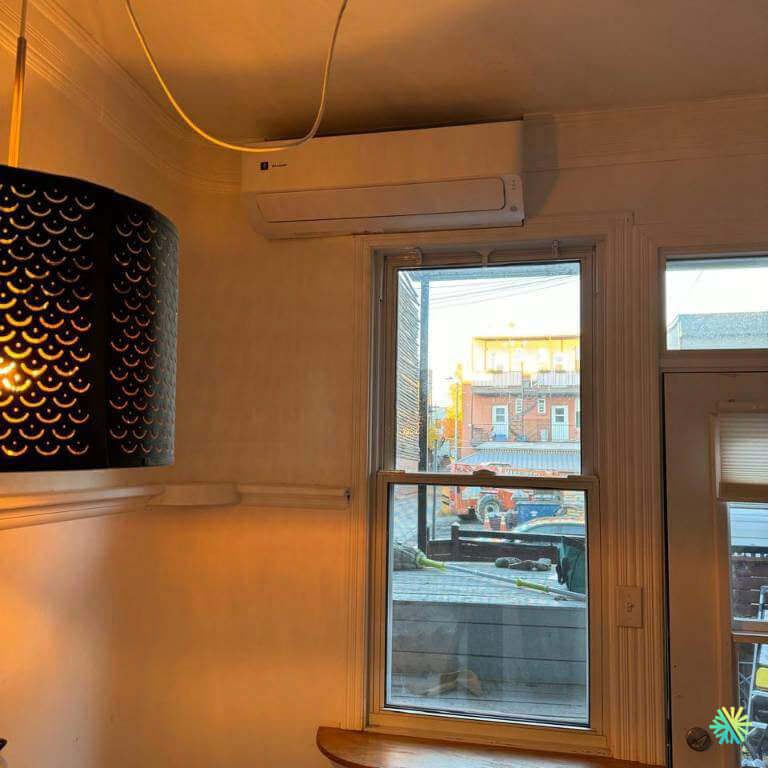
The photo shows the head installed in a high sill above the window , an ideal orientation for sweeping the air along the ceiling and taking advantage of the Coandă effect . Advantages:
-
Even diffusion in the living area.
-
Minimized nuisance : no direct blowing on the sofa or table.
-
Short refrigeration path : the wall opens directly onto the outside, limiting losses and optimizing efficiency .
Wall crossing and path
-
Carefully drilled Ø 65 mm with outward slope for gravity drainage of condensate.
-
Sheath and vapor barrier for airtightness.
-
Insulated refrigeration piping (copper supply/return) passing directly behind the unit: total length < 3 m , reducing pressure losses.
-
Gravity condensate drain : no visible pump or additional noise; the drain is protected against frost and splashing onto the lower balcony.
Power supply and protections
-
Dedicated circuit for the panel (208/230 V depending on the size chosen), circuit breaker and disconnect outside for safe maintenance.
-
Inside, the ceiling-molded cable follows the moldings to remain discreet and preserve the aesthetics. Our master electrician checks the polarities, grounding, and currents according to the nameplate of the selected Midea28.
Installation of the outdoor condenser
In an urban complex, we avoid taking up floor space. We generally install the condenser on galvanized wall brackets on the courtyard/alley side:
-
Clearances respected (free suction and blowing).
-
Snow-free height and anti-vibration mats for low noise transmitted to the structure.
-
Defrost water management : drip tray and safe routing to prevent ice on the balcony.
Rigorous commissioning
-
Leak test with high pressure nitrogen , then deep vacuum until stabilization.
-
Opening of the valves , weighing of the additional fluid if necessary according to the actual length.
-
Functional checks : ΔT in cold/heat, intensities, fan speed , communication and thermistor .
-
Comfort settings : auto tempered mode, vertical sweep , eco setting at night.
Observed results and concrete benefits for the occupant
Thermal comfort and humidity
The diffusion above the window stabilizes the temperature. In summer, the room remains in the 22–24 °C range with gentle dehumidification ; in winter, the Midea28 provides effective additional heating down to the low temperatures provided by the range, complementing the existing main heating.
Silence and air quality
The low speed of the indoor head is almost imperceptible on quiet evenings. Washable filters trap dust and pollen; biannual HVAC maintenance keeps the exchanger efficient and clean.
Energy sobriety
The combination of short refrigeration length , R-454B refrigerant and inverter electronics limits consumption. The customer notices a significant reduction in summer kWh compared to an old window air conditioner, while gaining the benefit of additional heating between seasons.
Technical details and AirGreen best practices
Finish and aesthetics
-
White UV exterior capping matching the brick/facing for a sober facade.
-
Controlled drain slope (3–5 mm/m): quiet drainage without gurgling.
-
Rodent/insect protection : discreet mesh at the drain outlet.
Recommended HVAC maintenance
-
Filter cleaning : every 4–6 weeks in summer.
-
Chemical washing of the evaporator and annual light biocide treatment.
-
Condenser clearance : 30 cm around free of leaves/snow.
-
Electrical inspection : terminal tightening, insulation test, operating current measurement.
Tips for maximizing savings
-
Maintain a stable temperature (23°C in summer; 20–21°C in mid-season).
-
Use dehumidification mode during humid episodes rather than lowering the setpoint excessively.
-
Program the auto speed in the evening for optimal acoustic comfort.
-
Keep interior doors ajar to even out the temperature in a 4 1/2.
-
Schedule maintenance in the spring before the heatwave and another in the fall before the frost.
Construction site challenges and solutions implemented
Constraint 1: Heritage and moldings
The high moldings and period woodwork require careful routing. We aligned the head with the lintel, ran the electrical molding through the ceiling , and drilled outside the joints to preserve the structure, without any unsightly visible returns.
Constraint 2: Backyard and neighborhood
Close proximity requires attention to outside noise . Installation on brackets with silent blocks and sufficient clearance limits resonance on the brick. The direction of the blowing avoids any disturbance towards the neighboring balcony.
Grants and eligibility (Montreal, Laval, Longueuil, North Shore, South Shore)
Depending on the configuration chosen in the Midea28 range (efficiency and operating temperature), the installation may be eligible for certain Quebec programs: Hydro-Québec – LogisVert for efficient heat pumps and Rénoclimat if an energy evaluation process is undertaken. We support our clients to verify the criteria , prepare the files and optimize the overall budget of the project.
What AirGreen changes for your project
-
Local engineering : precise sizing, respect for Montreal buildings.
-
Quality of execution : certified refrigeration engineers, vacuum to 500 microns and systematic pressure tests .
-
Clear warranty and local after-sales service .
-
Personalized usage tips to extend lifespan and reduce bills .
Next step
Are you planning a similar HVAC installation in Montreal , Laval , Longueuil , on the North Shore or South Shore ? We evaluate your home, suggest the right BTU output and deliver a clean, durable and quiet installation – in the spirit of this project in Rosemont–La Petite-Patrie .
The unit on this job, in figures
The range as published on airgreen.ca: pick a size to see its capacity in deep cold.
| Size | Heating at −8 °C | Heating at −15 °C | Coldest certified point | COP at −15 °C | SEER | HSPF | Indicative LogisVert aid |
|---|---|---|---|---|---|---|---|
| Midea Série 28 9 000 | 12,000 | 11,500 | −30 °C: 5,100 | 1.8 | 27.4 | 12.5 | – |
| Midea Série 28 12 000 | 12,000 | 11,500 | −30 °C: 5,900 | 1.8 | 25.4 | 10.5 | $1,440 |
| Midea Série 28 18 000 | 18,000 | 18,000 | −30 °C: 8,000 | 1.92 | 21.4 | 11.0 | $2,160 |
| Midea Série 28 24 000 | 22,200 | 24,200 | −30 °C: 11,900 | 2.34 | 21.0 | 13.5 | $2,664 |
| Midea Série 28 33 000 | 32,000 | 35,000 | −30 °C: 20,700 | 1.98 | 19.5 | 10.5 | $3,840 |
According to NEEP, it delivers 12,000 BTU/h at −8 °C (17 °F), as much as at 8 °C. It heats as hard in moderate cold as in mild weather.
At 8 °C, its certified maximum capacity reaches 16,000 BTU/h, 78% more than its nominal 9,000 BTU size.
According to NEEP, its certified heating capacity at −15 °C (5 °F) is 11,500 BTU/h, 128% of its nominal 9,000 BTU size. Its COP there is 1.80.
According to NEEP, it delivers 12,000 BTU/h at −8 °C (17 °F), as much as at 8 °C. It heats as hard in moderate cold as in mild weather.
At 8 °C, its certified maximum capacity reaches 16,000 BTU/h, 33% more than its nominal 12,000 BTU size.
At −30 °C, its certified minimum capacity is 2,000 BTU/h (3,800 at 8 °C). It slows down instead of cycling on and off.
According to NEEP, it delivers 18,000 BTU/h at −8 °C (17 °F), as much as at 8 °C. It heats as hard in moderate cold as in mild weather.
According to NEEP, its certified heating capacity at −15 °C (5 °F) is 18,000 BTU/h, 100% of its nominal 18,000 BTU size. Its COP there is 1.92.
According to NEEP, its COP at −15 °C is 2.34: the highest of the Série 28 line, which ranges from 1.80 to 1.98 at that temperature.
At −30 °C, its certified minimum capacity is 2,400 BTU/h (11,800 at 8 °C). It slows down instead of cycling on and off.
According to NEEP, its certified heating capacity at −15 °C (5 °F) is 24,200 BTU/h, 101% of its nominal 24,000 BTU size. Its COP there is 2.34.
According to NEEP, its certified maximum capacity at −30 °C (−22 °F) is 20,700 BTU/h, 63% of its nominal 33,000 BTU size.
At −30 °C, its certified minimum capacity is 4,200 BTU/h (19,700 at 8 °C). It slows down instead of cycling on and off.
According to NEEP, its certified heating capacity at −15 °C (5 °F) is 35,000 BTU/h, 106% of its nominal 33,000 BTU size. Its COP there is 1.98.
Data read live from the airgreen.ca page of each size (NEEP / AHRI certified performance). When the title names the installed size, it is highlighted; otherwise the whole range is shown. The aid shown is today’s, using Hydro-Québec’s rule ($120 per 1,000 BTU/h at −8 °C); amounts quoted in the article date from its publication. Only Hydro-Québec confirms the assistance granted.A dash in the aid column: amount to be confirmed for this model.
The big day, step by step
The main steps of this kind of job at AirGreen. Every house has its quirks: the estimate brings them out.
We look at the room, the outside wall, the line route and where the outdoor unit will go. That is where the capacity gets chosen.
Model, capacity and price, in writing. We also check whether the model qualifies for assistance programs.
Floors and furniture protected, wall plate position marked level, wall opening located.
A single opening, with the slope the drain needs to flow outside.
Set on a stand raised above the snow, with the clearances the manufacturer requires.
Connected, insulated and protected. The opening is then sealed against water, cold air and insects.
A dedicated circuit and an accessible disconnect near the outdoor unit.
Leak test, vacuum, then start-up and a check of heating and cooling.
Remote, modes, filters: we show you the essentials before we leave.
- The on-site estimateWe look at the room, the outside wall, the line route and where the outdoor unit will go. That is where the capacity gets chosen.
- The quoteModel, capacity and price, in writing. We also check whether the model qualifies for assistance programs.
- Getting readyFloors and furniture protected, wall plate position marked level, wall opening located.
- The wall openingA single opening, with the slope the drain needs to flow outside.
- The outdoor unitSet on a stand raised above the snow, with the clearances the manufacturer requires.
- Lines, cable and drainConnected, insulated and protected. The opening is then sealed against water, cold air and insects.
- The electrical workA dedicated circuit and an accessible disconnect near the outdoor unit.
- Tests and start-upLeak test, vacuum, then start-up and a check of heating and cooling.
- The walkthroughRemote, modes, filters: we show you the essentials before we leave.
What would it look like at your place?
Two quick checks with real numbers: what heat costs, and what your current heaters add up to in BTU/h.
Baseboards and electric furnaces turn 1 kWh of electricity into 1 kWh of heat. A heat pump delivers more: that is its COP. At Hydro-Québec’s rate D (11.142¢/kWh above 40 kWh a day, since 1 April 2026):
Hydro-Québec: a heat pump can be up to three times more efficient than baseboards for heating in the colder months.
Estimate per kWh of heat, at the chosen temperature, using the certified COP from the product page. Taxes, access charge and backup heat not included.
Conversion: 1 W = 3.412 BTU/h. An indication, not a load calculation: baseboards and furnaces are often stronger than the real need, and they can stay as backup. AirGreen confirms the capacity on site.
Four mistakes we do not make
Flip each card to see what we do instead.
Your own project, step by step
What to do, season by season
Three habits per season for this unit. They take a few minutes and prevent many calls.
- Clean the indoor unit's filters.
- Clear leaves and debris left on the outdoor unit by winter.
- Test cooling before the first hot days.
- Clean the filters more often when the unit runs a lot.
- Keep plants away from the outdoor unit.
- Check that no water drips from the indoor unit.
- Rake the leaves around the outdoor unit.
- Test heating before the first cold days.
- Book periodic maintenance before winter.
- Keep snow away from the stand and the front of the unit.
- Let the unit defrost: it is normal.
- Never hit the ice on the fins; call us if the unit stays iced up.
Is your home ready?
Check what applies at your place. A "no" is not a refusal: it is what we sort out during the estimate.
Four statements: true or false?
It all comes down to details you have just seen.
1. In heating mode, the outdoor unit can produce water.
During defrost cycles. That water must drain away without forming ice.
2. You pick the capacity with a simple square-footage rule.
Windows, insulation, orientation and how the room is used all count. Capacity is chosen on site.
3. A multi-zone connects several indoor heads to a single condenser.
One head per room, all on the same condenser. Each room keeps its own temperature.
4. The disconnect can sit behind the patio furniture.
It must stay accessible: it is what shuts the unit off for service.
0 / 4 right answers
What people ask us about this kind of work
Does a wall-mounted heat pump heat in winter?
Wall-mounted or multi-zone: how do I choose?
Where does the outdoor unit go?
Are there grants?
Do I need a permit?
How cold can it heat?
How much can I save?
How is the LogisVert assistance calculated?
Is it noisy?
The outdoor unit is covered in ice: is that normal?
Does AirGreen hold the required licences?
Is the estimate free?
No question matches. Write to us: we answer.
More jobs to see, near you
By town, by equipment or by region: browse more than 4,700 published projects.
Each dot: a town where AirGreen has published projects. The glowing dot: this job.
Every house has its constraints. We see them before we install.
The on-site estimate is free and the quote follows within 24 hours.
Text and photo: a real AirGreen Climatisation & Chauffage job. The diagrams are generic illustrations of the type of installation, not a survey of this job site. Sources of the added figures: airgreen.ca product pages (NEEP / AHRI performance), Hydro-Québec (Heat pumps page, LogisVert, read on 13 October 2026), Régie de l’énergie (rate D as of 1 April 2026).