
Installation of a Midea Wall-mounted heat pump in Côte-des-Neiges–Notre-Dame-de-Grâce
AirGreen installs a Midea wall-mounted heat pump in Côte-des-Neiges–Notre-Dame-de-Grâce: elegant integration into the living room, gravity drain, discreet finishes. Professional HVAC installation for Montreal, Laval, Longueuil, North Shore and South Shore.
- City
- Region
- Equipment
- Brand
- Challenges
- Published
The job on one screen
The article, chapter by chapter
An elegant integration into a classic living room: comfort without compromise
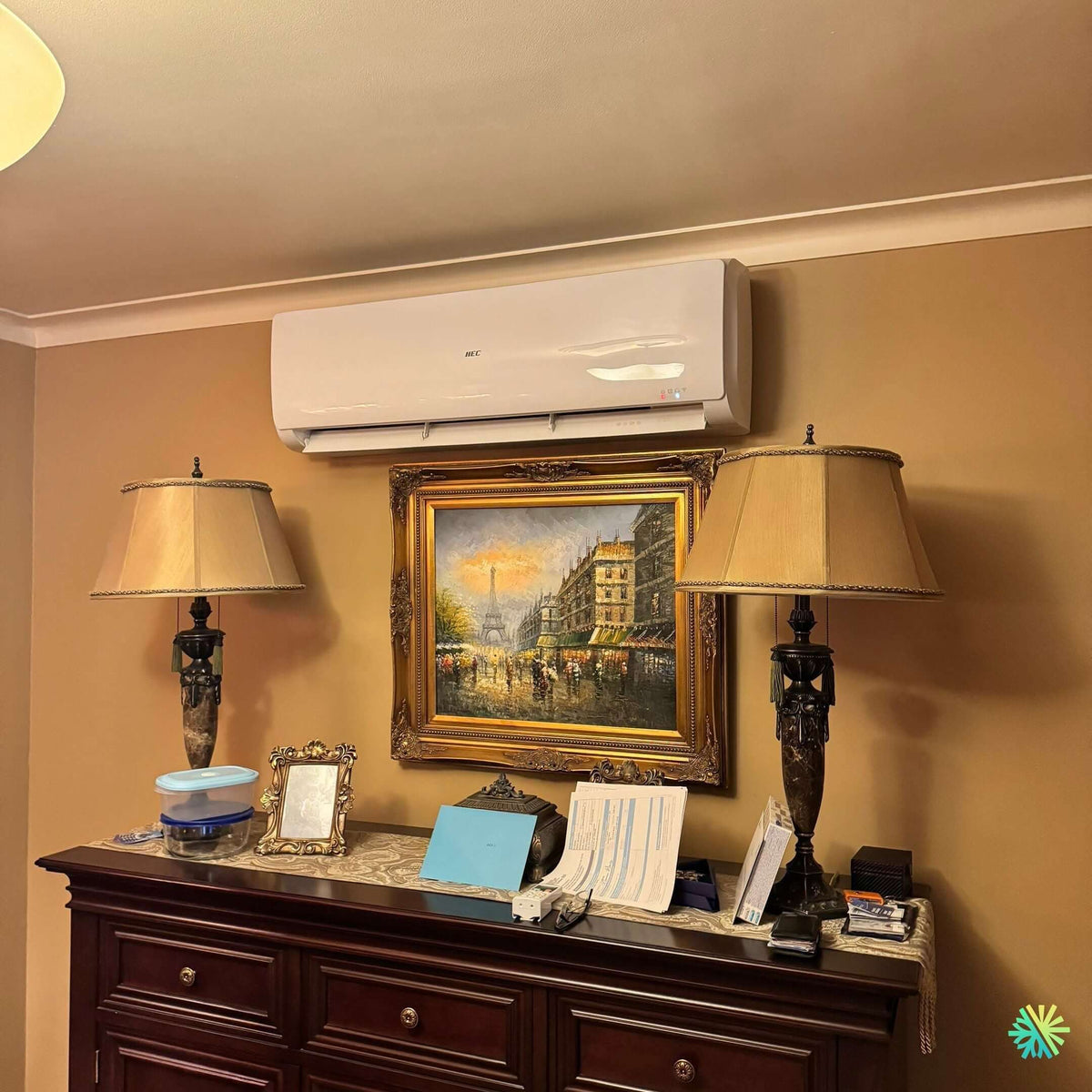
In a cozy apartment in Côte-des-Neiges–Notre-Dame-de-Grâce , we installed a Midea wall-mounted heat pump ( wall-mounted series), positioned above a sideboard, framed by two lamps and a painting. The goal is clear: to efficiently air condition and heat a traditionally decorated living space while respecting the aesthetic coherence of the room. At AirGreen , we know that the success of an HVAC installation is not only measured by BTUs or efficiency: it is also seen in the discretion of the device, the quality of the finishes , and the reliability of the performances throughout the Montreal seasons.
Context and customer expectations
-
Four-season comfort : rapid cooling during heat waves, stable heating when the thermometer plummets.
-
Preserved aesthetics : the unit must blend into a classic decor (moldings, gilded frame, light fixtures).
-
Silence : the room is used for relaxation and reading; the noise level must remain low during continuous operation.
-
Space optimization : no encroachment on passageways or existing furniture.
Technical choice: why a Midea wall-mounted heat pump?
Midea wall-mounted units are distinguished by their compactness, fine compressor modulation , and high efficiency ; depending on the generation chosen, recent series operate on R-32 (low GWP) and maintain performance down to approximately -25°C . The wall-mounted series covers the usual power outputs (9,000 to 18,000 BTU) suitable for Montreal living rooms. It fits perfectly into urban habitats in Montreal , Laval , Longueuil , as well as on the North Shore and South Shore .
AirGreen Installation Process: Method, Finishes and Performance
Preliminary study and positioning
We first confirm that the chosen wall is exterior to allow direct drilling and a gravity drain . The high position provides better air stratification : the blowing runs along the ceiling before gently descending, which homogenizes the temperature in the living-dining room area.
Points covered:
-
Clearances : maintain the recommended distances from the ceiling and sides to avoid any air recirculation and ensure accessibility for maintenance (opening the hood, removing filters).
-
Furniture and objects : check that the shutter does not hit the lampshades or the frame; advise the customer to leave a few centimeters between the painting and the base of the unit to facilitate cleaning and avoid turbulence that could attract dust to the canvas.
-
Acoustics : choice of mounting plate and anchors suitable for the support; level control to eliminate any vibration.
Drilling, refrigeration connections and drain
-
Single crossing of approximately 65 mm with core drill, slight outward slope (1–2%) to promote gravity flow of condensate.
-
Calibrated line lengths (often 3–5 m in this type of configuration) to remain within the manufacturer's range and avoid refrigerant overloads.
-
Discreet interior cladding if required (white tint) and UV-resistant exterior capping ; clean passage along the edge to minimize the visual impact on the facade.
-
Drain management : priority to gravity ; if the slope is impossible (e.g. interior cladding not passable), installation of a silent condensate pump with non-return valve and trap to prevent odors.
Power supply and communication
We draw a dedicated power supply from the panel on a circuit breaker compliant with the device's rating. The communication cable is laid according to the manufacturer's specifications, shielded if necessary to ensure a stable connection. The routings are secured and protected to prevent any unwanted hum and premature wear.
Vacuuming, checks and commissioning
-
Flaring carried out with calibrated tools; tightening torques respected.
-
Deep vacuum (micron controlled) followed by a seal test to confirm the seal.
-
Readmission of factory fluid and possible adjustment according to the actual length of the connections.
-
Measurements : delta-T in cool/heat mode, current, superheat/subcool, drain check under load.
-
Settings : orientation of shutters , activation of night mode , programming of recovery and adjustment of eco instructions .
Result: comfort, silence and aesthetics
-
Uniform comfort in the living area thanks to laminar blowing under the ceiling.
-
Low noise level at low speeds, compatible with reading and television.
-
Aesthetics preserved : the unit blends into the decor; the wiring remains invisible from the main viewing angles.
HVAC Use and Maintenance Tips
-
Maintain a stable setpoint (22–23°C) to limit cycles and maximize durability .
-
In summer, favor dehumidification mode when the heat is moderate: increased comfort with reduced consumption.
-
Clean filters every 6 to 8 weeks under heavy use; plan for annual maintenance including cleaning the turbine, checking electrical connections and checking the drain .
-
Slightly move decorative objects away from under the unit (lamp, frame) to maintain free airflow and prevent the lampshades from being deformed by hot air.
-
In winter, turn the shutters slightly upwards to promote convection and limit the effect of drafts on the occupants.
Grants and Compliance
Depending on the configuration chosen , the wall-mounted heat pump may be eligible for assistance programs ( Energy Star criteria, low temperature performance, validated AHRI number). We support our clients in Greater Montreal in verifying eligibility , preparing documents and submitting applications , whether you are in Montreal , Laval , Longueuil , on the North Shore or the South Shore .
What we avoid…and how
-
Air recirculation : we respect the clearances on the ceiling and above the board.
-
Sound effects : rigid mounting, anti-vibration collars, fan balancing on start-up.
-
Condensate : continuous slope and load test; if necessary, lifting pump with level detector.
-
Obstacles : validation of the height in relation to the lampshades and the frame so that the shutter swings freely .
Why AirGreen
Our promise: a clean , safe , and durable HVAC installation , carried out by certified technicians who are experts in both the standards and the aesthetics of Montreal interiors. We respond quickly, manage logistics with the union or owner, and schedule maintenance to protect your investment over time.
Are you planning a wall-mounted heat pump in Greater Montreal? We size the power (BTU) , validate grants , propose realistic deadlines , then deliver a site with impeccable finishes , ready for harsh winters and humid summers.
The job tools
Two quick checks with real numbers: what heat costs, and what your current heaters add up to in BTU/h.
Conversion: 1 W = 3.412 BTU/h. An indication, not a load calculation: baseboards and furnaces are often stronger than the real need, and they can stay as backup. AirGreen confirms the capacity on site.
How the job unfolds
The main steps of this kind of job at AirGreen. Every house has its quirks: the estimate brings them out.
We look at the room, the outside wall, the line route and where the outdoor unit will go. That is where the capacity gets chosen.
Model, capacity and price, in writing. We also check whether the model qualifies for assistance programs.
Floors and furniture protected, wall plate position marked level, wall opening located.
A single opening, with the slope the drain needs to flow outside.
Set on a stand raised above the snow, with the clearances the manufacturer requires.
Connected, insulated and protected. The opening is then sealed against water, cold air and insects.
A dedicated circuit and an accessible disconnect near the outdoor unit.
Leak test, vacuum, then start-up and a check of heating and cooling.
Remote, modes, filters: we show you the essentials before we leave.
- The on-site estimateWe look at the room, the outside wall, the line route and where the outdoor unit will go. That is where the capacity gets chosen.
- The quoteModel, capacity and price, in writing. We also check whether the model qualifies for assistance programs.
- Getting readyFloors and furniture protected, wall plate position marked level, wall opening located.
- The wall openingA single opening, with the slope the drain needs to flow outside.
- The outdoor unitSet on a stand raised above the snow, with the clearances the manufacturer requires.
- Lines, cable and drainConnected, insulated and protected. The opening is then sealed against water, cold air and insects.
- The electrical workA dedicated circuit and an accessible disconnect near the outdoor unit.
- Tests and start-upLeak test, vacuum, then start-up and a check of heating and cooling.
- The walkthroughRemote, modes, filters: we show you the essentials before we leave.
What we check on a job like this one
Each number is a point we check on site. Switch between summer and winter to watch air and heat move.
In summer, the outdoor unit rejects the house's heat outside.
Generic illustration of this type of installation, not a survey of this job site. Tap a number.
Mounted level on a wall plate, high enough for the air to reach the whole room, with enough space around it to slide the filters out easily.
The refrigerant lines, the communication cable and the drain go through the wall in a single opening, sealed against water, cold air and insects.
Two insulated copper pipes connect the two units. Outside, a line cover can protect them from sun, knocks and weather.
A shut-off switch near the outdoor unit isolates it safely for service. It must stay accessible at all times.
The compressor and the fan. In heating mode it captures heat from the outdoor air, even in winter, and moves it inside.
On the ground or on the wall, it keeps the unit above accumulated snow. The unit stays clear and defrost water can drain away.
The fan needs to blow freely. Storage, a fence or a wall too close, and efficiency drops while noise goes up.
Is your home ready?
Check what applies at your place. A "no" is not a refusal: it is what we sort out during the estimate.
Good habits, once the unit is in place
Six simple habits that keep the unit going. Your list stays on this device.
What to do, season by season
Three habits per season for this unit. They take a few minutes and prevent many calls.
- Clean the indoor unit's filters.
- Clear leaves and debris left on the outdoor unit by winter.
- Test cooling before the first hot days.
- Clean the filters more often when the unit runs a lot.
- Keep plants away from the outdoor unit.
- Check that no water drips from the indoor unit.
- Rake the leaves around the outdoor unit.
- Test heating before the first cold days.
- Book periodic maintenance before winter.
- Keep snow away from the stand and the front of the unit.
- Let the unit defrost: it is normal.
- Never hit the ice on the fins; call us if the unit stays iced up.
The right pages, at the right time
Four statements: true or false?
It all comes down to details you have just seen.
1. In heating mode, the outdoor unit can produce water.
During defrost cycles. That water must drain away without forming ice.
2. You pick the capacity with a simple square-footage rule.
Windows, insulation, orientation and how the room is used all count. Capacity is chosen on site.
3. A multi-zone connects several indoor heads to a single condenser.
One head per room, all on the same condenser. Each room keeps its own temperature.
4. The disconnect can sit behind the patio furniture.
It must stay accessible: it is what shuts the unit off for service.
0 / 4 right answers
What people ask us about this kind of work
Does a wall-mounted heat pump heat in winter?
Wall-mounted or multi-zone: how do I choose?
Where does the outdoor unit go?
Are there grants?
Do I need a permit?
How cold can it heat?
How much can I save?
How is the LogisVert assistance calculated?
Is it noisy?
The outdoor unit is covered in ice: is that normal?
Does AirGreen hold the required licences?
Is the estimate free?
No question matches. Write to us: we answer.
More jobs to see, near you
By town, by equipment or by region: browse more than 4,700 published projects.
Each dot: a town where AirGreen has published projects. The glowing dot: this job.
An on-site estimate, the right capacity, the right equipment.
The on-site estimate is free and the quote follows within 24 hours.
Text and photo: a real AirGreen Climatisation & Chauffage job. The diagrams are generic illustrations of the type of installation, not a survey of this job site. Sources of the added figures: airgreen.ca product pages (NEEP / AHRI performance), Hydro-Québec (Heat pumps page, LogisVert, read on 13 October 2026), Régie de l’énergie (rate D as of 1 April 2026).