
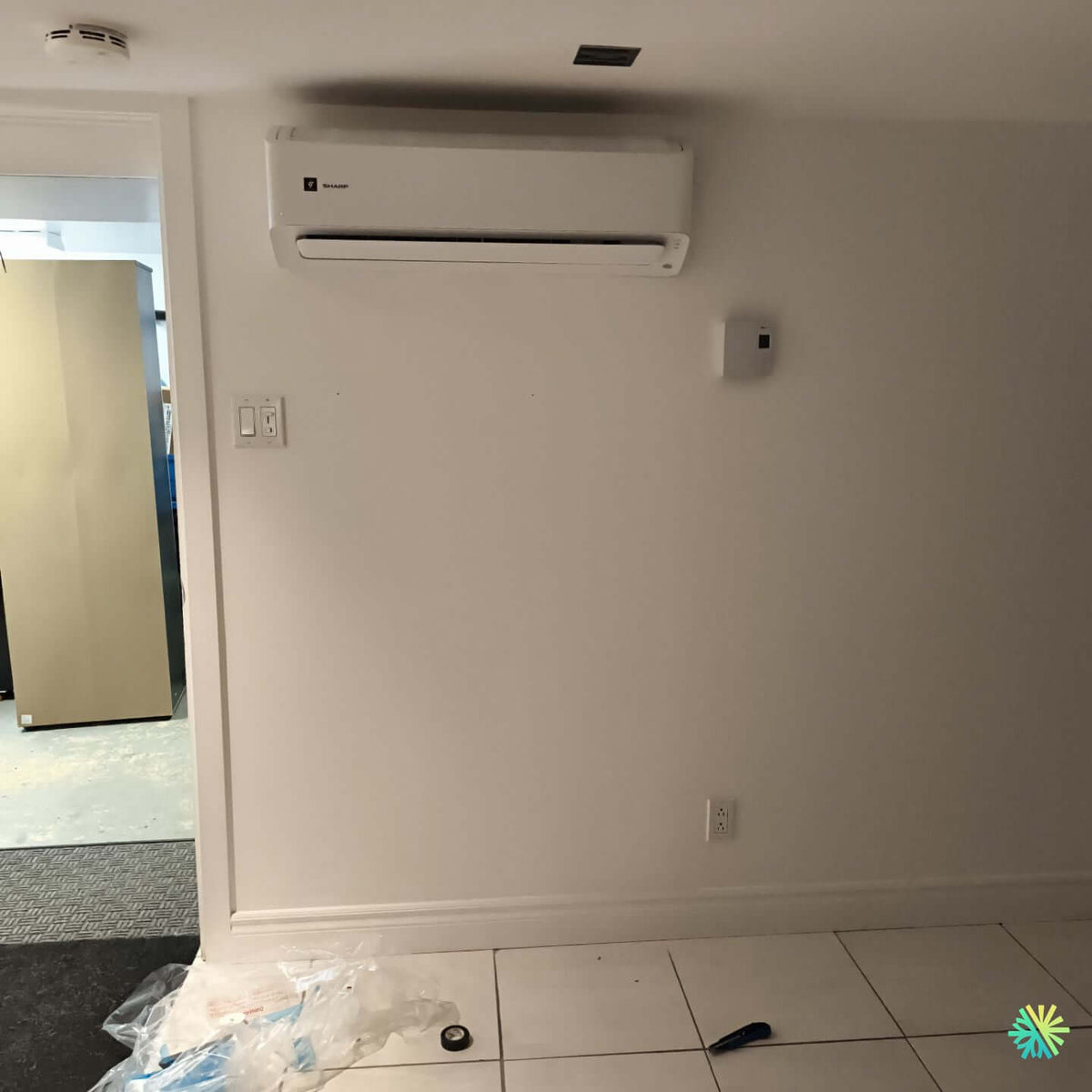
Installation of a Sharp Eco Inverter wall-mounted heat pump in Rosemont–La Petite-Patrie
Sharp R-32 heat pump installation on a flat roof in Rosemont–La Petite-Patrie: aluminum support, electrical disconnection, isolated connections and complete commissioning. AirGreen operates in Montreal, Laval, Longueuil, North Shore, South Shore .
In summer, the outdoor unit rejects the house's heat outside.
Generic illustration of this type of installation, not a survey of this job site. Tap a number.
Mounted level on a wall plate, high enough for the air to reach the whole room, with enough space around it to slide the filters out easily.
The refrigerant lines, the communication cable and the drain go through the wall in a single opening, sealed against water, cold air and insects.
Two insulated copper pipes connect the two units. Outside, a line cover can protect them from sun, knocks and weather.
A shut-off switch near the outdoor unit isolates it safely for service. It must stay accessible at all times.
The compressor and the fan. In heating mode it captures heat from the outdoor air, even in winter, and moves it inside.
On the ground or on the wall, it keeps the unit above accumulated snow. The unit stays clear and defrost water can drain away.
The fan needs to blow freely. Storage, a fence or a wall too close, and efficiency drops while noise goes up.
R-32 performance and careful execution on a flat roof: an AirGreen project designed to last
Customer context and choice of equipment
In Rosemont–La Petite-Patrie, a plex owner wants to stabilize the comfort of a two-story apartment while reducing energy costs. We recommend a Sharp Eco Inverter wall-mounted heat pump with R-32 (A2L) refrigerant , a compact, efficient solution suited to the neighborhood's typical flat roofs. The chosen unit provides reliable heating in cold weather while ensuring quiet cooling in the summer. The integrated Plasmacluster technology improves indoor air quality, a valued feature in high-occupancy Montreal homes.
Outdoor installation: stability, accessibility and compliance
The outdoor unit is installed on an aluminum support fixed to wooden joists, placed on the flat roof . This configuration:
-
guarantees proper clearances around the blower grille to optimize heat exchange;
-
reduces the transmission of vibrations to the structure thanks to anti-vibration pads;
-
facilitates HVAC maintenance and winter defrosting.
We position a cut-off box in the immediate vicinity, in accordance with current electrical practices, in order to secure service interventions.
Refrigerant and electrical connections: precision and cleanliness
The refrigerant lines (liquid and gas) are continuously insulated with high-density insulation, protected at the support points, and carefully bent to prevent throttling. The flare fittings are calibrated to the correct torque and then checked using an electronic detector. The power and communication cables follow the same route, secured to the structure without abrasive contact with the roof membrane.
For lasting performance, we follow a rigorous protocol:
-
Nitrogen test to check the tightness of the circuit.
-
Deep vacuum to remove residual moisture.
-
Instrumented commissioning with manifolds and thermometry to confirm superheating and subcooling in accordance with manufacturer ranges.
Result: a clean , quiet installation ready to deliver its nominal output.
Why R-32 matters in Greater Montreal
R-32 (class A2L) has a high volumetric capacity and a lower GWP than R-410A, which contributes to better seasonal efficiencies. Used on recent heat pumps , it promotes:
-
stable performance in low temperature heating;
-
more contained refrigerant charges;
-
simplified maintenance thanks to clearly established procedures.
Our teams are trained in A2L best practices (ventilation, absence of sparks, leak testing) in order to protect occupants and technicians.
Interior: targeted comfort and sound discretion
The wall-mounted airhead, positioned on a central load-bearing wall, supplies the main living area and a hallway. Motorized shutters distribute the air to limit cold spots, while the heating mode maintains a gentle, continuous flow. We fine-tune:
-
the blowing temperature for immediate comfort;
-
defrosting instructions adapted to Montreal winters;
-
ventilation levels for pleasant acoustics , including at night.
Condensate management: four-season reliability
The condensate drain follows a gravity path to the exterior with a controlled slope. In configurations where gravity is not possible, we integrate a lifting pump with a flow barrier, but here, the installation allowed for a natural, more reliable and quieter flow. All connections are insulated to prevent internal condensation during the summer.
Construction site challenges and solutions
-
Flat roof and membrane : systematic protection under each support point, paths without sharp edges, sealing of crossings with compatible materials.
-
Sun exposure : orientation of the condenser to limit the recirculation of hot air and preserve efficiency.
-
Service access : safe working height, valve side clearance and technical labels for future operations.
What the customer gains on a daily basis
-
Stable comfort in summer and winter, without disturbing noise on the terrace;
-
Energy savings thanks to the inverter and good seasonal settings;
-
Improved air quality via Plasmacluster;
-
Peace of mind : HVAC installation compliant, documented, and covered by our labor warranty.
Grants and procedures
Depending on the selected capacity and low-temperature performance, the equipment may be eligible for energy efficiency support programs . We assist our clients in Montreal, Laval, Longueuil, the North Shore, and the South Shore to verify eligibility, gather proof of installation, and optimize the application.
Recommended maintenance: the key to performance
To preserve yields:
-
Cleaning of internal filters every 4–8 weeks in season;
-
Annual inspection : exchanger, fans, electrical tightening, leak tests, parameter updates;
-
Winter clearance around the outdoor unit (ice/snow) to maintain free airflow.
Our HVAC maintenance contracts cover these operations and prioritize interventions before heat or cold peaks.
Best practices to remember for a flat roof in Rosemont
-
Choose a strong, corrosion-resistant support structure that is compatible with the distributed load of the roof;
-
Place a visible and accessible cut-off box ;
-
Protect line insulation against UV;
-
Avoid sharp bends and adhere to recommended linear lengths to ensure capacity;
-
Plan for snow removal and safe service access .
Why AirGreen for your project in Rosemont–La Petite-Patrie
Our teams work weekly on R-32 wall-mounted heat pumps in Greater Montreal . We understand the constraints of flat-roofed plexes, urban schedules, and tight access. Each project is documented , photographed, and delivered with commissioning measurements —a guarantee of performance and transparency.
Frequently Asked Questions
What power (BTU) should I choose?
Power depends on volume , insulation and solar orientation. We carry out room-by-room sizing to aim for a balance between comfort, acoustics and consumption.
What if I want to add a second room later?
The single-zone wall-mounted solution can be supplemented with a second dedicated unit. For multiple needs from the outset, a Multi-Zone Heat Pump can be considered; we evaluate the most appropriate option based on the layout of the home.
How long does it take to install?
For a similar configuration (flat roof, short route, adjacent power outage), the intervention is generally carried out in one day , including tests, subject to weather and access conditions.
Conclusion
This HVAC installation in Rosemont–La Petite-Patrie illustrates the AirGreen approach: advice , precise execution and instrumented commissioning . The Sharp Eco Inverter R-32 wall-mounted heat pump offers a winning combination: comfort, discretion and low operating costs – a sure value for homes in Greater Montreal .
Need a free estimate in Montreal, Laval, Longueuil, the North Shore, or the South Shore? Our experts will visit your site, confirm the power, and provide you with a clear proposal, ready for potential grant applications.
How it goes, from the first call to the end
The main steps of this kind of job at AirGreen. Every house has its quirks: the estimate brings them out.
We look at the room, the outside wall, the line route and where the outdoor unit will go. That is where the capacity gets chosen.
Model, capacity and price, in writing. We also check whether the model qualifies for assistance programs.
Floors and furniture protected, wall plate position marked level, wall opening located.
A single opening, with the slope the drain needs to flow outside.
Set on a stand raised above the snow, with the clearances the manufacturer requires.
Connected, insulated and protected. The opening is then sealed against water, cold air and insects.
A dedicated circuit and an accessible disconnect near the outdoor unit.
Leak test, vacuum, then start-up and a check of heating and cooling.
Remote, modes, filters: we show you the essentials before we leave.
- The on-site estimateWe look at the room, the outside wall, the line route and where the outdoor unit will go. That is where the capacity gets chosen.
- The quoteModel, capacity and price, in writing. We also check whether the model qualifies for assistance programs.
- Getting readyFloors and furniture protected, wall plate position marked level, wall opening located.
- The wall openingA single opening, with the slope the drain needs to flow outside.
- The outdoor unitSet on a stand raised above the snow, with the clearances the manufacturer requires.
- Lines, cable and drainConnected, insulated and protected. The opening is then sealed against water, cold air and insects.
- The electrical workA dedicated circuit and an accessible disconnect near the outdoor unit.
- Tests and start-upLeak test, vacuum, then start-up and a check of heating and cooling.
- The walkthroughRemote, modes, filters: we show you the essentials before we leave.
And at your place?
Two quick checks with real numbers: what heat costs, and what your current heaters add up to in BTU/h.
Conversion: 1 W = 3.412 BTU/h. An indication, not a load calculation: baseboards and furnaces are often stronger than the real need, and they can stay as backup. AirGreen confirms the capacity on site.
What to do, season by season
Three habits per season for this unit. They take a few minutes and prevent many calls.
- Clean the indoor unit's filters.
- Clear leaves and debris left on the outdoor unit by winter.
- Test cooling before the first hot days.
- Clean the filters more often when the unit runs a lot.
- Keep plants away from the outdoor unit.
- Check that no water drips from the indoor unit.
- Rake the leaves around the outdoor unit.
- Test heating before the first cold days.
- Book periodic maintenance before winter.
- Keep snow away from the stand and the front of the unit.
- Let the unit defrost: it is normal.
- Never hit the ice on the fins; call us if the unit stays iced up.
Which type of equipment for your project?
Pick what looks like your need.
Four mistakes we do not make
Flip each card to see what we do instead.
What people ask us about this kind of work
Does a wall-mounted heat pump heat in winter?
Wall-mounted or multi-zone: how do I choose?
Where does the outdoor unit go?
Are there grants?
Do I need a permit?
How cold can it heat?
How much can I save?
How is the LogisVert assistance calculated?
Is it noisy?
The outdoor unit is covered in ice: is that normal?
Does AirGreen hold the required licences?
Is the estimate free?
No question matches. Write to us: we answer.
Useful pages for what comes next
More jobs to see, near you
By town, by equipment or by region: browse more than 4,700 published projects.
Each dot: a town where AirGreen has published projects. The glowing dot: this job.
Tell us about your house. We come and see it for free.
The on-site estimate is free and the quote follows within 24 hours.
Text and photo: a real AirGreen Climatisation & Chauffage job. The diagrams are generic illustrations of the type of installation, not a survey of this job site. Sources of the added figures: airgreen.ca product pages (NEEP / AHRI performance), Hydro-Québec (Heat pumps page, LogisVert, read on 13 October 2026), Régie de l’énergie (rate D as of 1 April 2026).