
Installation of a Sharp Eco Inverter wall-mounted heat pump in Villeray–Saint-Michel–Parc-Extension
AirGreen installs a Sharp Eco Inverter wall-mounted heat pump in Villeray–Saint-Michel–Parc-Extension: wall brackets, silent blocks, vacuum ≤ 500 microns, short path. HVAC service Montreal, Laval, Longueuil, North Shore & South Shore.
- City
- Region
- Equipment
- Brand
- Challenges
- Published
The job on one screen
The article, chapter by chapter
Compact and neat assembly for stable comfort all year round
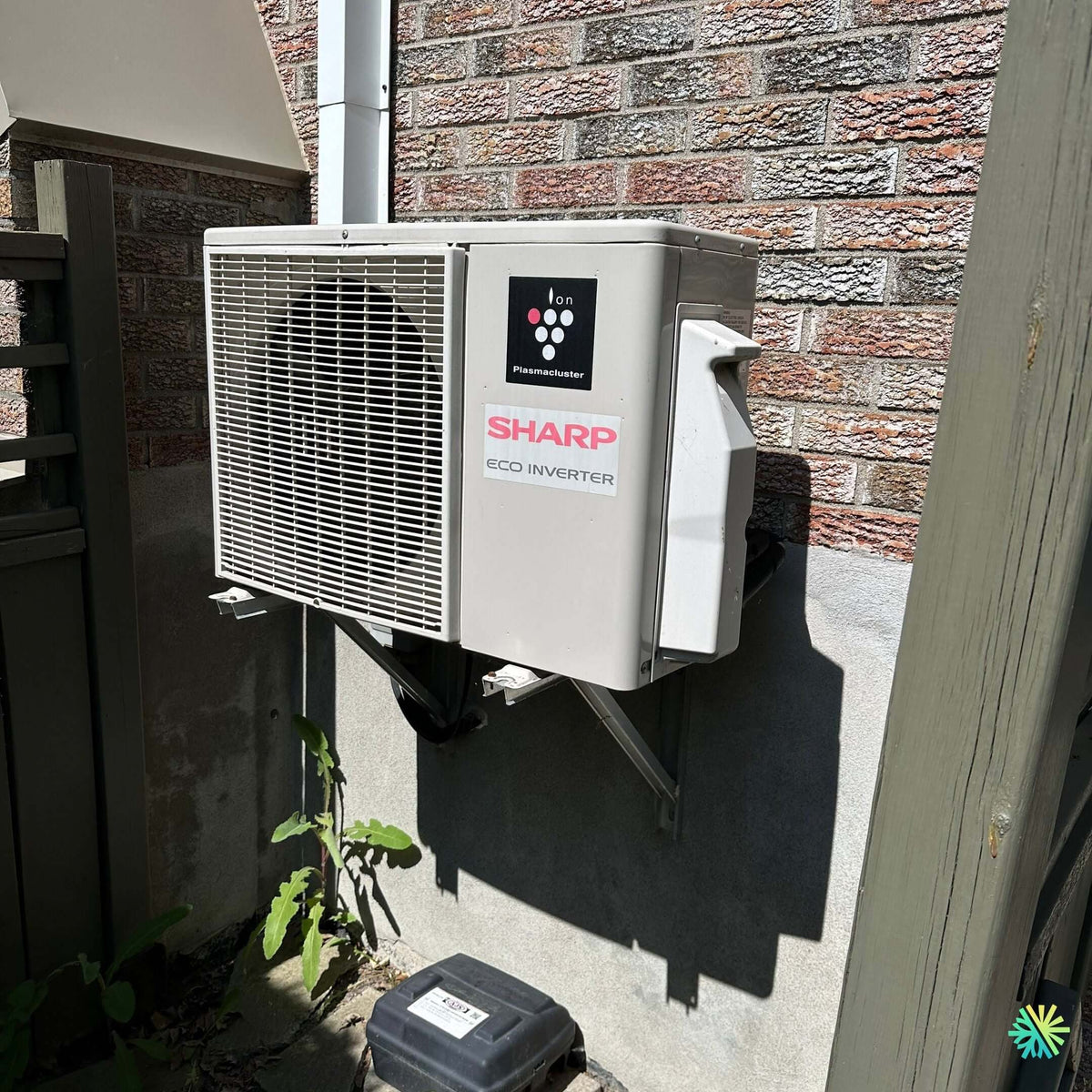
At AirGreen , we adapt each HVAC installation to the architectural realities of plexes and houses in Greater Montreal . Here, on a ground floor in Villeray–Saint-Michel–Parc-Extension , we are installing a Sharp Eco Inverter wall-mounted heat pump . The indoor head serves the living area on the courtyard side; the outdoor condenser is mounted on wall brackets above ground, against a brick wall, in a narrow side alley. The whole system favors a short refrigeration path , rigorous commissioning and clear maintenance access.
Client context and objectives
-
Family occupation, presence during the day; need for efficient heating in mid-season and gentle, quiet air conditioning in summer.
-
Typical envelope of Villeray brick buildings, close openings and narrow passage between fence and facade.
-
Priorities: limit floor space, reduce vibrations , facilitate maintenance, preserve the aesthetics of the facade.
Why a Sharp Eco Inverter wall-mounted heat pump?
-
Inverter modulation ensures rapid comfort and then adjusted power, for significant energy savings over the season.
-
Robust design and controlled noise level , essential in a side aisle close to windows.
-
Simple indoor-side filtration and monitoring, perfect for preventative HVAC maintenance by the owner, with our annual check-ups.
Sizing and logic of choice
The calculation of the load of the living areas (usable surface area, orientation, infiltration of openings) places the need in the range of 12,000 to 15,000 BTU . We retain 12,000 BTU to avoid oversizing, improve seasonal efficiencies (real SEER/HSPF) and maintain quiet operation . Performance objectives:
-
Summer: temperature stabilised around 23–24°C, effective dehumidification during humid episodes.
-
Mild to moderate winter: main heating of the day area; occasional relay of existing transmitters during extreme cold.
Installation details — quality is in the execution
-
Galvanized wall brackets with anti-vibration silent blocks : greatly reduced vibration transmission in the masonry, resistant to freezing and thawing.
-
Usable height above ground: safe clearance from packed snow and leaves; free air circulation in front of the fan.
-
Short refrigeration path (≈ 2–3 m) between the indoor head and the outdoor unit: minimized losses, better efficiency and faster response time.
-
Single hole (∅ ~ 65 mm) with insulated sleeve; double sealing (foam + elastomeric sealant) to block air and moisture infiltration.
-
Gravity drainage of condensates with continuous slope (≥ 2%) and outlet protection; no pump, therefore zero additional noise and reduced maintenance.
-
Protected electrical routing; dedicated panel circuit breaker , verified grounding.
AirGreen Refrigeration Procedure
-
Nitrogen test (≈ 450 psi) + pressure drop control.
-
Vacuum draw down to ≤ 500 microns, hold, then open the valves.
-
Compliant tightening torques, control of superheating/subcooling temperatures at commissioning.
These steps determine the longevity of the compressor and the stability of seasonal performance.
Noise and airflow management
-
Outside: installation away from reverberating angles, adjusted silent blocks and differentiated tightening to break up vibration bridges.
-
Inside: the shutter is oriented slightly downwards to capture the volume of the room without direct air flow onto the occupants; horizontal sweep programmed to irrigate the kitchen and living room.
Aesthetics, accessibility and sustainability
-
Aligned and screwed capping on rigid support; continuous seals resistant to freeze-thaw and UV.
-
Clearance maintained around openings (windows/doors) for safety and maintenance.
-
Easy access to washable filters on the front; maintenance reminder set on the remote control.
-
Free space in front of the external fan battery (≈ 60 cm) maintained by the customer; instructions provided in writing.
Results after commissioning
-
Uniform comfort across the living area, disappearance of “cold zones” near passageways.
-
Very low noise in stabilized mode thanks to modulation and vibration isolation.
-
Controlled consumption in mid-season compared to purely resistive heating.
AirGreen Best Practices for Villeray and Montreal Intramuros
-
Prefer wall mounting when the side aisle is narrow or subject to accumulations (snow, leaves).
-
Keep a clear area around the unit: no storage, bins or plants stuck to the fan.
-
Check the gravity drain at each change of season; clear the drain outlet.
-
Schedule annual HVAC maintenance : deep cleaning of the indoor unit, checking electrical connections, current measurement and visual inspection of the capping.
Financial aid and administrative support
High-efficiency wall-mounted heat pumps are often eligible for assistance programs in Quebec. We validate eligibility, gather evidence (installation photos, serial numbers, detailed invoice) and manage the file for our clients in Montreal , Laval , Longueuil , North Shore and South Shore .
For a similar project in Greater Montreal
-
Demand the shortest possible refrigeration journey and documented vacuuming.
-
Ensure winter clearance around the condenser (blowing and suction).
-
Choose a low-noise inverter range if the unit is located close to openings or neighbors.
-
Entrust the installation to a recognized HVAC contractor : the execution details (vacuum, torque, drainage) make the difference over 10–15 years.
Why choose AirGreen?
Our team understands the unique characteristics of Montreal 's dense neighborhoods: brick facades, narrow streets, complex access points, and frost cycles. Our approach—thermal studies, careful HVAC installation , comprehensive testing, and usage advice—delivers a discreet, efficient, and durable system, with local service in Montreal , Laval , Longueuil , and on the North and South Shores .
Naturally integrated keywords : heat pump , wall-mounted heat pump , wall-mounted air conditioner , HVAC installation , HVAC maintenance , Montreal , Laval , Longueuil , North Shore , South Shore .
The job tools
Two quick checks with real numbers: what heat costs, and what your current heaters add up to in BTU/h.
Conversion: 1 W = 3.412 BTU/h. An indication, not a load calculation: baseboards and furnaces are often stronger than the real need, and they can stay as backup. AirGreen confirms the capacity on site.
How the job unfolds
The main steps of this kind of job at AirGreen. Every house has its quirks: the estimate brings them out.
We look at the room, the outside wall, the line route and where the outdoor unit will go. That is where the capacity gets chosen.
Model, capacity and price, in writing. We also check whether the model qualifies for assistance programs.
Floors and furniture protected, wall plate position marked level, wall opening located.
A single opening, with the slope the drain needs to flow outside.
Set on a stand raised above the snow, with the clearances the manufacturer requires.
Connected, insulated and protected. The opening is then sealed against water, cold air and insects.
A dedicated circuit and an accessible disconnect near the outdoor unit.
Leak test, vacuum, then start-up and a check of heating and cooling.
Remote, modes, filters: we show you the essentials before we leave.
- The on-site estimateWe look at the room, the outside wall, the line route and where the outdoor unit will go. That is where the capacity gets chosen.
- The quoteModel, capacity and price, in writing. We also check whether the model qualifies for assistance programs.
- Getting readyFloors and furniture protected, wall plate position marked level, wall opening located.
- The wall openingA single opening, with the slope the drain needs to flow outside.
- The outdoor unitSet on a stand raised above the snow, with the clearances the manufacturer requires.
- Lines, cable and drainConnected, insulated and protected. The opening is then sealed against water, cold air and insects.
- The electrical workA dedicated circuit and an accessible disconnect near the outdoor unit.
- Tests and start-upLeak test, vacuum, then start-up and a check of heating and cooling.
- The walkthroughRemote, modes, filters: we show you the essentials before we leave.
What we check on a job like this one
Each number is a point we check on site. Switch between summer and winter to watch air and heat move.
In summer, the outdoor unit rejects the house's heat outside.
Generic illustration of this type of installation, not a survey of this job site. Tap a number.
Mounted level on a wall plate, high enough for the air to reach the whole room, with enough space around it to slide the filters out easily.
The refrigerant lines, the communication cable and the drain go through the wall in a single opening, sealed against water, cold air and insects.
Two insulated copper pipes connect the two units. Outside, a line cover can protect them from sun, knocks and weather.
A shut-off switch near the outdoor unit isolates it safely for service. It must stay accessible at all times.
The compressor and the fan. In heating mode it captures heat from the outdoor air, even in winter, and moves it inside.
On the ground or on the wall, it keeps the unit above accumulated snow. The unit stays clear and defrost water can drain away.
The fan needs to blow freely. Storage, a fence or a wall too close, and efficiency drops while noise goes up.
Is your home ready?
Check what applies at your place. A "no" is not a refusal: it is what we sort out during the estimate.
Good habits, once the unit is in place
Six simple habits that keep the unit going. Your list stays on this device.
What to do, season by season
Three habits per season for this unit. They take a few minutes and prevent many calls.
- Clean the indoor unit's filters.
- Clear leaves and debris left on the outdoor unit by winter.
- Test cooling before the first hot days.
- Clean the filters more often when the unit runs a lot.
- Keep plants away from the outdoor unit.
- Check that no water drips from the indoor unit.
- Rake the leaves around the outdoor unit.
- Test heating before the first cold days.
- Book periodic maintenance before winter.
- Keep snow away from the stand and the front of the unit.
- Let the unit defrost: it is normal.
- Never hit the ice on the fins; call us if the unit stays iced up.
The right pages, at the right time
Four statements: true or false?
It all comes down to details you have just seen.
1. In heating mode, the outdoor unit can produce water.
During defrost cycles. That water must drain away without forming ice.
2. You pick the capacity with a simple square-footage rule.
Windows, insulation, orientation and how the room is used all count. Capacity is chosen on site.
3. A multi-zone connects several indoor heads to a single condenser.
One head per room, all on the same condenser. Each room keeps its own temperature.
4. The disconnect can sit behind the patio furniture.
It must stay accessible: it is what shuts the unit off for service.
0 / 4 right answers
What people ask us about this kind of work
Does a wall-mounted heat pump heat in winter?
Wall-mounted or multi-zone: how do I choose?
Where does the outdoor unit go?
Are there grants?
Do I need a permit?
How cold can it heat?
How much can I save?
How is the LogisVert assistance calculated?
Is it noisy?
The outdoor unit is covered in ice: is that normal?
Does AirGreen hold the required licences?
Is the estimate free?
No question matches. Write to us: we answer.
More jobs to see, near you
By town, by equipment or by region: browse more than 4,700 published projects.
Each dot: a town where AirGreen has published projects. The glowing dot: this job.
An on-site estimate, the right capacity, the right equipment.
The on-site estimate is free and the quote follows within 24 hours.
Text and photo: a real AirGreen Climatisation & Chauffage job. The diagrams are generic illustrations of the type of installation, not a survey of this job site. Sources of the added figures: airgreen.ca product pages (NEEP / AHRI performance), Hydro-Québec (Heat pumps page, LogisVert, read on 13 October 2026), Régie de l’énergie (rate D as of 1 April 2026).