
Installation of a Sharp Eco Inverter wall-mounted heat pump in Plateau-Mont-Royal
AirGreen installs two Sharp Eco Inverter wall-mounted heat pumps in a narrow courtyard in Plateau-Mont-Royal: raised supports, black capping, rigorous commissioning and four-season comfort with simplified HVAC maintenance.
- City
- Region
- Equipment
- Brand
- Challenges
- Published
The job on one screen
The article, chapter by chapter
Two outdoor units for discreet comfort in a narrow courtyard
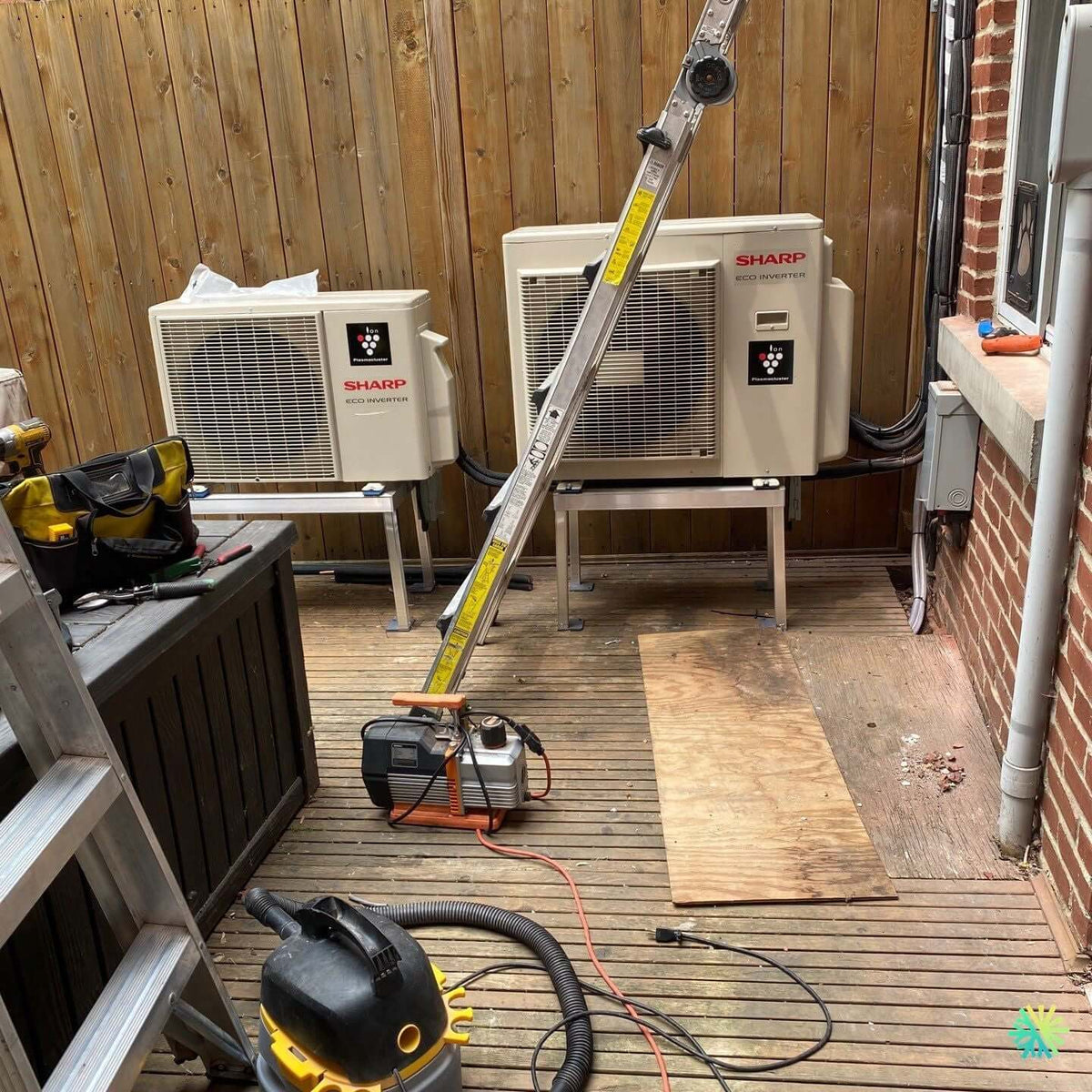
In a typical Plateau-Mont-Royal plex, we are installing Sharp Eco Inverter wall-mounted heat pumps designed for a cramped backyard space, bordered by a wooden fence and a brick wall . The project illustrates what we do every day: integrating high-performance equipment into tight urban settings, without compromising access, security, or the peace and quiet of the occupants—or that of their neighbors.
Context and objectives of the project
The owner wants four-season comfort with an energy-efficient and quiet solution for separate living areas. The constraints are clear:
-
Limited floor space on a wooden slatted deck.
-
Narrow technical passage , shared with maintenance access.
-
Low noise requirements due to proximity to neighbors.
-
Durable finish , capable of withstanding Montreal winters.
We offer a pair of Sharp Eco Inverter wall-mounted heat pumps in a two-room configuration (two dedicated outdoor units, each connected to an indoor head). This choice guarantees fine modulation of loads and appreciable redundancy: in the event of maintenance on one circuit, the other remains fully operational.
Why Sharp Eco Inverter for a Montreal plex
Sharp 's Eco Inverter range is distinguished by:
-
Variable speed compressor (Inverter) : continuous adaptation to demand, reducing on/off cycles and electricity consumption.
-
Seasonal efficiencies in accordance with current standards (SEER2/HSPF2), promoting access to subsidy programs when the chosen configuration meets the efficiency criteria.
-
Controlled noise levels , a decisive advantage in the interior courtyard.
-
Anti-corrosion treated components on the outdoor exchanger, relevant in an urban environment exposed to salt and freeze/thaw cycles.
-
Parts warranty and solid compressor , for long-term peace of mind.
Our recommendation is for stable heating in cold weather and gentle cooling in summer, with operating costs contained by inverter modulation.
Installation process: precision, safety, durability
Site preparation and surface protection
Even before opening the boxes, our team protects the surfaces: plywood to distribute the load during movement, a shop vacuum to keep the area clean, and tools organized away from traffic. This method prevents damage to the deck boards and makes it easier to restore them at the end of the project.
Positioning of outdoor units
The two Sharp Eco Inverter condensers are installed on raised aluminum supports :
-
Sufficient ground clearance for snow and water drainage.
-
Anti-vibration pads to limit structural transmission to the terrace and masonry.
-
Alignment parallel to the fence to preserve a traffic corridor and facilitate maintenance.
This choice of aluminum supports prevents corrosion and simplifies fine leveling, essential for oil return and proper circulation of the refrigerant.
Refrigeration and electricity route
The refrigeration connections (insulated copper) and the communication/power wiring are covered in black and guided against the brick wall in order to:
-
Reduce exposure to UV, shock and weather.
-
Provide a sober finish that blends into the decor.
-
Streamline maintenance : each circuit is identified and accessible.
An external disconnect switch is installed in the regulatory vicinity for each unit, in accordance with Quebec electrical codes . The holes in the brick are sealed and watertight , eliminating air infiltration and the risk of humidity.
Refrigeration procedure and commissioning
We apply our standard protocol:
-
Bending to the proper radius to preserve the integrity of the tubes.
-
Brazing under nitrogen when required, to prevent internal oxidation.
-
Nitrogen leak test with controlled pressure build-up.
-
Deep vacuum (pump visible in the photo) until a stable vacuum is reached, measured with a micron meter.
-
Refrigerant release , superheat/subcooling checks, current checks and taking temperature measurements on-line.
-
Setting up remote controls (modes, settings, fan speeds, shutter angles).
This approach guarantees a dry, clean and perfectly sealed circuit, an essential condition for the longevity of the compressor and electronic expansion valves.
Drainage management and acoustic comfort
Even though the condensate lines of the interior heads are not visible here, we favor:
-
Gravity evacuation as soon as possible for reliability and silence.
-
Condensate pump when slopes do not allow it, with service line for maintenance.
-
Anti-siphon and capillary break to prevent odors from rising.
On the noise side, the combined use of anti-vibration pads , the silent mode of the Sharp units and the lateral positioning relative to the neighborhood rest areas contributes to discreet operation , both in air conditioning and in winter defrosting.
Result: segmented comfort, efficiency and simplified maintenance
By separating the loads on two independent circuits , we provide:
-
Zoned comfort : each zone adjusts its setting without over-consuming.
-
Redundancy : maintenance on one unit does not immobilize the entire housing.
-
Easy maintenance : direct access, clearances respected, legible circuitry .
-
Controlled aesthetics : discreet black capping , clean holes, tidy cable management.
Grants and Eligibility
Depending on the chosen configuration and the certified performance of the Sharp Eco Inverter duo, the project may be eligible for provincial/municipal financial assistance when the efficiency thresholds are met. We support our clients in:
-
Assemble technical documents (product sheet, performance, certification numbers).
-
Establish proof of compliance (detailed invoices, installation photos).
-
Submit applications for Montreal, Laval, Longueuil, North Shore and South Shore .
AirGreen Best Practices to Remember for Narrow Yards
-
Raised aluminum supports : sturdy, adjustable, snow compatible.
-
Compliant clearances for air intake and service.
-
Continuous cover of lines to last beyond 10 years.
-
Disconnector per unit and identified wiring : faster diagnostics.
-
Measured deep vacuum : top priority for longevity.
-
Sealed passages and careful sealing : thermal comfort and air quality.
Typical timeline of a similar project
-
Technical visit : measurements, route survey, electrical check.
-
Proposal : sizing, clear quote, subsidy scenarios.
-
Pre-installation : supply, intervention plan, co-ownership coordination.
-
Installation (1 day for two single zones in this type of yard): supports, connections, electricity, commissioning.
-
Final checks : tests, explanations to the customer, maintenance advice.
-
Follow-up : assistance with financial aid applications and HVAC maintenance reminders.
Maintenance and longevity
To maintain yields:
-
Quarterly cleaning of wall head filters.
-
Annual check by our technicians: exchangers, fans, electrical tightening, performance measurements .
-
Winter clearance : avoid snow accumulation in front of the gates.
-
Observation of noise/vibrations : intervening early protects compressor and fans.
Why AirGreen for the Plateau, Montreal and surrounding areas?
Our team is familiar with the specific features of Montreal plexes : access via narrow alleys, wooden terraces, old masonry , and neighborhood rules. We deliver durable, neat, and easy-to-maintain HVAC systems in Montreal , Laval , Longueuil , and on the North and South Shores . Each project is planned , documented , and optimized for performance, safety, and aesthetics.
Conclusion
This installation of two Sharp Eco Inverter wall-mounted heat pumps in Plateau-Mont-Royal offers zoned comfort , energy efficiency and exemplary integration into a tight interior courtyard. At AirGreen, we combine engineering , rigorous implementation and administrative support to deliver projects that keep their promises over several winters.
The job tools
Two quick checks with real numbers: what heat costs, and what your current heaters add up to in BTU/h.
Conversion: 1 W = 3.412 BTU/h. An indication, not a load calculation: baseboards and furnaces are often stronger than the real need, and they can stay as backup. AirGreen confirms the capacity on site.
How the job unfolds
The main steps of this kind of job at AirGreen. Every house has its quirks: the estimate brings them out.
We look at the room, the outside wall, the line route and where the outdoor unit will go. That is where the capacity gets chosen.
Model, capacity and price, in writing. We also check whether the model qualifies for assistance programs.
Floors and furniture protected, wall plate position marked level, wall opening located.
A single opening, with the slope the drain needs to flow outside.
Set on a stand raised above the snow, with the clearances the manufacturer requires.
Connected, insulated and protected. The opening is then sealed against water, cold air and insects.
A dedicated circuit and an accessible disconnect near the outdoor unit.
Leak test, vacuum, then start-up and a check of heating and cooling.
Remote, modes, filters: we show you the essentials before we leave.
- The on-site estimateWe look at the room, the outside wall, the line route and where the outdoor unit will go. That is where the capacity gets chosen.
- The quoteModel, capacity and price, in writing. We also check whether the model qualifies for assistance programs.
- Getting readyFloors and furniture protected, wall plate position marked level, wall opening located.
- The wall openingA single opening, with the slope the drain needs to flow outside.
- The outdoor unitSet on a stand raised above the snow, with the clearances the manufacturer requires.
- Lines, cable and drainConnected, insulated and protected. The opening is then sealed against water, cold air and insects.
- The electrical workA dedicated circuit and an accessible disconnect near the outdoor unit.
- Tests and start-upLeak test, vacuum, then start-up and a check of heating and cooling.
- The walkthroughRemote, modes, filters: we show you the essentials before we leave.
What we check on a job like this one
Each number is a point we check on site. Switch between summer and winter to watch air and heat move.
In summer, the outdoor unit rejects the house's heat outside.
Generic illustration of this type of installation, not a survey of this job site. Tap a number.
Mounted level on a wall plate, high enough for the air to reach the whole room, with enough space around it to slide the filters out easily.
The refrigerant lines, the communication cable and the drain go through the wall in a single opening, sealed against water, cold air and insects.
Two insulated copper pipes connect the two units. Outside, a line cover can protect them from sun, knocks and weather.
A shut-off switch near the outdoor unit isolates it safely for service. It must stay accessible at all times.
The compressor and the fan. In heating mode it captures heat from the outdoor air, even in winter, and moves it inside.
On the ground or on the wall, it keeps the unit above accumulated snow. The unit stays clear and defrost water can drain away.
The fan needs to blow freely. Storage, a fence or a wall too close, and efficiency drops while noise goes up.
Is your home ready?
Check what applies at your place. A "no" is not a refusal: it is what we sort out during the estimate.
Good habits, once the unit is in place
Six simple habits that keep the unit going. Your list stays on this device.
What to do, season by season
Three habits per season for this unit. They take a few minutes and prevent many calls.
- Clean the indoor unit's filters.
- Clear leaves and debris left on the outdoor unit by winter.
- Test cooling before the first hot days.
- Clean the filters more often when the unit runs a lot.
- Keep plants away from the outdoor unit.
- Check that no water drips from the indoor unit.
- Rake the leaves around the outdoor unit.
- Test heating before the first cold days.
- Book periodic maintenance before winter.
- Keep snow away from the stand and the front of the unit.
- Let the unit defrost: it is normal.
- Never hit the ice on the fins; call us if the unit stays iced up.
The right pages, at the right time
Four statements: true or false?
It all comes down to details you have just seen.
1. In heating mode, the outdoor unit can produce water.
During defrost cycles. That water must drain away without forming ice.
2. You pick the capacity with a simple square-footage rule.
Windows, insulation, orientation and how the room is used all count. Capacity is chosen on site.
3. A multi-zone connects several indoor heads to a single condenser.
One head per room, all on the same condenser. Each room keeps its own temperature.
4. The disconnect can sit behind the patio furniture.
It must stay accessible: it is what shuts the unit off for service.
0 / 4 right answers
What people ask us about this kind of work
Does a wall-mounted heat pump heat in winter?
Wall-mounted or multi-zone: how do I choose?
Where does the outdoor unit go?
Are there grants?
Do I need a permit?
How cold can it heat?
How much can I save?
How is the LogisVert assistance calculated?
Is it noisy?
The outdoor unit is covered in ice: is that normal?
Does AirGreen hold the required licences?
Is the estimate free?
No question matches. Write to us: we answer.
More jobs to see, near you
By town, by equipment or by region: browse more than 4,700 published projects.
Each dot: a town where AirGreen has published projects. The glowing dot: this job.
An on-site estimate, the right capacity, the right equipment.
The on-site estimate is free and the quote follows within 24 hours.
Text and photo: a real AirGreen Climatisation & Chauffage job. The diagrams are generic illustrations of the type of installation, not a survey of this job site. Sources of the added figures: airgreen.ca product pages (NEEP / AHRI performance), Hydro-Québec (Heat pumps page, LogisVert, read on 13 October 2026), Régie de l’énergie (rate D as of 1 April 2026).