
Installation of a Sharp wall-mounted heat pump in Villeray–Saint-Michel–Parc-Extension
High-level installation of a Sharp wall-mounted heat pump in Villeray–Saint-Michel–Parc-Extension: brick anchors, silentblocs, vertical capping, vacuum draw, and complete testing. Durable and quiet HVAC installation by AirGreen, Greater Montreal.
- City
- Region
- Equipment
- Brand
- Challenges
- Published
The job on one screen
The article, chapter by chapter
Height, safety and careful finishing: an exemplary HVAC installation on a brick facade in Montreal
Building context and objectives
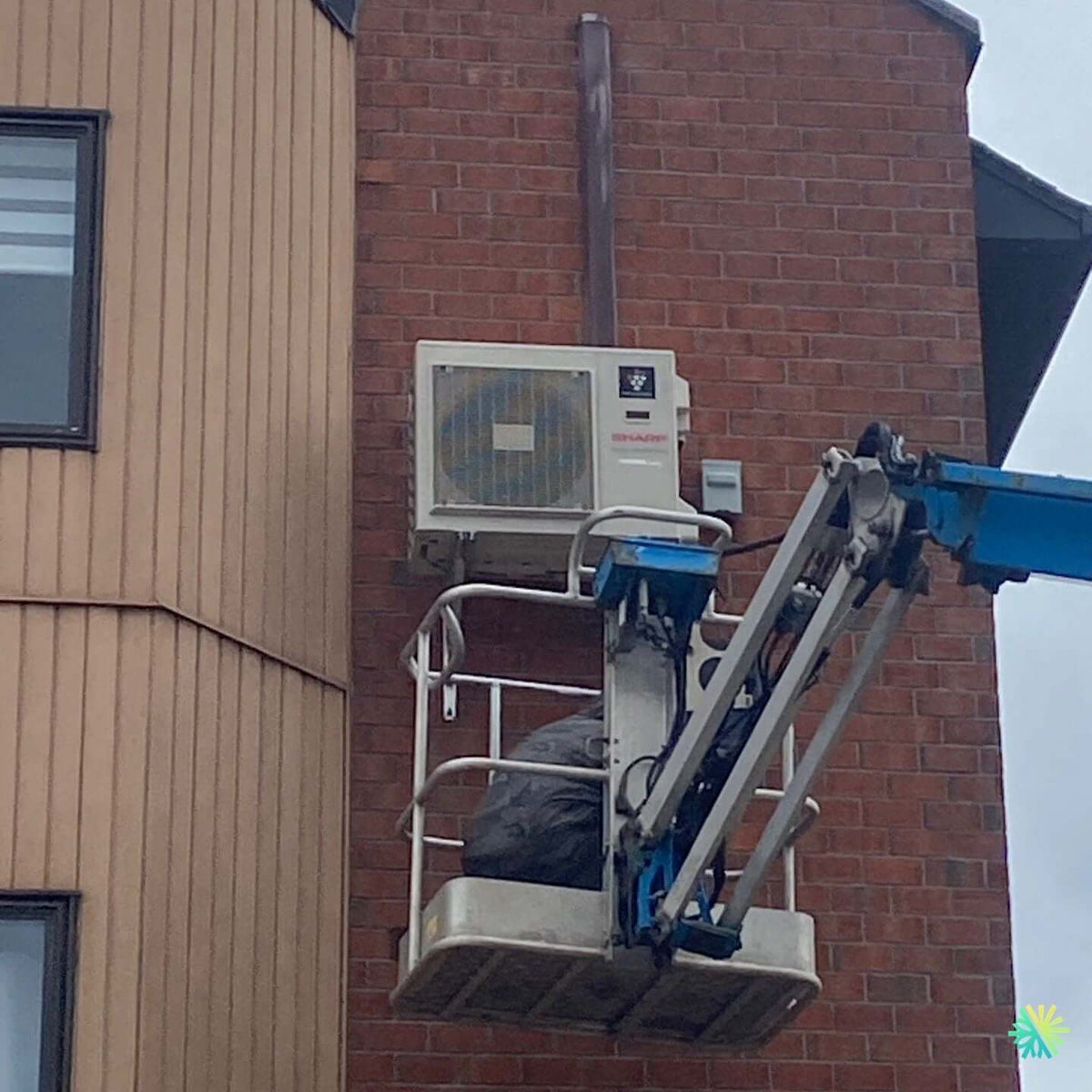
We are working on a typical residential building in Villeray–Saint-Michel–Parc-Extension , featuring a brick facade with rounded volumes and wood cladding. The occupants are looking for four-season comfort without losing interior space, with a quiet and reliable HVAC solution. The chosen option is aSharp wall-mounted heat pump : compact, efficient, and discreetly integrated into the envelope.
Why a Sharp wall-mounted heat pump for this urban project?
-
Dual function : air conditioning in summer, efficient heating in mid-season and in moderate cold weather — a major asset for Montreal .
-
Modularity : room-by-room coverage and the possibility of adding other areas.
-
Energy efficiency : variable speed compressor to maintain the setpoint with contained consumption.
-
Controlled noise level : ideal in dense areas.
-
Simplified maintenance : clear access to the outdoor unit and interior components.
At AirGreen, we size and install each heat pump so it delivers its real-world performance in the field, not just on paper.
Study and sizing: the basis of lasting comfort
Before any installation, we perform a load calculation : orientation of the facades, glazed surfaces, air infiltration, sealing and insulation. In a plex housing, a range of 9,000 to 18,000 BTU/h per zone is common; we avoid oversizing (short cycles, insufficient dehumidification) as well as undersizing (discomfort at peaks). The result: a system that stabilizes the temperature and lowers humidity on heavy days.
Site challenges: working at height and mixed brick/wood facade
This facade presents three constraints:
-
Installation height : The outdoor unit is placed at an elevated position for safety, protection against vandalism and snow. We use a cradle (lifting platform) and a controlled lifting method.
-
Wall support : the load-bearing brick requires suitable mechanical anchoring , with compliant sealing and the interposition of silent blocks to absorb vibrations.
-
Vertical technical route : the vertical capping (brown color, matching the facade) groups together refrigerant lines, supply and condensate evacuation.
Technical choices retained
-
Galvanized wall brackets sized for load and lever arm, with anti-vibration mounts .
-
Clearances respected at the rear and front of the unit for optimal heat exchange and easy HVAC maintenance .
-
Insulated copper refrigerant lines , controlled bend radius , anti-friction fasteners, UV tape and penetration-proof sleeves.
-
Electricity : dedicated circuit to the panel, suitable circuit breaker, external disconnection near the unit.
-
Condensates : gravity slope priority; compact pump considered only if final levels require it.
-
Finish : sealed wall penetration (compatible sealants, clean apron), continuous and discreet capping.
Step-by-step installation methodology
-
Site preparation : ground marking, checking anchor points, checking the platform and recording safety procedures.
-
Installation of the brackets : drilling of the correct diameter, chemical anchors /mechanical-chemical anchors according to the density of the brick; perfect leveling for the stability of the compressor.
-
Installation of the outdoor unit : safe handling, torque tightening, installation of silent blocks .
-
Through-hole with sheath: protected passage of lines, fire-resistant and airtight.
-
Brazing under nitrogen (if necessary) and connection to the manufacturer's torque; continuous insulation of the pipes.
-
Deep vacuum : stabilization and leak test, performance check.
-
Electrical connection : cable calibration, controlled tightening, continuity and polarity tests.
-
Commissioning : cold then hot tests, pressure readings, delta T, intensities, settings (defrosting, automatic restart).
-
Customer delivery : usage advice, maintenance schedule, explanation of the remote control and eco modes.
Result for the occupants
-
Immediate and consistent comfort in the service area.
-
Silent operation perceived from the living areas and outside.
-
No footprint in the yard or on the sidewalk, which is valuable in Villeray–Saint-Michel–Parc-Extension.
-
Secure service access via the basket, allowing rapid interventions without disturbing neighbors.
AirGreen best practices on brick facades
-
Study of the support (full brick vs facing brick) and selection of compatible anchors .
-
Spacing of the brackets to distribute the load and limit stress on the wall.
-
Vibration management : silent blocks, fan unbalance control, tightening and fine adjustment.
-
Line protection : lined collars, anti-abrasion spacers, UV-stable capping .
-
Compliant air clearances : guaranteed performance and longevity.
Recommended HVAC maintenance
-
Spring : cleaning the external battery, checking the tank and drain, inspecting the wiring.
-
Summer : dusting of internal filters , checking of condensate flow.
-
Autumn : check the fasteners, test in heating mode, inspect the seals.
-
Winter : Clear snow/ice around the unit if necessary, listen for abnormal noises.
Annual maintenance by our technicians preserves the warranty , maintains performance and prevents increases in consumption.
Grants and Compliance
High-efficiency heat pumps may be eligible for assistance programs when they meet the criteria (seasonal performance, cold weather performance, installation by an RBQ-licensed contractor). We support our customers in:
-
check eligibility according to power and technology;
-
gather the required documents (serial numbers, proof of installation);
-
offer compatible options (low temperature operating ranges, new generation refrigerants where applicable).
Usage tips for maximum effectiveness
-
Maintain a stable setpoint (avoid large variations).
-
Angle the blower flap to sweep the room rather than blowing directly on the occupants.
-
In summer, use dehumidification mode on humid days.
-
Free up space around the outdoor unit and avoid storage under the appliance.
-
Schedule a maintenance appointment before the heatwave.
What this installation says about our know-how
-
Mastery of working at height : planning, cradle, safety, coordination with occupants.
-
Respect for the architecture : discreet matching capping , careful alignments, no superfluous projections.
-
Long-lasting performance : rigorous vacuum draw, fine adjustments, documented pressure and intensity controls.
-
Complete service : study, HVAC installation , commissioning , maintenance — a single point of contact.
Do you have a similar project in Montreal, Laval, Longueuil, North Shore or South Shore?
We install Sharp wall-mounted heat pumps , as well as multi-zone and central systems , adapting the sizing to the realities of plexes, condominiums and single-family homes. Our promise: energy-efficient , quiet and durable solutions, installed with precision of execution that makes the difference day after day.
In short
This intervention in Villeray–Saint-Michel–Parc-Extension illustrates what a wall-mounted heat pump installation on a facade should be: safety at height , anchors adapted to the brick , clean technical route and rigorous commissioning . The result is 4-season comfort, controlled consumption and clear architectural integration - the AirGreen signature.
The job tools
Two quick checks with real numbers: what heat costs, and what your current heaters add up to in BTU/h.
Conversion: 1 W = 3.412 BTU/h. An indication, not a load calculation: baseboards and furnaces are often stronger than the real need, and they can stay as backup. AirGreen confirms the capacity on site.
How the job unfolds
The main steps of this kind of job at AirGreen. Every house has its quirks: the estimate brings them out.
We look at the room, the outside wall, the line route and where the outdoor unit will go. That is where the capacity gets chosen.
Model, capacity and price, in writing. We also check whether the model qualifies for assistance programs.
Floors and furniture protected, wall plate position marked level, wall opening located.
A single opening, with the slope the drain needs to flow outside.
Set on a stand raised above the snow, with the clearances the manufacturer requires.
Connected, insulated and protected. The opening is then sealed against water, cold air and insects.
A dedicated circuit and an accessible disconnect near the outdoor unit.
Leak test, vacuum, then start-up and a check of heating and cooling.
Remote, modes, filters: we show you the essentials before we leave.
- The on-site estimateWe look at the room, the outside wall, the line route and where the outdoor unit will go. That is where the capacity gets chosen.
- The quoteModel, capacity and price, in writing. We also check whether the model qualifies for assistance programs.
- Getting readyFloors and furniture protected, wall plate position marked level, wall opening located.
- The wall openingA single opening, with the slope the drain needs to flow outside.
- The outdoor unitSet on a stand raised above the snow, with the clearances the manufacturer requires.
- Lines, cable and drainConnected, insulated and protected. The opening is then sealed against water, cold air and insects.
- The electrical workA dedicated circuit and an accessible disconnect near the outdoor unit.
- Tests and start-upLeak test, vacuum, then start-up and a check of heating and cooling.
- The walkthroughRemote, modes, filters: we show you the essentials before we leave.
What we check on a job like this one
Each number is a point we check on site. Switch between summer and winter to watch air and heat move.
In summer, the outdoor unit rejects the house's heat outside.
Generic illustration of this type of installation, not a survey of this job site. Tap a number.
Mounted level on a wall plate, high enough for the air to reach the whole room, with enough space around it to slide the filters out easily.
The refrigerant lines, the communication cable and the drain go through the wall in a single opening, sealed against water, cold air and insects.
Two insulated copper pipes connect the two units. Outside, a line cover can protect them from sun, knocks and weather.
A shut-off switch near the outdoor unit isolates it safely for service. It must stay accessible at all times.
The compressor and the fan. In heating mode it captures heat from the outdoor air, even in winter, and moves it inside.
On the ground or on the wall, it keeps the unit above accumulated snow. The unit stays clear and defrost water can drain away.
The fan needs to blow freely. Storage, a fence or a wall too close, and efficiency drops while noise goes up.
Is your home ready?
Check what applies at your place. A "no" is not a refusal: it is what we sort out during the estimate.
Good habits, once the unit is in place
Six simple habits that keep the unit going. Your list stays on this device.
What to do, season by season
Three habits per season for this unit. They take a few minutes and prevent many calls.
- Clean the indoor unit's filters.
- Clear leaves and debris left on the outdoor unit by winter.
- Test cooling before the first hot days.
- Clean the filters more often when the unit runs a lot.
- Keep plants away from the outdoor unit.
- Check that no water drips from the indoor unit.
- Rake the leaves around the outdoor unit.
- Test heating before the first cold days.
- Book periodic maintenance before winter.
- Keep snow away from the stand and the front of the unit.
- Let the unit defrost: it is normal.
- Never hit the ice on the fins; call us if the unit stays iced up.
The right pages, at the right time
Four statements: true or false?
It all comes down to details you have just seen.
1. In heating mode, the outdoor unit can produce water.
During defrost cycles. That water must drain away without forming ice.
2. You pick the capacity with a simple square-footage rule.
Windows, insulation, orientation and how the room is used all count. Capacity is chosen on site.
3. A multi-zone connects several indoor heads to a single condenser.
One head per room, all on the same condenser. Each room keeps its own temperature.
4. The disconnect can sit behind the patio furniture.
It must stay accessible: it is what shuts the unit off for service.
0 / 4 right answers
What people ask us about this kind of work
Does a wall-mounted heat pump heat in winter?
Wall-mounted or multi-zone: how do I choose?
Where does the outdoor unit go?
Are there grants?
Do I need a permit?
How cold can it heat?
How much can I save?
How is the LogisVert assistance calculated?
Is it noisy?
The outdoor unit is covered in ice: is that normal?
Does AirGreen hold the required licences?
Is the estimate free?
No question matches. Write to us: we answer.
More jobs to see, near you
By town, by equipment or by region: browse more than 4,700 published projects.
Each dot: a town where AirGreen has published projects. The glowing dot: this job.
An on-site estimate, the right capacity, the right equipment.
The on-site estimate is free and the quote follows within 24 hours.
Text and photo: a real AirGreen Climatisation & Chauffage job. The diagrams are generic illustrations of the type of installation, not a survey of this job site. Sources of the added figures: airgreen.ca product pages (NEEP / AHRI performance), Hydro-Québec (Heat pumps page, LogisVert, read on 13 October 2026), Régie de l’énergie (rate D as of 1 April 2026).