
Installation of a Sharp ZU1 wall-mounted heat pump in Rosemont
AirGreen installs a Sharp ZU1 wall-mounted heat pump in Rosemont, Montreal, ensuring four-season comfort, energy efficiency and access to local subsidies.
In summer, the outdoor unit rejects the house's heat outside.
Generic illustration of this type of installation, not a survey of this job site. Tap a number.
Mounted level on a wall plate, high enough for the air to reach the whole room, with enough space around it to slide the filters out easily.
The refrigerant lines, the communication cable and the drain go through the wall in a single opening, sealed against water, cold air and insects.
Two insulated copper pipes connect the two units. Outside, a line cover can protect them from sun, knocks and weather.
A shut-off switch near the outdoor unit isolates it safely for service. It must stay accessible at all times.
The compressor and the fan. In heating mode it captures heat from the outdoor air, even in winter, and moves it inside.
On the ground or on the wall, it keeps the unit above accumulated snow. The unit stays clear and defrost water can drain away.
The fan needs to blow freely. Storage, a fence or a wall too close, and efficiency drops while noise goes up.
A winter comfort project in the heart of Montreal
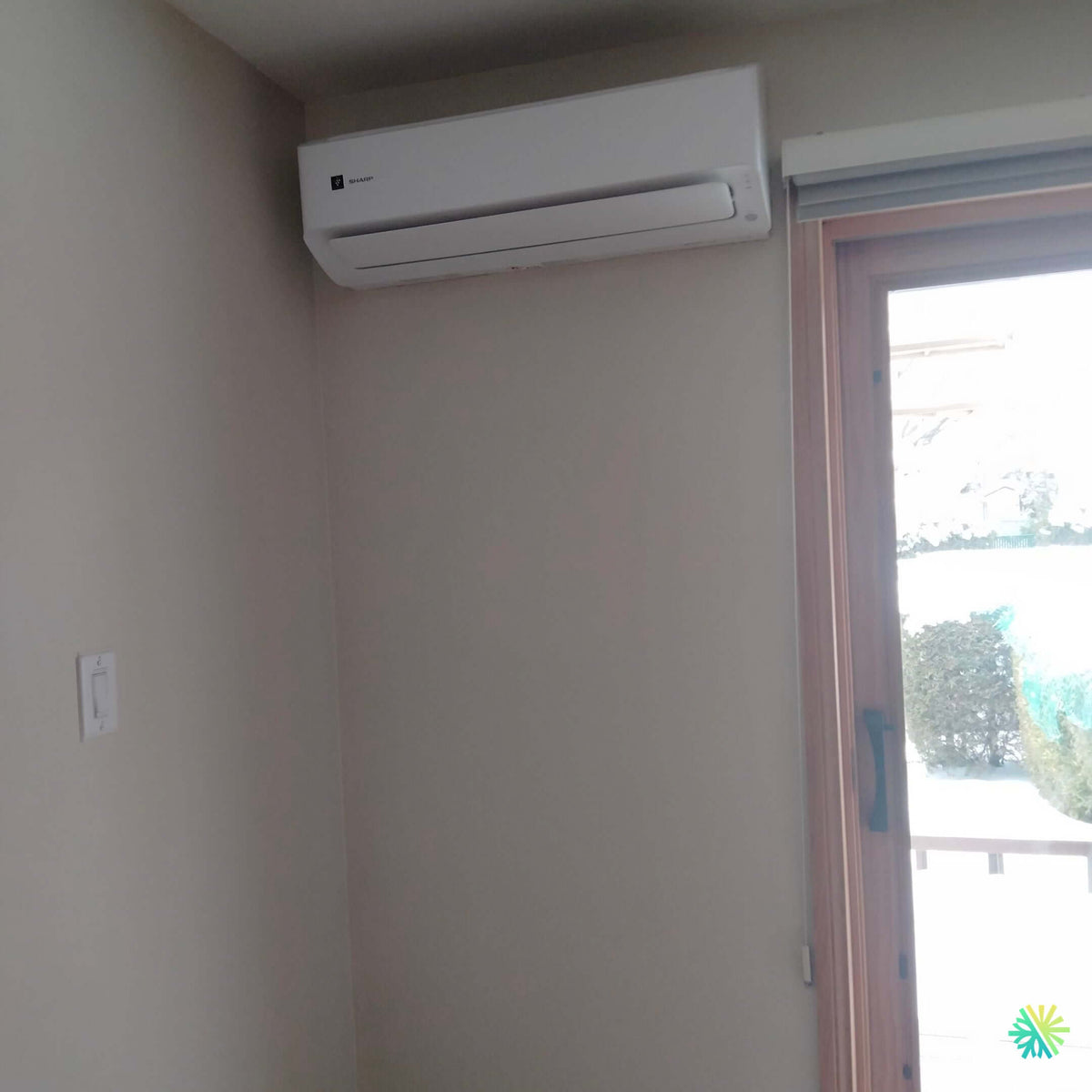
At AirGreen , we recently completed the installation of a Sharp ZU1 wall-mounted heat pump in a residence in the Rosemont–La Petite-Patrie neighborhood of Montreal. This project perfectly illustrates how a modern unit can transform indoor comfort, even during the city's harsh winters.
Client context and needs
Our client had recently renovated part of their home and wanted to add an energy-efficient HVAC system capable of providing both heating and cooling. The main challenge was installing an efficient unit in a room with a large patio door, a space often prone to heat loss and temperature fluctuations.
Device choice: the Sharp ZU1
The Sharp ZU1 is one of the new generation of R-32 wall-mounted heat pumps , renowned for their energy efficiency and performance down to -25 °C. The version installed here, with a capacity of 12,000 BTU, is perfectly suited for medium-sized rooms, offering an ideal balance between power and energy efficiency.
Among its advantages:
-
R-32 technology is more environmentally friendly than R-410A, reducing environmental impact.
-
Stable heating capacity even in the middle of a Montreal winter.
-
Silent mode , ideal for a living space adjacent to a door opening onto the terrace.
-
Eligibility for provincial subsidies (Hydro-Québec LogisVert, Maisons Plus Vertes program), thanks to its Energy Star certification and its performance in cold climates.
Installation Steps
The wall unit was installed at a strategic height, above the patio door, to optimize air diffusion throughout the room.
-
Discreet wall drilling for the passage of refrigeration connections.
-
Gravity route for condensate drainage, thus avoiding the installation of an additional pump.
-
White capping to match the wall color, ensuring an aesthetic and discreet finish.
-
Outdoor condenser positioned in a recess, with adequate clearance to ensure optimal airflow even in winter, including clearance from accumulated snow.
Challenges and solutions
The presence of a large glass door presented a challenge: we had to position the heat pump without obstructing access or compromising efficiency. We therefore:
-
Prefer side wall mounting, avoiding any interference with the door opening.
-
Checked the partition insulation to ensure it was watertight after drilling.
-
Adjust the installation height to ensure even distribution of hot and cold air throughout the space.
Results obtained
From the moment it was commissioned, the residence benefited from increased comfort. The client noticed a rapid increase in temperature despite the cold outside and a significant reduction in noise compared to his previous auxiliary heating. The optimized energy consumption of the Sharp ZU1 will allow him to reduce his bills while enjoying a stable and pleasant indoor climate.
Why choose AirGreen for your HVAC installation in Montreal
At AirGreen, we combine technical expertise, in-depth knowledge of local grants, and attention to aesthetic detail. Our wall-mounted heat pump installations in neighborhoods like Rosemont, Laval, Longueuil, the North Shore, and the South Shore demonstrate our ability to adapt each project to the unique constraints of each home.
Our customers benefit from:
-
Complete support in selecting the model suited to their needs.
-
Installation by a certified team, respecting RBQ standards.
-
Optimization of technical routes (refrigeration lines, drainage, supports).
-
Privileged access to available financing programs and grants.
Towards sustainable four-season comfort
The installation of this Sharp ZU1 in Rosemont demonstrates how a well-chosen and properly installed appliance improves comfort while reducing the energy footprint. Thanks to our team's precision, every detail—from the choice of drilling to optimal positioning—contributes to maximum performance and customer satisfaction.
How it goes, from the first call to the end
The main steps of this kind of job at AirGreen. Every house has its quirks: the estimate brings them out.
We look at the room, the outside wall, the line route and where the outdoor unit will go. That is where the capacity gets chosen.
Model, capacity and price, in writing. We also check whether the model qualifies for assistance programs.
Floors and furniture protected, wall plate position marked level, wall opening located.
A single opening, with the slope the drain needs to flow outside.
Set on a stand raised above the snow, with the clearances the manufacturer requires.
Connected, insulated and protected. The opening is then sealed against water, cold air and insects.
A dedicated circuit and an accessible disconnect near the outdoor unit.
Leak test, vacuum, then start-up and a check of heating and cooling.
Remote, modes, filters: we show you the essentials before we leave.
- The on-site estimateWe look at the room, the outside wall, the line route and where the outdoor unit will go. That is where the capacity gets chosen.
- The quoteModel, capacity and price, in writing. We also check whether the model qualifies for assistance programs.
- Getting readyFloors and furniture protected, wall plate position marked level, wall opening located.
- The wall openingA single opening, with the slope the drain needs to flow outside.
- The outdoor unitSet on a stand raised above the snow, with the clearances the manufacturer requires.
- Lines, cable and drainConnected, insulated and protected. The opening is then sealed against water, cold air and insects.
- The electrical workA dedicated circuit and an accessible disconnect near the outdoor unit.
- Tests and start-upLeak test, vacuum, then start-up and a check of heating and cooling.
- The walkthroughRemote, modes, filters: we show you the essentials before we leave.
What the unit delivers when it is cold
The range as published on airgreen.ca: pick a size to see its capacity in deep cold.
| Size | Heating at −8 °C | Heating at −15 °C | Coldest certified point | COP at −15 °C | SEER | HSPF | Indicative LogisVert aid |
|---|---|---|---|---|---|---|---|
| Sharp ZU1 12 000 | 14,500 | 12,000 | −27 °C: 7,200 | 2.11 | 22.0 | 11.0 | $1,740 |
| Sharp ZU1 15 000 | 18,100 | 15,300 | −27 °C: 10,100 | 2.1 | 24.0 | 11.0 | $2,172 |
| Sharp ZU1 18 000 | 22,000 | 18,000 | −27 °C: 11,500 | 2.2 | 24.0 | 11.0 | $2,640 |
| Sharp ZU1 24 000 | 22,400 | 19,000 | −27 °C: 12,300 | 2.2 | 22.0 | 11.0 | $2,688 |
According to NEEP, it delivers 14,500 BTU/h at −8 °C (17 °F), more than at 8 °C (14,000 BTU/h). It heats as hard in moderate cold as in mild weather.
According to NEEP, its certified maximum capacity at −27 °C (−17 °F) is 7,200 BTU/h, 60% of its nominal 12,000 BTU size.
At 8 °C, its certified maximum capacity reaches 17,100 BTU/h, 42% more than its nominal 12,000 BTU size.
According to NEEP, it delivers 18,100 BTU/h at −8 °C (17 °F), more than at 8 °C (18,000 BTU/h). It heats as hard in moderate cold as in mild weather.
According to NEEP, its certified maximum capacity at −27 °C (−17 °F) is 10,100 BTU/h, 67% of its nominal 15,000 BTU size.
At 8 °C, its certified maximum capacity reaches 21,800 BTU/h, 45% more than its nominal 15,000 BTU size.
According to NEEP, it delivers 22,000 BTU/h at −8 °C (17 °F), more than at 8 °C (21,600 BTU/h). It heats as hard in moderate cold as in mild weather.
According to NEEP, its COP at −27 °C is 1.88: the highest of the ZU1 line, which ranges from 1.79 to 1.82 at that temperature.
According to NEEP, its certified maximum capacity at −27 °C (−17 °F) is 11,500 BTU/h, 64% of its nominal 18,000 BTU size.
At −27 °C, its certified minimum capacity is 3,200 BTU/h (5,500 at 8 °C). It slows down instead of cycling on and off.
According to NEEP, its certified heating capacity at −15 °C (5 °F) is 19,000 BTU/h, 79% of its nominal 24,000 BTU size. Its COP there is 2.20.
Data read live from the airgreen.ca page of each size (NEEP / AHRI certified performance). When the title names the installed size, it is highlighted; otherwise the whole range is shown. The aid shown is today’s, using Hydro-Québec’s rule ($120 per 1,000 BTU/h at −8 °C); amounts quoted in the article date from its publication. Only Hydro-Québec confirms the assistance granted.
And at your place?
Two quick checks with real numbers: what heat costs, and what your current heaters add up to in BTU/h.
Baseboards and electric furnaces turn 1 kWh of electricity into 1 kWh of heat. A heat pump delivers more: that is its COP. At Hydro-Québec’s rate D (11.142¢/kWh above 40 kWh a day, since 1 April 2026):
Hydro-Québec: a heat pump can be up to three times more efficient than baseboards for heating in the colder months.
Estimate per kWh of heat, at the chosen temperature, using the certified COP from the product page. Taxes, access charge and backup heat not included.
Conversion: 1 W = 3.412 BTU/h. An indication, not a load calculation: baseboards and furnaces are often stronger than the real need, and they can stay as backup. AirGreen confirms the capacity on site.
What to do, season by season
Three habits per season for this unit. They take a few minutes and prevent many calls.
- Clean the indoor unit's filters.
- Clear leaves and debris left on the outdoor unit by winter.
- Test cooling before the first hot days.
- Clean the filters more often when the unit runs a lot.
- Keep plants away from the outdoor unit.
- Check that no water drips from the indoor unit.
- Rake the leaves around the outdoor unit.
- Test heating before the first cold days.
- Book periodic maintenance before winter.
- Keep snow away from the stand and the front of the unit.
- Let the unit defrost: it is normal.
- Never hit the ice on the fins; call us if the unit stays iced up.
Which type of equipment for your project?
Pick what looks like your need.
Four mistakes we do not make
Flip each card to see what we do instead.
What people ask us about this kind of work
Does a wall-mounted heat pump heat in winter?
Wall-mounted or multi-zone: how do I choose?
Where does the outdoor unit go?
Are there grants?
Do I need a permit?
How cold can it heat?
How much can I save?
How is the LogisVert assistance calculated?
Is it noisy?
The outdoor unit is covered in ice: is that normal?
Does AirGreen hold the required licences?
Is the estimate free?
No question matches. Write to us: we answer.
Useful pages for what comes next
More jobs to see, near you
By town, by equipment or by region: browse more than 4,700 published projects.
Each dot: a town where AirGreen has published projects. The glowing dot: this job.
Tell us about your house. We come and see it for free.
The on-site estimate is free and the quote follows within 24 hours.
Text and photo: a real AirGreen Climatisation & Chauffage job. The diagrams are generic illustrations of the type of installation, not a survey of this job site. Sources of the added figures: airgreen.ca product pages (NEEP / AHRI performance), Hydro-Québec (Heat pumps page, LogisVert, read on 13 October 2026), Régie de l’énergie (rate D as of 1 April 2026).