
GREE Central Heat Pump Installation in Plateau-Mont-Royal, Montreal: Strategic Replacement and Careful Integration in a Densely Populated Residential Area
AirGreen installs a GREE central heat pump in Plateau-Mont-Royal: meticulous integration, Inverter technology, centralized comfort, and HVAC expertise for Montreal, Laval, Longueuil, North Shore, and South Shore.
- City
- Region
- Equipment
- Brand
- Challenges
- Published
The job on one screen
The article, chapter by chapter
An HVAC System Designed for the Comfort of a Typical Plateau Montreal Home
In Plateau-Mont-Royal, central heating and air conditioning projects rarely require a standard approach. Between semi-detached houses, renovated plexes, narrow backyards, brick walls, basement windows, access constraints, and the frequent presence of existing equipment, each intervention demands a precise understanding of the building. It is precisely in this context that AirGreen installed a GREE central heat pump for a residence located in this iconic sector of Montreal.
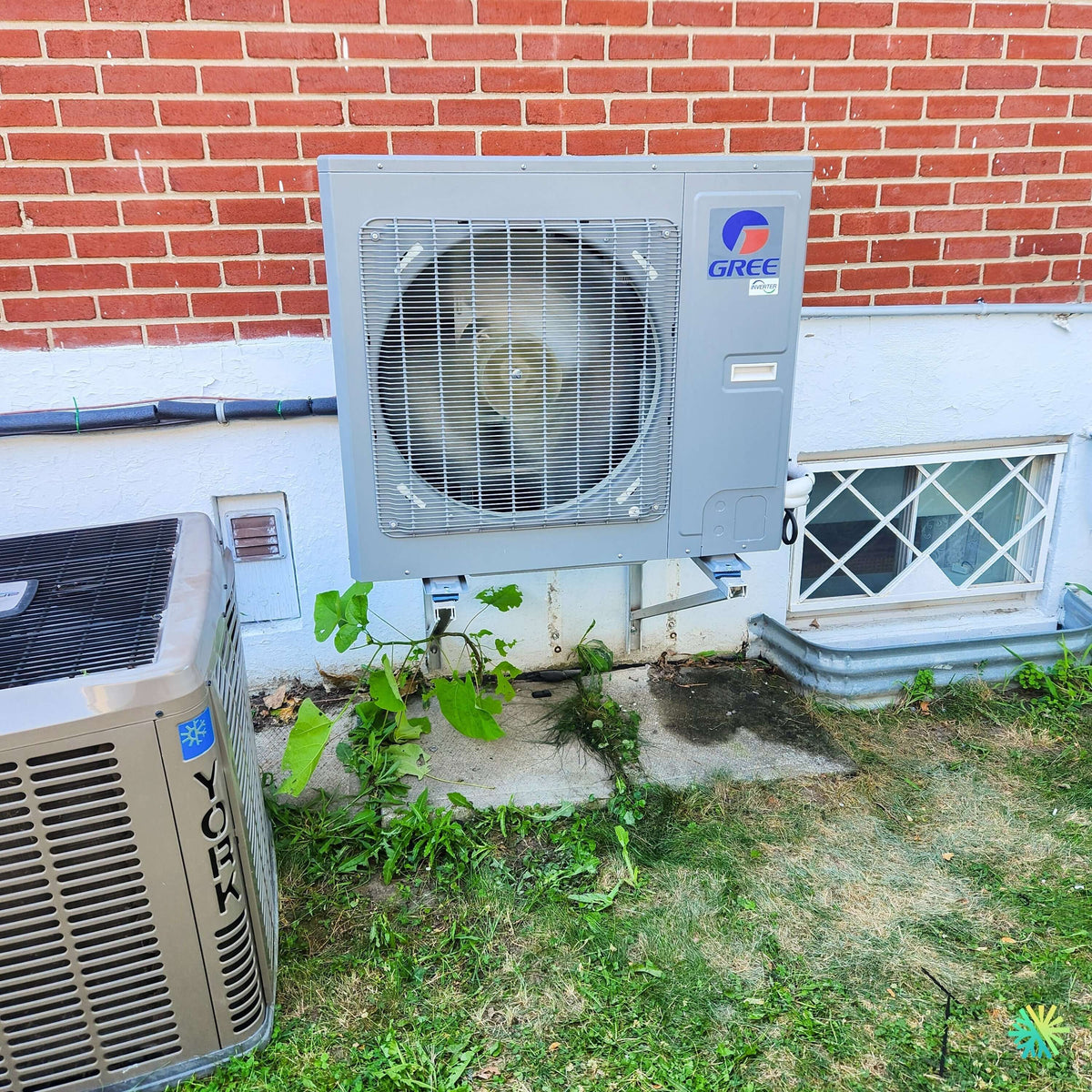
The project photo clearly shows the GREE Inverter outdoor unit, installed on robust metal wall brackets, in front of a red brick wall and above a ground clearance where plants and a basement window are located. To the left, an old York unit is still visible, which clearly illustrates the type of transition we often encounter: modernizing an existing system, improving energy efficiency, optimizing indoor comfort, and integrating a new HVAC solution without compromising the available space around the house.
This installation is not just about placing an outdoor unit. It involves several essential elements: choosing the right equipment, managing clearances, the quality of refrigerant connections, mechanical protection of pipes, unit positioning, structural stability, vibration reduction, accessibility for HVAC maintenance, and compliance with best practices applicable to heat pump systems in Quebec.
Why a GREE Central Heat Pump is a Relevant Choice in Plateau-Mont-Royal
A central heat pump is particularly suitable for residences that already have a duct network or a central furnace that can be integrated into a more efficient heating and air conditioning solution. Unlike a wall-mounted air conditioner or a single-zone wall unit, a central heat pump distributes conditioned or heated air to multiple rooms from a centralized system.
In a neighborhood like Plateau-Mont-Royal, this approach offers several concrete advantages:
- More uniform temperature in main rooms.
- Better integration with an existing ventilation or air distribution system.
- A discreet solution inside the house.
- Potential reduction in reliance on more expensive heating methods.
- Better comfort management during intense heat periods in Montreal.
- Significant heating capacity for much of the cold season.
GREE's Inverter technology, visible on the installed outdoor unit, allows the compressor to modulate its operation rather than simply cycling on and off. This modulation helps reduce temperature fluctuations, improve comfort, and limit electricity consumption peaks when the system is properly sized and installed.
An Outdoor Environment That Required Precision
The positioning of the outdoor unit is one of the most important aspects of this project. In many areas of Montreal, and particularly in the Plateau, lateral or rear spaces are often limited. Here, the unit had to be installed near a brick wall, above ground level, while respecting the ventilation needs around the appliance.
Installation on wall brackets allowed the unit to be elevated from the ground. This method offers several advantages:
- It limits direct exposure to snow accumulation.
- It reduces risks associated with standing water or ground debris.
- It facilitates clearance around the equipment.
- It helps preserve usable outdoor space.
- It provides better stability when the ground is not ideal for a ground-level base.
In this specific case, the installation also had to consider the nearby basement window. A poorly positioned outdoor unit can hinder access to a window, reduce natural light, complicate future maintenance work, or generate acoustic discomfort. Our team therefore took care to align the unit to maintain a clean, accessible, and coherent setup with the existing architecture.
Management of Refrigerant Lines and Exterior Finishing
The photo also shows the protected pipes routed horizontally along the wall. This part of the work is often underestimated by clients, but it directly influences the durability of the HVAC installation.
A refrigerant line must be:
- correctly insulated;
- protected against weather;
- securely fastened;
- routed with appropriate bends;
- installed to limit mechanical stress;
- accessible for future inspection;
- neatly integrated into the exterior of the building.
In a central heat pump project, the quality of the connection between the outdoor unit and the indoor equipment is fundamental. Poor insulation, a kink in the pipe, lack of protection, or improper water drainage can lead to performance losses, noise, unwanted condensation, or premature wear of certain components.
At AirGreen, we pay particular attention to these details because they make the difference between an installation that is functional on day one and one that is reliable year after year.
The Presence of the Old York System: An Important Detail
The old York unit visible in the photo highlights a frequent reality in our projects in Montreal, Laval, Longueuil, on the North Shore, and the South Shore: many owners want to improve their comfort without starting completely from scratch.
In some cases, it's a complete replacement. In others, the new heat pump is integrated into an existing configuration after evaluating the indoor components, ductwork, electrical supply, required heating capacity, and the overall condition of the current system.
Before recommending a GREE central heat pump, we particularly check:
- the area to be heated and cooled;
- the building's insulation;
- the room configuration;
- the condition of the ducts;
- compatibility with the indoor unit or existing cabinet;
- electrical requirements;
- the necessary BTU capacity;
- exterior clearances;
- the client's expectations regarding noise, comfort, and consumption.
This analysis avoids common mistakes, such as oversizing or undersizing. A heat pump that is too small will work too hard and may not meet needs during temperature extremes. A heat pump that is too large can lead to short cycling, reduce comfort, and affect humidity management during cooling.
The Practical Advantages of a Central Heat Pump in a Plateau Home
Plateau-Mont-Royal contains several types of buildings: renovated houses, duplexes, triplexes, ground floors with basements, open-plan floors, rear extensions, and properties whose mechanical systems have been modified over the years. In this context, a central heat pump can offer a very effective solution, especially when the air distribution network is already present or can be adapted.
For the client, the benefits are tangible:
- more stable comfort throughout the house;
- effective air conditioning during humid periods;
- economical heating for much of the winter;
- quieter operation than old, aging equipment;
- better added value to the property;
- reduced reliance on auxiliary heating appliances;
- simpler control from a central thermostat.
The GREE brand is often appreciated for its excellent balance of performance, technology, and accessibility. For many residential projects, we use it when the client is looking for a reliable solution, well-suited to the Quebec climate, and capable of meeting heating and cooling needs with modern technology.
A Clean Outdoor Installation Despite Site Constraints
The exterior finish is particularly important in a neighborhood like Plateau-Mont-Royal, where facades, backyards, and brick walls are part of the building's aesthetic. Even when a unit is installed in a technical or less visible area, we always strive for a clean and orderly result.
In this project, several elements are worth highlighting:
- the unit is elevated from the ground thanks to metal supports;
- the mounting brackets are well aligned;
- the pipes are grouped and protected;
- front access to the unit remains available for maintenance;
- clearance around the fan allows for adequate air circulation;
- the location avoids unnecessarily cluttering the ground area.
This kind of detail may seem simple, but it reflects a professional approach. A poorly designed outdoor installation can complicate future services, promote dirt accumulation around the unit, or impair thermal performance. A well-executed HVAC installation, on the contrary, facilitates maintenance, protects the equipment, and improves the owner's experience.
Mistakes to Avoid When Installing a Central Heat Pump
Many homeowners compare prices of central heat pumps without always comparing the actual quality of the installation. However, a system's performance depends as much on the installation as on the equipment chosen.
Here are the most common mistakes we observe in the field:
Choosing Based Solely on Price
A lower price can hide shortcuts: inadequate supports, poorly protected pipes, insufficient insulation, incomplete start-up, lack of existing network verification, or poor electrical coordination. A central heat pump is a significant investment; it must be installed to last.
Neglecting Outdoor Clearances
An outdoor unit needs air. If it is too close to a wall, fence, hedge, another appliance, or a window, its performance can decrease. Noise can also become more noticeable.
Poorly Evaluating the Ductwork
A high-performance appliance will not yield good results if the ducts are undersized, obstructed, leaky, or unbalanced. Air must circulate properly to ensure uniform distribution throughout the house.
Installing Without Considering Future Maintenance
A unit that is difficult to access often costs more to maintain and can be neglected over time. Access to the service panel, connections, and fan should always be considered.
Forgetting Drainage and Winter Conditions
A heat pump used for heating produces defrosting. Water must be able to drain properly. In Quebec, snow, ice, and freeze-thaw cycles must be anticipated during installation.
The AirGreen Approach: Diagnosis, Execution, and Follow-up
For this project in Plateau-Mont-Royal, our team applied the same method as for our installations in Montreal, Laval, Longueuil, on the North Shore and South Shore: understanding the building before proposing a solution.
Our work always begins with a technical evaluation. We observe the existing location, mechanical constraints, interior configuration, electrical supply, client expectations, and comfort objectives. Then, we propose a realistic solution, adapted to the house and the budget.
The installation itself is carried out by qualified technicians, accustomed to the constraints of Montreal buildings. In a dense sector like the Plateau, experience counts enormously: restricted access, close neighbors, old walls, exterior finishes to respect, schedules to coordinate, and the need to leave the premises clean at the end of the work.
After installation, commissioning is a key step. We check the system's operation, basic parameters, outdoor unit behavior, thermostat response, and overall comfort. The client also receives practical advice for daily use, filter maintenance, signs to watch for, and planning regular HVAC maintenance.
Grants and Eligibility: A Point to Check Before Purchase
Certain central heat pumps may be eligible for financial assistance programs based on their characteristics, energy efficiency, certification, and current criteria at the time of installation. Programs such as LogisVert or other energy efficiency initiatives may evolve, and amounts vary depending on the exact model, capacity, and administrative requirements.
At AirGreen, we support our clients in this step by providing the necessary technical information, detailed invoices, and useful information to facilitate the process. However, it is essential to confirm the eligibility of the specific model before committing, as not all central heat pumps automatically qualify for the same amounts.
For an owner in Plateau-Mont-Royal, this verification can make a real difference in the net cost of the project. That's why we always integrate the question of grants into the initial discussion, especially when it comes to a replacement or a significant energy improvement.
A Result That Combines Performance, Integration, and Durability
This installation of a GREE central heat pump in Plateau-Mont-Royal perfectly illustrates what we at AirGreen are looking for: a solid technical solution, a clean outdoor integration, and a tangible improvement in residential comfort.
The client now benefits from a modern system, designed to offer better temperature control, improved operational efficiency, and a solution better suited to current heating and air conditioning requirements. The GREE outdoor unit, well-positioned and securely fastened, advantageously replaces an older approach and is part of a modernization effort for the house's HVAC system.
Through this project, we find the elements that define our work: attention to detail, understanding of the building, respect for site constraints, clear explanation to the client, and quality of execution.
Practical advice for homeowners considering a central heat pump
Before choosing a central heat pump, we always recommend taking the time to evaluate several points:
- Request a technical visit rather than an approximate remote price.
- Check compatibility with the existing ductwork system.
- Confirm the required capacity based on the house, not just the surface area.
- Compare the quality of the installation, not just the brand.
- Plan for an outdoor location that respects clearances.
- Check electrical requirements.
- Confirm eligibility for grants before installation.
- Plan regular maintenance to preserve performance.
A well-chosen and well-installed central heat pump can transform a home's comfort. Conversely, a good unit poorly installed can quickly disappoint. This is why we favor a rigorous approach, from the first estimate to the final commissioning.
At AirGreen, we perform installations of heat pumps, central air conditioners, wall-mounted air conditioners, multi-zone systems, and complete HVAC solutions in Montreal, Laval, Longueuil, on the North Shore, and the South Shore. Each project is handled according to its real constraints, with particular attention to performance, durability, and customer satisfaction.
The job tools
Two quick checks with real numbers: what heat costs, and what your current heaters add up to in BTU/h.
Conversion: 1 W = 3.412 BTU/h. An indication, not a load calculation: baseboards and furnaces are often stronger than the real need, and they can stay as backup. AirGreen confirms the capacity on site.
How the job unfolds
The main steps of this kind of job at AirGreen. Every house has its quirks: the estimate brings them out.
We look at the ducts, the current indoor module, the electrical panel and the planned spot for the outdoor unit.
The equipment combination, capacity and price, in writing. We check whether the combination qualifies for assistance programs.
Access protected, old unit disconnected and removed when it is being replaced.
Electric furnace or air handler, with its coil, connected to the supply and return ducts.
On a level base, raised above the snow, with free space all around.
Insulated, they enter through a sealed opening and run to the indoor coil.
Dedicated circuits, accessible disconnect, a thermostat that works with the heat pump and the backup heat.
Leak test, vacuum, start-up, airflow check and a test of both modes.
Filter, thermostat, backup heat in extreme cold: what to know before winter.
- The on-site estimateWe look at the ducts, the current indoor module, the electrical panel and the planned spot for the outdoor unit.
- The quoteThe equipment combination, capacity and price, in writing. We check whether the combination qualifies for assistance programs.
- Getting readyAccess protected, old unit disconnected and removed when it is being replaced.
- The indoor moduleElectric furnace or air handler, with its coil, connected to the supply and return ducts.
- The outdoor unitOn a level base, raised above the snow, with free space all around.
- The refrigerant linesInsulated, they enter through a sealed opening and run to the indoor coil.
- Electrical and thermostatDedicated circuits, accessible disconnect, a thermostat that works with the heat pump and the backup heat.
- Tests and start-upLeak test, vacuum, start-up, airflow check and a test of both modes.
- The walkthroughFilter, thermostat, backup heat in extreme cold: what to know before winter.
What we check on a job like this one
Each number is a point we check on site. Switch between summer and winter to watch air and heat move.
In summer, the outdoor unit rejects the house's heat outside.
Generic illustration of this type of installation, not a survey of this job site. Tap a number.
It captures or rejects heat outside. It sits on a level base, above the snow, with free space all around.
The insulated refrigerant lines enter the house through a sealed opening and run to the indoor coil.
A shut-off switch near the outdoor unit isolates it safely for service.
Sitting on the indoor module, it moves heat between the house air and the refrigerant.
Electric furnace or air handler: its fan pushes air through the ducts. The electric backup takes over in extreme cold.
Supply ducts bring air to the rooms; returns bring it back to the unit. Their condition matters as much as the unit's.
It protects the coil and the fan. A dirty filter cuts airflow, so it gets checked regularly.
It runs the heat pump and the backup heat. It must be compatible with the installed system.
Is your home ready?
Check what applies at your place. A "no" is not a refusal: it is what we sort out during the estimate.
Good habits, once the unit is in place
Six simple habits that keep the unit going. Your list stays on this device.
What to do, season by season
Three habits per season for this unit. They take a few minutes and prevent many calls.
- Check the indoor module's filter.
- Clear winter debris from the outdoor unit.
- Test cooling before the heat arrives.
- Check the filter more often in peak season.
- Keep registers and returns clear.
- Watch condensate drainage near the coil.
- Change or clean the filter.
- Test heating and backup heat before the cold.
- Book periodic maintenance.
- Clear snow around the outdoor unit.
- Store nothing in front of the indoor module.
- Note any unusual noise or smell and call us.
The right pages, at the right time
Four statements: true or false?
It all comes down to details you have just seen.
1. A central heat pump uses the house's ducts.
It connects to the existing ducts to heat and cool everywhere.
2. In extreme cold, electric backup heat can take over.
The indoor module (furnace or air handler) works with the heat pump and takes over in extreme cold.
3. The filter only gets changed when the unit breaks down.
A dirty filter cuts airflow. It gets checked regularly.
4. You can reuse the old unit's size without checking.
The house may have changed: insulation, windows, added rooms. Capacity is confirmed on site.
0 / 4 right answers
What people ask us about this kind of work
Can I keep my current ducts?
What happens in extreme cold?
Furnace, air handler, ducted: what is the difference?
Are there grants?
Do I need a permit?
How much can I save?
How is the LogisVert assistance calculated?
Will my current thermostat work?
Central or wall units: which one?
Does AirGreen hold the required licences?
Is the estimate free?
No question matches. Write to us: we answer.
More jobs to see, near you
By town, by equipment or by region: browse more than 4,700 published projects.
Each dot: a town where AirGreen has published projects. The glowing dot: this job.
An on-site estimate, the right capacity, the right equipment.
The on-site estimate is free and the quote follows within 24 hours.
Text and photo: a real AirGreen Climatisation & Chauffage job. The diagrams are generic illustrations of the type of installation, not a survey of this job site. Sources of the added figures: airgreen.ca product pages (NEEP / AHRI performance), Hydro-Québec (Heat pumps page, LogisVert, read on 13 October 2026), Régie de l’énergie (rate D as of 1 April 2026).