
Installation of a Midea central heat pump in Blainville
AirGreen installed a Midea central heat pump on a single-family home in Blainville, with a raised condenser on wall brackets, connection to the existing ductwork system and complete commissioning to provide the owner with 4-season comfort and sustainable energy savings.
In summer, the outdoor unit rejects the house's heat outside.
Generic illustration of this type of installation, not a survey of this job site. Tap a number.
It captures or rejects heat outside. It sits on a level base, above the snow, with free space all around.
The insulated refrigerant lines enter the house through a sealed opening and run to the indoor coil.
A shut-off switch near the outdoor unit isolates it safely for service.
Sitting on the indoor module, it moves heat between the house air and the refrigerant.
Electric furnace or air handler: its fan pushes air through the ducts. The electric backup takes over in extreme cold.
Supply ducts bring air to the rooms; returns bring it back to the unit. Their condition matters as much as the unit's.
It protects the coil and the fan. A dirty filter cuts airflow, so it gets checked regularly.
It runs the heat pump and the backup heat. It must be compatible with the installed system.
In Blainville, on Montreal's North Shore, a growing number of single-family homeowners are looking to replace their traditional heating systems with more efficient and environmentally friendly solutions. In this project, our team completed the installation of a Midea central heat pump in a home with a basement, ensuring year-round comfort while reducing electricity bills.
The client's need: to replace an energy-intensive system
The owner of this Blainville house already had a hot air duct system. His primary heating system relied on an energy-inefficient electric source, combined with an aging central air conditioner. His objectives were clear:
-
Modernizing the installation without redoing the entire air distribution system
-
Reduce your energy consumption while improving comfort
-
Benefit from a reliable heating and air conditioning system
-
Preserve the exterior aesthetics of the house and the accessibility of the basement
We recommended the installation of a recent Midea central heat pump , perfectly compatible with a ducted indoor air manager, to transform his existing system into a high-efficiency 4-season solution.
The chosen solution: Midea central heat pump, high energy efficiency
For this project, we installed a new generation Midea central heat pump , designed to operate efficiently in the Quebec climate. Coupled with an indoor air handler, it ensures:
-
Air conditioning for the entire house during the summer
-
Efficient and economical heating for much of the winter
-
Power modulation allows capacity to be adjusted according to actual needs.
-
Quiet operation, both indoors and outdoors
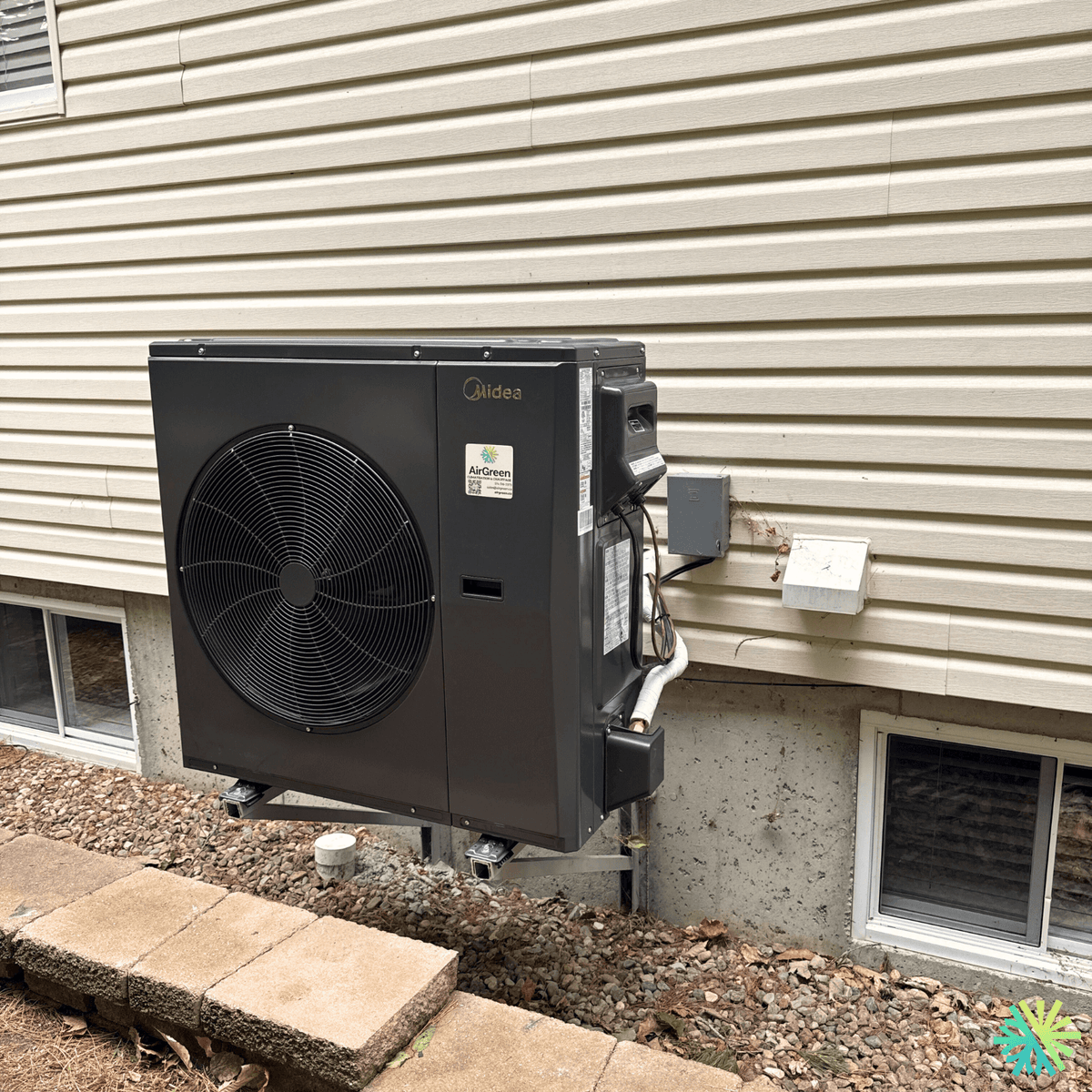
The Midea outdoor compressor, clearly visible in the photo, supplies the entire existing ductwork system. Heat (or cold) is thus distributed evenly throughout all rooms: living room, kitchen, bedrooms, and basement.
Installation details: a Midea condenser perfectly integrated into the home
The photo shows the Midea condenser installed on the side wall of the house:
-
Mounting on raised wall brackets
-
The unit is mounted on a solid metal support , anchored in the concrete foundation.
-
This elevated installation allows for:
-
Clear the unit from the ground to prevent the accumulation of snow and ice.
-
Protect the device from moisture and debris
-
Facilitate access for maintenance and service
-
-
-
Land and drainage management
-
The house is surrounded by a bed of decorative stones along the foundation. This permeable area contributes to good drainage of rainwater and condensation , without splashing onto the vinyl siding.
-
A small border of concrete blocks delimits the passage and allows for clean access to the condenser.
-
-
Positioning in relation to the windows
-
The Midea condenser is installed between two basement windows , respecting the minimum safety and ventilation distances.
-
This avoids blowing air directly onto the openings and limits the transmission of noise into the interior.
-
-
Refrigeration connections and insulation
-
The insulated refrigeration pipes are carefully routed to the wall and protected in a sheath.
-
The wall penetration is watertight and well sealed to prevent air or moisture infiltration.
-
Insulating the lines helps to minimize heat loss in heating mode.
-
-
Electrical connection compliant
-
To the right of the unit, you can see the external disconnect box , which is mandatory for any central system.
-
This box allows for quick power cut-off during an intervention and ensures the installation complies with the Quebec Electrical Code.
-
The cabling is discreet and follows the foundation, without detracting from the aesthetics of the facade.
-
-
Noise and vibration reduction
-
Anti-vibration pads are installed under the condenser feet to limit the transmission of vibrations to the structure.
-
The operation of the heat pump thus remains very discreet , both for the occupants and for the neighborhood.
-
Interior integration: a house fully served by the central heat pump
Inside, the Midea central heat pump is connected:
-
To a compatible air handler , which replaces or supplements the old furnace
-
The existing ductwork system allows for the supply of hot or cold air to all rooms.
-
A programmable wall thermostat , allowing the customer to easily manage temperatures according to the time of day
This configuration offers several advantages:
-
Uniform comfort : no more rooms that are too hot in summer or too cold in winter.
-
Ease of use : a single integrated system for heating and air conditioning.
-
Energy saving : the heat pump recovers heat from outside in winter and expels heat from inside in summer with high efficiency.
Winter performance in Blainville
Blainville's climate is typical of the North Shore: cold winters, heavy snowfall, and frequent temperature fluctuations. The Midea central heat pump installed in this house is designed to:
-
To provide stable and comfortable heating for most of the winter
-
Significantly reduce the consumption of older electrical systems alone
-
Operates reliably even in extreme cold , with optimized defrost cycles.
On the most extreme days, the heat pump can be supported by an electric backup integrated into the air handler, thus ensuring constant comfort throughout the house.
A sustainable investment for the owner
Thanks to this installation, the owner now benefits from:
-
A modern 4-season system for his entire property
-
An expected reduction in energy costs , particularly in winter
-
Offering a superior level of comfort , with a more stable and consistent temperature
-
The increased resale value of his home, thanks to the presence of a recently installed Midea central heat pump, has increased its resale value.
-
A device installed according to best practices, ready to be maintained and monitored for many years
AirGreen, your partner for Midea central heat pumps on the North Shore and in Greater Montreal
At AirGreen, we support homeowners in Blainville, Terrebonne, Laval, and throughout Greater Montreal with their heating and air conditioning modernization projects. For every Midea central heat pump installation, we:
-
Let's carry out a detailed assessment of the house's thermal load.
-
We recommend the right capacity and equipment configuration
-
Let's plan an optimal route for the outdoor condenser and connections.
-
We ensure a complete commissioning , including performance testing and explanations to the client.
-
We offer after-sales and maintenance services to ensure the longevity of the installation.
If you also wish to transform your existing system into a high-efficiency Midea central solution , our team will be happy to study your project and offer you a tailor-made installation.
How it goes, from the first call to the end
The main steps of this kind of job at AirGreen. Every house has its quirks: the estimate brings them out.
We look at the ducts, the current indoor module, the electrical panel and the planned spot for the outdoor unit.
The equipment combination, capacity and price, in writing. We check whether the combination qualifies for assistance programs.
Access protected, old unit disconnected and removed when it is being replaced.
Electric furnace or air handler, with its coil, connected to the supply and return ducts.
On a level base, raised above the snow, with free space all around.
Insulated, they enter through a sealed opening and run to the indoor coil.
Dedicated circuits, accessible disconnect, a thermostat that works with the heat pump and the backup heat.
Leak test, vacuum, start-up, airflow check and a test of both modes.
Filter, thermostat, backup heat in extreme cold: what to know before winter.
- The on-site estimateWe look at the ducts, the current indoor module, the electrical panel and the planned spot for the outdoor unit.
- The quoteThe equipment combination, capacity and price, in writing. We check whether the combination qualifies for assistance programs.
- Getting readyAccess protected, old unit disconnected and removed when it is being replaced.
- The indoor moduleElectric furnace or air handler, with its coil, connected to the supply and return ducts.
- The outdoor unitOn a level base, raised above the snow, with free space all around.
- The refrigerant linesInsulated, they enter through a sealed opening and run to the indoor coil.
- Electrical and thermostatDedicated circuits, accessible disconnect, a thermostat that works with the heat pump and the backup heat.
- Tests and start-upLeak test, vacuum, start-up, airflow check and a test of both modes.
- The walkthroughFilter, thermostat, backup heat in extreme cold: what to know before winter.
And at your place?
Two quick checks with real numbers: what heat costs, and what your current heaters add up to in BTU/h.
Conversion: 1 W = 3.412 BTU/h. An indication, not a load calculation: baseboards and furnaces are often stronger than the real need, and they can stay as backup. AirGreen confirms the capacity on site.
What to do, season by season
Three habits per season for this unit. They take a few minutes and prevent many calls.
- Check the indoor module's filter.
- Clear winter debris from the outdoor unit.
- Test cooling before the heat arrives.
- Check the filter more often in peak season.
- Keep registers and returns clear.
- Watch condensate drainage near the coil.
- Change or clean the filter.
- Test heating and backup heat before the cold.
- Book periodic maintenance.
- Clear snow around the outdoor unit.
- Store nothing in front of the indoor module.
- Note any unusual noise or smell and call us.
Which type of equipment for your project?
Pick what looks like your need.
Four mistakes we do not make
Flip each card to see what we do instead.
What people ask us about this kind of work
Can I keep my current ducts?
What happens in extreme cold?
Furnace, air handler, ducted: what is the difference?
Are there grants?
Do I need a permit?
How much can I save?
How is the LogisVert assistance calculated?
Will my current thermostat work?
Central or wall units: which one?
Does AirGreen hold the required licences?
Is the estimate free?
No question matches. Write to us: we answer.
Useful pages for what comes next
More jobs to see, near you
By town, by equipment or by region: browse more than 4,700 published projects.
Each dot: a town where AirGreen has published projects. The glowing dot: this job.
Tell us about your house. We come and see it for free.
The on-site estimate is free and the quote follows within 24 hours.
Text and photo: a real AirGreen Climatisation & Chauffage job. The diagrams are generic illustrations of the type of installation, not a survey of this job site. Sources of the added figures: airgreen.ca product pages (NEEP / AHRI performance), Hydro-Québec (Heat pumps page, LogisVert, read on 13 October 2026), Régie de l’énergie (rate D as of 1 April 2026).