
Installation of a MIDEA EVOX G3 2.5 ton central heat pump in Îles-Laval: a discreet, high-performance HVAC solution adapted to Quebec winters
AirGreen installs a MIDEA EVOX G3 2.5 ton central heat pump in Îles-Laval: uniform comfort, energy efficiency, meticulous installation, and lasting HVAC expertise.
Take a tour of the installation
Each number is a point we check on site. Switch between summer and winter to watch air and heat move.
In summer, the outdoor unit rejects the house's heat outside.
Generic illustration of this type of installation, not a survey of this job site. Tap a number.
It captures or rejects heat outside. It sits on a level base, above the snow, with free space all around.
The insulated refrigerant lines enter the house through a sealed opening and run to the indoor coil.
A shut-off switch near the outdoor unit isolates it safely for service.
Sitting on the indoor module, it moves heat between the house air and the refrigerant.
Electric furnace or air handler: its fan pushes air through the ducts. The electric backup takes over in extreme cold.
Supply ducts bring air to the rooms; returns bring it back to the unit. Their condition matters as much as the unit's.
It protects the coil and the fan. A dirty filter cuts airflow, so it gets checked regularly.
It runs the heat pump and the backup heat. It must be compatible with the installed system.
A central installation designed for complete home comfort in Îles-Laval
In Îles-Laval, homes are often exposed to significant temperature variations: summer humidity near the shores, cold winter winds, sustained freezing periods, and constant heating needs for several months. For this residence, our AirGreen team carried out the installation of a 2.5-ton MIDEA EVOX G3 central heat pump, a solution designed to provide uniform comfort throughout the home while improving the energy efficiency of the existing HVAC system.
Unlike a wall-mounted heat pump or a wall-mounted air conditioner, a central heat pump works with the home's ventilation duct system. It thus allows heated or air-conditioned air to be distributed evenly across several rooms, without multiplying visible indoor units. In this project, the objective was clear: to modernize the residence's comfort with a reliable machine, properly sized and installed with particular attention to exterior details, mechanical protection, and durability.
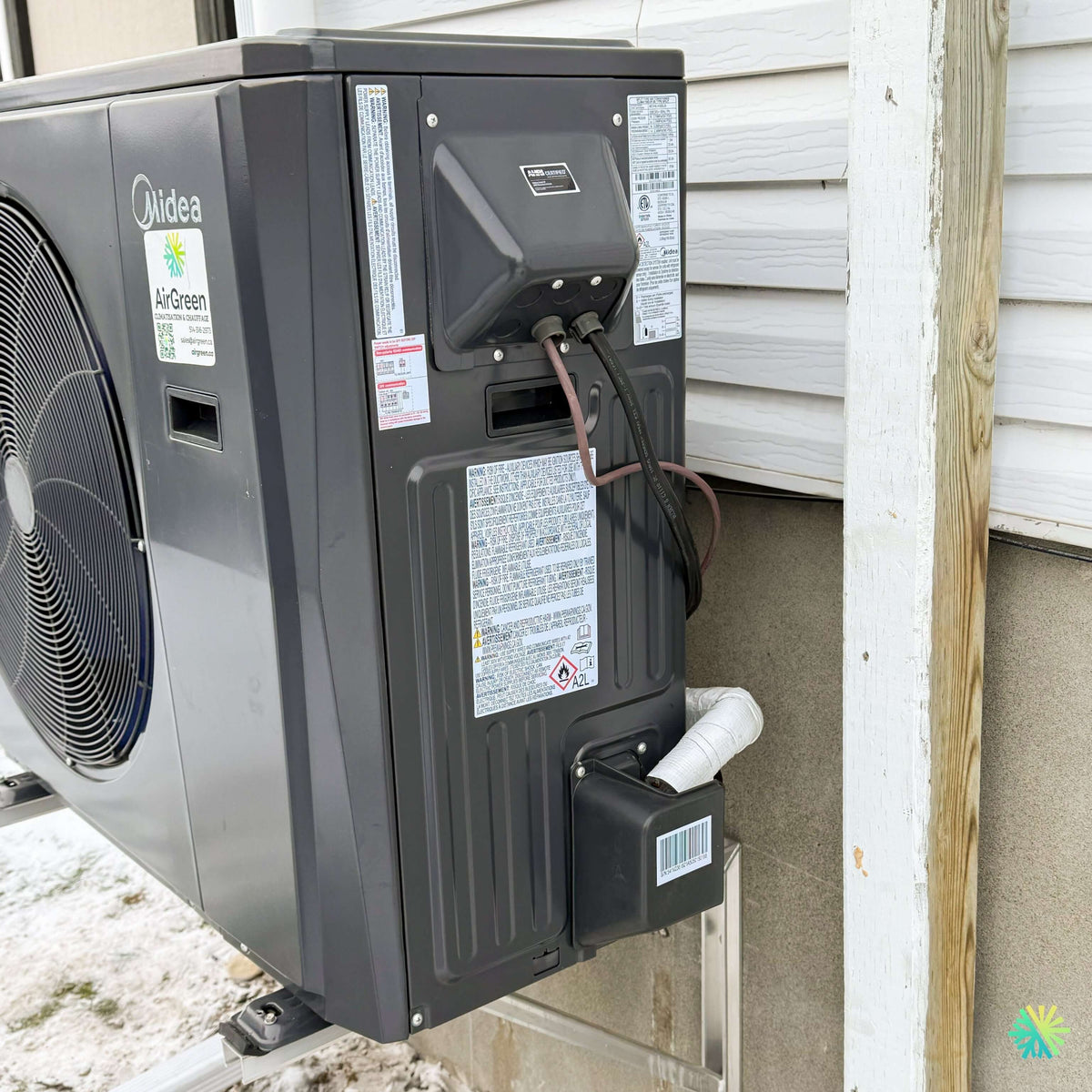
The installation photo clearly shows the MIDEA outdoor unit, securely positioned on metal supports, near the foundation wall. It also shows the care taken with connections, insulated ducts, refrigerant line routing, and system integration near the existing structure. This type of detail, often invisible to the client once the project is completed, is nonetheless essential for ensuring a durable, quiet, and easy-to-maintain HVAC installation.
Why the 2.5-ton MIDEA EVOX G3 was perfectly suited for this project
The MIDEA EVOX G3 is a central heat pump renowned for its ability to combine performance, installation flexibility, and energy efficiency. In a residence like this in Îles-Laval, the choice of a 2.5-ton model is not random. A unit that is too small would have difficulty maintaining a stable temperature during severe cold spells or very hot days. A unit that is too large, on the other hand, could lead to short cycling, insufficient dehumidification in summer, and premature wear of components.
At AirGreen, we place great importance on proper sizing. Before recommending a central heat pump, we evaluate several factors:
- livable area;
- house insulation;
- condition and configuration of existing ducts;
- sun exposure;
- number of floors;
- occupants' heating and cooling habits;
- available electrical capacity;
- client's energy saving goals.
In this specific case, the 2.5-ton capacity allowed for an excellent balance between heating power, cooling efficiency, and daily comfort. The MIDEA EVOX G3 also represents an attractive option for homeowners who want to improve their system without necessarily overhauling the entire indoor infrastructure of the house.
A central heat pump adapted to the Greater Montreal climate
Homeowners in Montreal, Laval, Longueuil, the North Shore, and the South Shore are increasingly looking for equipment that can reduce their reliance on traditional electric heating or less efficient systems. A well-installed central heat pump can help reduce energy consumption, especially when the unit operates efficiently during transitional seasons and a good part of winter.
The MIDEA EVOX G3 is designed to deliver stable performance under varying conditions. It can provide heating, cooling, and dehumidification through a single centralized system. For a family home, this type of solution is particularly appreciated because it prevents temperature differences between rooms and improves overall comfort without adding multiple wall-mounted units.
Invisible comfort: a major advantage of the central system
A client who chooses a central heat pump is often looking for a more discreet solution. The outdoor unit remains visible outside, but indoors, comfort is diffused through the existing grilles. There is no wall unit in the living room, bedroom, or hallway. For many homeowners, especially in houses where interior aesthetics matter a lot, this is a significant advantage.
In this installation in Îles-Laval, the house already had a favorable configuration for a central system. Our job was therefore to integrate the new MIDEA EVOX G3 unit cleanly, safely, and efficiently, while respecting the physical constraints around the foundation and available outdoor space.
An outdoor installation carried out with precision
The project image reveals several important elements. The outdoor unit is installed close to the wall, but with sufficient clearance to allow air circulation around the machine. This point is essential: a heat pump needs adequate air supply to function efficiently. Poor clearance can reduce performance, increase noise, overwork the compressor, and shorten the equipment's lifespan.
We also paid particular attention to the height and stability of the unit. In Îles-Laval, as elsewhere in the Laval and Greater Montreal region, snow accumulation, ice, and humidity must be taken into account. Installing the unit on sturdy supports helps to better protect the base of the unit, facilitate drainage, and reduce risks associated with winter accumulations.
The insulated ducts visible near the unit also highlight the importance of a meticulous installation. A poorly protected refrigerant line can lead to efficiency losses, condensation, premature deterioration of insulation, or problems during heating and cooling cycles. In this project, the connections were made to ensure good mechanical and thermal protection.
The challenge of limited space near the structure
One of the interesting aspects of this installation was the space available around the unit. We notice the presence of a post and the exterior siding nearby. This kind of situation is common in houses in Laval, Montreal, and the North Shore, where side yards, balconies, decks, or technical accesses can limit placement options.
Our team therefore had to position the outdoor unit to meet several priorities simultaneously:
- maintain adequate service access;
- prevent the unit from being too close to an obstruction;
- protect lines and connections;
- reduce vibrations transmitted to the structure;
- maintain a clean and professional appearance;
- ensure proper defrost water drainage;
- comply with HVAC industry best practices.
This on-site adjustment work makes a big difference. A good HVAC installation is not just about connecting a machine: it requires an understanding of the building, the local climate, applicable standards, and the real constraints of each property.
Refrigerant connections: a critical step
On a central heat pump, refrigerant connections must be carried out rigorously. Lines must be properly sized, insulated, and protected. Connections must be airtight, clean, and comply with manufacturer requirements.
At AirGreen, only qualified technicians handle refrigerants and perform this work. This precision is essential, as a poorly charged or poorly connected system can lead to:
- a drop in performance;
- abnormal noises;
- higher electricity consumption;
- premature compressor wear;
- icing problems;
- avoidable service calls;
- a loss of comfort for occupants.
In this project in Îles-Laval, our team took the time to validate the connections, airtightness, communication between components, and overall system operation. This step is particularly important for a central heat pump, as the unit must integrate correctly with the indoor system and thermostatic control.
The importance of the ductwork in a central heat pump
Installing a MIDEA EVOX G3 central heat pump is not limited to choosing a good outdoor unit. Actual performance also depends on the quality of the ductwork. Poorly sized, overly restrictive, poorly insulated, or unbalanced ducts can reduce system efficiency, even with an excellent machine.
During our central installations, we always check the following:
Airflow
Insufficient airflow can lead to reduced performance, poor heat or cold distribution, and excessive pressure in the system.
Duct sealing
Air leaks in ducts can cause a significant loss of generated energy. In some homes, this can explain rooms being too cold in winter or too hot in summer.
Thermostat location
A poorly positioned thermostat can distort temperature readings and impair comfort. It must be placed in an area representative of the house, away from direct heat sources, sunlight, or drafts.
Room balancing
Central comfort depends on proper distribution. Some rooms may require register adjustments or a more thorough check of the ductwork.
For this installation in Îles-Laval, the goal was to optimize the entire system, not just replace or add an outdoor unit.
A prized solution for heating, cooling, and dehumidification
The comfort of a home is not just measured by the temperature displayed on the thermostat. Humidity, air circulation, thermal stability, and noise level also play an important role. A well-installed central heat pump significantly improves these aspects.
In summer, the MIDEA EVOX G3 helps maintain a pleasant temperature while helping to control indoor humidity. This is an important point in areas like Îles-Laval, where humid air can make a home uncomfortable even when the temperature seems reasonable.
In winter, the system provides heat distributed throughout the house, reducing temperature differences between rooms. For occupants, this means fewer cold spots, fewer constant thermostat adjustments, and a better overall sense of comfort.
Subsidies and energy efficiency: an important point for homeowners
Homeowners who install an eligible central heat pump may sometimes benefit from subsidy programs, depending on the model, current criteria, and requirements of the relevant organizations. Programs like those related to Hydro-Québec can represent a significant financial advantage, but eligibility must always be verified with the exact information of the installed appliance.
At AirGreen, we assist our clients in understanding the administrative procedures. We provide the necessary information on the invoice and project documents so that the client can submit their application when the model is eligible. For homeowners in Montreal, Laval, Longueuil, the North Shore, and the South Shore, this support greatly simplifies the process.
It is important to remember that a subsidy should never be the sole decision criterion. The right equipment choice depends primarily on the building, client needs, installation quality, and actual expected performance over several years.
Common mistakes to avoid when installing a central heat pump
A central heat pump represents a significant investment. To avoid unpleasant surprises, several mistakes must be avoided.
Choosing an approximate capacity
A quick estimate based only on floor area may be insufficient. The calculation must consider insulation, heat loss, house configuration, and ductwork.
Neglecting the outdoor location
The outdoor unit needs to breathe. It must also remain accessible for HVAC maintenance, cleaning, inspections, and potential repairs.
Underestimating the role of electrical installation
A central heat pump requires a compliant power supply. A serious electrical check helps avoid overloads, circuit breaker problems, or non-compliant installations.
Ignoring maintenance
Even an excellent heat pump needs to be maintained. Filters, coils, drains, connections, and components must be checked periodically.
Relying solely on price
A very low price can hide shortcuts: flimsy supports, minimal insulation, poorly protected connections, absence of complete commissioning, or limited after-sales service. A durable installation relies on the quality of work as much as on the chosen brand.
Complete commissioning after installation
After the installation of this MIDEA EVOX G3 in Îles-Laval, our team proceeded with the complete commissioning of the system. This step includes operational checks, control parameters, discharge temperatures, communication between components, and the overall behavior of the heat pump.
We also explained best practices for use to the client:
- avoid sudden and constant temperature changes;
- keep filters clean;
- clear the outdoor unit after snowstorms;
- monitor for abnormal ice accumulation;
- plan a periodic HVAC maintenance;
- use stable settings to maximize efficiency.
This approach allows the client to fully enjoy the system from the first days, while reducing the risks of usage errors.
A clean, solid, and durable result
The final result reflects what we seek in every AirGreen project: a clean installation, well-thought-out, and adapted to the building. The MIDEA outdoor unit is well-positioned, the connections are accessible, the ducts are protected, and the whole integrates correctly into the immediate surroundings of the house.
For homeowners, this type of finish inspires confidence. But for us, it is mainly a question of durability. A well-executed installation better withstands freeze-thaw cycles, vibrations, humidity, and seasonal stresses typical of Quebec's climate.
AirGreen's Expertise in Central Installations
AirGreen carries out HVAC projects throughout the Greater Metropolitan Area, including Montreal, Laval, Longueuil, the North Shore, and the South Shore. Our experience covers both wall-mounted and central systems, replacements of existing units, installations in single-family homes, condos, plexes, and small commercial buildings.
Each project requires a precise reading of the site. In Îles-Laval, for example, the residential context, outdoor space, and local climatic conditions directly influence installation choices. In other sectors, like Longueuil or the South Shore, the constraints can be different: limited rear access, unit to be positioned on a wall mount, older ducts, electrical panel to be upgraded, or specific co-ownership requirements.
Our strength is to adapt the solution to the building, instead of imposing a standard formula. This method allows for more reliable and comfortable installations in the long term.
Practical advice for homeowners considering a central heat pump
For an owner comparing different options, a central heat pump can be an excellent choice when the house already has a functional duct network. Before making a decision, we recommend checking several elements.
1. Have the house evaluated on site
A remote estimate can give a general idea, but a technical visit allows validating the real constraints: outdoor location, access to ducts, electrical panel, drainage, clearances, and sound level.
2. Check compatibility with the existing system
The heat pump must work harmoniously with the indoor system, thermostat, ducts, and existing equipment.
3. Think about maintenance from the start
A well-placed unit will be easier to maintain. Access to service panels, connections, and components must be planned from installation.
4. Request a detailed quote
A good quote should explain what is included: appliance, labor, supports, connections, protections, commissioning, warranty, taxes, and possible options.
5. Choose a qualified team
The quality of the installation directly influences performance. A good quality machine can be disappointing if poorly installed. Conversely, a well-chosen and well-installed equipment can offer years of reliable comfort.
An installation that meets the client's real needs
This project in Îles-Laval perfectly illustrates our approach: choosing an adapted technical solution, installing with care, and delivering a concrete result for the client. The MIDEA EVOX G3 2.5 ton central heat pump offers a balanced response to heating, air conditioning, and overall comfort needs here.
The installation was not treated as a simple equipment placement. We considered the exterior structure, clearances, connection protection, centralized operation, and the daily experience of the occupants. It is this attention to detail that distinguishes an average installation from a truly professional one.
Why trust AirGreen for an HVAC installation in Îles-Laval
Installing a central heat pump requires comprehensive expertise: appliance selection, technical validation, refrigeration installation, electrical coordination, commissioning, and post-installation support. At AirGreen, we bring together these skills to offer a turnkey service to homeowners in Montreal, Laval, Longueuil, the North Shore, and the South Shore.
Our priority is simple: deliver a reliable, efficient, and well-integrated system into the home. In this project, the 2.5-ton MIDEA EVOX G3 perfectly matches this vision. It brings the comfort of a central system, the versatility of a modern heat pump, and the peace of mind of an installation carried out according to best HVAC practices.
For homeowners who wish to improve their comfort while optimizing their energy consumption, a well-sized and well-installed central heat pump remains one of the most relevant solutions. In Îles-Laval, this achievement is an excellent example: a clean, durable installation designed for the true conditions of the Quebec climate.
The unit on this job, in figures
The range as published on airgreen.ca: pick a size to see its capacity in deep cold.
| Size | Heating at −8 °C | Heating at −15 °C | Coldest certified point | COP at −15 °C | SEER | HSPF | Indicative LogisVert aid |
|---|---|---|---|---|---|---|---|
| Midea EVOX G3 · 1.5 tons | 14,700 | 18,600 | −30 °C: 11,800 | 2.12 | 19.0 | 10.1 | $1,764 |
| Midea EVOX G3 · 2 tons | 20,800 | 20,600 | −30 °C: 12,100 | 2.14 | 18.6 | 10.0 | $2,496 |
| Midea EVOX G3 · 2.5 tons | 24,000 | 33,200 | −30 °C: 17,900 | 1.97 | 17.2 | 10.8 | $2,880 |
| Midea EVOX G3 · 3 tons | 33,000 | 37,400 | −30 °C: 27,600 | 1.9 | 18.0 | 10.0 | $3,960 |
| Midea EVOX G3 · 4 tons | 39,500 | 48,000 | −30 °C: 27,200 | 2.0 | 17.5 | 9.5 | $4,740 |
| Midea EVOX G3 · 5 tons | 45,000 | 54,000 | −30 °C: 37,300 | 1.9 | 17.5 | 9.5 | $5,400 |
Data read live from the airgreen.ca page of each size (NEEP / AHRI certified performance). When the title names the installed size, it is highlighted; otherwise the whole range is shown. The aid shown is today’s, using Hydro-Québec’s rule ($120 per 1,000 BTU/h at −8 °C); amounts quoted in the article date from its publication. Only Hydro-Québec confirms the assistance granted.
The big day, step by step
The main steps of this kind of job at AirGreen. Every house has its quirks: the estimate brings them out.
We look at the ducts, the current indoor module, the electrical panel and the planned spot for the outdoor unit.
The equipment combination, capacity and price, in writing. We check whether the combination qualifies for assistance programs.
Access protected, old unit disconnected and removed when it is being replaced.
Electric furnace or air handler, with its coil, connected to the supply and return ducts.
On a level base, raised above the snow, with free space all around.
Insulated, they enter through a sealed opening and run to the indoor coil.
Dedicated circuits, accessible disconnect, a thermostat that works with the heat pump and the backup heat.
Leak test, vacuum, start-up, airflow check and a test of both modes.
Filter, thermostat, backup heat in extreme cold: what to know before winter.
- The on-site estimateWe look at the ducts, the current indoor module, the electrical panel and the planned spot for the outdoor unit.
- The quoteThe equipment combination, capacity and price, in writing. We check whether the combination qualifies for assistance programs.
- Getting readyAccess protected, old unit disconnected and removed when it is being replaced.
- The indoor moduleElectric furnace or air handler, with its coil, connected to the supply and return ducts.
- The outdoor unitOn a level base, raised above the snow, with free space all around.
- The refrigerant linesInsulated, they enter through a sealed opening and run to the indoor coil.
- Electrical and thermostatDedicated circuits, accessible disconnect, a thermostat that works with the heat pump and the backup heat.
- Tests and start-upLeak test, vacuum, start-up, airflow check and a test of both modes.
- The walkthroughFilter, thermostat, backup heat in extreme cold: what to know before winter.
What would it look like at your place?
Two quick checks with real numbers: what heat costs, and what your current heaters add up to in BTU/h.
Baseboards and electric furnaces turn 1 kWh of electricity into 1 kWh of heat. A heat pump delivers more: that is its COP. At Hydro-Québec’s rate D (11.142¢/kWh above 40 kWh a day, since 1 April 2026):
Hydro-Québec: a heat pump can be up to three times more efficient than baseboards for heating in the colder months.
Estimate per kWh of heat, at the chosen temperature, using the certified COP from the product page. Taxes, access charge and backup heat not included.
Conversion: 1 W = 3.412 BTU/h. An indication, not a load calculation: baseboards and furnaces are often stronger than the real need, and they can stay as backup. AirGreen confirms the capacity on site.
Four mistakes we do not make
Flip each card to see what we do instead.
Your own project, step by step
What to do, season by season
Three habits per season for this unit. They take a few minutes and prevent many calls.
- Check the indoor module's filter.
- Clear winter debris from the outdoor unit.
- Test cooling before the heat arrives.
- Check the filter more often in peak season.
- Keep registers and returns clear.
- Watch condensate drainage near the coil.
- Change or clean the filter.
- Test heating and backup heat before the cold.
- Book periodic maintenance.
- Clear snow around the outdoor unit.
- Store nothing in front of the indoor module.
- Note any unusual noise or smell and call us.
Is your home ready?
Check what applies at your place. A "no" is not a refusal: it is what we sort out during the estimate.
Four statements: true or false?
It all comes down to details you have just seen.
1. A central heat pump uses the house's ducts.
It connects to the existing ducts to heat and cool everywhere.
2. In extreme cold, electric backup heat can take over.
The indoor module (furnace or air handler) works with the heat pump and takes over in extreme cold.
3. The filter only gets changed when the unit breaks down.
A dirty filter cuts airflow. It gets checked regularly.
4. You can reuse the old unit's size without checking.
The house may have changed: insulation, windows, added rooms. Capacity is confirmed on site.
0 / 4 right answers
What people ask us about this kind of work
Can I keep my current ducts?
What happens in extreme cold?
Furnace, air handler, ducted: what is the difference?
Are there grants?
Do I need a permit?
How much can I save?
How is the LogisVert assistance calculated?
Will my current thermostat work?
Central or wall units: which one?
Does AirGreen hold the required licences?
Is the estimate free?
No question matches. Write to us: we answer.
More jobs to see, near you
By town, by equipment or by region: browse more than 4,700 published projects.
Each dot: a town where AirGreen has published projects. The glowing dot: this job.
Every house has its constraints. We see them before we install.
The on-site estimate is free and the quote follows within 24 hours.
Text and photo: a real AirGreen Climatisation & Chauffage job. The diagrams are generic illustrations of the type of installation, not a survey of this job site. Sources of the added figures: airgreen.ca product pages (NEEP / AHRI performance), Hydro-Québec (Heat pumps page, LogisVert, read on 13 October 2026), Régie de l’énergie (rate D as of 1 April 2026).