
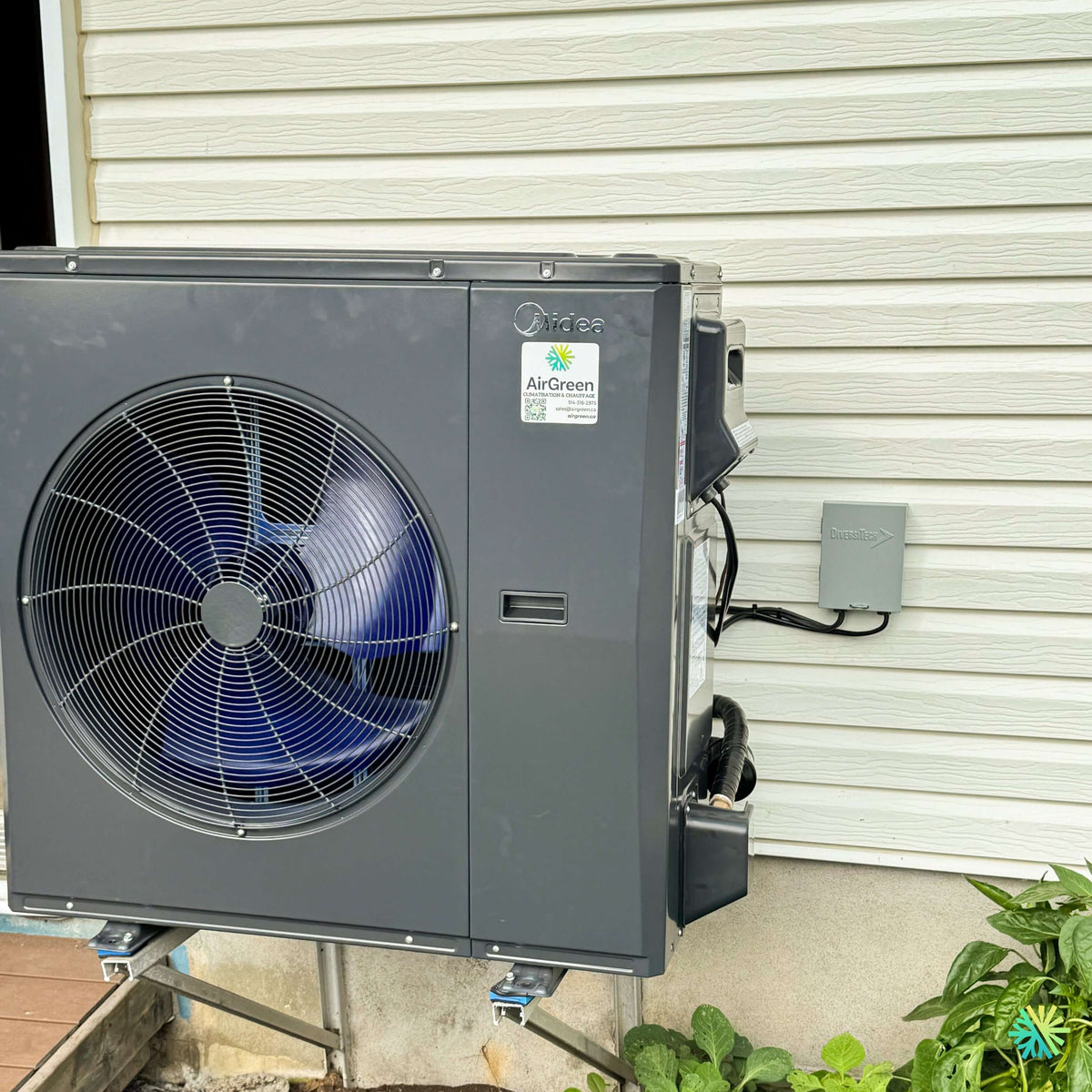
Installation of a MIDEA EVOX G3 3-ton central heat pump in Anjou
HVAC installation in Anjou of a 3-ton MIDEA EVOX G3 central heat pump. High-performance, quiet solution eligible for subsidies in Montreal, Laval, Longueuil, North Shore, and South Shore.
- City
- Region
- Equipment
- Brand
- Challenges
- Published
The job on one screen
The unit’s data sheet
The range as published on airgreen.ca: pick a size to see its capacity in deep cold.
| Size | Heating at −8 °C | Heating at −15 °C | Coldest certified point | COP at −15 °C | SEER | HSPF | Indicative LogisVert aid |
|---|---|---|---|---|---|---|---|
| Midea EVOX G3 · 1.5 tons | 14,700 | 18,600 | −30 °C: 11,800 | 2.12 | 19.0 | 10.1 | $1,764 |
| Midea EVOX G3 · 2 tons | 20,800 | 20,600 | −30 °C: 12,100 | 2.14 | 18.6 | 10.0 | $2,496 |
| Midea EVOX G3 · 2.5 tons | 24,000 | 33,200 | −30 °C: 17,900 | 1.97 | 17.2 | 10.8 | $2,880 |
| Midea EVOX G3 · 3 tons | 33,000 | 37,400 | −30 °C: 27,600 | 1.9 | 18.0 | 10.0 | $3,960 |
| Midea EVOX G3 · 4 tons | 39,500 | 48,000 | −30 °C: 27,200 | 2.0 | 17.5 | 9.5 | $4,740 |
| Midea EVOX G3 · 5 tons | 45,000 | 54,000 | −30 °C: 37,300 | 1.9 | 17.5 | 9.5 | $5,400 |
Data read live from the airgreen.ca page of each size (NEEP / AHRI certified performance). When the title names the installed size, it is highlighted; otherwise the whole range is shown. The aid shown is today’s, using Hydro-Québec’s rule ($120 per 1,000 BTU/h at −8 °C); amounts quoted in the article date from its publication. Only Hydro-Québec confirms the assistance granted.
The article, chapter by chapter
Strategic HVAC Modernization for Lasting Comfort in Anjou
In a residential neighborhood in Anjou, we recently completed a complete HVAC installation, replacing an aging central system with a 3-ton MIDEA EVOX G3 central heat pump. This project perfectly illustrates the current challenges faced by homeowners in Montreal, Laval, Longueuil, the North Shore, and the South Shore: improving indoor comfort while reducing energy costs, without compromising winter performance.
From the first technical visit, it was clear that the client was looking for a reliable solution to face Quebec's harsh winters, while optimizing summer air conditioning. The choice of the MIDEA EVOX G3 quickly stood out due to its advanced technical characteristics and its compatibility with existing installations.
A Central Heat Pump Designed for Quebec's Climate
Heating Performance Down to -30°C
The MIDEA EVOX G3 central heat pump installed in Anjou offers exceptional heating capacity down to -30°C, a crucial criterion in our region. Unlike many standard systems that lose efficiency in very cold weather, this model maintains stable performance thanks to its advanced Inverter compressor.
In this specific project, the client previously used an inefficient hybrid system during periods of intense cold. As soon as the new unit was commissioned, the difference was immediate:
- faster temperature rise
- uniform heat in all rooms
- significant reduction in the use of electric auxiliary heat
ENERGY STAR® Certified Energy Efficiency
With a SEER2 of 17.7, an HSPF2 of 10.0, and ENERGY STAR® (Cold Climate) certification, this heat pump is a wise choice for homeowners looking to reduce their energy consumption.
In the case of this residence in Anjou, we estimate a significant drop in heating costs from the first year, particularly in winter when energy performance makes all the difference.
Technical Challenges Encountered During Installation
Adaptation to an Existing System
The building was equipped with an old central system with air ducts in good condition, but presenting certain constraints:
- limited mechanical space
- restricted basement access
- uneven air distribution between floors
Our team therefore had to adapt the installation to maximize the performance of the central heat pump without requiring a complete reconstruction of the duct network.
Solutions Implemented by AirGreen
We applied several technical adjustments:
- Rebalancing of the duct network to ensure optimal air circulation
- Installation of a smart control system with integrated WiFi
- Complete verification of airtightness and airflows
- Integration of the system with a modern thermostat for precise control
Thanks to these interventions, the client now benefits from homogeneous heat and air conditioning distribution, even in distant rooms.
Technical Details of the Installed MIDEA EVOX G3
Here are the key specifications of the installed system:
- Capacity: 3 tons (36,000 BTU)
- Refrigerant: R-454B (low environmental impact)
- Voltage: 220V
- Outdoor Dimensions: 37.25 x 16.13 x 31.88
- Outdoor Sound Level: 62.5 dB(A)
- Piping: 3/8 – 3/4
- Integrated WiFi: yes
This model is also distinguished by its silent operation and its ability to maintain constant comfort without temperature fluctuations.
An Installation Designed to Last
Key Project Stages
At AirGreen, every HVAC installation follows a rigorous process. For this project in Anjou:
-
On-site technical evaluation
Complete analysis of thermal needs and existing system. -
Site preparation
Installation of outdoor support, secure fastening, and surface protection. -
Outdoor unit installation
Strategic positioning to reduce noise and optimize air circulation. -
Piping and duct connection
Strict adherence to standards to guarantee efficiency and durability. -
Performance tests and calibration
Verification of optimal operation before delivery to the client.
Importance of Vacuum Pull-Down and Testing
As with all our installations, we carried out a thorough vacuum pull-down and pressure tests to ensure the absence of leaks and the longevity of the system. These steps, often neglected by some installers, are essential to guarantee stable performance over several years.
Grants and Project Profitability
LogisVert Grant
This model is eligible for a provincial grant of up to $3720, a major financial advantage for homeowners.
We assisted the client through all administrative procedures to simplify obtaining this aid.
Return on Investment
Thanks to:
- high energy efficiency
- reduced electric auxiliary heat
- cold climate performance
the client will be able to amortize their investment over a reasonable period while enjoying superior comfort.
Testimonial and Customer Feedback
A few weeks after the installation, the client shared their impressions with us:
- constant temperature throughout the house
- significant reduction in outdoor noise
- simple use via the mobile application
- improved overall comfort, summer and winter
This type of feedback is common for MIDEA EVOX G3 central heat pump installations carried out by our team in Montreal, Laval, Longueuil, the North Shore, and the South Shore.
Practical Advice Before Installing a Central Heat Pump
Mistakes to Avoid
- Choosing an unsuitable capacity (oversizing or undersizing)
- Neglecting the condition of existing ducts
- Installing without pressure testing or vacuum pull-down
- Prioritizing price at the expense of installation quality
AirGreen Recommendations
- Always perform an on-site evaluation
- Opt for a ENERGY STAR® Cold Climate certified system
- Choose an experienced and certified installer
- Plan annual HVAC maintenance to maintain performance
Why Choose AirGreen for Your HVAC Installation
Our expertise is based on dozens of similar installations carried out in the greater Montreal area. What distinguishes us:
- Rigorous technical approach
- Total transparency in our quotes
- Professional installation without compromise
- Fast and reliable after-sales service
Each project is handled with precision, whether in Anjou, on the North Shore, the South Shore, in Laval, or in Longueuil.
Conclusion: A High-Performance and Durable Central Solution
The installation of this MIDEA EVOX G3 central heat pump in Anjou represents an excellent example of successful HVAC system modernization. It combines:
- exceptional winter performance
- high energy efficiency
- uniform comfort all year round
For any homeowner looking to improve their heating and air conditioning system, this type of equipment is a solid choice, especially when installed rigorously by an experienced team.
The job tools
Two quick checks with real numbers: what heat costs, and what your current heaters add up to in BTU/h.
Baseboards and electric furnaces turn 1 kWh of electricity into 1 kWh of heat. A heat pump delivers more: that is its COP. At Hydro-Québec’s rate D (11.142¢/kWh above 40 kWh a day, since 1 April 2026):
Hydro-Québec: a heat pump can be up to three times more efficient than baseboards for heating in the colder months.
Estimate per kWh of heat, at the chosen temperature, using the certified COP from the product page. Taxes, access charge and backup heat not included.
Conversion: 1 W = 3.412 BTU/h. An indication, not a load calculation: baseboards and furnaces are often stronger than the real need, and they can stay as backup. AirGreen confirms the capacity on site.
How the job unfolds
The main steps of this kind of job at AirGreen. Every house has its quirks: the estimate brings them out.
We look at the ducts, the current indoor module, the electrical panel and the planned spot for the outdoor unit.
The equipment combination, capacity and price, in writing. We check whether the combination qualifies for assistance programs.
Access protected, old unit disconnected and removed when it is being replaced.
Electric furnace or air handler, with its coil, connected to the supply and return ducts.
On a level base, raised above the snow, with free space all around.
Insulated, they enter through a sealed opening and run to the indoor coil.
Dedicated circuits, accessible disconnect, a thermostat that works with the heat pump and the backup heat.
Leak test, vacuum, start-up, airflow check and a test of both modes.
Filter, thermostat, backup heat in extreme cold: what to know before winter.
- The on-site estimateWe look at the ducts, the current indoor module, the electrical panel and the planned spot for the outdoor unit.
- The quoteThe equipment combination, capacity and price, in writing. We check whether the combination qualifies for assistance programs.
- Getting readyAccess protected, old unit disconnected and removed when it is being replaced.
- The indoor moduleElectric furnace or air handler, with its coil, connected to the supply and return ducts.
- The outdoor unitOn a level base, raised above the snow, with free space all around.
- The refrigerant linesInsulated, they enter through a sealed opening and run to the indoor coil.
- Electrical and thermostatDedicated circuits, accessible disconnect, a thermostat that works with the heat pump and the backup heat.
- Tests and start-upLeak test, vacuum, start-up, airflow check and a test of both modes.
- The walkthroughFilter, thermostat, backup heat in extreme cold: what to know before winter.
What we check on a job like this one
Each number is a point we check on site. Switch between summer and winter to watch air and heat move.
In summer, the outdoor unit rejects the house's heat outside.
Generic illustration of this type of installation, not a survey of this job site. Tap a number.
It captures or rejects heat outside. It sits on a level base, above the snow, with free space all around.
The insulated refrigerant lines enter the house through a sealed opening and run to the indoor coil.
A shut-off switch near the outdoor unit isolates it safely for service.
Sitting on the indoor module, it moves heat between the house air and the refrigerant.
Electric furnace or air handler: its fan pushes air through the ducts. The electric backup takes over in extreme cold.
Supply ducts bring air to the rooms; returns bring it back to the unit. Their condition matters as much as the unit's.
It protects the coil and the fan. A dirty filter cuts airflow, so it gets checked regularly.
It runs the heat pump and the backup heat. It must be compatible with the installed system.
Is your home ready?
Check what applies at your place. A "no" is not a refusal: it is what we sort out during the estimate.
Good habits, once the unit is in place
Six simple habits that keep the unit going. Your list stays on this device.
What to do, season by season
Three habits per season for this unit. They take a few minutes and prevent many calls.
- Check the indoor module's filter.
- Clear winter debris from the outdoor unit.
- Test cooling before the heat arrives.
- Check the filter more often in peak season.
- Keep registers and returns clear.
- Watch condensate drainage near the coil.
- Change or clean the filter.
- Test heating and backup heat before the cold.
- Book periodic maintenance.
- Clear snow around the outdoor unit.
- Store nothing in front of the indoor module.
- Note any unusual noise or smell and call us.
The right pages, at the right time
Four statements: true or false?
It all comes down to details you have just seen.
1. A central heat pump uses the house's ducts.
It connects to the existing ducts to heat and cool everywhere.
2. In extreme cold, electric backup heat can take over.
The indoor module (furnace or air handler) works with the heat pump and takes over in extreme cold.
3. The filter only gets changed when the unit breaks down.
A dirty filter cuts airflow. It gets checked regularly.
4. You can reuse the old unit's size without checking.
The house may have changed: insulation, windows, added rooms. Capacity is confirmed on site.
0 / 4 right answers
What people ask us about this kind of work
Can I keep my current ducts?
What happens in extreme cold?
Furnace, air handler, ducted: what is the difference?
Are there grants?
Do I need a permit?
How much can I save?
How is the LogisVert assistance calculated?
Will my current thermostat work?
Central or wall units: which one?
Does AirGreen hold the required licences?
Is the estimate free?
No question matches. Write to us: we answer.
More jobs to see, near you
By town, by equipment or by region: browse more than 4,700 published projects.
Each dot: a town where AirGreen has published projects. The glowing dot: this job.
An on-site estimate, the right capacity, the right equipment.
The on-site estimate is free and the quote follows within 24 hours.
Text and photo: a real AirGreen Climatisation & Chauffage job. The diagrams are generic illustrations of the type of installation, not a survey of this job site. Sources of the added figures: airgreen.ca product pages (NEEP / AHRI performance), Hydro-Québec (Heat pumps page, LogisVert, read on 13 October 2026), Régie de l’énergie (rate D as of 1 April 2026).