
Installation of a MIDEA EVOX G3 3 Ton Central Heat Pump on Montreal's South Shore
HVAC installation of a MIDEA EVOX G3 3-ton central heat pump on the South Shore of Montreal. Optimal comfort, energy efficiency, available subsidy, and AirGreen expertise.
Take a tour of the installation
Each number is a point we check on site. Switch between summer and winter to watch air and heat move.
In summer, the outdoor unit rejects the house's heat outside.
Generic illustration of this type of installation, not a survey of this job site. Tap a number.
It captures or rejects heat outside. It sits on a level base, above the snow, with free space all around.
The insulated refrigerant lines enter the house through a sealed opening and run to the indoor coil.
A shut-off switch near the outdoor unit isolates it safely for service.
Sitting on the indoor module, it moves heat between the house air and the refrigerant.
Electric furnace or air handler: its fan pushes air through the ducts. The electric backup takes over in extreme cold.
Supply ducts bring air to the rooms; returns bring it back to the unit. Their condition matters as much as the unit's.
It protects the coil and the fan. A dirty filter cuts airflow, so it gets checked regularly.
It runs the heat pump and the backup heat. It must be compatible with the installed system.
A Powerful Central Solution Designed for the Demanding Winters of the South Shore
At AirGreen, we recently completed a full HVAC installation of a MIDEA EVOX G3 3-ton central heat pump in a single-family residence located on the South Shore of Montreal. This project perfectly illustrates the real challenges encountered in Quebec homes and the concrete solutions we implement to ensure comfort, energy efficiency, and durability.
From the first visit, our client wanted to replace an old, noisy, and energy-intensive central system. The objective was clear: to obtain a reliable heating and air conditioning solution capable of maintaining a stable temperature even during periods of extreme cold, while significantly reducing energy costs.
Technical Analysis and Strategic Choice of the MIDEA EVOX G3
Why this model stands out on the South Shore
The MIDEA EVOX G3 | 3-ton (36,000 BTU) central heat pump emerged as the optimal choice for several technical reasons:
- Heating capacity down to -30°C
- ENERGY STAR® (Cold Climate) certification
- SEER2: 17.7 | HSPF2: 10.0 | EER2: 12.0
- Eco-friendly R-454B refrigerant
- Advanced Inverter technology
- Integrated WiFi for smart control
In the climatic context of the South Shore, where winter temperatures can drop sharply, this model guarantees stable performance without excessive reliance on auxiliary heating.
Precise Sizing: an often-overlooked element
One of the critical elements of this installation was sizing. Too often, systems are poorly calibrated, causing overconsumption or discomfort.
In this specific case:
- House area: ~2,100 sq ft
- Insulation: renovated standard
- Configuration: existing forced-air system
We validated that a 3-ton capacity was ideal to ensure:
- Uniform air distribution
- Efficient humidity management
- Optimized energy consumption
Challenges Encountered on Site and AirGreen Solutions
Outdoor Installation: Space Constraints and Durability
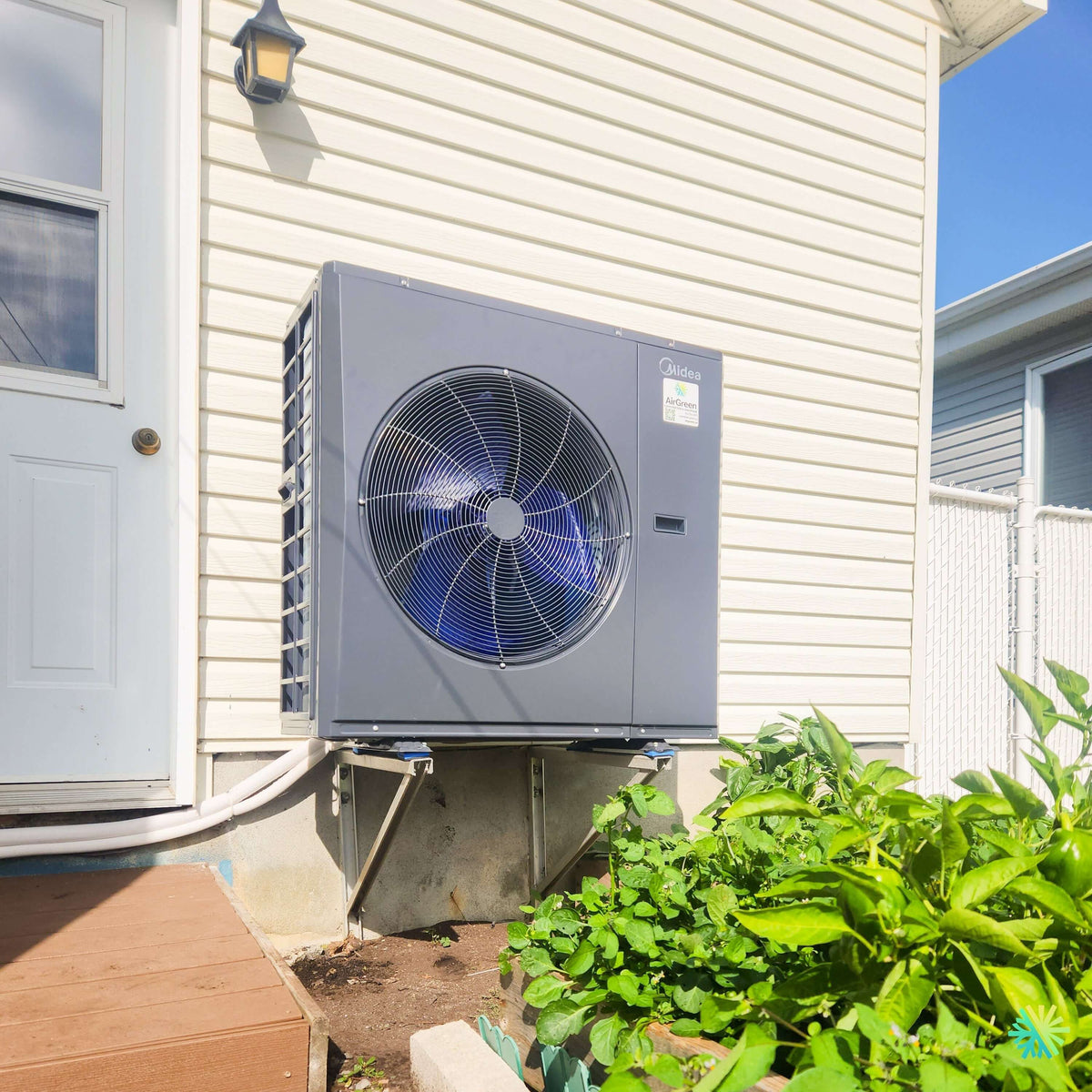
The image above clearly shows an outdoor wall installation on metal supports. This choice is never trivial.
Problem identified:
- Restricted space near foundations
- Risk of snow accumulation in winter
- Need to protect the unit from ground moisture
Solution implemented:
- Installation on robust raised wall supports
- Precise alignment to reduce vibrations
- Optimal clearance for air circulation
Result: a durable, silent installation perfectly adapted to the climatic conditions of the South Shore of Montreal.
Management of existing ducts
Another major challenge concerned the ducts:
- Presence of existing partially obstructed ducts
- Uneven air distribution in some rooms
AirGreen Intervention:
- Complete network inspection
- Thorough cleaning
- Adjustment of airflow rates using the Computational Constant Airflow 2.0 system
This ensured homogeneous distribution throughout the house, a point often overlooked in standard installations.
Rigorous Installation Process by AirGreen
Every HVAC installation on the South Shore follows a strict methodology:
1. Preparation and planning
- Complete thermal analysis
- Electrical validation (220V required)
- Planning of refrigerant line routing (3/8 – 3/4)
2. Mechanical installation
- Secure fastening of the outdoor unit
- Installation of the indoor unit (MAUSE-H36B-2A air handler)
- Duct connection
3. Critical steps often overlooked elsewhere
- Complete pressure test
- Vacuum pull (micron test) to eliminate all moisture
- Micro-leak verification
These steps ensure the system's longevity, avoiding costly long-term problems.
4. Commissioning
- Inverter system calibration
- WiFi configuration
- Performance test under real conditions
Actual Performance Observed After Installation
A few weeks after commissioning, the results were already visible:
Thermal comfort
- Stable temperature in all rooms
- No noticeable variation between floors
Noise level
- Exterior: discreet despite its 62.5 dB(A)
- Interior: almost imperceptible (31.5 – 49.5 dB(A))
Energy consumption
- Estimated reduction of 20 to 35%
- Smart operation thanks to Inverter technology
LogisVert Subsidy: A Major Financial Advantage
This installation allowed the client to benefit from a LogisVert provincial subsidy of up to $3720.
At AirGreen, we systematically support our clients with:
- Eligibility validation
- Document preparation
- File submission
This type of assistance makes the MIDEA EVOX G3 central heat pump even more accessible for homeowners in Montreal, Laval, Longueuil, North Shore, and South Shore.
Common Mistakes to Avoid During HVAC Installation
1. Choosing a heat pump without thermal analysis
Result: discomfort and overconsumption.
2. Neglecting the condition of the ducts
Even the best machine will not compensate for a faulty network.
3. Ground installation without protection
High risk of winter damage.
4. Omitting vacuum pull
This is one of the main causes of premature failure.
At AirGreen, we systematically avoid these errors through a methodical and professional approach.
Why Trust AirGreen for Your Installation on the South Shore
We distinguish ourselves by:
- Advanced technical expertise in HVAC
- Clean, durable, and compliant installations
- Complete transparency in our quotes
- Prompt and efficient after-sales service
Every project is treated with the same level of demanding standards, whether it's a single-family home or an apartment building.
A Smart Investment for Your Long-Term Comfort
The MIDEA EVOX G3 central heat pump represents a remarkable balance between:
- Cold climate performance
- Energy efficiency
- Constant comfort
- Reduced environmental impact
For homeowners on the South Shore of Montreal, this is a solution perfectly adapted to current climatic and economic realities.
Conclusion
This installation on the South Shore of Montreal clearly demonstrates that a well-chosen and correctly installed system completely transforms the comfort of a home. Thanks to the MIDEA EVOX G3 3-ton central heat pump, our client now benefits from a stable, quiet, and economical indoor environment.
At AirGreen, we continue to offer high-end HVAC installations in Montreal, Laval, Longueuil, as well as on the North Shore and South Shore, always emphasizing quality, precision, and lasting satisfaction.
The unit on this job, in figures
The range as published on airgreen.ca: pick a size to see its capacity in deep cold.
| Size | Heating at −8 °C | Heating at −15 °C | Coldest certified point | COP at −15 °C | SEER | HSPF | Indicative LogisVert aid |
|---|---|---|---|---|---|---|---|
| Midea EVOX G3 · 1.5 tons | 14,700 | 18,600 | −30 °C: 11,800 | 2.12 | 19.0 | 10.1 | $1,764 |
| Midea EVOX G3 · 2 tons | 20,800 | 20,600 | −30 °C: 12,100 | 2.14 | 18.6 | 10.0 | $2,496 |
| Midea EVOX G3 · 2.5 tons | 24,000 | 33,200 | −30 °C: 17,900 | 1.97 | 17.2 | 10.8 | $2,880 |
| Midea EVOX G3 · 3 tons | 33,000 | 37,400 | −30 °C: 27,600 | 1.9 | 18.0 | 10.0 | $3,960 |
| Midea EVOX G3 · 4 tons | 39,500 | 48,000 | −30 °C: 27,200 | 2.0 | 17.5 | 9.5 | $4,740 |
| Midea EVOX G3 · 5 tons | 45,000 | 54,000 | −30 °C: 37,300 | 1.9 | 17.5 | 9.5 | $5,400 |
Data read live from the airgreen.ca page of each size (NEEP / AHRI certified performance). When the title names the installed size, it is highlighted; otherwise the whole range is shown. The aid shown is today’s, using Hydro-Québec’s rule ($120 per 1,000 BTU/h at −8 °C); amounts quoted in the article date from its publication. Only Hydro-Québec confirms the assistance granted.
The big day, step by step
The main steps of this kind of job at AirGreen. Every house has its quirks: the estimate brings them out.
We look at the ducts, the current indoor module, the electrical panel and the planned spot for the outdoor unit.
The equipment combination, capacity and price, in writing. We check whether the combination qualifies for assistance programs.
Access protected, old unit disconnected and removed when it is being replaced.
Electric furnace or air handler, with its coil, connected to the supply and return ducts.
On a level base, raised above the snow, with free space all around.
Insulated, they enter through a sealed opening and run to the indoor coil.
Dedicated circuits, accessible disconnect, a thermostat that works with the heat pump and the backup heat.
Leak test, vacuum, start-up, airflow check and a test of both modes.
Filter, thermostat, backup heat in extreme cold: what to know before winter.
- The on-site estimateWe look at the ducts, the current indoor module, the electrical panel and the planned spot for the outdoor unit.
- The quoteThe equipment combination, capacity and price, in writing. We check whether the combination qualifies for assistance programs.
- Getting readyAccess protected, old unit disconnected and removed when it is being replaced.
- The indoor moduleElectric furnace or air handler, with its coil, connected to the supply and return ducts.
- The outdoor unitOn a level base, raised above the snow, with free space all around.
- The refrigerant linesInsulated, they enter through a sealed opening and run to the indoor coil.
- Electrical and thermostatDedicated circuits, accessible disconnect, a thermostat that works with the heat pump and the backup heat.
- Tests and start-upLeak test, vacuum, start-up, airflow check and a test of both modes.
- The walkthroughFilter, thermostat, backup heat in extreme cold: what to know before winter.
What would it look like at your place?
Two quick checks with real numbers: what heat costs, and what your current heaters add up to in BTU/h.
Baseboards and electric furnaces turn 1 kWh of electricity into 1 kWh of heat. A heat pump delivers more: that is its COP. At Hydro-Québec’s rate D (11.142¢/kWh above 40 kWh a day, since 1 April 2026):
Hydro-Québec: a heat pump can be up to three times more efficient than baseboards for heating in the colder months.
Estimate per kWh of heat, at the chosen temperature, using the certified COP from the product page. Taxes, access charge and backup heat not included.
Conversion: 1 W = 3.412 BTU/h. An indication, not a load calculation: baseboards and furnaces are often stronger than the real need, and they can stay as backup. AirGreen confirms the capacity on site.
Four mistakes we do not make
Flip each card to see what we do instead.
Your own project, step by step
What to do, season by season
Three habits per season for this unit. They take a few minutes and prevent many calls.
- Check the indoor module's filter.
- Clear winter debris from the outdoor unit.
- Test cooling before the heat arrives.
- Check the filter more often in peak season.
- Keep registers and returns clear.
- Watch condensate drainage near the coil.
- Change or clean the filter.
- Test heating and backup heat before the cold.
- Book periodic maintenance.
- Clear snow around the outdoor unit.
- Store nothing in front of the indoor module.
- Note any unusual noise or smell and call us.
Is your home ready?
Check what applies at your place. A "no" is not a refusal: it is what we sort out during the estimate.
Four statements: true or false?
It all comes down to details you have just seen.
1. A central heat pump uses the house's ducts.
It connects to the existing ducts to heat and cool everywhere.
2. In extreme cold, electric backup heat can take over.
The indoor module (furnace or air handler) works with the heat pump and takes over in extreme cold.
3. The filter only gets changed when the unit breaks down.
A dirty filter cuts airflow. It gets checked regularly.
4. You can reuse the old unit's size without checking.
The house may have changed: insulation, windows, added rooms. Capacity is confirmed on site.
0 / 4 right answers
What people ask us about this kind of work
Can I keep my current ducts?
What happens in extreme cold?
Furnace, air handler, ducted: what is the difference?
Are there grants?
Do I need a permit?
How much can I save?
How is the LogisVert assistance calculated?
Will my current thermostat work?
Central or wall units: which one?
Does AirGreen hold the required licences?
Is the estimate free?
No question matches. Write to us: we answer.
More jobs to see, near you
By town, by equipment or by region: browse more than 4,700 published projects.
Each dot: a town where AirGreen has published projects. The glowing dot: this job.
Every house has its constraints. We see them before we install.
The on-site estimate is free and the quote follows within 24 hours.
Text and photo: a real AirGreen Climatisation & Chauffage job. The diagrams are generic illustrations of the type of installation, not a survey of this job site. Sources of the added figures: airgreen.ca product pages (NEEP / AHRI performance), Hydro-Québec (Heat pumps page, LogisVert, read on 13 October 2026), Régie de l’énergie (rate D as of 1 April 2026).