
Installation of a MIDEA EVOX G3 5-ton central heat pump in Lachine: a robust HVAC solution for consistent comfort throughout the home
AirGreen installs a 5-ton MIDEA EVOX G3 central heat pump in Lachine: uniform comfort, elevated snow stand, tidy connections, and comprehensive HVAC expertise.
- City
- Region
- Equipment
- Brand
- Challenges
- Published
The job on one screen
The unit’s data sheet
The range as published on airgreen.ca: pick a size to see its capacity in deep cold.
| Size | Heating at −8 °C | Heating at −15 °C | Coldest certified point | COP at −15 °C | SEER | HSPF | Indicative LogisVert aid |
|---|---|---|---|---|---|---|---|
| Midea EVOX G3 · 1.5 tons | 14,700 | 18,600 | −30 °C: 11,800 | 2.12 | 19.0 | 10.1 | $1,764 |
| Midea EVOX G3 · 2 tons | 20,800 | 20,600 | −30 °C: 12,100 | 2.14 | 18.6 | 10.0 | $2,496 |
| Midea EVOX G3 · 2.5 tons | 24,000 | 33,200 | −30 °C: 17,900 | 1.97 | 17.2 | 10.8 | $2,880 |
| Midea EVOX G3 · 3 tons | 33,000 | 37,400 | −30 °C: 27,600 | 1.9 | 18.0 | 10.0 | $3,960 |
| Midea EVOX G3 · 4 tons | 39,500 | 48,000 | −30 °C: 27,200 | 2.0 | 17.5 | 9.5 | $4,740 |
| Midea EVOX G3 · 5 tons | 45,000 | 54,000 | −30 °C: 37,300 | 1.9 | 17.5 | 9.5 | $5,400 |
Data read live from the airgreen.ca page of each size (NEEP / AHRI certified performance). When the title names the installed size, it is highlighted; otherwise the whole range is shown. The aid shown is today’s, using Hydro-Québec’s rule ($120 per 1,000 BTU/h at −8 °C); amounts quoted in the article date from its publication. Only Hydro-Québec confirms the assistance granted.
The article, chapter by chapter
A Central Installation Designed to Tackle Montreal Winters Without Compromise
In Lachine, a residential area where homes must contend with the wide temperature fluctuations typical of Montreal Island, our AirGreen team recently completed the installation of a MIDEA EVOX G3 5-ton central heat pump. This project perfectly illustrates what many homeowners in Montreal, Laval, Longueuil, the North Shore, and the South Shore are looking for: a central heating and air conditioning solution capable of providing stable comfort, excellent energy efficiency, and clean integration into the existing home envelope.
Unlike a simple wall-mounted unit for a specific zone, a 5-ton central heat pump aims for a much broader objective: to supply the entire residence through the existing or adapted duct network. In this case, the MIDEA EVOX G3 model was chosen as a logical response to the client's needs: high capacity, operation adapted to Quebec's climate, heating performance, compatibility with a residential central installation, and an excellent option for reducing dependence on traditional heating when the house configuration allows it.
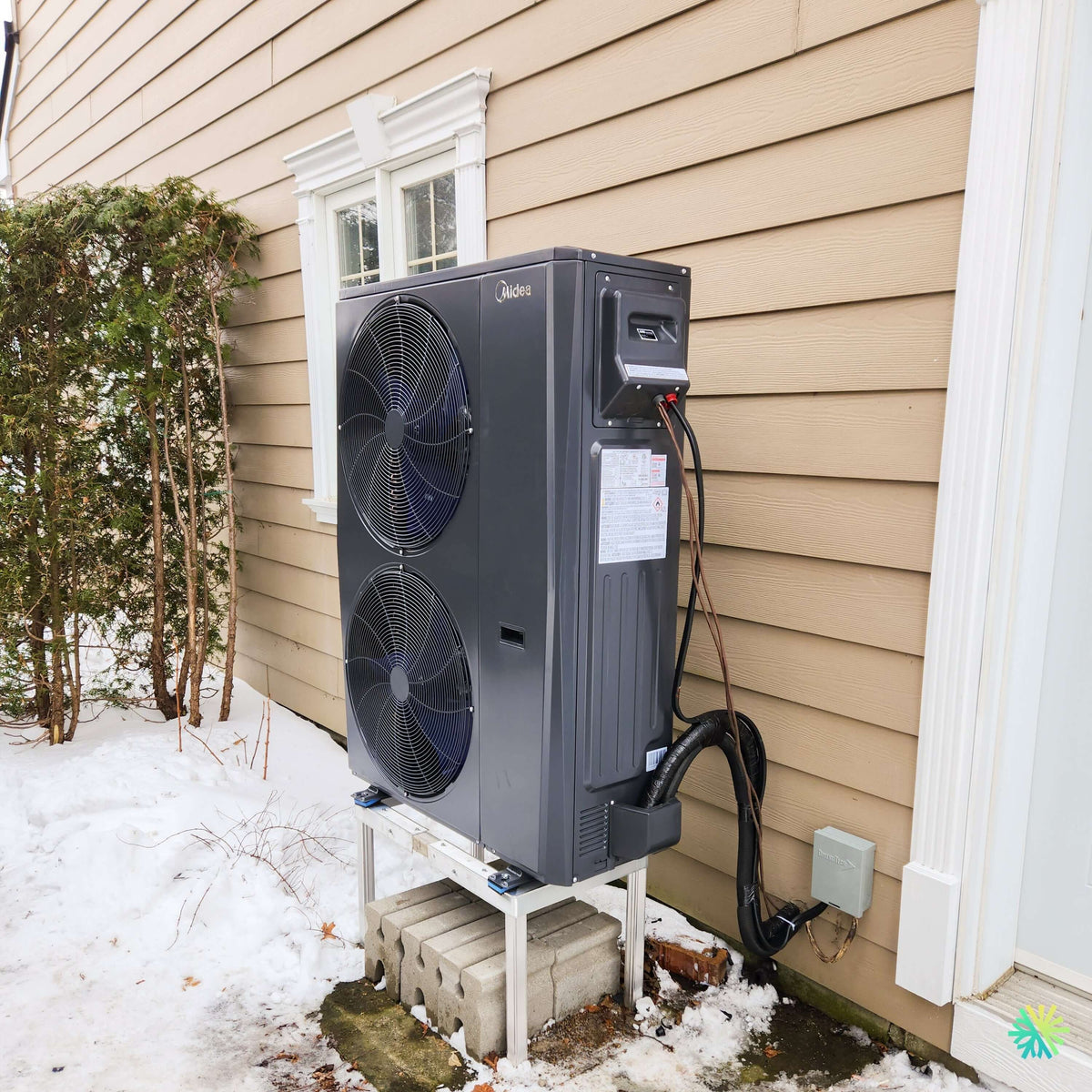
The project photo speaks for itself: the imposing and well-clear MIDEA outdoor unit was installed on a raised support, at an adequate distance from the snowy ground, with precise positioning along the exterior wall. This type of detail is fundamental in an HVAC installation in Quebec. A central heat pump is never limited to plugging in a machine: one must consider snow, drainage, ventilation clearances, vibrations, protection of refrigeration lines, access for HVAC maintenance, electrical safety, and exterior aesthetics.
The Project Context in Lachine: Replacing Uncertainty with Measurable Comfort
The owner of this house in Lachine wanted to improve their year-round comfort without increasing the number of visible indoor units. The residence had a configuration suitable for a central solution, allowing for a high-capacity heat pump rather than a multi-zone wall-mounted system. The objective was clear: achieve a homogeneous temperature, reduce variations between rooms, benefit from efficient air conditioning in summer, and effective heating for a large part of winter.
In many Lachine homes, particularly those with an existing forced-air system, adding or replacing it with a central heat pump represents an excellent avenue. The duct network can distribute air to bedrooms, living room, kitchen, basement, and circulation areas without adding wall-mounted units in each zone. This solution is very popular with homeowners who want to maintain a streamlined interior while improving the overall performance of their HVAC system.
In this project, our work began with a complete analysis of the outdoor location. The chosen area was along the side wall, near the necessary connections, but several constraints had to be respected:
- maintaining sufficient clearance in front of the unit's fans;
- installing the machine high enough to limit problems related to snow accumulation;
- avoiding compromising access to the door and existing exterior elements;
- protecting refrigeration lines and wiring from the elements;
- limiting vibrations transmitted to the structure;
- providing realistic access for service and HVAC maintenance.
These constraints are common in central heat pump projects in Montreal, but each home requires a tailored approach. In Lachine, the available space on the side of the residence demanded a compact, neat, and durable installation.
Why a MIDEA EVOX G3 5-ton for this residence?
The MIDEA EVOX G3 series is known for its modern approach to residential heating and air conditioning. In a central configuration, the 5-ton capacity is intended for homes with significant thermal demand, whether due to surface area, air volume to be treated, number of floors, sun exposure, insulation, or duct network configuration.
A 5-ton capacity should never be chosen at random. At AirGreen, we always emphasize this point: a heat pump that is too small will run too long without achieving the desired comfort, while an oversized unit can lead to short cycles, poor dehumidification in summer, and premature wear. The right choice is based on building analysis, not just the apparent size of the house.
In the case of this installation in Lachine, the MIDEA EVOX G3 5-ton model met the desired criteria:
- a capacity adapted for central distribution;
- an excellent option for efficient electric heating;
- relevant performance for Montreal's winters;
- possible integration with a central indoor system;
- a robust outdoor design;
- compatibility with a professional installation compliant with Quebec requirements.
This type of appliance may also be eligible for certain energy subsidies according to current criteria, the installed configuration, the exact model number, indoor-outdoor pairing, and programs available at the time of work. At AirGreen, we assist our clients in verifying information related to programs like Hydro-Québec's LogisVert, so they can better understand the procedures, required documents, and steps after installation.
An Outdoor Unit Installed at Height to Better Manage Snow
One of the most visible elements in the photo is the raised support. This choice is not merely aesthetic or practical: it directly addresses the climatic realities of Greater Montreal. A central heat pump must be able to breathe freely, even after several episodes of snow or freezing rain. When the unit is placed too close to the ground, snow accumulation can reduce airflow, hinder defrosting, and force the appliance to operate in unfavorable conditions.
In this installation, the unit was mounted on a stable structure, resting on a solid base, with sufficient height to reduce the risk of obstruction. The ground blocks and metal structure help distribute weight and ensure good stability. This type of mounting is particularly important for a high-capacity machine like a MIDEA EVOX G3 5-ton, whose weight, dimensions, and airflow demand rigorous installation.
We also paid attention to the space around the fans. A double-fan unit requires adequate front clearance to ensure good air circulation. Lack of clearance can affect performance, increase energy consumption, and reduce component lifespan. In this project, the positioning allowed for effective ventilation while respecting terrain constraints.
Refrigerant Connections: Precision, Protection, and Durability
The refrigeration lines visible on the side of the unit were carefully routed into the house. In an HVAC installation of this magnitude, the quality of the refrigeration connection plays a crucial role. Poor practice can lead to performance losses, leaks, poor refrigerant circulation, or long-term reliability issues.
Our technicians ensured that the lines were protected, bending radii were respected, lines were properly insulated, and passage into the interior was secured. Connecting a central heat pump also requires adequate evacuation, leak testing, and controlled startup. These steps are not visible in a photo, but they make all the difference between a merely functional installation and a truly professional one.
At AirGreen, we often remind our customers in Montreal, Laval, Longueuil, the North Shore, and the South Shore that a good appliance poorly installed will rarely yield good results. The actual performance of a heat pump depends as much on the model choice as on the on-site execution.
Electrical Integration: Safety and Compliance
In the photo, the outdoor electrical box near the unit is also visible. For a 5-ton central heat pump, the electrical supply must be handled with seriousness. Electrical loads, circuit protection, the outdoor disconnect, and wiring routing must comply with applicable standards.
In this project in Lachine, our team coordinated the necessary electrical elements so that the unit could operate safely. The outdoor disconnect allows for local shutdown during service interventions. This is an essential detail for HVAC maintenance, inspections, and any future intervention on the appliance.
A common mistake among some homeowners is underestimating the electrical part of an installation. A high-capacity central heat pump should never be installed without validating the panel, circuit, and required protections. This step is an integral part of our turnkey approach.
The Lateral Space Challenge: Large Installation, Neatly Done
One of the interesting challenges of this project was the available lateral space. The MIDEA EVOX G3 5-ton unit is a large appliance, and the immediate environment included an exterior wall with siding, a window, a nearby door, shrubs on the side, and a snowy area on the ground.
Our goal was to make the installation practical, durable, and visually tidy. We had to avoid blocking access, limit clutter, and position the unit to facilitate future interventions. A central heat pump is not an appliance installed for a few seasons: it must be designed for many years of use.
We therefore prioritized a layout that respects airflow, connection protection, and technical access. The lines were neatly grouped, the unit was stabilized, and exterior elements were arranged coherently. This type of finish is important, as visible outdoor installations are part of the property's overall appearance.
Achieved Comfort: More Uniform Central Distribution
After startup, the initial results focused on comfort stability. A well-installed central heat pump allows conditioned or heated air to be distributed through ducts, reducing temperature differences between rooms. For families, this is often the most tangible benefit: fewer overheated zones, fewer uncomfortable rooms, fewer constant thermostat adjustments.
In summer, the cooling capacity of a central system is particularly appreciated in homes where multiple rooms are occupied simultaneously. Air conditioning does not depend on a single wall-mounted unit in the living room; it circulates throughout the house. In winter, the heat pump can provide a significant portion of the heating, depending on outdoor conditions and the auxiliary system's configuration.
In Lachine, this installation modernized the home's comfort while maintaining a discreet approach indoors. For many homeowners, this is precisely the ideal compromise: a high-performing system, but without multiplying visible appliances in the rooms.
What Homeowners Should Check Before Choosing a Central Heat Pump
A MIDEA EVOX G3 5-ton central heat pump can be an excellent choice, but it must be selected in the right context. Before recommending this type of appliance, we check several essential points:
Surface Area and Actual Thermal Load
Surface area alone is not enough. Two similarly sized houses can have very different needs depending on insulation, window age, orientation, airtightness, ceiling height, and interior configuration.
Condition of the Ductwork
A central appliance heavily depends on the quality of air distribution. Undersized, obstructed, leaky, or unbalanced ducts can reduce system performance. In some cases, adjustments are necessary to achieve an optimal result.
Available Outdoor Space
A high-capacity unit requires good clearance. It must be placed to breathe correctly, remain accessible, and avoid unnecessary disturbances for occupants or neighbors.
Electrical Compatibility
The electrical panel capacity and circuit requirements must be validated before installation. This is a critical point to avoid unpleasant surprises.
Eligibility for Subsidies
Subsidy programs can provide significant financial aid, but criteria must be checked carefully. The model, pairing, installation, and provided documents can influence eligibility.
Common Mistakes to Avoid in a Central Installation
Across our projects in Montreal, Laval, Longueuil, on the North Shore and South Shore, we often see the same mistakes when homeowners compare offers.
The first is to choose only the lowest price without analyzing installation quality. A central heat pump is a significant investment, and initial savings can be costly if the appliance is undersized, poorly connected, or poorly positioned.
The second is neglecting outdoor support. In Quebec, a unit installed too low can quickly be exposed to snow, ice, and excessive humidity. The support must be stable, elevated, and adapted to the appliance's weight.
The third is ignoring the importance of air balancing. A high-performing central system must distribute air correctly. If some rooms receive too much air and others not enough, comfort will be uneven, even with an excellent machine.
The fourth is delaying HVAC maintenance. A central heat pump requires regular maintenance: filters, coils, drainage, pressure, defrost operation, electrical components, and general condition. Good maintenance helps preserve the system's efficiency and lifespan.
The AirGreen Approach: A Turnkey Project, from Advice to Commissioning
For this project in Lachine, our role wasn't limited to installing the outdoor unit. We supported the client in assessing their needs, selecting the system, planning the location, connections, technical verifications, and commissioning.
Our approach is based on a simple idea: a successful HVAC installation must be clear for the client and meticulous on-site. We explain technical choices, anticipate constraints, and carry out the work with particular attention to visible and invisible details.
In several similar installations carried out in Montreal and the surrounding areas, we have observed that clients particularly appreciate three elements: the transparency of recommendations, the cleanliness of the installation, and the quality of post-work follow-up. A central system transforms the comfort of a home; it is therefore normal for owners to want to understand what is being installed, why this model was chosen, and how to use it effectively.
A relevant choice for homes in Lachine and Greater Montreal
Lachine is an area with a variety of homes: single-family residences, renovated properties, houses with forced-air systems, and older buildings modernized over the years. In many of these configurations, a central heat pump represents a highly relevant solution.
The MIDEA EVOX G3 5-ton installed here perfectly meets the needs of a home requiring significant capacity and uniform distribution. It is intended for owners who want a more comprehensive solution than a wall-mounted unit, while also seeking to improve their energy efficiency.
For owners in Montreal, Laval, Longueuil, the North Shore, or the South Shore, this project demonstrates the importance of entrusting the installation to a team that understands local realities: snow, limited clearances, electrical standards, heating efficiency, subsidy eligibility, and aesthetic integration.
Practical tips after installation
After installing a central heat pump, we always recommend that owners follow a few best practices:
- replace or clean filters according to system recommendations;
- keep the outdoor unit clear, especially after snowstorms;
- avoid accumulating objects around the unit;
- monitor for unusual noises or changes in performance;
- schedule periodic HVAC maintenance;
- use thermostat settings consistently rather than making frequent large variations;
- keep installation documents, invoices, and technical data sheets for warranties and subsidies.
These simple actions lead to better performance, more controlled consumption, and an extended lifespan.
An installation that reflects our expertise in central heat pumps
This installation of a MIDEA EVOX G3 5-ton central heat pump in Lachine demonstrates the importance of professional execution. The choice of location, support height, pipe protection, electrical integration, and commissioning are all elements that contribute to the final result.
At AirGreen, we know that a good HVAC system must be efficient, reliable, well-installed, and adapted to the building's reality. This is what sets us apart in heat pump, central air conditioning, residential heating, and HVAC maintenance projects throughout Greater Montreal.
For this Lachine home, the MIDEA EVOX G3 5-ton provides a robust central solution, capable of meeting comfort needs year-round. It's a clean, thoughtful installation designed to last – exactly the kind of project we love to carry out at AirGreen.
The job tools
Two quick checks with real numbers: what heat costs, and what your current heaters add up to in BTU/h.
Baseboards and electric furnaces turn 1 kWh of electricity into 1 kWh of heat. A heat pump delivers more: that is its COP. At Hydro-Québec’s rate D (11.142¢/kWh above 40 kWh a day, since 1 April 2026):
Hydro-Québec: a heat pump can be up to three times more efficient than baseboards for heating in the colder months.
Estimate per kWh of heat, at the chosen temperature, using the certified COP from the product page. Taxes, access charge and backup heat not included.
Conversion: 1 W = 3.412 BTU/h. An indication, not a load calculation: baseboards and furnaces are often stronger than the real need, and they can stay as backup. AirGreen confirms the capacity on site.
How the job unfolds
The main steps of this kind of job at AirGreen. Every house has its quirks: the estimate brings them out.
We look at the ducts, the current indoor module, the electrical panel and the planned spot for the outdoor unit.
The equipment combination, capacity and price, in writing. We check whether the combination qualifies for assistance programs.
Access protected, old unit disconnected and removed when it is being replaced.
Electric furnace or air handler, with its coil, connected to the supply and return ducts.
On a level base, raised above the snow, with free space all around.
Insulated, they enter through a sealed opening and run to the indoor coil.
Dedicated circuits, accessible disconnect, a thermostat that works with the heat pump and the backup heat.
Leak test, vacuum, start-up, airflow check and a test of both modes.
Filter, thermostat, backup heat in extreme cold: what to know before winter.
- The on-site estimateWe look at the ducts, the current indoor module, the electrical panel and the planned spot for the outdoor unit.
- The quoteThe equipment combination, capacity and price, in writing. We check whether the combination qualifies for assistance programs.
- Getting readyAccess protected, old unit disconnected and removed when it is being replaced.
- The indoor moduleElectric furnace or air handler, with its coil, connected to the supply and return ducts.
- The outdoor unitOn a level base, raised above the snow, with free space all around.
- The refrigerant linesInsulated, they enter through a sealed opening and run to the indoor coil.
- Electrical and thermostatDedicated circuits, accessible disconnect, a thermostat that works with the heat pump and the backup heat.
- Tests and start-upLeak test, vacuum, start-up, airflow check and a test of both modes.
- The walkthroughFilter, thermostat, backup heat in extreme cold: what to know before winter.
What we check on a job like this one
Each number is a point we check on site. Switch between summer and winter to watch air and heat move.
In summer, the outdoor unit rejects the house's heat outside.
Generic illustration of this type of installation, not a survey of this job site. Tap a number.
It captures or rejects heat outside. It sits on a level base, above the snow, with free space all around.
The insulated refrigerant lines enter the house through a sealed opening and run to the indoor coil.
A shut-off switch near the outdoor unit isolates it safely for service.
Sitting on the indoor module, it moves heat between the house air and the refrigerant.
Electric furnace or air handler: its fan pushes air through the ducts. The electric backup takes over in extreme cold.
Supply ducts bring air to the rooms; returns bring it back to the unit. Their condition matters as much as the unit's.
It protects the coil and the fan. A dirty filter cuts airflow, so it gets checked regularly.
It runs the heat pump and the backup heat. It must be compatible with the installed system.
Is your home ready?
Check what applies at your place. A "no" is not a refusal: it is what we sort out during the estimate.
Good habits, once the unit is in place
Six simple habits that keep the unit going. Your list stays on this device.
What to do, season by season
Three habits per season for this unit. They take a few minutes and prevent many calls.
- Check the indoor module's filter.
- Clear winter debris from the outdoor unit.
- Test cooling before the heat arrives.
- Check the filter more often in peak season.
- Keep registers and returns clear.
- Watch condensate drainage near the coil.
- Change or clean the filter.
- Test heating and backup heat before the cold.
- Book periodic maintenance.
- Clear snow around the outdoor unit.
- Store nothing in front of the indoor module.
- Note any unusual noise or smell and call us.
The right pages, at the right time
Four statements: true or false?
It all comes down to details you have just seen.
1. A central heat pump uses the house's ducts.
It connects to the existing ducts to heat and cool everywhere.
2. In extreme cold, electric backup heat can take over.
The indoor module (furnace or air handler) works with the heat pump and takes over in extreme cold.
3. The filter only gets changed when the unit breaks down.
A dirty filter cuts airflow. It gets checked regularly.
4. You can reuse the old unit's size without checking.
The house may have changed: insulation, windows, added rooms. Capacity is confirmed on site.
0 / 4 right answers
What people ask us about this kind of work
Can I keep my current ducts?
What happens in extreme cold?
Furnace, air handler, ducted: what is the difference?
Are there grants?
Do I need a permit?
How much can I save?
How is the LogisVert assistance calculated?
Will my current thermostat work?
Central or wall units: which one?
Does AirGreen hold the required licences?
Is the estimate free?
No question matches. Write to us: we answer.
More jobs to see, near you
By town, by equipment or by region: browse more than 4,700 published projects.
Each dot: a town where AirGreen has published projects. The glowing dot: this job.
An on-site estimate, the right capacity, the right equipment.
The on-site estimate is free and the quote follows within 24 hours.
Text and photo: a real AirGreen Climatisation & Chauffage job. The diagrams are generic illustrations of the type of installation, not a survey of this job site. Sources of the added figures: airgreen.ca product pages (NEEP / AHRI performance), Hydro-Québec (Heat pumps page, LogisVert, read on 13 October 2026), Régie de l’énergie (rate D as of 1 April 2026).