
Installation of a FORESTAIR MZ dual-zone heat pump in Saint-Anicet
AirGreen presents a FORESTAIR MZ dual-zone heat pump installation in Saint-Anicet. A modern HVAC solution with R454B refrigerant, professional installation, and optimized comfort in both summer and winter.
- City
- Region
- Equipment
- Brand
- Challenges
- Published
The job on one screen
The article, chapter by chapter
An HVAC installation designed to provide balanced comfort across multiple living spaces
At AirGreen, we install wall-mounted heat pumps suited to the realities of Quebec homeowners, both in rural areas and in major urban areas such as Montreal, Laval, Longueuil, the North Shore, and the South Shore. Every project has its own constraints: the home's layout, the available location for the outdoor unit, the desired airflow, and heating needs during cold periods.
This installation in Saint-Anicet perfectly illustrates the approach we prioritize: analyzing the home, selecting an efficient solution, and ensuring a clean finish that meets the requirements of a professional HVAC installation.
For this residence, our team installed a FORESTAIR MZ dual-zone heat pump, a solution designed to provide independent control of two indoor spaces with a single outdoor unit. This type of system is a particularly appealing alternative for homes where a single wall-mounted unit would not provide uniform temperatures throughout all rooms.
The main goal of this installation was to provide greater comfort in both summer and winter while reducing energy consumption associated with traditional electric heating.
A FORESTAIR MZ dual-zone heat pump suited to Quebec's climate
Why choose a dual-zone heat pump?
In many homes in Saint-Anicet and surrounding municipalities, the interior layout can make it difficult to distribute heat or air conditioning evenly. Bedrooms located upstairs, additions, remote living rooms, or rooms with extensive windows may have different needs.
A dual-zone heat pump addresses this issue with two indoor units connected to a single outdoor unit. Each zone can operate with its own temperature setting, which improves:
- room-by-room comfort;
- energy consumption management;
- stable indoor temperatures;
- flexibility for occupants.
Unlike a centralized system requiring ductwork, a dual-zone wall-mounted heat pump allows for a less invasive installation, with only the necessary openings for the refrigerant lines, electrical power, and condensate drainage.
FORESTAIR MZ technology with R454B refrigerant
One of the technical elements visible in this installation is the use of the refrigerant R454B, a new-generation refrigerant used in several recent HVAC systems.
R454B has a lower global warming potential compared with older refrigerants such as R410A. Its adoption reflects the industry’s new direction toward more environmentally responsible equipment.
For Quebec homeowners, this also means investing in technology designed to remain relevant for many years, with modern components and improved energy efficiency.
Analysis of the outdoor installation completed in Saint-Anicet
A wall-mounted installation that optimizes available space
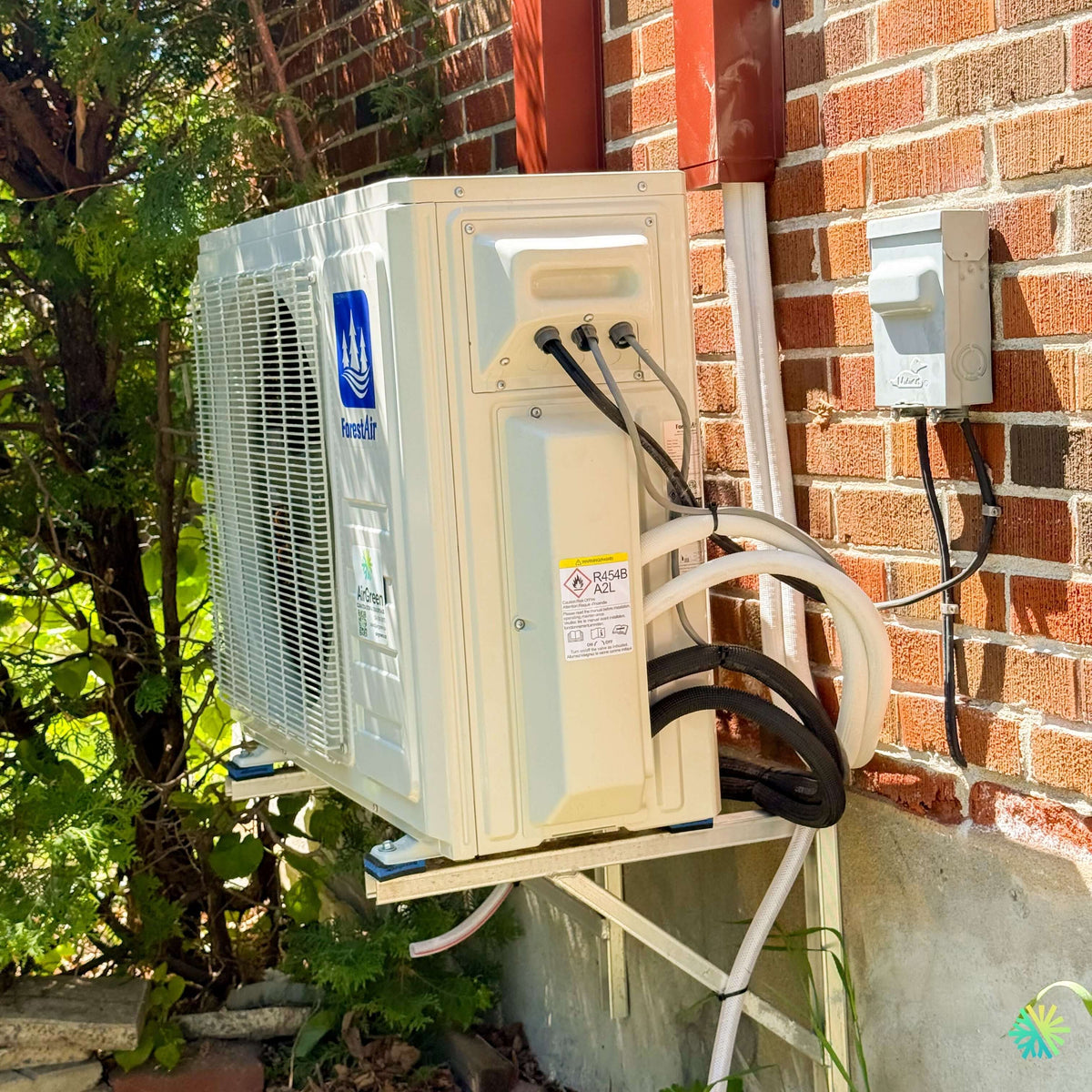
For this installation, the FORESTAIR outdoor unit was mounted on a sturdy wall structure with brackets suited to the weight of the equipment.
This installation method offers several advantages:
- reduced ground-level clutter;
- better protection against snow accumulation;
- reduced risks associated with standing water or debris;
- easier access for HVAC maintenance.
In Quebec, installing the outdoor unit must always take winter conditions into account. A heat pump installed too close to the ground may be exposed to ice, blowing snow, or water accumulation from defrost cycles.
The wall bracket used for this project therefore maintains adequate clearance around the unit so that air can circulate properly.
A clean, durable exterior finish
One of the important aspects of a professional installation is not only the machine’s performance, but also its visual integration.
For this installation in Saint-Anicet, we paid particular attention to the routing of the lines:
- adequate insulation of the refrigerant lines;
- cable protection;
- properly directed drainage;
- maintaining a clean exterior appearance.
Line covers also help extend the installation's lifespan by protecting components from UV rays, weather, and significant temperature fluctuations.
A properly completed HVAC installation must be technically efficient while maintaining a neat appearance on the home's exterior.
The steps for installing a FORESTAIR dual-zone heat pump
Assessment of indoor unit locations
Before installation, our team evaluates several factors:
- the size of the rooms;
- the location of doors and openings;
- natural air circulation;
- the areas that require more heating or cooling.
A common mistake is to install a wall-mounted unit solely based on ease of access. However, its location directly affects air distribution and system performance.
For a dual-zone installation, each indoor head must be positioned to effectively cover its area without creating zones that are too cold or too warm.
Installation of refrigerant lines and connections
A wall-mounted heat pump requires a connection between the outdoor unit and the indoor units that includes:
- refrigerant lines;
- communication cables;
- the power supply;
- condensate drain lines.
At AirGreen, we place great importance on finishing work because improper conduit installation can lead to future problems:
- performance losses;
- water infiltration;
- vibrations;
- excessive noise;
- reduced compressor lifespan.
Each connection must be made according to the manufacturer's recommendations to preserve the equipment's reliability.
The benefits of a FORESTAIR MZ heat pump for a home in Quebec
Efficient heating during the colder seasons
A modern heat pump is no longer used only to cool a home during the summer. Recent models are designed to provide efficient heating for much of the year.
In Saint-Anicet, as throughout Quebec, the primary needs often concern the fall and spring seasons, when conventional electric heating becomes less economical.
A heat pump can then transfer the heat present in the outdoor air into the home, consuming less electricity than traditional resistance heating.
Comfortable air conditioning during the summer
During the hot and humid days of the Montérégie region, a dual-zone installation helps maintain a comfortable indoor environment.
Benefits include:
- reduced humidity;
- more stable temperature;
- quiet operation;
- customized control according to the rooms in use.
For a home where some rooms are occupied more frequently than others, this flexibility is a significant advantage.
Common mistakes to avoid when installing a wall-mounted heat pump
Choosing a unit based solely on price
A heat pump is a long-term investment. The initial price should never be the only criterion.
An improperly selected unit can lead to:
- inefficient operating cycles;
- insufficient comfort;
- higher electricity consumption;
- premature wear.
Sizing must take the home, insulation, sun exposure, and occupants’ habits into account.
Neglecting HVAC maintenance
Even an excellent heat pump requires regular maintenance.
We particularly recommend:
- filter cleaning;
- coil inspection;
- drainage inspection;
- performance checks;
- professional cleaning when necessary.
Preventive HVAC maintenance helps maintain energy efficiency and extend the system’s service life.
AirGreen’s expertise in heat pump installations in Quebec
Every installation completed by AirGreen is based on a comprehensive approach: needs analysis, equipment selection, professional installation, and post-installation support.
Whether for a home in Montreal, Laval, Longueuil, the North Shore, or the South Shore, we adapt our solutions to the building’s actual characteristics.
This installation of a FORESTAIR MZ dual-zone heat pump in Saint-Anicet demonstrates the importance of precise work: modern equipment, proper mounting, a clean exterior finish, and a configuration designed to maximize occupant comfort.
A good HVAC installation is not just about mounting a unit on a wall. It is about creating a durable solution that will operate efficiently year after year.
The job tools
Two quick checks with real numbers: what heat costs, and what your current heaters add up to in BTU/h.
Conversion: 1 W = 3.412 BTU/h. An indication, not a load calculation: baseboards and furnaces are often stronger than the real need, and they can stay as backup. AirGreen confirms the capacity on site.
How the job unfolds
The main steps of this kind of job at AirGreen. Every house has its quirks: the estimate brings them out.
We look at the room, the outside wall, the line route and where the outdoor unit will go. That is where the capacity gets chosen.
Model, capacity and price, in writing. We also check whether the model qualifies for assistance programs.
Floors and furniture protected, wall plate position marked level, wall opening located.
A single opening, with the slope the drain needs to flow outside.
Set on a stand raised above the snow, with the clearances the manufacturer requires.
Connected, insulated and protected. The opening is then sealed against water, cold air and insects.
A dedicated circuit and an accessible disconnect near the outdoor unit.
Leak test, vacuum, then start-up and a check of heating and cooling.
Remote, modes, filters: we show you the essentials before we leave.
- The on-site estimateWe look at the room, the outside wall, the line route and where the outdoor unit will go. That is where the capacity gets chosen.
- The quoteModel, capacity and price, in writing. We also check whether the model qualifies for assistance programs.
- Getting readyFloors and furniture protected, wall plate position marked level, wall opening located.
- The wall openingA single opening, with the slope the drain needs to flow outside.
- The outdoor unitSet on a stand raised above the snow, with the clearances the manufacturer requires.
- Lines, cable and drainConnected, insulated and protected. The opening is then sealed against water, cold air and insects.
- The electrical workA dedicated circuit and an accessible disconnect near the outdoor unit.
- Tests and start-upLeak test, vacuum, then start-up and a check of heating and cooling.
- The walkthroughRemote, modes, filters: we show you the essentials before we leave.
What we check on a job like this one
Each number is a point we check on site. Switch between summer and winter to watch air and heat move.
In summer, the outdoor unit rejects the house's heat outside.
Generic illustration of this type of installation, not a survey of this job site. Tap a number.
Mounted level on a wall plate, high enough for the air to reach the whole room, with enough space around it to slide the filters out easily.
The refrigerant lines, the communication cable and the drain go through the wall in a single opening, sealed against water, cold air and insects.
Two insulated copper pipes connect the two units. Outside, a line cover can protect them from sun, knocks and weather.
A shut-off switch near the outdoor unit isolates it safely for service. It must stay accessible at all times.
The compressor and the fan. In heating mode it captures heat from the outdoor air, even in winter, and moves it inside.
On the ground or on the wall, it keeps the unit above accumulated snow. The unit stays clear and defrost water can drain away.
The fan needs to blow freely. Storage, a fence or a wall too close, and efficiency drops while noise goes up.
Is your home ready?
Check what applies at your place. A "no" is not a refusal: it is what we sort out during the estimate.
Good habits, once the unit is in place
Six simple habits that keep the unit going. Your list stays on this device.
What to do, season by season
Three habits per season for this unit. They take a few minutes and prevent many calls.
- Clean the indoor unit's filters.
- Clear leaves and debris left on the outdoor unit by winter.
- Test cooling before the first hot days.
- Clean the filters more often when the unit runs a lot.
- Keep plants away from the outdoor unit.
- Check that no water drips from the indoor unit.
- Rake the leaves around the outdoor unit.
- Test heating before the first cold days.
- Book periodic maintenance before winter.
- Keep snow away from the stand and the front of the unit.
- Let the unit defrost: it is normal.
- Never hit the ice on the fins; call us if the unit stays iced up.
The right pages, at the right time
Four statements: true or false?
It all comes down to details you have just seen.
1. In heating mode, the outdoor unit can produce water.
During defrost cycles. That water must drain away without forming ice.
2. You pick the capacity with a simple square-footage rule.
Windows, insulation, orientation and how the room is used all count. Capacity is chosen on site.
3. A multi-zone connects several indoor heads to a single condenser.
One head per room, all on the same condenser. Each room keeps its own temperature.
4. The disconnect can sit behind the patio furniture.
It must stay accessible: it is what shuts the unit off for service.
0 / 4 right answers
What people ask us about this kind of work
Does a wall-mounted heat pump heat in winter?
Wall-mounted or multi-zone: how do I choose?
Where does the outdoor unit go?
Are there grants?
Do I need a permit?
How cold can it heat?
How much can I save?
How is the LogisVert assistance calculated?
Is it noisy?
The outdoor unit is covered in ice: is that normal?
Does AirGreen hold the required licences?
Is the estimate free?
No question matches. Write to us: we answer.
More jobs to see, near you
By town, by equipment or by region: browse more than 4,700 published projects.
Each dot: a town where AirGreen has published projects. The glowing dot: this job.
An on-site estimate, the right capacity, the right equipment.
The on-site estimate is free and the quote follows within 24 hours.
Text and photo: a real AirGreen Climatisation & Chauffage job. The diagrams are generic illustrations of the type of installation, not a survey of this job site. Sources of the added figures: airgreen.ca product pages (NEEP / AHRI performance), Hydro-Québec (Heat pumps page, LogisVert, read on 13 October 2026), Régie de l’énergie (rate D as of 1 April 2026).