
Installation of a MIDEA MIDEA28 dual-zone heat pump in Baie-D'Urfé: two wall-mounted units, one outdoor unit, precise and discreet comfort
AirGreen installs a MIDEA MIDEA28 dual-zone heat pump in Baie-D'Urfé: two wall-mounted units, one outdoor unit, precise comfort, and meticulous HVAC installation.
Take a tour of the installation
Each number is a point we check on site. Switch between summer and winter to watch air and heat move.
In summer, the outdoor unit rejects the house's heat outside.
Generic illustration of this type of installation, not a survey of this job site. Tap a number.
Mounted level on a wall plate, high enough for the air to reach the whole room, with enough space around it to slide the filters out easily.
The refrigerant lines, the communication cable and the drain go through the wall in a single opening, sealed against water, cold air and insects.
Two insulated copper pipes connect the two units. Outside, a line cover can protect them from sun, knocks and weather.
A shut-off switch near the outdoor unit isolates it safely for service. It must stay accessible at all times.
The compressor and the fan. In heating mode it captures heat from the outdoor air, even in winter, and moves it inside.
On the ground or on the wall, it keeps the unit above accumulated snow. The unit stays clear and defrost water can drain away.
The fan needs to blow freely. Storage, a fence or a wall too close, and efficiency drops while noise goes up.
An HVAC installation designed to optimize two spaces without cluttering the home
In Baie-D’Urfé, the AirGreen team carried out a particularly interesting residential HVAC installation: a MIDEA MIDEA28 dual-zone heat pump, consisting of two indoor wall-mounted units connected to a single outdoor unit. This type of configuration is often sought after by homeowners who wish to improve the comfort of several rooms, without multiplying visible outdoor equipment or complicating the home's mechanical layout.
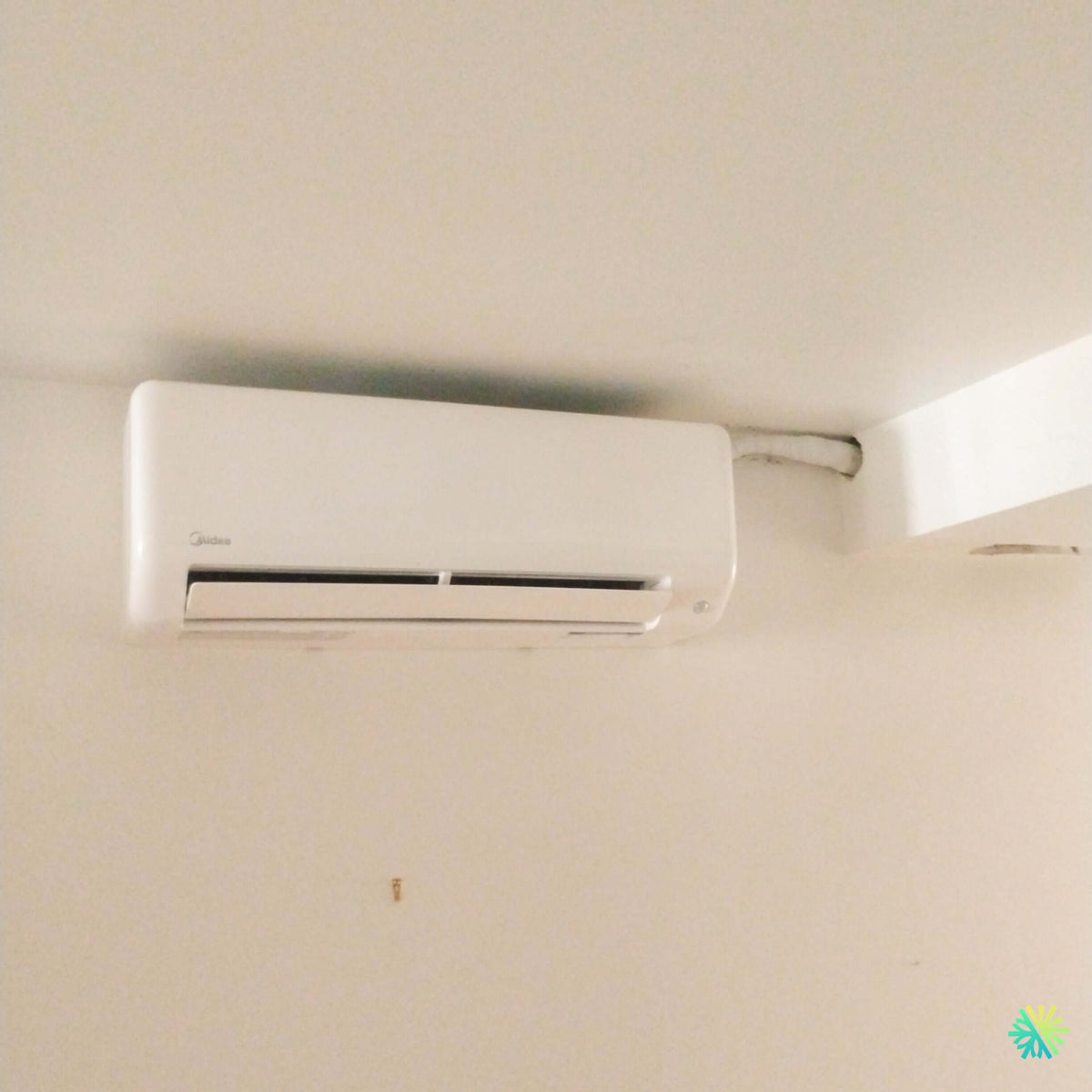
In this project, the objective was clear: to provide efficient heating and cooling in two distinct areas of the residence, while respecting existing architectural constraints. The installation image clearly shows one of the essential elements of the project: a MIDEA wall-mounted unit installed very close to the ceiling, in a space where ducting had to be handled with care. Notably, the proximity of a soffit and a wall corner required precise planning to ensure the appliance's aesthetics, accessibility, and performance.
Why a MIDEA28 dual-zone heat pump in Baie-D’Urfé?
In many homes in the West Island, including those in Baie-D’Urfé, comfort needs are not always uniform from one room to another. A sun-exposed bedroom, a home office, an open living room, or a section further from the central system may require a more flexible solution than a simple single-zone wall-mounted air conditioner.
The MIDEA MIDEA28 dual-zone heat pump precisely meets this need. With a single outdoor unit and two indoor units, it allows two zones to be controlled independently, giving the owner better temperature control while reducing energy losses associated with heating or cooling unused rooms.
For this project, we recommended this configuration for several reasons:
- excellent comfort flexibility in two separate spaces;
- a single outdoor unit, more discreet and simpler to integrate;
- technology adapted to Quebec winters;
- reliable heating and cooling performance;
- an interesting solution for homes without existing ducts;
- a more targeted installation than a complete central system.
A wall-mounted unit installed in a confined space: precision, finish, and air circulation
One of the most important aspects of this installation was the positioning of the wall-mounted unit visible in the photo. The unit is placed high on the wall, near the ceiling, with piping exiting to the right side. This type of configuration requires clean execution, as every detail matters: drain slope, minimal clearance, refrigerant line routing, finish aesthetics, and accessibility for HVAC maintenance.
At AirGreen, we pay particular attention to these details, because a poorly positioned wall-mounted heat pump can create several long-term problems: inadequate condensation drainage, unnecessary noise, less efficient air distribution, or difficult access for filter cleaning.
In this specific case, our team worked with the constraints of the wall and ceiling to maintain a functional and discreet installation. The positioning allows air to diffuse efficiently throughout the room, while keeping the indoor unit well integrated into the space.
Key steps in this MIDEA dual-zone installation
Analysis of the two zones before installation
Before installing a dual-zone heat pump, it is important to understand the real needs of each space. A common mistake is to choose based solely on total area, without considering room orientation, insulation, ceiling height, number of windows, or daily use of the zones.
For this residence in Baie-D’Urfé, our team validated:
- the optimal location of the two wall-mounted units;
- the route of the refrigerant lines;
- the positioning of the outdoor unit;
- condensation drainage management;
- necessary clearances for maintenance;
- the interior and exterior visual impact;
- the capacity required to ensure stable comfort.
This step is essential, especially in a two-head wall-mounted installation. Each head must be sized and positioned for its zone, while remaining compatible with the capacity of the outdoor unit.
Installation of indoor units
The two wall-mounted units were installed with particular attention to support solidity, alignment, and finish. On the head visible in the image, we note that the unit is placed in an area where the wall meets a soffit. This proximity requires great precision, as the unit must not be too cramped against surrounding surfaces.
A good installation must allow for:
- adequate air intake from above;
- free air diffusion into the room;
- easy access to filters;
- correct condensation drainage;
- a clean finish around the ducts.
In this type of project, aesthetics are as important as performance. A successful HVAC installation must not only function but also respect the interior of the home.
Refrigerant line routing and drainage management
Routing refrigerant lines is often one of the most delicate parts of a dual-zone installation. The two indoor units must be connected to the outdoor unit by refrigerant lines, communication wiring, and a drainage system.
In an existing house, it is rarely possible to follow a perfectly direct route. Our job is therefore to find the best compromise between performance, durability, accessibility, and appearance.
For this project, we ensured that the lines were installed safely, with adequate protection and a well-respected drainage slope. Poor condensation management can cause moisture marks, odors, blockages, or damage to interior surfaces. That's why we always check the flow before finalizing the installation.
Outdoor unit installation
The outdoor unit of a MIDEA28 heat pump must be placed in a location that respects technical clearances, while minimizing noise and visual disturbances. In Baie-D’Urfé, as in many residential areas of Montreal, Laval, Longueuil, the North Shore, and the South Shore, exterior integration is often an important issue.
Our team considers several elements:
- distance from windows;
- air circulation around the unit;
- possible snow accumulation;
- access for service;
- support stability;
- length of refrigerant lines;
- visual impact for the owner and neighbors.
A well-installed outdoor unit directly contributes to the system's longevity. It also allows the heat pump to operate with less effort, improving efficiency and reducing premature wear.
Commissioning and final checks
Once the units are installed, we proceed with a complete commissioning. This step is often underestimated, but it is essential to ensure lasting performance.
We check, in particular:
- communication between the outdoor unit and the two wall-mounted units;
- heating and cooling modes;
- pressure and tightness of the refrigerant circuit;
- condensation water drainage;
- remote control response;
- sound stability;
- air distribution in each zone;
- cleanliness of the finish.
For the client, this step is also an opportunity to receive clear explanations on system use: temperature settings, recommended modes, filter maintenance, and seasonal best practices.
What this installation teaches homeowners in Baie-D’Urfé and Greater Montreal
Do not choose a heat pump based solely on price
The choice of a dual-zone heat pump must be made according to the actual configuration of the house. A system that is too small will constantly work at full capacity, while a system that is too large can create discomfort, short cycles, and less effective dehumidification.
The MIDEA MIDEA28 represents a very interesting option for homeowners who want a high-performance, modern, and well-suited solution for two zones. However, even an excellent machine must be installed correctly to deliver its full potential.
At AirGreen, we regularly see installations where the problem does not come from the brand, but from the planning: poorly positioned heads, misaligned drains, overly cramped outdoor units, poorly protected lines, or incorrectly estimated capacity. This is precisely what we aim to avoid in each of our projects.
The importance of wall unit positioning
The photo of this installation shows a very concrete point: the location of a wall-mounted unit is never trivial. It is necessary to consider the structure, the ceiling, obstacles, air circulation, and the overall appearance.
A head installed too close to an obstacle can hinder air intake. A head placed too low can cause direct discomfort. A poorly centered head can heat or cool part of the room less efficiently. In a house with multiple zones, these details become even more important.
Plan for maintenance from the start
A good HVAC system must be easy to maintain. Filters must be accessible, heads must be cleanable, and the outdoor unit must remain reachable for inspections.
For a dual-zone wall-mounted heat pump, we generally recommend:
- regular filter cleaning;
- a visual inspection of the indoor units;
- a drainage check;
- periodic professional cleaning;
- special attention before periods of heavy use.
Good HVAC maintenance helps maintain performance, reduce odors, improve air quality, and extend the system's lifespan.
A solution adapted to existing homes
Dual-zone wall-mounted heat pumps are particularly useful in homes where adding ducts would be costly, invasive, or impossible. They improve comfort without undertaking major central ventilation work.
In the Baie-D’Urfé area, many residences have configurations where a ductless solution is more logical: extensions, remote rooms, floors with different needs, home offices, or bedrooms difficult to air condition. A dual-zone heat pump then allows for a targeted and effective approach.
Subsidies and energy eligibility
Depending on the exact model, the installed configuration, and the criteria in force at the time of application, certain heat pumps may be eligible for financial aid programs such as energy efficiency subsidies. Eligibility depends notably on AHRI numbers, energy performance, installed capacity, and the conditions of the applicable program.
At AirGreen, we help our clients understand the important criteria before installation. This helps avoid unpleasant surprises and choose equipment that meets both comfort needs and administrative requirements when subsidies are available.
The AirGreen approach: technical, transparent, and adapted to the field
Every AirGreen installation is based on a simple idea: a good recommendation must match the house, not just a technical sheet. In this Baie-D’Urfé project, the MIDEA MIDEA28 dual-zone heat pump was chosen because it met the client's needs, the building's constraints, and the goal of comfort in two distinct spaces.
Our experience in Greater Montreal allows us to quickly recognize the pitfalls of a poorly planned installation. Whether in Montreal, Laval, Longueuil, on the North Shore, or the South Shore, we apply the same rigor: precise evaluation, clean installation, clear communication, and complete commissioning.
This installation perfectly illustrates what we seek in every project: a high-performance system, a meticulous finish, discreet integration, and lasting comfort.
Practical tips before installing a dual-zone heat pump
Before choosing a dual-zone heat pump, it's helpful to validate a few essential points:
- Determine which rooms genuinely need independent control.
- Check if the refrigerant line routing can be done neatly.
- Choose wall unit locations that promote good air circulation.
- Plan for cleaning and maintenance access.
- Confirm the appropriate capacity for each zone.
- Validate the outdoor unit location to avoid noise, snow, or access constraints.
- Request installation by a team experienced in residential HVAC.
A well-chosen and well-installed heat pump becomes a lasting investment. It improves daily comfort, reduces reliance on less efficient systems, and provides valuable flexibility in homes where needs vary from room to room.
A clean, functional, and durable result
The final result of this installation in Baie-D'Urfé reflects a professional approach: a well-integrated wall unit, a dual-zone system designed to meet the client's actual needs, and an installation designed to function efficiently for both heating and air conditioning.
The MIDEA MIDEA28 offers a balanced solution for homeowners looking for a reliable, flexible heat pump adapted to Quebec's climate. For AirGreen, this type of project represents exactly what a good HVAC installation should be: precise, clean, durable, and truly adapted to the home.
The big day, step by step
The main steps of this kind of job at AirGreen. Every house has its quirks: the estimate brings them out.
We look at the room, the outside wall, the line route and where the outdoor unit will go. That is where the capacity gets chosen.
Model, capacity and price, in writing. We also check whether the model qualifies for assistance programs.
Floors and furniture protected, wall plate position marked level, wall opening located.
A single opening, with the slope the drain needs to flow outside.
Set on a stand raised above the snow, with the clearances the manufacturer requires.
Connected, insulated and protected. The opening is then sealed against water, cold air and insects.
A dedicated circuit and an accessible disconnect near the outdoor unit.
Leak test, vacuum, then start-up and a check of heating and cooling.
Remote, modes, filters: we show you the essentials before we leave.
- The on-site estimateWe look at the room, the outside wall, the line route and where the outdoor unit will go. That is where the capacity gets chosen.
- The quoteModel, capacity and price, in writing. We also check whether the model qualifies for assistance programs.
- Getting readyFloors and furniture protected, wall plate position marked level, wall opening located.
- The wall openingA single opening, with the slope the drain needs to flow outside.
- The outdoor unitSet on a stand raised above the snow, with the clearances the manufacturer requires.
- Lines, cable and drainConnected, insulated and protected. The opening is then sealed against water, cold air and insects.
- The electrical workA dedicated circuit and an accessible disconnect near the outdoor unit.
- Tests and start-upLeak test, vacuum, then start-up and a check of heating and cooling.
- The walkthroughRemote, modes, filters: we show you the essentials before we leave.
What would it look like at your place?
Two quick checks with real numbers: what heat costs, and what your current heaters add up to in BTU/h.
Conversion: 1 W = 3.412 BTU/h. An indication, not a load calculation: baseboards and furnaces are often stronger than the real need, and they can stay as backup. AirGreen confirms the capacity on site.
Four mistakes we do not make
Flip each card to see what we do instead.
Your own project, step by step
What to do, season by season
Three habits per season for this unit. They take a few minutes and prevent many calls.
- Clean the indoor unit's filters.
- Clear leaves and debris left on the outdoor unit by winter.
- Test cooling before the first hot days.
- Clean the filters more often when the unit runs a lot.
- Keep plants away from the outdoor unit.
- Check that no water drips from the indoor unit.
- Rake the leaves around the outdoor unit.
- Test heating before the first cold days.
- Book periodic maintenance before winter.
- Keep snow away from the stand and the front of the unit.
- Let the unit defrost: it is normal.
- Never hit the ice on the fins; call us if the unit stays iced up.
Is your home ready?
Check what applies at your place. A "no" is not a refusal: it is what we sort out during the estimate.
Four statements: true or false?
It all comes down to details you have just seen.
1. In heating mode, the outdoor unit can produce water.
During defrost cycles. That water must drain away without forming ice.
2. You pick the capacity with a simple square-footage rule.
Windows, insulation, orientation and how the room is used all count. Capacity is chosen on site.
3. A multi-zone connects several indoor heads to a single condenser.
One head per room, all on the same condenser. Each room keeps its own temperature.
4. The disconnect can sit behind the patio furniture.
It must stay accessible: it is what shuts the unit off for service.
0 / 4 right answers
What people ask us about this kind of work
Does a wall-mounted heat pump heat in winter?
Wall-mounted or multi-zone: how do I choose?
Where does the outdoor unit go?
Are there grants?
Do I need a permit?
How cold can it heat?
How much can I save?
How is the LogisVert assistance calculated?
Is it noisy?
The outdoor unit is covered in ice: is that normal?
Does AirGreen hold the required licences?
Is the estimate free?
No question matches. Write to us: we answer.
More jobs to see, near you
By town, by equipment or by region: browse more than 4,700 published projects.
Each dot: a town where AirGreen has published projects. The glowing dot: this job.
Every house has its constraints. We see them before we install.
The on-site estimate is free and the quote follows within 24 hours.
Text and photo: a real AirGreen Climatisation & Chauffage job. The diagrams are generic illustrations of the type of installation, not a survey of this job site. Sources of the added figures: airgreen.ca product pages (NEEP / AHRI performance), Hydro-Québec (Heat pumps page, LogisVert, read on 13 October 2026), Régie de l’énergie (rate D as of 1 April 2026).