
Installation of a FUJITSU Aquila XLTH R32 TripleZone 36,000 BTU Heat Pump in Brossard
Discover a TripleZone FUJITSU Aquila XLTH 36,000 BTU HVAC installation in Brossard. 3-zone comfort, high energy efficiency, and LogisVert subsidy. AirGreen expertise in Montreal, Laval, and the South Shore.
Take a tour of the installation
Each number is a point we check on site. Switch between summer and winter to watch air and heat move.
In summer, the outdoor unit rejects the house's heat outside.
Generic illustration of this type of installation, not a survey of this job site. Tap a number.
Mounted level on a wall plate, high enough for the air to reach the whole room, with enough space around it to slide the filters out easily.
The refrigerant lines, the communication cable and the drain go through the wall in a single opening, sealed against water, cold air and insects.
Two insulated copper pipes connect the two units. Outside, a line cover can protect them from sun, knocks and weather.
A shut-off switch near the outdoor unit isolates it safely for service. It must stay accessible at all times.
The compressor and the fan. In heating mode it captures heat from the outdoor air, even in winter, and moves it inside.
On the ground or on the wall, it keeps the unit above accumulated snow. The unit stays clear and defrost water can drain away.
The fan needs to blow freely. Storage, a fence or a wall too close, and efficiency drops while noise goes up.
A Strategic HVAC Installation for Perfectly Distributed Comfort Across Three Zones
In Brossard, on Montreal's South Shore, we recently completed a full HVAC installation of a FUJITSU Aquila XLTH R32 36,000 BTU TripleZone heat pump in a brick single-family home. This project perfectly illustrates the modern challenges of Quebec homes: efficiently distributing heating and air conditioning across multiple floors while maximizing energy efficiency.
The client wanted to replace an old, inefficient, and noisy electric system with a solution capable of heating effectively down to -26°C, while also providing stable air conditioning in the summer. The objective was clear: improve comfort in three distinct zones (basement, ground floor, and upper floor), while reducing energy costs.
Technical Challenges Encountered and Tailored Solutions Proposed
Restricted Outdoor Configuration and Optimized Placement
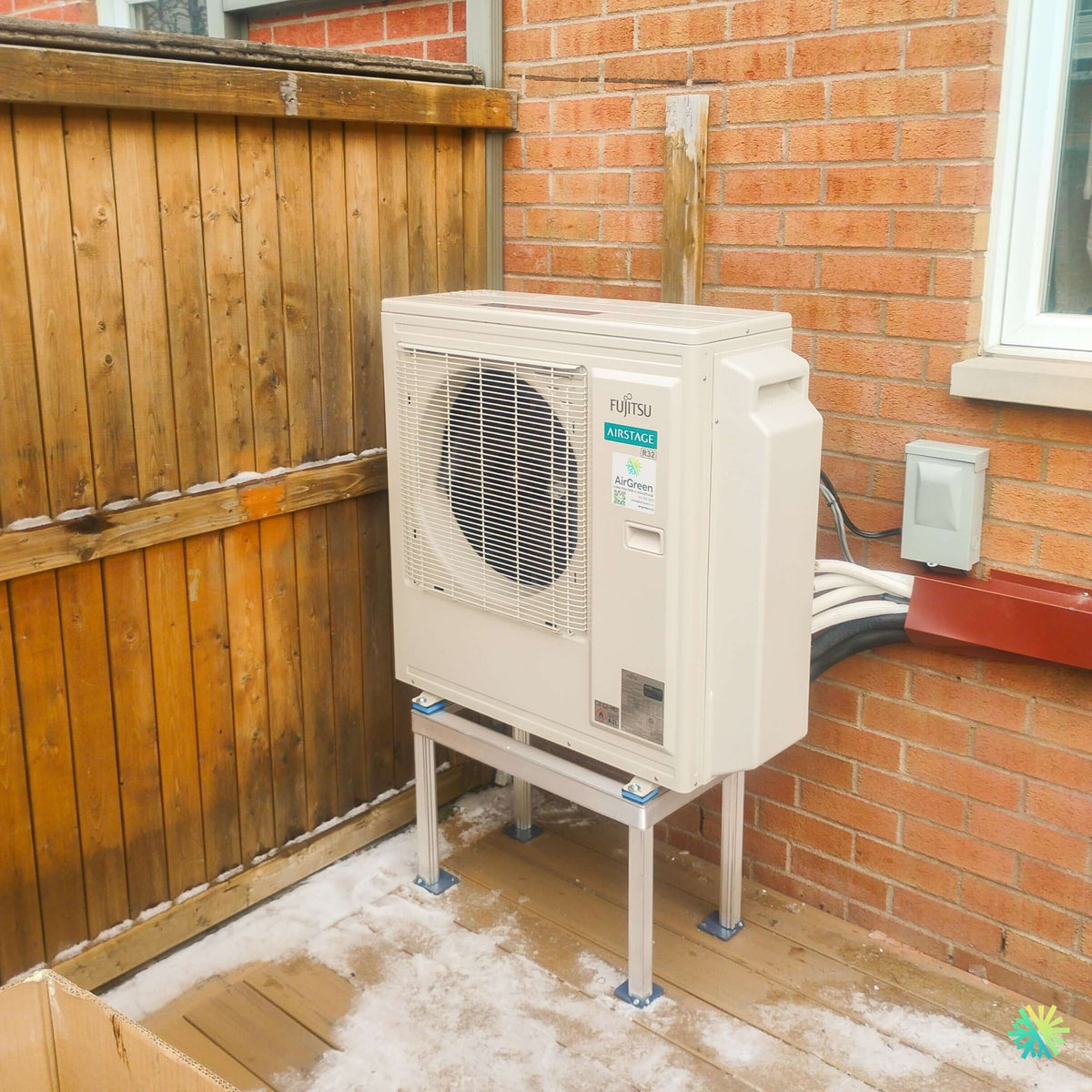
The outdoor unit was installed in a relatively narrow space, between a wooden fence and a brick wall. This type of configuration is common in Brossard and on the South Shore, but it requires particular attention:
- Respect minimum clearances to ensure good air circulation
- Installation on raised supports to prevent snow accumulation
- Reduction of vibrations using anti-vibration pads
- Strategic positioning to minimize noise for neighbors
We installed the unit on a raised, solidly anchored metal base to ensure its durability even in extreme winter conditions.
Refrigerant Line Passage and Aesthetic Integration
The refrigerant lines were carefully routed along the exterior wall, then channeled to the three indoor units. We used white protective conduits perfectly integrated into the house's architecture, ensuring:
- A clean and professional finish
- Protection against bad weather
- Improved durability of components
This type of installation is essential to preserve the exterior aesthetics, especially in well-maintained residential neighborhoods in Brossard.
Technical Details of the FUJITSU Aquila XLTH TripleZone Heat Pump
Power Adapted to Quebec Realities
The installed FUJITSU Aquila XLTH R32 heat pump has the following characteristics:
- Total Capacity: 36,000 BTU
- Type: Multi-zone (TripleZone)
- Refrigerant Gas: R-32 (more ecological)
- Heating Capacity: down to -26°C
- SEER2: 22.0
- HSPF2: 10.0
- EER2: 13.0
- Outdoor Sound Level: 56 dB(A)
This configuration allows three indoor units to be connected with customized combinations according to room needs (e.g., 9+9+18 BTU).
Performance in Extreme Conditions
Thanks to XLTH (Extra Low Temperature Heating) technology, this heat pump maintains stable performance even during the harsh winters of Montreal, Laval, and Longueuil. Unlike standard systems, it does not significantly lose efficiency when the temperature drops.
Zone Distribution: Tailored Comfort
Zone 1: Ground Floor
The main living area benefits from a wall-mounted unit providing constant comfort, even with external temperature variations.
Zone 2: Upper Floor
A second unit ensures optimal comfort in the bedrooms, with quiet operation (down to 19 dB), ideal for sleep.
Zone 3: Basement
The basement, often difficult to heat, is now perfectly tempered thanks to efficient air distribution.
This multi-zone approach avoids unnecessary energy loss and allows for temperature adjustment room by room.
Subsidy and Real Savings for the Customer
LogisVert Program: A Major Advantage
This installation is eligible for a subsidy of up to $2928 through Hydro-Québec's LogisVert program. At AirGreen, we support our clients through all stages:
- Eligibility verification
- Document preparation
- Application submission
Reduced Energy Costs
In this specific project, the client expects a reduction of:
- 30% to 40% on heating costs
- Much more efficient air conditioning in summer
- Better overall thermal stability
What Sets Our AirGreen Approach Apart
An Installation Designed to Last
Each installation is performed according to strict standards:
- Compliance with RBQ standards
- Rigorous material selection
- Full system testing (pressure, vacuum, performance)
- Airflow verification and balancing
Specific Expertise in FUJITSU Systems
We have perfect mastery of FUJITSU multi-zone systems, which allows us to:
- Optimize zone configuration
- Avoid sizing errors
- Ensure maximum performance
Transparency and Comprehensive Support
We offer our clients:
- A clear and detailed estimate
- No hidden fees
- Payment only upon completion of work
- Fast and efficient post-installation support
Common Mistakes to Avoid in a Multi-Zone Installation
Many homeowners make certain mistakes when choosing a triple-zone heat pump:
- Undersizing the total capacity
- Neglecting the outdoor unit's location
- Choosing installers without multi-zone experience
- Ignoring available subsidies
In this Brossard project, we avoided these pitfalls through a comprehensive analysis of the client's needs.
Final Result: Comfort, Silence, and Efficiency
After installation, the client immediately noticed:
- A significant improvement in comfort in all rooms
- A significant reduction in noise compared to the old system
- Better temperature management by zone
The aesthetic integration of the outdoor unit and conduits was also highly appreciated.
Why This Type of Heat Pump is Ideal for Brossard and the South Shore
Brossard homes often feature:
- Multiple floors
- Open spaces
- Varying heating needs
The FUJITSU Aquila XLTH TripleZone heat pump perfectly addresses these realities by offering exceptional flexibility.
At AirGreen, we recommend this type of system for:
- Single-family homes
- Duplexes and triplexes
- Major renovations
Conclusion: A Sustainable and Smart HVAC Solution
This installation in Brossard clearly demonstrates the efficiency of a high-performance multi-zone system when properly designed and installed. The FUJITSU Aquila XLTH 36,000 BTU represents a smart choice for homeowners seeking to combine comfort, savings, and durability.
At AirGreen, we continue to support residents of Montreal, Laval, Longueuil, as well as the entire North Shore and South Shore, in their heat pump, air conditioning, and HVAC heating projects with recognized expertise and a rigorous approach.
The big day, step by step
The main steps of this kind of job at AirGreen. Every house has its quirks: the estimate brings them out.
We look at the room, the outside wall, the line route and where the outdoor unit will go. That is where the capacity gets chosen.
Model, capacity and price, in writing. We also check whether the model qualifies for assistance programs.
Floors and furniture protected, wall plate position marked level, wall opening located.
A single opening, with the slope the drain needs to flow outside.
Set on a stand raised above the snow, with the clearances the manufacturer requires.
Connected, insulated and protected. The opening is then sealed against water, cold air and insects.
A dedicated circuit and an accessible disconnect near the outdoor unit.
Leak test, vacuum, then start-up and a check of heating and cooling.
Remote, modes, filters: we show you the essentials before we leave.
- The on-site estimateWe look at the room, the outside wall, the line route and where the outdoor unit will go. That is where the capacity gets chosen.
- The quoteModel, capacity and price, in writing. We also check whether the model qualifies for assistance programs.
- Getting readyFloors and furniture protected, wall plate position marked level, wall opening located.
- The wall openingA single opening, with the slope the drain needs to flow outside.
- The outdoor unitSet on a stand raised above the snow, with the clearances the manufacturer requires.
- Lines, cable and drainConnected, insulated and protected. The opening is then sealed against water, cold air and insects.
- The electrical workA dedicated circuit and an accessible disconnect near the outdoor unit.
- Tests and start-upLeak test, vacuum, then start-up and a check of heating and cooling.
- The walkthroughRemote, modes, filters: we show you the essentials before we leave.
What would it look like at your place?
Two quick checks with real numbers: what heat costs, and what your current heaters add up to in BTU/h.
Conversion: 1 W = 3.412 BTU/h. An indication, not a load calculation: baseboards and furnaces are often stronger than the real need, and they can stay as backup. AirGreen confirms the capacity on site.
Four mistakes we do not make
Flip each card to see what we do instead.
Your own project, step by step
What to do, season by season
Three habits per season for this unit. They take a few minutes and prevent many calls.
- Clean the indoor unit's filters.
- Clear leaves and debris left on the outdoor unit by winter.
- Test cooling before the first hot days.
- Clean the filters more often when the unit runs a lot.
- Keep plants away from the outdoor unit.
- Check that no water drips from the indoor unit.
- Rake the leaves around the outdoor unit.
- Test heating before the first cold days.
- Book periodic maintenance before winter.
- Keep snow away from the stand and the front of the unit.
- Let the unit defrost: it is normal.
- Never hit the ice on the fins; call us if the unit stays iced up.
Is your home ready?
Check what applies at your place. A "no" is not a refusal: it is what we sort out during the estimate.
Four statements: true or false?
It all comes down to details you have just seen.
1. In heating mode, the outdoor unit can produce water.
During defrost cycles. That water must drain away without forming ice.
2. You pick the capacity with a simple square-footage rule.
Windows, insulation, orientation and how the room is used all count. Capacity is chosen on site.
3. A multi-zone connects several indoor heads to a single condenser.
One head per room, all on the same condenser. Each room keeps its own temperature.
4. The disconnect can sit behind the patio furniture.
It must stay accessible: it is what shuts the unit off for service.
0 / 4 right answers
What people ask us about this kind of work
Does a wall-mounted heat pump heat in winter?
Wall-mounted or multi-zone: how do I choose?
Where does the outdoor unit go?
Are there grants?
Do I need a permit?
How cold can it heat?
How much can I save?
How is the LogisVert assistance calculated?
Is it noisy?
The outdoor unit is covered in ice: is that normal?
Does AirGreen hold the required licences?
Is the estimate free?
No question matches. Write to us: we answer.
More jobs to see, near you
By town, by equipment or by region: browse more than 4,700 published projects.
Each dot: a town where AirGreen has published projects. The glowing dot: this job.
Every house has its constraints. We see them before we install.
The on-site estimate is free and the quote follows within 24 hours.
Text and photo: a real AirGreen Climatisation & Chauffage job. The diagrams are generic illustrations of the type of installation, not a survey of this job site. Sources of the added figures: airgreen.ca product pages (NEEP / AHRI performance), Hydro-Québec (Heat pumps page, LogisVert, read on 13 October 2026), Régie de l’énergie (rate D as of 1 April 2026).