
Installation of a GREE FREE MATCH R32 Quad-Zone heat pump with 4 heads in Montreal-North on a residential roof
AirGreen installs a GREE FREE MATCH R32 Quad-Zone heat pump in Montreal-North: outdoor unit on a flat roof, 4 comfort zones, clean and sustainable HVAC installation.
Take a tour of the installation
Each number is a point we check on site. Switch between summer and winter to watch air and heat move.
In summer, the outdoor unit rejects the house's heat outside.
Generic illustration of this type of installation, not a survey of this job site. Tap a number.
Mounted level on a wall plate, high enough for the air to reach the whole room, with enough space around it to slide the filters out easily.
The refrigerant lines, the communication cable and the drain go through the wall in a single opening, sealed against water, cold air and insects.
Two insulated copper pipes connect the two units. Outside, a line cover can protect them from sun, knocks and weather.
A shut-off switch near the outdoor unit isolates it safely for service. It must stay accessible at all times.
The compressor and the fan. In heating mode it captures heat from the outdoor air, even in winter, and moves it inside.
On the ground or on the wall, it keeps the unit above accumulated snow. The unit stays clear and defrost water can drain away.
The fan needs to blow freely. Storage, a fence or a wall too close, and efficiency drops while noise goes up.
A multi-zone flat-roof installation in Montréal-Nord: when performance must also respect the building's architecture
In Montréal-Nord, our AirGreen team carried out a complete HVAC installation of a GREE FREE MATCH R32 Quad-Zone heat pump, configured to power 4 distinct zones of the property. This project perfectly illustrates the level of planning required when a multi-zone system needs to be installed in a dense urban environment, with an outdoor unit positioned on a flat roof.
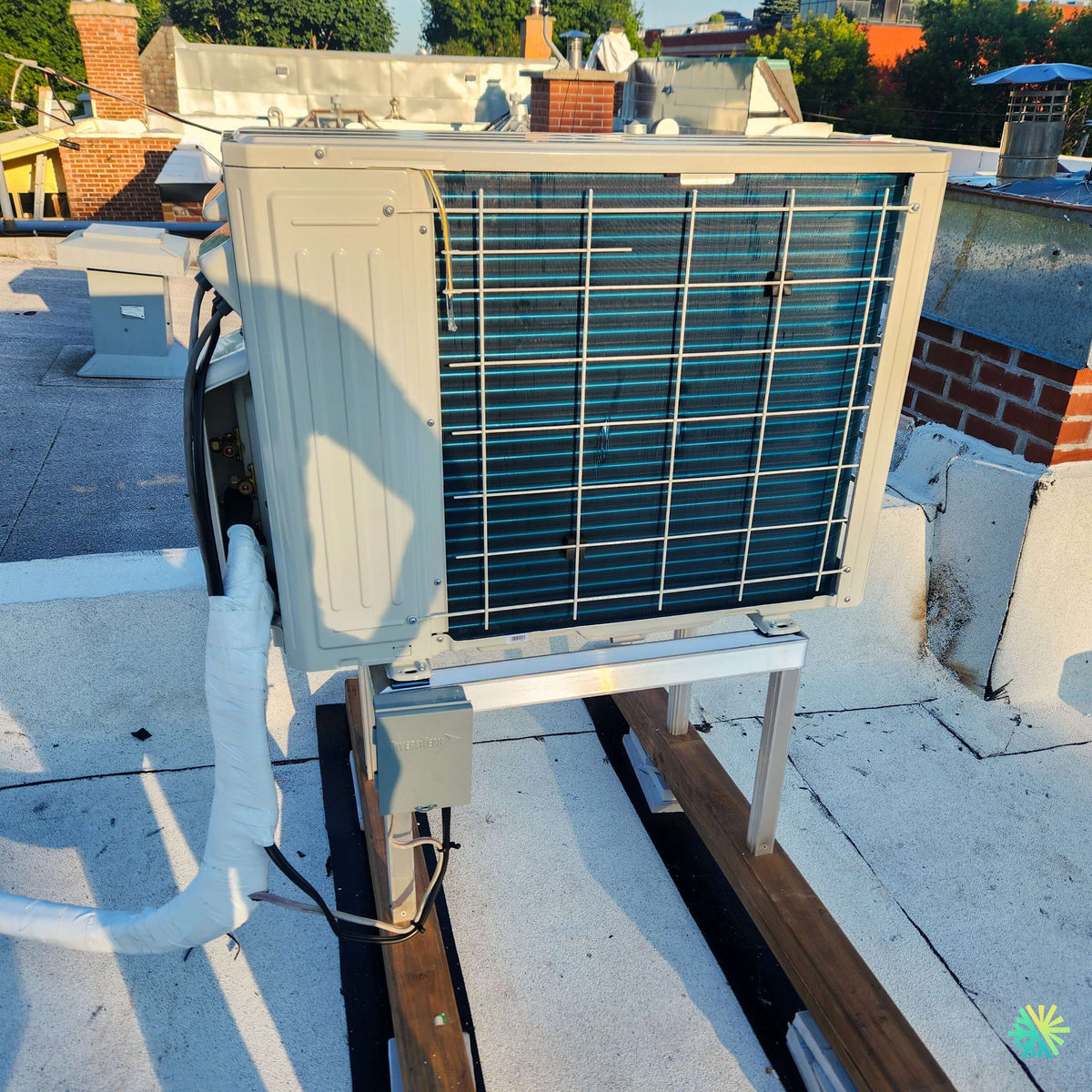
The photo of this installation shows the outdoor unit of the GREE FREE MATCH R32 solidly installed on an elevated aluminum structure, itself placed on treated wooden bases and stabilized on the roofing membrane. Also visible are the insulated refrigerant lines, the outdoor electrical box, mechanical supports, and the clearance space around the unit. These are essential details in a professional installation, especially when a Quad-Zone - 4-Zone - 4-Head heat pump system needs to operate efficiently for several seasons, both for air conditioning and heating.
In a neighborhood like Montréal-Nord, residential buildings with flat roofs are numerous. This requires very different expertise than a ground-level, balcony, or side-wall installation. The outdoor unit cannot simply be placed in a convenient location. Consideration must be given to weight, vibrations, air clearance, maintenance access, membrane protection, roof drainage, electrical standards, and visual discretion.
At AirGreen, we approach every HVAC installation as a custom project. In this specific case, the client wanted a solution capable of improving comfort in several rooms without cluttering the facade, yard, or side passages. The roof was therefore a logical choice, but only on condition of designing a stable, accessible, and durable installation.
Why a GREE FREE MATCH R32 Quad-Zone was the right choice for this Montréal-Nord property
The GREE FREE MATCH R32 is particularly well-suited for projects where multiple rooms need to be heated and cooled from a single outdoor unit. With a Quad-Zone configuration, the system can power four indoor heads, each dedicated to a specific zone of the house or dwelling.
A single outdoor unit for four living spaces
One of the great advantages of a Quad-Zone heat pump is the reduction in the number of outdoor units. Instead of installing four independent systems, a single outdoor compressor serves four indoor heads. For a property in Montréal-Nord, this approach helps preserve outdoor space, limit visual impact, and simplify the building's technical organization.
In the residential sectors of Montreal, Laval, Longueuil, the North Shore, and the South Shore, we often see homes where occupants have different needs from one room to another. A sun-exposed bedroom, a ground-floor living room, a home office, and a family room do not react in the same way to temperature variations. The multi-zone system addresses precisely this reality.
With four heads, the client can adjust each zone according to its use. This flexibility improves daily comfort and helps avoid unnecessary air conditioning or heating of rarely used rooms.
R32 refrigerant: modern technology for residential installations
The GREE FREE MATCH R32 model uses R32 refrigerant, which is increasingly present in recent heat pump systems. This choice is relevant for owners who wish to invest in a current, high-performance solution aligned with new HVAC market trends.
R32 allows for good energy efficiency and is part of a transition towards equipment better suited to modern requirements. For a client installing a multi-zone system, this is an important point: an HVAC installation is not a short-term purchase, but an investment over several years.
More stable comfort in urban buildings
Houses and dwellings in Montréal-Nord can exhibit significant temperature differences between rooms. Party walls, flat roofs, exposed windows, upper floors, and elongated spaces often create areas that are difficult to balance with a single appliance.
A GREE FREE MATCH R32 Quad-Zone heat pump can correct this problem by placing indoor heads in strategic locations. The desired result is not just a lower temperature in summer or a higher temperature in winter. The goal is to achieve a more evenly distributed sense of comfort, with fewer rooms that are too hot, too cold, or poorly ventilated.
An outdoor unit installed on the roof: the details that make the difference
The image shows an outdoor unit installed on a flat roof with particular attention paid to stability and roof protection. This part of the project deserves explanation, as it makes all the difference between a temporarily functional installation and a durable one.
An elevated structure to protect the roof
The outdoor unit is placed on an elevated metal structure. This configuration offers several advantages:
- keeping the unit above the roof surface;
- facilitating water drainage around the base;
- reducing the risk of snow accumulation directly against the unit;
- providing better airflow around the condenser;
- facilitating access for HVAC maintenance;
- preventing the unit from resting directly on the membrane.
On a flat roof, protecting the membrane is a priority. A poorly designed installation can create pressure points, lead to premature wear, or complicate roof maintenance work. Here, the base was designed to distribute the load and stabilize the equipment.
Solid and well-positioned bases
Under the structure, wooden pieces installed as support are visible. Their role is to stabilize the entire assembly, distribute the weight, and allow for secure fastening of the structure. The goal is to keep the unit in place despite normal compressor vibrations, winds, temperature variations, and the freeze-thaw cycles typical of Montreal's climate.
This type of detail is essential in a roof installation. A poorly supported unit can generate vibrations, become misaligned, or create stress on the refrigerant lines. At AirGreen, we pay particular attention to these elements that are invisible to the client but fundamental to the system's durability.
Sufficient clearance for the condenser
The visible rear face of the unit shows the heat exchanger protected by a grille. For a heat pump to operate efficiently, air must circulate freely around the unit. An outdoor unit too close to a wall, parapet, chimney, obstruction, or other equipment risks losing performance.
In this Montréal-Nord installation, the unit was positioned to maintain appropriate clearance, while also considering roof constraints. This allows the system to reject or absorb heat more efficiently, depending on the mode used.
Refrigerant line routing: insulation, protection, and precision
In the photo, the refrigerant lines are grouped and carefully insulated. In a Quad-Zone system, managing the lines is more complex than with a single wall-mounted unit. Each zone requires its connections, and the whole system must be organized to avoid stress, efficiency losses, and weather-related damage.
Why line insulation is essential
Refrigerant lines transport refrigerant between the outdoor unit and the indoor heads. Inadequate insulation can lead to thermal losses, condensation, premature degradation of materials, and reduced performance.
In this installation, the visible white insulation around the lines helps protect the system against temperature variations and external conditions. This is a very important detail for roof installations, where the lines are exposed to sun, wind, rain, snow, and frost.
Clean organization to facilitate future interventions
A good installation should not only function on the day of commissioning. It must also be accessible for inspections, verifications, and HVAC maintenance. The lines, electrical box, and connections must be arranged clearly and safely.
This logic is particularly important for multi-zone systems. When a technician returns for maintenance, diagnosis, or repair, they must be able to quickly identify connections and access components without unnecessarily dismantling the installation.
Electrical supply: safety and compliance
The image also shows an outdoor electrical box installed near the unit. This component is essential, as a Quad-Zone heat pump requires a power supply adapted to its capacity and operation.
At AirGreen, we place great importance on electrical compliance. A heat pump installation is not limited to refrigerant connections. The power supply must be properly sized, protected, and installed according to applicable rules in Quebec.
An electrical error can lead to frequent tripping, premature wear of components, or safety risks. This is why each project is coordinated with care, especially when it involves a multi-zone system that is more demanding than a simple wall-mounted unit.
Key steps in this HVAC installation in Montréal-Nord
Even though each project is unique, the installation of a GREE FREE MATCH R32 Quad-Zone follows a structured method. For this Montréal-Nord property, our team worked according to a precise sequence to ensure a clean, safe, and high-performance result.
Needs analysis and zone selection
Before work began, the four zones to be served had to be determined. This step takes into account several elements:
- the area of each room;
- sun exposure;
- daily use of the spaces;
- the distance between indoor heads and the outdoor unit;
- constraints on line routing;
- wall height;
- the comfort desired by occupants.
This analysis avoids one of the most common mistakes in multi-zone systems: installing heads simply where passage seems easy, without considering actual airflow.
Planning of the outdoor unit on the roof
The choice of the roof required particular attention. It was necessary to select a location that respects both the technical needs of the appliance and the realities of the building. A flat roof often has several obstacles: chimneys, plumbing vents, conduits, parapets, drains, antennas, existing equipment, and circulation areas.
The unit had to be placed so that it remained accessible, without blocking existing elements or creating a risk to the membrane. This step is particularly important in urban buildings in Montreal, where technical space is often limited.
Installation of supports and placement of the unit
The elevated structure was then carefully installed. Positioning must be precise, as an outdoor unit must remain stable and level. Incorrect inclination can affect internal drainage, mechanical stability, and the longevity of certain components.
Once the support was installed, the outdoor unit was put in place, secured, and checked. The goal was to achieve a solid installation, capable of withstanding external conditions without unnecessarily transmitting vibrations to the building structure.
Refrigerant connections and vacuuming
Refrigerant connections are a critical step. Lines must be cut, flared, connected, and rigorously tested. In a system using R32 refrigerant, the precision of the work is essential.
After connections, the system must be vacuumed to remove moisture and air from the lines. This step directly influences the system's reliability. Neglecting to vacuum can cause performance problems or reduce the compressor's lifespan.
Functional tests of the four zones
Once the system is installed, all four heads must be tested individually. Our team verifies:
- the startup of each zone;
- communication with the outdoor unit;
- the air conditioning mode;
- the heating mode;
- ventilation;
- response to commands;
- absence of abnormal noise;
- condensation drainage;
- operating stability.
These tests are essential for a Quad-Zone - 4-Zone - 4-Head heat pump, as an inversion or incorrect identification of lines can create control problems between zones. The final verification allows for the delivery of a reliable and consistent system.
Concrete benefits for the client
After installation, the client benefits from a system capable of managing four separate spaces, with a single outdoor unit on the roof. This configuration offers several practical advantages.
More comfort in daily used rooms
Each zone can be adjusted according to the occupants' preferences. This avoids the frequent compromises when a single thermostat controls the entire house. One room can be quickly cooled, while another remains at a more moderate temperature.
Less outdoor clutter
Since the outdoor unit is installed on the roof, the yard, exterior walls, and passages remain clear. For properties in Montréal-Nord, where space can be limited, this is a significant advantage.
Better integration into the building
Roof installation makes the equipment less visible from the street or yard. This is often a popular solution when exterior aesthetics matter or when ground-level options are limited.
A solution adapted to the actual use of the house
Multi-zone systems allow rooms to be air-conditioned or heated as needed, rather than imposing a uniform temperature throughout. This approach is particularly useful in families, multi-story dwellings, or homes with versatile rooms.
Mistakes to avoid for a Quad-Zone rooftop installation
Flat roof installation requires precise expertise. Here are the mistakes we recommend avoiding:
- placing the unit directly on the roofing membrane;
- neglecting weight distribution;
- installing the unit too close to an obstruction;
- forgetting future access for maintenance;
- poorly insulating the refrigerant lines;
- creating tension on the lines;
- underestimating the impact of wind on the roof;
- ignoring natural roof drainage;
- choosing capacity without zone analysis;
- entrusting the project to a team unfamiliar with multi-zone systems.
These errors can cause vibrations, performance issues, risks to the roofing, or costly interventions. A professional HVAC installation helps avoid these complications from the outset.
AirGreen: Local Expertise for Multi-Zone Projects in Montreal
AirGreen regularly participates in residential and commercial projects in Montreal, Laval, Longueuil, on the North Shore, and the South Shore. Multi-zone installations are part of our expertise, as they require a combination of skills: building assessment, line planning, product knowledge, refrigeration execution, electrical coordination, and attention to detail.
In this project in Montreal-North, success depended on our ability to adapt the GREE FREE MATCH R32 heat pump to an existing flat roof, while ensuring reliable operation for four zones. The result is a clean, stable installation designed to last.
Advice for homeowners considering a multi-zone heat pump
Before installing a Quad-Zone heat pump, it is useful to prepare some information. This allows the technical team to propose a more precise solution.
We recommend considering the following points:
- which rooms are most uncomfortable in summer;
- which rooms need better heating in winter;
- how many hours per day each zone is used;
- where the outdoor unit could be installed;
- whether the roof, ground, or exterior wall offers the best location;
- if exterior aesthetics are a priority;
- if access for maintenance is easy;
- if interior renovations are planned.
These elements help choose a configuration that meets real needs, rather than a too-general solution.
An installation that demonstrates the value of well-planned work
This installation of a GREE FREE MATCH R32 Quad-Zone in Montreal-North shows that a good system depends as much on the quality of the equipment as on the quality of the installation. The machine can be efficient, but if it is poorly positioned, improperly connected, or inadequately supported, the result will not be satisfactory.
On this project, the outdoor unit installed on the roof, the raised supports, the insulated lines, the electrical organization, and the clearance around the condenser demonstrate a thoughtful approach. Every detail contributes to the stability, efficiency, and durability of the system.
For homeowners in Montreal-North and the greater metropolitan area, this type of project represents a serious solution when multiple rooms need to be controlled independently without multiplying outdoor equipment.
Conclusion: an efficient, discreet, and durable Quad-Zone solution in Montreal-North
This installation of a GREE FREE MATCH R32 Quad-Zone heat pump with 4 indoor units in Montreal-North is an excellent example of HVAC integration in an urban environment. The outdoor unit on the roof frees up ground space, preserves the building's aesthetics, and powers four indoor zones with a single machine.
Thanks to rigorous planning, an adapted support structure, well-protected lines, and complete commissioning, the client now benefits from a modern, flexible system designed for Montreal's climate.
For a heat pump, a wall-mounted air conditioner, an HVAC installation, or HVAC maintenance in Montreal, Laval, Longueuil, on the North Shore or the South Shore, AirGreen applies its field expertise to every building, with solutions adapted to the reality of its occupants.
The big day, step by step
The main steps of this kind of job at AirGreen. Every house has its quirks: the estimate brings them out.
We look at the room, the outside wall, the line route and where the outdoor unit will go. That is where the capacity gets chosen.
Model, capacity and price, in writing. We also check whether the model qualifies for assistance programs.
Floors and furniture protected, wall plate position marked level, wall opening located.
A single opening, with the slope the drain needs to flow outside.
Set on a stand raised above the snow, with the clearances the manufacturer requires.
Connected, insulated and protected. The opening is then sealed against water, cold air and insects.
A dedicated circuit and an accessible disconnect near the outdoor unit.
Leak test, vacuum, then start-up and a check of heating and cooling.
Remote, modes, filters: we show you the essentials before we leave.
- The on-site estimateWe look at the room, the outside wall, the line route and where the outdoor unit will go. That is where the capacity gets chosen.
- The quoteModel, capacity and price, in writing. We also check whether the model qualifies for assistance programs.
- Getting readyFloors and furniture protected, wall plate position marked level, wall opening located.
- The wall openingA single opening, with the slope the drain needs to flow outside.
- The outdoor unitSet on a stand raised above the snow, with the clearances the manufacturer requires.
- Lines, cable and drainConnected, insulated and protected. The opening is then sealed against water, cold air and insects.
- The electrical workA dedicated circuit and an accessible disconnect near the outdoor unit.
- Tests and start-upLeak test, vacuum, then start-up and a check of heating and cooling.
- The walkthroughRemote, modes, filters: we show you the essentials before we leave.
What would it look like at your place?
Two quick checks with real numbers: what heat costs, and what your current heaters add up to in BTU/h.
Conversion: 1 W = 3.412 BTU/h. An indication, not a load calculation: baseboards and furnaces are often stronger than the real need, and they can stay as backup. AirGreen confirms the capacity on site.
Four mistakes we do not make
Flip each card to see what we do instead.
Your own project, step by step
What to do, season by season
Three habits per season for this unit. They take a few minutes and prevent many calls.
- Clean the indoor unit's filters.
- Clear leaves and debris left on the outdoor unit by winter.
- Test cooling before the first hot days.
- Clean the filters more often when the unit runs a lot.
- Keep plants away from the outdoor unit.
- Check that no water drips from the indoor unit.
- Rake the leaves around the outdoor unit.
- Test heating before the first cold days.
- Book periodic maintenance before winter.
- Keep snow away from the stand and the front of the unit.
- Let the unit defrost: it is normal.
- Never hit the ice on the fins; call us if the unit stays iced up.
Is your home ready?
Check what applies at your place. A "no" is not a refusal: it is what we sort out during the estimate.
Four statements: true or false?
It all comes down to details you have just seen.
1. In heating mode, the outdoor unit can produce water.
During defrost cycles. That water must drain away without forming ice.
2. You pick the capacity with a simple square-footage rule.
Windows, insulation, orientation and how the room is used all count. Capacity is chosen on site.
3. A multi-zone connects several indoor heads to a single condenser.
One head per room, all on the same condenser. Each room keeps its own temperature.
4. The disconnect can sit behind the patio furniture.
It must stay accessible: it is what shuts the unit off for service.
0 / 4 right answers
What people ask us about this kind of work
Does a wall-mounted heat pump heat in winter?
Wall-mounted or multi-zone: how do I choose?
Where does the outdoor unit go?
Are there grants?
Do I need a permit?
How cold can it heat?
How much can I save?
How is the LogisVert assistance calculated?
Is it noisy?
The outdoor unit is covered in ice: is that normal?
Does AirGreen hold the required licences?
Is the estimate free?
No question matches. Write to us: we answer.
More jobs to see, near you
By town, by equipment or by region: browse more than 4,700 published projects.
Each dot: a town where AirGreen has published projects. The glowing dot: this job.
Every house has its constraints. We see them before we install.
The on-site estimate is free and the quote follows within 24 hours.
Text and photo: a real AirGreen Climatisation & Chauffage job. The diagrams are generic illustrations of the type of installation, not a survey of this job site. Sources of the added figures: airgreen.ca product pages (NEEP / AHRI performance), Hydro-Québec (Heat pumps page, LogisVert, read on 13 October 2026), Régie de l’énergie (rate D as of 1 April 2026).