
Installation of an ELIOS EMC wall-mounted heat pump in Ormstown
In Ormstown, AirGreen installs an ELIOS EMC wall-mounted heat pump on an outdoor wall bracket, designed for Quebec’s cold climate with Inverter technology, R454B, and heating down to -30 °C.
- City
- Region
- Equipment
- Brand
- Challenges
- Published
The job on one screen
The article, chapter by chapter
A clean, durable outdoor installation for a Montérégie home
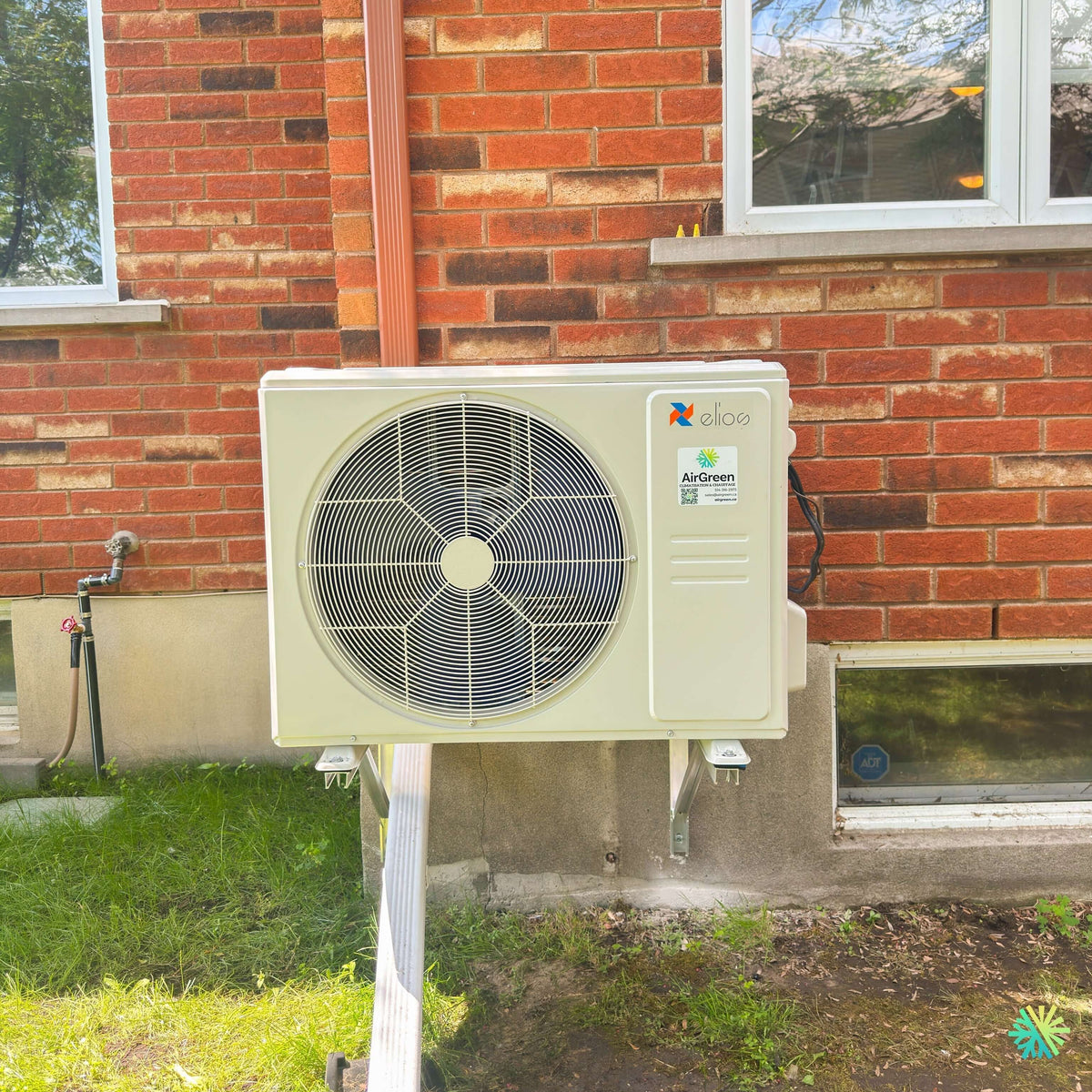
In Ormstown, we installed an ELIOS EMC wall-mounted heat pump at a residence where the goal was to achieve an efficient heating and cooling solution while maintaining a discreet exterior finish. The photo of this installation shows an ELIOS outdoor unit secured to a sturdy wall mount, installed near the home’s brick wall, with adequate clearance around the fan and coil.
This configuration is especially appealing to homeowners who want to free up ground space, protect the unit from certain snow accumulations, or prevent an outdoor unit from being exposed to frequent foot traffic around the house.
A professional HVAC installation involves more than simply installing a functional machine. The outdoor positioning directly affects the equipment’s service life, noise level, energy efficiency, and ease of future maintenance. In Ormstown, as elsewhere in Montérégie, winter conditions require particular attention to clearance, defrost drainage, and mechanical protection for the unit.
A wall mount suited to the building’s specific needs
With this installation, the ELIOS EMC outdoor unit is mounted on wall brackets rather than placed on a ground-level pad. This choice offers several advantages when the configuration of the property or site makes it appropriate.
A wall-mounted installation offers several advantages, including:
- to keep the unit away from snow accumulated on the ground;
- to reduce the risk of contact with leaves, soil, or debris;
- to free up space around the foundation;
- to make cleaning underneath the unit easier;
- to limit certain risks related to animals or accidental damage;
- to provide more unobstructed airflow around the unit.
For this project in Ormstown, the brick wall provided a stable surface for installing the brackets. However, mounting on masonry requires a different method from installation on lightweight exterior siding. The quality of the anchors, weight distribution, and strength of the support must be verified before installation.
Why outdoor positioning is essential
The outdoor unit of a wall-mounted heat pump must be able to draw in and discharge a large volume of air. Even a highly efficient machine can lose efficiency if it is placed in an overly confined space.
During installation, we pay particular attention to the following:
- distance between the unit and the wall;
- clearance in front of the fan;
- space above the unit;
- natural airflow;
- sun exposure;
- proximity to windows;
- proximity to ventilation outlets;
- access for technicians.
In this home, the unit is positioned in front of an unobstructed section of the brick wall. The fan can operate without major obstacles, promoting better heat exchange during both cooling and heating periods.
A heat pump designed for Quebec winters
The ELIOS EMC range belongs to the cold-climate wall-mounted heat pump category. It is designed to provide heating even when outdoor temperatures become very low.
According to the manufacturer's technical documentation, the EMC series uses R454B refrigerant, features Inverter Drive technology, and is certified ENERGY STAR V6.1 cold climate. It is designed to operate in heating mode down to -30 °C.
This feature is particularly well suited to homes in Ormstown and the Montérégie region, where temperature differences between seasons can be significant.
A cold-climate heat pump can help:
- reduce the use of traditional electric heating;
- improve comfort during the fall and spring;
- maintain a more stable temperature;
- provide air conditioning during the summer;
- enjoy a single system for multiple seasons.
Heat+ technology: maintaining performance as the temperature drops
The ELIOS EMC series uses Heat+ technology, designed to increase heating capacity during cold periods.
The documentation indicates that the systems can provide up to 100% of their rated capacity at -15 °C and continue operating down to -30 °C.
In a region like Ormstown, this feature is important because heating needs increase precisely as the outdoor temperature decreases.
However, it is important to remember that good performance always depends on several factors:
- correct sizing;
- building insulation;
- installation quality;
- indoor unit location;
- regular maintenance;
- proper system adjustment.
A high-performance heat pump that is poorly installed can deliver inferior results compared with a properly selected and commissioned system.
An Inverter compressor for more consistent comfort
One of the important features of the ELIOS EMC series is its Inverter compressor. Unlike traditional systems that operate primarily by switching on and off, Inverter technology adjusts the compressor’s output according to actual demand.
The EMC series uses compressor frequency control that can be adjusted in increments of 1 %, allowing more precise modulation of operation.
For occupants, this can result in:
- less temperature variation;
- quieter operation;
- greater efficiency during periods of low demand;
- fewer frequent starts;
- more consistent comfort.
This technology is particularly appealing in a home where occupants want to maintain a stable temperature without experiencing significant changes between cycles.
An outdoor installation designed for future maintenance
Maintenance is often overlooked when choosing a location, but it should be part of the planning from the outset.
For this installation in Ormstown, mounting the unit on a wall bracket maintains reasonable access to the unit. This facilitates future work such as:
- outdoor coil cleaning;
- fan inspection;
- connection checks;
- preventive maintenance;
- diagnostics during a service call.
An outdoor unit that is difficult to access can lead to additional costs during service calls and discourage regular maintenance.
At AirGreen, we consider future maintenance from the design stage. A successful installation must work today while remaining practical several years later.
An ELIOS EMC installation tailored to the needs of a residence in Ormstown
Capacity selection should be based on an actual analysis
The photo identifies an ELIOS EMC outdoor unit, but it does not make it possible to confirm the installed capacity in BTUs precisely. The EMC series is available in several sizes:
- 9,000 BTU;
- 12,000 BTU;
- 18,000 BTU;
- 24,000 BTU;
- 33,000 BTU.
Performance varies according to the capacity selected. For example, models in the series offer cooling ratings of up to 26 SEER2 and heating performance suited to cold-climate requirements.
The capacity selection should not be based solely on the size of the home. Instead, we analyze:
- the size of the rooms;
- the ceiling height;
- the level of insulation;
- sun exposure;
- the number of windows;
- the presence of a basement;
- the layout of the spaces;
- winter heating needs.
An older home in Ormstown may have very different needs from a well-insulated recent construction.
Managing winter drainage
During heating operation, an outdoor heat pump produces water during defrost cycles. This water must be able to drain properly.
The ELIOS EMC series includes a heated condensate pan, designed to limit ice accumulation in the base of the outdoor unit.
Even with this feature, the installation must follow certain best practices:
- maintain sufficient clearance from the ground;
- avoid areas where water accumulates;
- do not block the openings;
- provide a location where ice will not cause problems;
- maintain access for winter maintenance.
The wall bracket visible in this installation helps keep the unit away from areas where accumulation occurs at ground level.
Outdoor protection against Canadian conditions
An outdoor unit installed in Quebec must withstand:
- rain;
- snow;
- freeze-thaw cycles;
- rapid temperature fluctuations;
- sun exposure;
- humidity.
The ELIOS EMC series includes several features designed to improve reliability, including an anti-corrosion coating on the heat exchanger and TU1 high-purity copper coils.
These features help protect the equipment in a demanding outdoor environment.
Common mistakes when installing a wall-mounted heat pump
Installing the unit too close to an obstacle
A wall, fence, or another unit that is too close can restrict airflow and reduce efficiency.
Neglecting vibrations
An inadequately supported outdoor unit can transmit vibrations to the building. Suitable supports and a level installation are essential.
Choosing the location based solely on appearance
Aesthetics are important, but they should never take precedence over the unit’s mechanical requirements.
Forgetting maintenance
A heat pump requires periodic filter cleaning and outdoor coil maintenance to maintain its performance.
Underestimating the local climate
A heat pump intended for Ormstown must be selected to operate efficiently during cold periods, not only on mild days.
The comfort features offered by the ELIOS EMC
The EMC series includes several features designed to improve everyday use:
- variable-speed indoor fan;
- turbo mode;
- quiet mode;
- “Do Not Disturb” mode;
- freeze protection maintaining an indoor temperature of 8 °C;
- automatic restart after a power outage;
- compatibility with certain smart thermostats;
- auxiliary heating control.
The unit also includes a two-stage filtration system that filters dust, pollen, pet hair, and certain odors through the carbon filter.
A representative example of AirGreen installations in Montérégie
This ELIOS EMC wall-mounted heat pump installation in Ormstown demonstrates the importance of a comprehensive approach: choosing the right location, using a suitable support, respecting the required clearances, and preparing the unit for Québec’s climate conditions.
The result visible in the photo is a clean, stable, and functional outdoor installation, with a protected, accessible unit positioned to ensure efficient heat exchange.
At AirGreen, we install wall-mounted heat pumps, wall-mounted air conditioners, and HVAC systems in Montréal, Laval, Longueuil, the North Shore, and the South Shore, adapting each project to the building’s actual characteristics.
A well-planned installation allows you to fully enjoy the benefits of a heat pump: efficient heating in winter, comfortable cooling in summer, and reliable operation year after year.
The job tools
Two quick checks with real numbers: what heat costs, and what your current heaters add up to in BTU/h.
Conversion: 1 W = 3.412 BTU/h. An indication, not a load calculation: baseboards and furnaces are often stronger than the real need, and they can stay as backup. AirGreen confirms the capacity on site.
How the job unfolds
The main steps of this kind of job at AirGreen. Every house has its quirks: the estimate brings them out.
We look at the room, the outside wall, the line route and where the outdoor unit will go. That is where the capacity gets chosen.
Model, capacity and price, in writing. We also check whether the model qualifies for assistance programs.
Floors and furniture protected, wall plate position marked level, wall opening located.
A single opening, with the slope the drain needs to flow outside.
Set on a stand raised above the snow, with the clearances the manufacturer requires.
Connected, insulated and protected. The opening is then sealed against water, cold air and insects.
A dedicated circuit and an accessible disconnect near the outdoor unit.
Leak test, vacuum, then start-up and a check of heating and cooling.
Remote, modes, filters: we show you the essentials before we leave.
- The on-site estimateWe look at the room, the outside wall, the line route and where the outdoor unit will go. That is where the capacity gets chosen.
- The quoteModel, capacity and price, in writing. We also check whether the model qualifies for assistance programs.
- Getting readyFloors and furniture protected, wall plate position marked level, wall opening located.
- The wall openingA single opening, with the slope the drain needs to flow outside.
- The outdoor unitSet on a stand raised above the snow, with the clearances the manufacturer requires.
- Lines, cable and drainConnected, insulated and protected. The opening is then sealed against water, cold air and insects.
- The electrical workA dedicated circuit and an accessible disconnect near the outdoor unit.
- Tests and start-upLeak test, vacuum, then start-up and a check of heating and cooling.
- The walkthroughRemote, modes, filters: we show you the essentials before we leave.
What we check on a job like this one
Each number is a point we check on site. Switch between summer and winter to watch air and heat move.
In summer, the outdoor unit rejects the house's heat outside.
Generic illustration of this type of installation, not a survey of this job site. Tap a number.
Mounted level on a wall plate, high enough for the air to reach the whole room, with enough space around it to slide the filters out easily.
The refrigerant lines, the communication cable and the drain go through the wall in a single opening, sealed against water, cold air and insects.
Two insulated copper pipes connect the two units. Outside, a line cover can protect them from sun, knocks and weather.
A shut-off switch near the outdoor unit isolates it safely for service. It must stay accessible at all times.
The compressor and the fan. In heating mode it captures heat from the outdoor air, even in winter, and moves it inside.
On the ground or on the wall, it keeps the unit above accumulated snow. The unit stays clear and defrost water can drain away.
The fan needs to blow freely. Storage, a fence or a wall too close, and efficiency drops while noise goes up.
Is your home ready?
Check what applies at your place. A "no" is not a refusal: it is what we sort out during the estimate.
Good habits, once the unit is in place
Six simple habits that keep the unit going. Your list stays on this device.
What to do, season by season
Three habits per season for this unit. They take a few minutes and prevent many calls.
- Clean the indoor unit's filters.
- Clear leaves and debris left on the outdoor unit by winter.
- Test cooling before the first hot days.
- Clean the filters more often when the unit runs a lot.
- Keep plants away from the outdoor unit.
- Check that no water drips from the indoor unit.
- Rake the leaves around the outdoor unit.
- Test heating before the first cold days.
- Book periodic maintenance before winter.
- Keep snow away from the stand and the front of the unit.
- Let the unit defrost: it is normal.
- Never hit the ice on the fins; call us if the unit stays iced up.
The right pages, at the right time
Four statements: true or false?
It all comes down to details you have just seen.
1. In heating mode, the outdoor unit can produce water.
During defrost cycles. That water must drain away without forming ice.
2. You pick the capacity with a simple square-footage rule.
Windows, insulation, orientation and how the room is used all count. Capacity is chosen on site.
3. A multi-zone connects several indoor heads to a single condenser.
One head per room, all on the same condenser. Each room keeps its own temperature.
4. The disconnect can sit behind the patio furniture.
It must stay accessible: it is what shuts the unit off for service.
0 / 4 right answers
What people ask us about this kind of work
Does a wall-mounted heat pump heat in winter?
Wall-mounted or multi-zone: how do I choose?
Where does the outdoor unit go?
Are there grants?
Do I need a permit?
How cold can it heat?
How much can I save?
How is the LogisVert assistance calculated?
Is it noisy?
The outdoor unit is covered in ice: is that normal?
Does AirGreen hold the required licences?
Is the estimate free?
No question matches. Write to us: we answer.
More jobs to see, near you
By town, by equipment or by region: browse more than 4,700 published projects.
Each dot: a town where AirGreen has published projects. The glowing dot: this job.
An on-site estimate, the right capacity, the right equipment.
The on-site estimate is free and the quote follows within 24 hours.
Text and photo: a real AirGreen Climatisation & Chauffage job. The diagrams are generic illustrations of the type of installation, not a survey of this job site. Sources of the added figures: airgreen.ca product pages (NEEP / AHRI performance), Hydro-Québec (Heat pumps page, LogisVert, read on 13 October 2026), Régie de l’énergie (rate D as of 1 April 2026).