
GREE CHARMO R32 Wall-Mounted Heat Pump Installation in Vimont, Laval: a discreet mini-split solution for lasting residential comfort
AirGreen installs a GREE CHARMO R32 wall-mounted heat pump in Vimont, Laval: discreet mini-split, neat installation, efficient comfort, HVAC advice, and local expertise.
- City
- Region
- Equipment
- Brand
- Challenges
- Published
The job on one screen
The article, chapter by chapter
A neat wall-mounted installation in an interior where space demanded precision and discretion
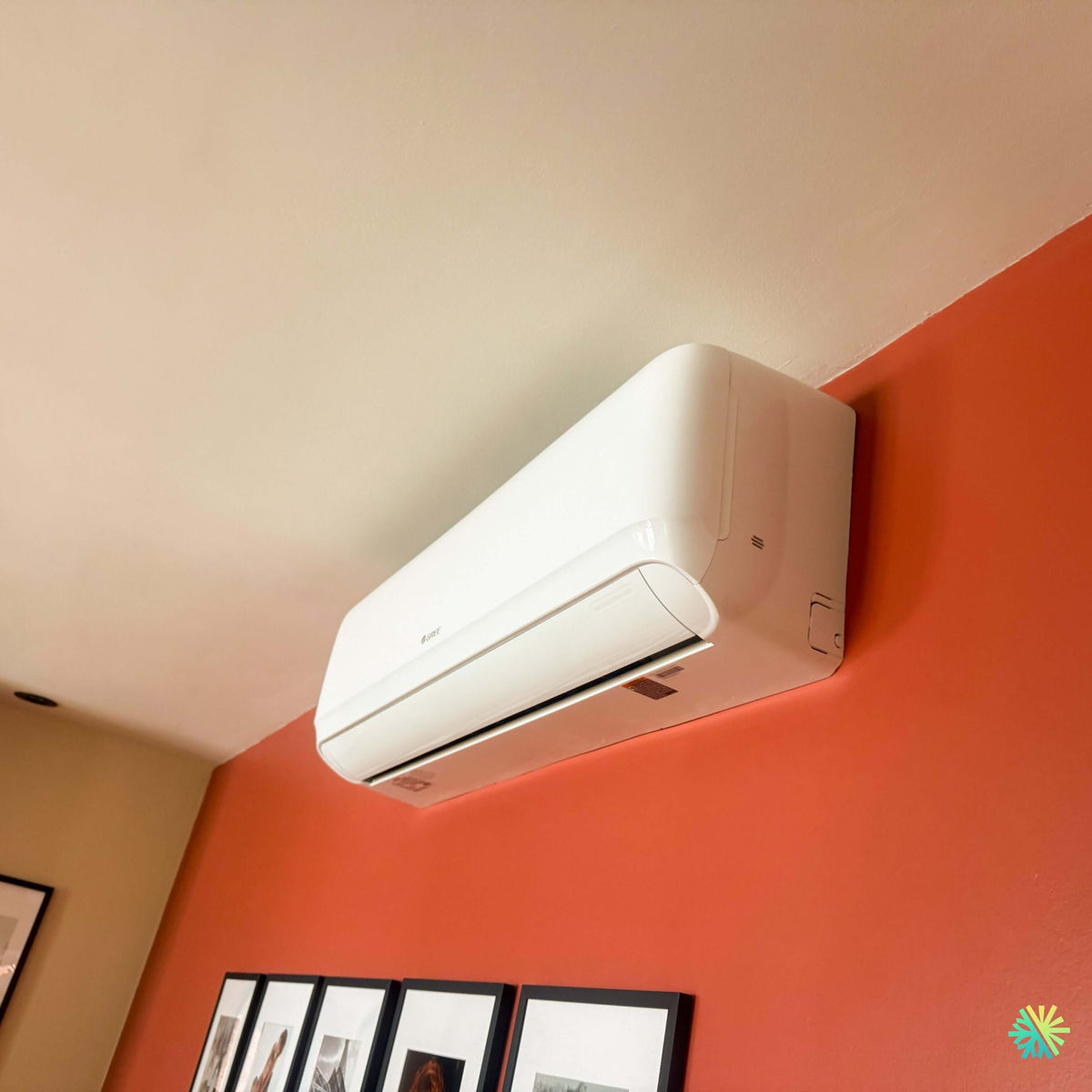
In Vimont, in the Laval area, our AirGreen team recently completed the installation of a GREE CHARMO R32 wall-mounted heat pump, a mini split solution designed to provide efficient heating and cooling comfort, while integrating seamlessly into the existing interior design. The photo of this installation perfectly illustrates an essential point that many homeowners underestimate when choosing a wall-mounted heat pump: the quality of the result depends as much on the choice of the device as on the precision of the installation.
In this residence, the indoor unit was installed high up on a warm-colored accent wall, near the ceiling and above an area decorated with several frames. This type of location requires rigorous planning. It's not enough to simply attach a wall-mounted air conditioner to an empty wall: it's necessary to analyze air circulation, access for future maintenance, the path of refrigerant lines, condensate drainage, distance from the ceiling, visual balance in the room, and the unit's ability to diffuse air without creating direct discomfort for occupants.
The installed model, the GREE CHARMO R32, belongs to a range of single-zone wall-mounted heat pumps offered in nominal capacities ranging from 9,000 to 36,000 BTU/h depending on the selected configuration, with heating, cooling, dehumidification, ventilation, and automatic modes. The technical sheet also indicates a 208/230 V, 60 Hz, single-phase power supply for this series. The CHARMO R32 range boasts efficiencies of up to 22 SEER2, 12.5 EER2, and 9 HSPF2, with an advertised heating range down to -25 °C and a cooling range up to 50 °C according to product documentation.
Why the GREE CHARMO R32 was a good fit for this project in Vimont
In a residential area like Vimont, many houses and condos have living spaces where wall space is already occupied by artwork, furniture, openings, wall returns, or structural constraints. In this context, the GREE CHARMO R32 represents an attractive option for homeowners looking for an efficient, affordable, and visually discreet wall-mounted heating and air conditioning solution.
The unit installed here is distinguished by its understated white casing, which contrasts slightly with the orange wall without overpowering the space. The rounded shape of the indoor unit allows for softer integration, especially in a room where the decor is already pronounced. Practically speaking, this installation frees up floor space, avoids visible indoor ducts, and provides targeted comfort in the main area.
Among the useful features of the CHARMO R32, GREE documentation notably mentions Wi-Fi, Turbo mode, low voltage start-up, multiple fan speeds, three sleep modes, self-diagnosis, I-Feel mode, intelligent auto-restart, intelligent preheating, and a quiet design. For a homeowner, these characteristics are not just technical arguments: they directly influence daily experience. Wi-Fi facilitates remote adjustments, sleep mode helps maintain a more stable temperature at night, and fan speeds allow air flow to be adapted according to actual room occupancy.
A visible constraint in the photo: installing high, neatly, without compromising access
The image shows a unit placed very close to the ceiling. This positioning can be advantageous for air diffusion, especially in a living room or open area, but it must be executed with caution. A poorly planned HVAC installation in this type of situation can cause several problems: difficult access to filters, wall vibration, poor condensate drainage, obstructed airflow, or a neglected visual appearance.
At AirGreen, we approach this type of installation by considering three priority elements:
-
Air diffusion performance
The unit must be able to blow air into the room uniformly, without directing a cold or hot jet directly onto occupants sitting nearby. -
Access for HVAC maintenance
Even if the unit is installed high up, the filters must remain accessible. A well-installed unit today must also be easily cleaned, inspected, and maintained in subsequent years. -
Aesthetic finish
In a residence, visual results matter. Here, the unit is neatly aligned, with no unnecessary elements visible in the interior field. This level of finish contributes to the natural integration of the wall-mounted heat pump into the room.
The role of R32 in a modern installation
The mention R32 is important. This refrigerant is increasingly present in new generations of wall-mounted heat pumps and mini split air conditioners. In the case of the GREE CHARMO R32, it aligns with a logic of efficiency and modernization of residential equipment. For customers in Montreal, Laval, Longueuil, the North Shore, and the South Shore, switching to newer models using R32 often allows for combining comfort, seasonal performance, and a more current equipment choice.
It should be remembered, however, that a system using refrigerant must be installed by qualified professionals. Refrigerant lines, connections, vacuuming, leak tests, electrical connections, and commissioning are not secondary steps. These are precisely the steps that determine the long-term reliability of the system.
Key steps in our installation in Vimont
For this installation in Vimont, our intervention followed a methodical sequence to ensure a clean, safe, and durable result.
Analysis of the indoor location
Before fixing the unit, we checked the available height, the wall composition, the distance from the ceiling, the desired airflow direction, and the visual impact in the room. The objective was to achieve a balance between performance and discretion. In a decorated room, moving the unit a few centimeters can make a big difference to the final result.
Preparation for pipe passage
A mini split wall-mounted heat pump requires an outdoor passage for refrigerant lines, communication wiring, power supply, and condensate drain. In this type of installation, drilling precision is essential. A wrong angle or approximate positioning can complicate water drainage or necessitate visible corrections.
Installation of the indoor unit
The indoor unit was securely fastened to its wall bracket, respecting horizontal alignment and necessary clearances. The visible result in the photo shows a clean and stable installation, with no apparent deformation or tilt. This step is important, as a slightly uneven unit can produce undesirable leaks or noise during use.
Connection and commissioning
Once the connections are made, our team always performs a complete commissioning: checking connections, controlling drainage, testing in cooling and heating modes, validating remote control operation, explaining settings to the customer, and providing maintenance recommendations. A professional HVAC installation doesn't end when the unit turns on; it ends when the customer understands how to use it effectively.
What homeowners in Laval, Montreal, and surrounding areas should remember before installing a wall-mounted heat pump
The right model should be chosen according to the room, not just the price
A device like the GREE CHARMO R32 can be suitable for several types of residential projects, but the final choice must always be validated according to the area, insulation, sunlight, ceiling height, number of occupants, room configuration, and winter heating expectations. An oversized unit may cycle too quickly, reduce comfort, and hinder dehumidification. An undersized unit may run too long, failing to achieve the desired comfort on very hot or very cold days.
That's why, at AirGreen, we favor an approach based on the actual context of the home. An installation in Vimont does not necessarily have the same constraints as an installation in a Plateau-Mont-Royal condo, a Brossard house, a Longueuil duplex, or a North Shore property. The choice of a wall-mounted heat pump must be consistent with the building.
Common mistakes to avoid
Many problems we fix in the field stem from installations that are too fast or poorly planned. The most common errors include:
- Installing the unit too close to an obstacle that blocks airflow.
- Neglecting the condensate drain slope.
- Choosing BTU capacity without evaluating the room.
- Placing the unit in a hard-to-reach spot for HVAC maintenance.
- Using an unnecessarily long or poorly protected piping route.
- Forgetting the visual impact of the installation in a main room.
- Entrusting the work to an unqualified person to handle refrigerant.
In the Vimont project, the high positioning specifically required avoiding many of these pitfalls. The unit had to be high enough to integrate well with the wall and efficiently diffuse air, but not so high as to make maintenance difficult or compromise the space needed for operation.
Comfort, quietness, and control: customers' real expectations
When a client contacts us for a wall-mounted heat pump in Laval, the initial request often seems simple: more coolness in summer and reduced reliance on primary heating in mid-season or winter. But during the evaluation, the real expectations are more precise. Clients want a quiet, easy-to-control, space-saving, reliable, well-installed appliance that fits their daily routine.
In this project, the unit had to integrate into a lived-in, decorated, and visible room. Noise level, aesthetics, and ease of use were therefore as important as performance. The GREE CHARMO R32 meets this type of need well thanks to its understated design and practical features such as multiple fan speeds, sleep mode, and smart settings.
Subsidies and eligibility: a check to make before purchase
Some wall-mounted heat pumps may be eligible for subsidy programs, depending on the exact model, capacity, certifications, AHRI number, and criteria in effect at the time of installation. Amounts and conditions may change. For this reason, we always verify applicable information before presenting a final recommendation.
At AirGreen, we support our clients from Montreal, Laval, Longueuil, the North Shore, and the South Shore in this step to avoid unpleasant surprises. The goal is simple: choose efficient equipment that is well-suited to the building and, when possible, compatible with available financial aid.
Tips for use after installation
To get the most out of a GREE CHARMO R32 wall-mounted heat pump, we recommend that homeowners follow a few best practices:
- Clean filters regularly, especially during periods of intensive use.
- Avoid setting the temperature to extremes; a stable setting improves comfort.
- Use ventilation modes and directional vanes to distribute air.
- Program the unit according to occupancy habits.
- Perform periodic HVAC maintenance to maintain efficiency.
- Keep the outdoor unit clear of snow, leaves, and debris.
These simple actions extend the system's lifespan and help maintain consistent performance.
Why choose AirGreen for an HVAC installation in Vimont
Our value is not just about providing a device. It's about the entire process: evaluation, recommendation, installation, finishing, commissioning, and post-installation support. In the case of this GREE CHARMO R32 wall-mounted heat pump installation in Vimont, the final result demonstrates the importance of precise work in a real residential environment, with its aesthetic and technical constraints.
We regularly carry out similar installations in Laval, Montreal, Longueuil, on the North Shore, and on the South Shore, in single-family homes, condos, duplexes, triplexes, and small commercial spaces. Each building has its specificities. Our role is to adapt the HVAC solution to the location, the client, and the actual use, rather than applying a uniform method.
A well-chosen and properly installed wall-mounted heat pump can transform the comfort of a room. It can stabilize the temperature, improve quality of life during heatwaves, provide efficient heating for much of the year, and reduce reliance on less flexible systems. But to achieve this result, the installation must be done correctly from the start.
The job tools
Two quick checks with real numbers: what heat costs, and what your current heaters add up to in BTU/h.
Conversion: 1 W = 3.412 BTU/h. An indication, not a load calculation: baseboards and furnaces are often stronger than the real need, and they can stay as backup. AirGreen confirms the capacity on site.
How the job unfolds
The main steps of this kind of job at AirGreen. Every house has its quirks: the estimate brings them out.
We look at the room, the outside wall, the line route and where the outdoor unit will go. That is where the capacity gets chosen.
Model, capacity and price, in writing. We also check whether the model qualifies for assistance programs.
Floors and furniture protected, wall plate position marked level, wall opening located.
A single opening, with the slope the drain needs to flow outside.
Set on a stand raised above the snow, with the clearances the manufacturer requires.
Connected, insulated and protected. The opening is then sealed against water, cold air and insects.
A dedicated circuit and an accessible disconnect near the outdoor unit.
Leak test, vacuum, then start-up and a check of heating and cooling.
Remote, modes, filters: we show you the essentials before we leave.
- The on-site estimateWe look at the room, the outside wall, the line route and where the outdoor unit will go. That is where the capacity gets chosen.
- The quoteModel, capacity and price, in writing. We also check whether the model qualifies for assistance programs.
- Getting readyFloors and furniture protected, wall plate position marked level, wall opening located.
- The wall openingA single opening, with the slope the drain needs to flow outside.
- The outdoor unitSet on a stand raised above the snow, with the clearances the manufacturer requires.
- Lines, cable and drainConnected, insulated and protected. The opening is then sealed against water, cold air and insects.
- The electrical workA dedicated circuit and an accessible disconnect near the outdoor unit.
- Tests and start-upLeak test, vacuum, then start-up and a check of heating and cooling.
- The walkthroughRemote, modes, filters: we show you the essentials before we leave.
What we check on a job like this one
Each number is a point we check on site. Switch between summer and winter to watch air and heat move.
In summer, the outdoor unit rejects the house's heat outside.
Generic illustration of this type of installation, not a survey of this job site. Tap a number.
Mounted level on a wall plate, high enough for the air to reach the whole room, with enough space around it to slide the filters out easily.
The refrigerant lines, the communication cable and the drain go through the wall in a single opening, sealed against water, cold air and insects.
Two insulated copper pipes connect the two units. Outside, a line cover can protect them from sun, knocks and weather.
A shut-off switch near the outdoor unit isolates it safely for service. It must stay accessible at all times.
The compressor and the fan. In heating mode it captures heat from the outdoor air, even in winter, and moves it inside.
On the ground or on the wall, it keeps the unit above accumulated snow. The unit stays clear and defrost water can drain away.
The fan needs to blow freely. Storage, a fence or a wall too close, and efficiency drops while noise goes up.
Is your home ready?
Check what applies at your place. A "no" is not a refusal: it is what we sort out during the estimate.
Good habits, once the unit is in place
Six simple habits that keep the unit going. Your list stays on this device.
What to do, season by season
Three habits per season for this unit. They take a few minutes and prevent many calls.
- Clean the indoor unit's filters.
- Clear leaves and debris left on the outdoor unit by winter.
- Test cooling before the first hot days.
- Clean the filters more often when the unit runs a lot.
- Keep plants away from the outdoor unit.
- Check that no water drips from the indoor unit.
- Rake the leaves around the outdoor unit.
- Test heating before the first cold days.
- Book periodic maintenance before winter.
- Keep snow away from the stand and the front of the unit.
- Let the unit defrost: it is normal.
- Never hit the ice on the fins; call us if the unit stays iced up.
The right pages, at the right time
Four statements: true or false?
It all comes down to details you have just seen.
1. In heating mode, the outdoor unit can produce water.
During defrost cycles. That water must drain away without forming ice.
2. You pick the capacity with a simple square-footage rule.
Windows, insulation, orientation and how the room is used all count. Capacity is chosen on site.
3. A multi-zone connects several indoor heads to a single condenser.
One head per room, all on the same condenser. Each room keeps its own temperature.
4. The disconnect can sit behind the patio furniture.
It must stay accessible: it is what shuts the unit off for service.
0 / 4 right answers
What people ask us about this kind of work
Does a wall-mounted heat pump heat in winter?
Wall-mounted or multi-zone: how do I choose?
Where does the outdoor unit go?
Are there grants?
Do I need a permit?
How cold can it heat?
How much can I save?
How is the LogisVert assistance calculated?
Is it noisy?
The outdoor unit is covered in ice: is that normal?
Does AirGreen hold the required licences?
Is the estimate free?
No question matches. Write to us: we answer.
More jobs to see, near you
By town, by equipment or by region: browse more than 4,700 published projects.
Each dot: a town where AirGreen has published projects. The glowing dot: this job.
An on-site estimate, the right capacity, the right equipment.
The on-site estimate is free and the quote follows within 24 hours.
Text and photo: a real AirGreen Climatisation & Chauffage job. The diagrams are generic illustrations of the type of installation, not a survey of this job site. Sources of the added figures: airgreen.ca product pages (NEEP / AHRI performance), Hydro-Québec (Heat pumps page, LogisVert, read on 13 October 2026), Régie de l’énergie (rate D as of 1 April 2026).