
Installation of a Midea wall-mounted heat pump in Sainte-Dorothée (Laval): four-season comfort, even in the dead of winter
In Sainte-Dorothée, AirGreen installed a Midea wall-mounted heat pump on a raised support, ideal for Quebec winters. Discover the installation details, the heating/cooling benefits, and our tips for maintaining optimal performance.
- City
- Region
- Equipment
- Brand
- Challenges
- Published
The job on one screen
The article, chapter by chapter
In Sainte-Dorothée, residents are all too familiar with the reality of long winters, damp thaws… and comfort needs that don't always follow the calendar. In this residential area of Laval, AirGreen recently installed aMidea wall-mounted heat pump , a solution perfectly suited to single-family homes where the goal is efficient heating and quiet cooling as soon as the temperature rises (even during colder periods).
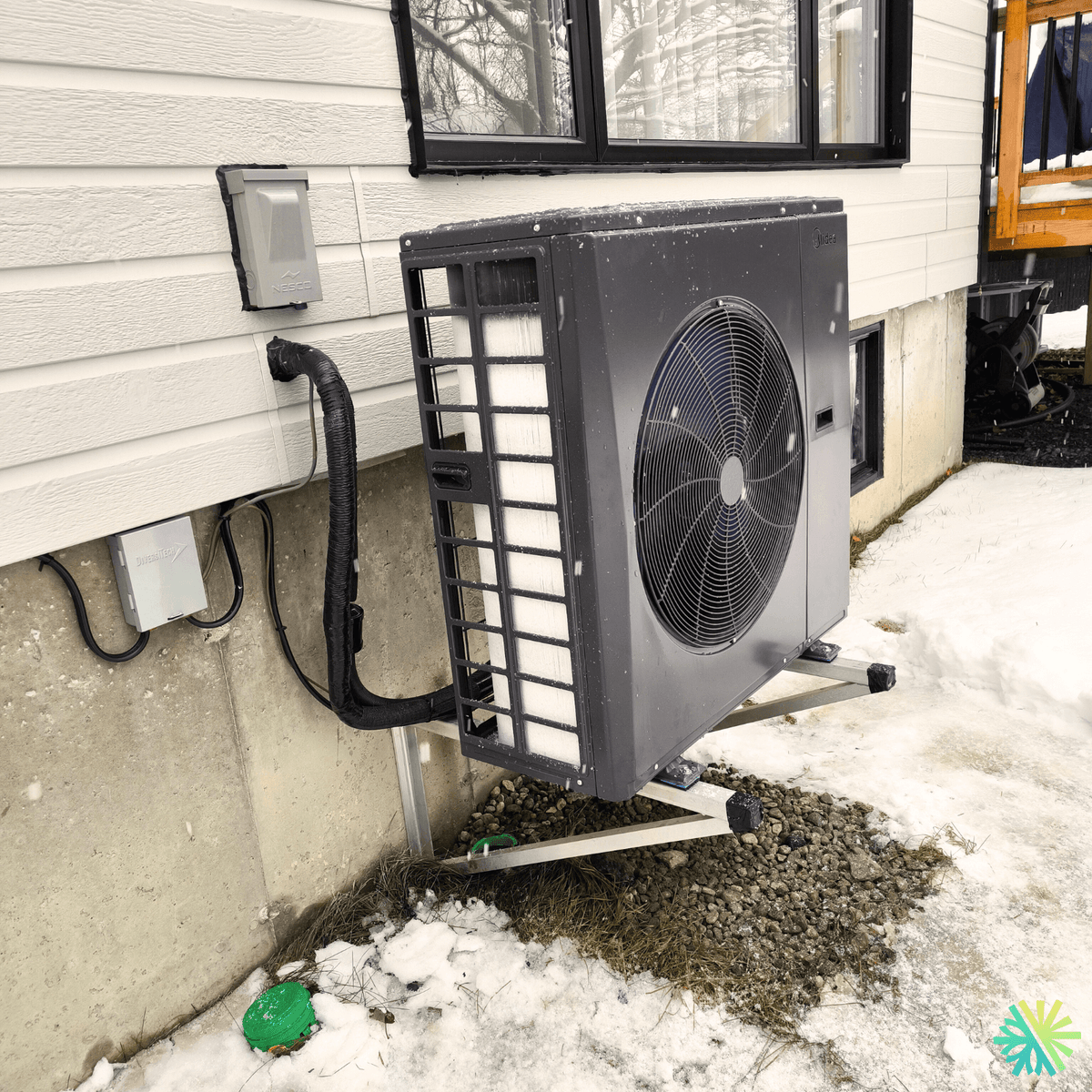
The photo clearly shows the outdoor unit mounted on a raised support near the foundation, with the refrigerant lines carefully protected. This type of installation is crucial: in Quebec, a heat pump's performance depends as much on the machine itself as on how it is installed.
A logical choice in Sainte-Dorothée: the wall-mounted heat pump (mini-split)
In this project, a wall-mounted heat pump (mini-split) was chosen. This is often the best option for:
-
Maximize comfort in living areas (living room, open-plan area, upstairs bedrooms)
-
Reduce energy consumption compared to supplementary electric heaters
-
Get precise air conditioning in the summer, without major renovations
-
Keeping the installation clean and free of ducts (ideal for many homes in Laval)
Mini-splits are particularly well suited to homes where insulation varies from one section to another (progressive renovations, extensions, partially finished basements), which is regularly encountered in Sainte-Dorothée.
Chosen model: a Midea Midea28 (consistent with the context)
The exact model is not legible in the image, but the configuration observed and the range commonly installed in Greater Montreal lead us to a coherent choice: Midea Midea28 , a “new generation” wall-mounted heat pump appreciated for its heating performance in our Quebec conditions (and its ability to continue to deliver comfort even when temperatures are very low).
In practice, this type of system is sought after by customers who want to:
-
Heating a large part of the house without relying solely on baseboard heaters
-
Maintaining reliable air conditioning in the summer
-
Having a stable, quiet, and easy-to-maintain solution
What the installation reveals: a pose designed for winter (and that changes everything)
In the photo, several important elements show an installation done “properly” for the Laval region.
1) Elevated outdoor unit: protection against snow and frost
The outdoor unit is installed on a raised, securely anchored metal support , which provides tangible advantages:
-
Clearance above the snow accumulation
-
Reducing the risk of the unit being “buried” during storms
-
Better protection against meltwater freezing/refreezing
-
Easier access for servicing and maintenance
In Sainte-Dorothée, where snowbanks can be significant (and sometimes blown against the walls), this height is a real plus.
2) Soil drainage: gravel and clearance
There is a gravel area visible under the unit. This is not just for aesthetic reasons:
-
The defrost water drains better
-
Less ice accumulates under the machine
-
Reduction of mud splashes in the spring
-
A more stable base over the seasons
This is exactly the kind of detail that protects the investment in the long term.
3) Protected and insulated refrigerant lines
The lines are grouped together in a black sheath/insulation, securely fastened and protected where they exit the wall. Why is this important?
-
Less heat loss (therefore better efficiency)
-
Protection against UV rays, humidity, and friction.
-
Cleaner and more durable installation
-
Reduction of the risk of poorly managed condensation
4) Outdoor electrical box: safety and compliance
We can also see an electrical disconnect nearby. This is essential for:
-
The safety of technicians during interventions
-
Compliance with good installation practices
-
A simpler interview (without risky manipulations)
Everyday comfort: what the customer actually gains
A properly installed Midea wall-mounted heat pump first provides a feeling of comfort that is quickly noticeable.
During heating (autumn, winter, spring)
-
More stable temperature in living areas
-
Fewer "peaks" of dry heat like with some portable heaters
-
Reducing reliance on electric baseboard heaters
-
Defrosting is managed automatically, without customer intervention.
With air conditioning (summer)
-
Rapid and uniform cooling
-
Precise control (temperature, mode, speed, dehumidification)
-
Quiet operation, ideal for residential areas
Our AirGreen tips for keeping your machine performing well in Laval
Even an excellent heat pump can lose efficiency if maintenance is neglected. Here are our practical (and realistic) recommendations.
To be done regularly (by the client)
-
Clean the filters of the indoor unit (as needed)
-
Keep the outdoor unit clear:
-
no snowbank stuck in front
-
no leaves/branches in spring
-
no objects stored too close
-
To be done periodically (by professionals)
-
Complete cleaning of the heat exchanger (inside/outside)
-
Checking pressures and heating behavior
-
Electrical connection check
-
Inspection of pipe insulation and fixings
Proper maintenance is often what makes the difference between a "decent" machine and a truly high-performing machine for 10–15 years .
Why AirGreen is choosing this type of installation for Sainte-Dorothée
Each neighborhood has its own realities: wind direction, clearances, foundation type, snow depth, backyard access, etc. In Sainte-Dorothée, you'll often find:
-
Houses with visible foundations and side service exits
-
Courtyards where snow accumulates against some of the walls
-
Spaces to optimize to keep a clean and safe yard
In this context, installation on a raised support , with ample clearance, clean pipe management and easy access for maintenance, is exactly what we aim for at AirGreen: efficiency + durability + clean installation .
Conclusion: a well-installed Midea offers simple (and cost-effective) comfort.
This installation in Sainte-Dorothée perfectly illustrates what we seek to deliver: a Midea wall-mounted heat pump installed intelligently for the Quebec climate, with particular attention to snow, defrosting, drainage and the durability of the components.
If you are in Laval (Sainte-Dorothée, Fabreville, Chomedey, Laval-Ouest or elsewhere) and you want a reliable heating and cooling solution without complicating your life, this is exactly the type of project we carry out daily — cleanly, solidly, and with a performance-oriented approach.
The job tools
Two quick checks with real numbers: what heat costs, and what your current heaters add up to in BTU/h.
Conversion: 1 W = 3.412 BTU/h. An indication, not a load calculation: baseboards and furnaces are often stronger than the real need, and they can stay as backup. AirGreen confirms the capacity on site.
How the job unfolds
The main steps of this kind of job at AirGreen. Every house has its quirks: the estimate brings them out.
We look at the room, the outside wall, the line route and where the outdoor unit will go. That is where the capacity gets chosen.
Model, capacity and price, in writing. We also check whether the model qualifies for assistance programs.
Floors and furniture protected, wall plate position marked level, wall opening located.
A single opening, with the slope the drain needs to flow outside.
Set on a stand raised above the snow, with the clearances the manufacturer requires.
Connected, insulated and protected. The opening is then sealed against water, cold air and insects.
A dedicated circuit and an accessible disconnect near the outdoor unit.
Leak test, vacuum, then start-up and a check of heating and cooling.
Remote, modes, filters: we show you the essentials before we leave.
- The on-site estimateWe look at the room, the outside wall, the line route and where the outdoor unit will go. That is where the capacity gets chosen.
- The quoteModel, capacity and price, in writing. We also check whether the model qualifies for assistance programs.
- Getting readyFloors and furniture protected, wall plate position marked level, wall opening located.
- The wall openingA single opening, with the slope the drain needs to flow outside.
- The outdoor unitSet on a stand raised above the snow, with the clearances the manufacturer requires.
- Lines, cable and drainConnected, insulated and protected. The opening is then sealed against water, cold air and insects.
- The electrical workA dedicated circuit and an accessible disconnect near the outdoor unit.
- Tests and start-upLeak test, vacuum, then start-up and a check of heating and cooling.
- The walkthroughRemote, modes, filters: we show you the essentials before we leave.
What we check on a job like this one
Each number is a point we check on site. Switch between summer and winter to watch air and heat move.
In summer, the outdoor unit rejects the house's heat outside.
Generic illustration of this type of installation, not a survey of this job site. Tap a number.
Mounted level on a wall plate, high enough for the air to reach the whole room, with enough space around it to slide the filters out easily.
The refrigerant lines, the communication cable and the drain go through the wall in a single opening, sealed against water, cold air and insects.
Two insulated copper pipes connect the two units. Outside, a line cover can protect them from sun, knocks and weather.
A shut-off switch near the outdoor unit isolates it safely for service. It must stay accessible at all times.
The compressor and the fan. In heating mode it captures heat from the outdoor air, even in winter, and moves it inside.
On the ground or on the wall, it keeps the unit above accumulated snow. The unit stays clear and defrost water can drain away.
The fan needs to blow freely. Storage, a fence or a wall too close, and efficiency drops while noise goes up.
Is your home ready?
Check what applies at your place. A "no" is not a refusal: it is what we sort out during the estimate.
Good habits, once the unit is in place
Six simple habits that keep the unit going. Your list stays on this device.
What to do, season by season
Three habits per season for this unit. They take a few minutes and prevent many calls.
- Clean the indoor unit's filters.
- Clear leaves and debris left on the outdoor unit by winter.
- Test cooling before the first hot days.
- Clean the filters more often when the unit runs a lot.
- Keep plants away from the outdoor unit.
- Check that no water drips from the indoor unit.
- Rake the leaves around the outdoor unit.
- Test heating before the first cold days.
- Book periodic maintenance before winter.
- Keep snow away from the stand and the front of the unit.
- Let the unit defrost: it is normal.
- Never hit the ice on the fins; call us if the unit stays iced up.
The right pages, at the right time
Four statements: true or false?
It all comes down to details you have just seen.
1. In heating mode, the outdoor unit can produce water.
During defrost cycles. That water must drain away without forming ice.
2. You pick the capacity with a simple square-footage rule.
Windows, insulation, orientation and how the room is used all count. Capacity is chosen on site.
3. A multi-zone connects several indoor heads to a single condenser.
One head per room, all on the same condenser. Each room keeps its own temperature.
4. The disconnect can sit behind the patio furniture.
It must stay accessible: it is what shuts the unit off for service.
0 / 4 right answers
What people ask us about this kind of work
Does a wall-mounted heat pump heat in winter?
Wall-mounted or multi-zone: how do I choose?
Where does the outdoor unit go?
Are there grants?
Do I need a permit?
How cold can it heat?
How much can I save?
How is the LogisVert assistance calculated?
Is it noisy?
The outdoor unit is covered in ice: is that normal?
Does AirGreen hold the required licences?
Is the estimate free?
No question matches. Write to us: we answer.
More jobs to see, near you
By town, by equipment or by region: browse more than 4,700 published projects.
Each dot: a town where AirGreen has published projects. The glowing dot: this job.
An on-site estimate, the right capacity, the right equipment.
The on-site estimate is free and the quote follows within 24 hours.
Text and photo: a real AirGreen Climatisation & Chauffage job. The diagrams are generic illustrations of the type of installation, not a survey of this job site. Sources of the added figures: airgreen.ca product pages (NEEP / AHRI performance), Hydro-Québec (Heat pumps page, LogisVert, read on 13 October 2026), Régie de l’énergie (rate D as of 1 April 2026).