
Installation of a SHARP ZU1 Wall-Mounted Heat Pump | 18,000 BTU | Flat Roof in LaSalle
Installation of a SHARP ZU1 18,000 BTU wall-mounted heat pump on a flat roof in LaSalle. Performance at -27°C, Wi-Fi, R-32 refrigerant, $2,640 LogisVert grant. HVAC expertise by AirGreen.
- City
- Region
- Equipment
- Brand
- Challenges
- Published
The job on one screen
The unit’s data sheet
The range as published on airgreen.ca: pick a size to see its capacity in deep cold.
| Size | Heating at −8 °C | Heating at −15 °C | Coldest certified point | COP at −15 °C | SEER | HSPF | Indicative LogisVert aid |
|---|---|---|---|---|---|---|---|
| Sharp ZU1 12 000 | 14,500 | 12,000 | −27 °C: 7,200 | 2.11 | 22.0 | 11.0 | $1,740 |
| Sharp ZU1 15 000 | 18,100 | 15,300 | −27 °C: 10,100 | 2.1 | 24.0 | 11.0 | $2,172 |
| Sharp ZU1 18 000 | 22,000 | 18,000 | −27 °C: 11,500 | 2.2 | 24.0 | 11.0 | $2,640 |
| Sharp ZU1 24 000 | 22,400 | 19,000 | −27 °C: 12,300 | 2.2 | 22.0 | 11.0 | $2,688 |
According to NEEP, it delivers 14,500 BTU/h at −8 °C (17 °F), more than at 8 °C (14,000 BTU/h). It heats as hard in moderate cold as in mild weather.
According to NEEP, its certified maximum capacity at −27 °C (−17 °F) is 7,200 BTU/h, 60% of its nominal 12,000 BTU size.
At 8 °C, its certified maximum capacity reaches 17,100 BTU/h, 42% more than its nominal 12,000 BTU size.
According to NEEP, it delivers 18,100 BTU/h at −8 °C (17 °F), more than at 8 °C (18,000 BTU/h). It heats as hard in moderate cold as in mild weather.
According to NEEP, its certified maximum capacity at −27 °C (−17 °F) is 10,100 BTU/h, 67% of its nominal 15,000 BTU size.
At 8 °C, its certified maximum capacity reaches 21,800 BTU/h, 45% more than its nominal 15,000 BTU size.
According to NEEP, it delivers 22,000 BTU/h at −8 °C (17 °F), more than at 8 °C (21,600 BTU/h). It heats as hard in moderate cold as in mild weather.
According to NEEP, its COP at −27 °C is 1.88: the highest of the ZU1 line, which ranges from 1.79 to 1.82 at that temperature.
According to NEEP, its certified maximum capacity at −27 °C (−17 °F) is 11,500 BTU/h, 64% of its nominal 18,000 BTU size.
At −27 °C, its certified minimum capacity is 3,200 BTU/h (5,500 at 8 °C). It slows down instead of cycling on and off.
According to NEEP, its certified heating capacity at −15 °C (5 °F) is 19,000 BTU/h, 79% of its nominal 24,000 BTU size. Its COP there is 2.20.
Data read live from the airgreen.ca page of each size (NEEP / AHRI certified performance). When the title names the installed size, it is highlighted; otherwise the whole range is shown. The aid shown is today’s, using Hydro-Québec’s rule ($120 per 1,000 BTU/h at −8 °C); amounts quoted in the article date from its publication. Only Hydro-Québec confirms the assistance granted.
The article, chapter by chapter
A powerful and quiet HVAC solution expertly installed on a residential roof in LaSalle
At AirGreen, we know that every installation is unique, especially when it comes to integrating a wall-mounted heat pump on a residential flat roof , as was the case for this project in LaSalle . Our client was looking for a reliable and energy-efficient solution to ensure optimal thermal comfort all year round, even in Montreal's winter. We recommended the SHARP ZU1 – 18,000 BTU , a model that combines performance, silence and energy efficiency, perfectly suited to Quebec's harsh winters.

Why the SHARP ZU1 was the perfect choice
The SHARP ZU1 heat pump is one of the most advanced models in its class. It stands out for its:
-
Heating capacity down to -27°C , ideal for the climate of Montreal, Laval, Longueuil, the North Shore and the South Shore .
-
Exceptional energy class with a SEER2 of 24.0 and HSPF2 of 10.0.
-
R-32 technology , an eco-responsible refrigerant with low GHG emissions.
-
ENERGY STAR Cold Climate certification , guaranteeing substantial energy savings.
-
Built-in Wi-Fi , for smart remote control.
Key Steps to Rooftop Installation in LaSalle
Site preparation and analysis
The installation took place on a typical LaSalle residential building with a flat roof. Our team began with a structural analysis to determine the permissible load and optimal duct layout.
Securing the outdoor unit on the roof
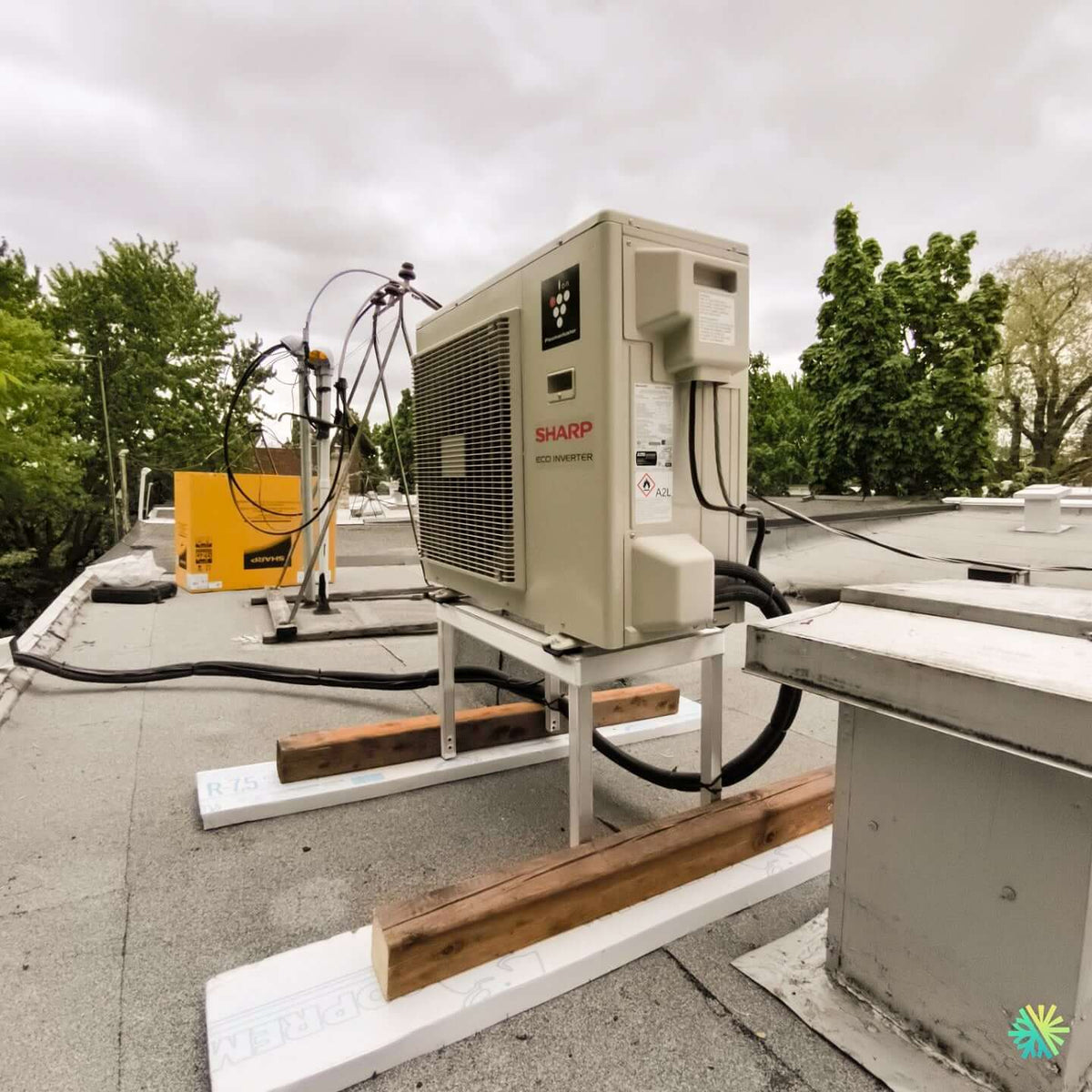
The outdoor unit (model AE-X18ZU1) was mounted on a raised metal structure , secured with treated wood support blocks and rigid insulation (R-25) to ensure stability and avoid direct contact with the roof membrane. This type of mounting also prevents infiltration and optimizes ventilation around the compressor.
Management of pipes and connections
We carefully positioned the refrigerant (1/4 – 3/8) and electrical lines for a clean and professional finish, while respecting RBQ and CSA standards. Everything was connected to the indoor unit (model AY-XP18ZU1), installed in a spacious living room benefiting from the system's excellent airflow.
Aesthetic details and safety
The rooftop cable routing was carried out with UV-protected conduits and a securely anchored metal tripod stand for maximum durability against the elements. All visible components were organized to maintain a clean aesthetic , even at height.

Challenges encountered and solutions provided
-
Roof space constraint : We used an adjustable base to maximize stability despite the restricted space between two ventilation vents.
-
Duct Passage : To avoid damaging the roof membrane, our technicians used existing passage points, sealed with urethane, to ensure watertightness.
-
Limited Access : Transporting the unit required the use of a portable winch to safely hoist the equipment without damaging the gutters.
An installation subsidized by LogisVert
Thanks to our administrative support, this client was able to benefit from the LogisVert grant of $2,640 , applicable to this SHARP model. We take care of everything: documentation, photo evidence, AHRI, invoice and form for a quick and validated submission.
Customer reviews and satisfaction
“Fast installation, super quiet and very efficient, even at -20°C. Thanks to AirGreen for the impeccable service!” — Aurélie R., LaSalle
Results obtained after installation
-
Immediate reduction in heating costs thanks to stable performance even at -25°C.
-
Significant improvement in indoor air quality , notably thanks to SHARP Plasmacluster technology.
-
No noise : The unit operates at only 52 dB outdoors and 25 dB indoors.
-
Seamless remote control , allowing the customer to adjust the temperature via their phone.
Why trust AirGreen in LaSalle and throughout Quebec?
At AirGreen, we don't just install. We transform living spaces , thanks to:
-
Our RBQ certified expertise with over 15 years of experience in residential and commercial HVAC.
-
Technicians specifically trained on SHARP, Gree, Fujitsu, Bosch models, and more.
-
Responsive and transparent after-sales service , with zero deposit required, payment only once the customer is 100% satisfied.
-
In-depth knowledge of provincial and federal grants available in Montreal, Laval, Longueuil, North Shore, and South Shore.

Tips for Homeowners with Flat Roofs in LaSalle
-
Choose a Cold Climate certified wall-mounted heat pump for consistent performance even below -25°C.
-
Install the raised unit with insulation to protect your roof membrane.
-
Work with local HVAC specialists who understand the architectural constraints of buildings in LaSalle and the metropolitan area.
To remember
This installation of a SHARP ZU1 – 18,000 BTU wall-mounted heat pump in LaSalle perfectly illustrates AirGreen's expertise in the world of residential HVAC in Quebec . Whether for similar projects on flat roofs or in condominiums, we have the technical, aesthetic and regulatory solutions to make your energy saving and thermal comfort project a success.
Need a free quote in LaSalle, Montreal, or on the South Shore? Contact AirGreen today at (514) 316-2973 or by email at sales@airgreen.ca
The job tools
Two quick checks with real numbers: what heat costs, and what your current heaters add up to in BTU/h.
Baseboards and electric furnaces turn 1 kWh of electricity into 1 kWh of heat. A heat pump delivers more: that is its COP. At Hydro-Québec’s rate D (11.142¢/kWh above 40 kWh a day, since 1 April 2026):
Hydro-Québec: a heat pump can be up to three times more efficient than baseboards for heating in the colder months.
Estimate per kWh of heat, at the chosen temperature, using the certified COP from the product page. Taxes, access charge and backup heat not included.
Conversion: 1 W = 3.412 BTU/h. An indication, not a load calculation: baseboards and furnaces are often stronger than the real need, and they can stay as backup. AirGreen confirms the capacity on site.
How the job unfolds
The main steps of this kind of job at AirGreen. Every house has its quirks: the estimate brings them out.
We look at the room, the outside wall, the line route and where the outdoor unit will go. That is where the capacity gets chosen.
Model, capacity and price, in writing. We also check whether the model qualifies for assistance programs.
Floors and furniture protected, wall plate position marked level, wall opening located.
A single opening, with the slope the drain needs to flow outside.
Set on a stand raised above the snow, with the clearances the manufacturer requires.
Connected, insulated and protected. The opening is then sealed against water, cold air and insects.
A dedicated circuit and an accessible disconnect near the outdoor unit.
Leak test, vacuum, then start-up and a check of heating and cooling.
Remote, modes, filters: we show you the essentials before we leave.
- The on-site estimateWe look at the room, the outside wall, the line route and where the outdoor unit will go. That is where the capacity gets chosen.
- The quoteModel, capacity and price, in writing. We also check whether the model qualifies for assistance programs.
- Getting readyFloors and furniture protected, wall plate position marked level, wall opening located.
- The wall openingA single opening, with the slope the drain needs to flow outside.
- The outdoor unitSet on a stand raised above the snow, with the clearances the manufacturer requires.
- Lines, cable and drainConnected, insulated and protected. The opening is then sealed against water, cold air and insects.
- The electrical workA dedicated circuit and an accessible disconnect near the outdoor unit.
- Tests and start-upLeak test, vacuum, then start-up and a check of heating and cooling.
- The walkthroughRemote, modes, filters: we show you the essentials before we leave.
What we check on a job like this one
Each number is a point we check on site. Switch between summer and winter to watch air and heat move.
In summer, the outdoor unit rejects the house's heat outside.
Generic illustration of this type of installation, not a survey of this job site. Tap a number.
Mounted level on a wall plate, high enough for the air to reach the whole room, with enough space around it to slide the filters out easily.
The refrigerant lines, the communication cable and the drain go through the wall in a single opening, sealed against water, cold air and insects.
Two insulated copper pipes connect the two units. Outside, a line cover can protect them from sun, knocks and weather.
A shut-off switch near the outdoor unit isolates it safely for service. It must stay accessible at all times.
The compressor and the fan. In heating mode it captures heat from the outdoor air, even in winter, and moves it inside.
On the ground or on the wall, it keeps the unit above accumulated snow. The unit stays clear and defrost water can drain away.
The fan needs to blow freely. Storage, a fence or a wall too close, and efficiency drops while noise goes up.
Is your home ready?
Check what applies at your place. A "no" is not a refusal: it is what we sort out during the estimate.
Good habits, once the unit is in place
Six simple habits that keep the unit going. Your list stays on this device.
What to do, season by season
Three habits per season for this unit. They take a few minutes and prevent many calls.
- Clean the indoor unit's filters.
- Clear leaves and debris left on the outdoor unit by winter.
- Test cooling before the first hot days.
- Clean the filters more often when the unit runs a lot.
- Keep plants away from the outdoor unit.
- Check that no water drips from the indoor unit.
- Rake the leaves around the outdoor unit.
- Test heating before the first cold days.
- Book periodic maintenance before winter.
- Keep snow away from the stand and the front of the unit.
- Let the unit defrost: it is normal.
- Never hit the ice on the fins; call us if the unit stays iced up.
The right pages, at the right time
Four statements: true or false?
It all comes down to details you have just seen.
1. In heating mode, the outdoor unit can produce water.
During defrost cycles. That water must drain away without forming ice.
2. You pick the capacity with a simple square-footage rule.
Windows, insulation, orientation and how the room is used all count. Capacity is chosen on site.
3. A multi-zone connects several indoor heads to a single condenser.
One head per room, all on the same condenser. Each room keeps its own temperature.
4. The disconnect can sit behind the patio furniture.
It must stay accessible: it is what shuts the unit off for service.
0 / 4 right answers
What people ask us about this kind of work
Does a wall-mounted heat pump heat in winter?
Wall-mounted or multi-zone: how do I choose?
Where does the outdoor unit go?
Are there grants?
Do I need a permit?
How cold can it heat?
How much can I save?
How is the LogisVert assistance calculated?
Is it noisy?
The outdoor unit is covered in ice: is that normal?
Does AirGreen hold the required licences?
Is the estimate free?
No question matches. Write to us: we answer.
More jobs to see, near you
By town, by equipment or by region: browse more than 4,700 published projects.
Each dot: a town where AirGreen has published projects. The glowing dot: this job.
An on-site estimate, the right capacity, the right equipment.
The on-site estimate is free and the quote follows within 24 hours.
Text and photo: a real AirGreen Climatisation & Chauffage job. The diagrams are generic illustrations of the type of installation, not a survey of this job site. Sources of the added figures: airgreen.ca product pages (NEEP / AHRI performance), Hydro-Québec (Heat pumps page, LogisVert, read on 13 October 2026), Régie de l’énergie (rate D as of 1 April 2026).