
Installation of a FUJITSU Aquila XLTH R32 36,000 BTU TripleZone heat pump in Longueuil
Real project in Longueuil: installation of a FUJITSU TripleZone 36,000 BTU heat pump. Multi-zone comfort, energy efficiency, and professional HVAC installation by AirGreen.
- City
- Region
- Equipment
- Brand
- Challenges
- Published
The job on one screen
The article, chapter by chapter
Strategic HVAC installation for perfectly controlled multi-zone comfort
In Longueuil, on Montreal's South Shore, we recently completed the installation of a TripleZone FUJITSU Aquila XLTH R32 36,000 BTU heat pump, a project that perfectly illustrates our rigorous and technical approach to HVAC installation. This intervention aimed to optimize the thermal comfort of a residence while significantly reducing energy costs.
The client wanted a reliable, quiet solution capable of efficiently heating even during the periods of intense cold typical of Quebec's climate. The objective was clear: to air condition and heat three distinct zones with a single high-performance system.
Project analysis and on-site constraints
A demanding outdoor configuration
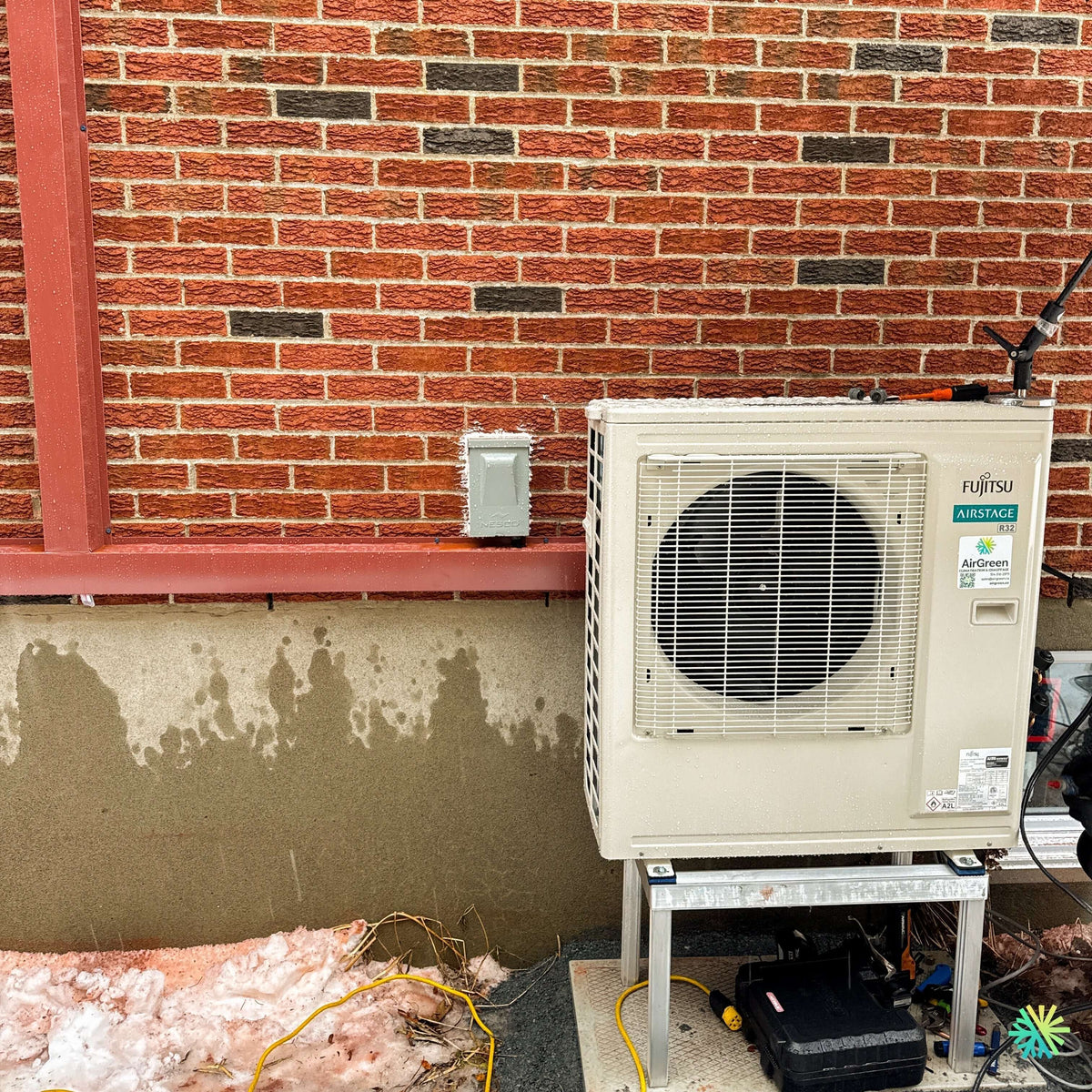
The installation image shows a FUJITSU outdoor unit installed on a raised aluminum support, against a brick wall. This choice is never insignificant.
In this specific project in Longueuil, several technical constraints influenced our approach:
- Significant snow accumulation in winter: hence the raised installation to prevent fan blockage.
- Solid brick wall: requiring strong fastening and suitable anchors.
- Condensate water management: visible at the base of the wall, requiring good drainage planning.
- Accessibility for HVAC maintenance: clear space under the unit to facilitate future interventions.
Optimized electrical supply
An outdoor watertight electrical box is also noted, installed in the immediate vicinity of the outdoor unit. This configuration complies with safety standards and allows for:
- Quick shutdown for maintenance
- Clean installation conforming to RBQ requirements
- Better durability against bad weather
Heat pump choice: FUJITSU Aquila XLTH TripleZone
Why this specific model?
The FUJITSU Aquila XLTH R32 36,000 BTU stands out as a strategic choice for multi-room properties in Longueuil, Laval, and Montreal.
Here are the key features that motivated our recommendation:
- Heating capacity down to -26°C
- Advanced Inverter technology
- Ecological R-32 refrigerant
- ENERGY STAR® certified (cold climate)
- Ultra-quiet operation (56 dB outdoor)
Zone configuration
For this installation, we configured the three zones as follows:
- Main living room: 12,000 BTU
- Master bedroom: 9,000 BTU
- Finished basement: 15,000 BTU
This distribution allows for independent management of each space, maximizing comfort while avoiding energy waste.
Complete HVAC installation process
Step 1: Preparation and positioning
Before any installation, our team:
- Verified the wall structure
- Determined the ideal height for the outdoor unit
- Planned the routing of refrigerant lines
The positioning was chosen to minimize vibrations and optimize air circulation.
Step 2: Outdoor unit installation
The unit was mounted on a robust metal support with:
- Anti-vibration pads
- Precise alignment to avoid mechanical stress
- Sufficient clearance around the fan
This type of support is particularly recommended in Greater Montreal to prevent freezing issues.
Step 3: Refrigerant line routing
We installed high-quality insulated lines connecting the three indoor units:
- Reinforced thermal insulation
- Protection against humidity
- Maximum visual discretion
An important point: avoid unnecessary bends to preserve system performance.
Step 4: Electrical connections and commissioning
Once connections were completed:
- Pressure test
- Complete system vacuum
- Performance verification for heating and cooling
Each step is documented according to our strict internal standards.
Energy performance and real savings
Impressive efficiency
This heat pump offers remarkable performance:
- SEER2: 22.0
- HSPF2: 10.0
- High COP even at low temperatures
Concretely, this means:
- Less electricity consumption
- Stable heating even in winter
- Significant reduction in energy bills
LogisVert subsidy
This project is eligible for a subsidy of up to $2928 through the LogisVert program.
We assisted the client with:
- Validation of criteria
- Preparation of the application
- Final submission
Challenges encountered and solutions provided
Managing ground moisture
As visible in the image, traces of water were present on the foundation. Therefore, we:
- Adjusted the condensate drainage
- Prevented any stagnation under the unit
- Ensured efficient evacuation
Space optimization
Space being limited:
- Precise positioning to avoid any obstruction
- Maintained access for future maintenance
- Optimized arrangement of tools and conduits
Resistance to winter conditions
We anticipated:
- Ice accumulation
- Prevailing wind
- Snowfall
Result: a durable and reliable installation.
Practical tips for homeowners
Absolutely avoid
- Installing the unit too close to the ground
- Neglecting conduit insulation
- Choosing inadequate power
Recommended best practices
- Always provide a raised support
- Call on certified experts
- Maintain the system annually
Why choose AirGreen in Longueuil and Greater Montreal
Our expertise in HVAC installation in Longueuil, Montreal, Laval, North Shore, and South Shore is based on:
- Complete mastery of FUJITSU systems
- A rigorous technical approach
- Total transparency in our interventions
Each project is treated as unique, with particular attention to detail.
A proven field approach
In this specific project:
- In-depth needs analysis
- Installation adapted to real constraints
- High-performing result from the first startup
Final result: comfort, performance, and peace of mind
The client now benefits from:
- Stable comfort in each zone
- A quiet system
- A significant reduction in energy consumption
This type of installation represents a smart investment for any residential property in Quebec.
Technical Conclusion
The TripleZone FUJITSU Aquila XLTH R32 36,000 BTU heat pump stands out as an ideal solution for residences requiring efficient multi-zone management. In a climatic context like Longueuil, this type of system offers an optimal combination of performance, durability, and energy efficiency.
At AirGreen, we continue to implement this type of solution across Montreal, Laval, and the entire South Shore, adapting each installation to on-site realities.
The job tools
Two quick checks with real numbers: what heat costs, and what your current heaters add up to in BTU/h.
Conversion: 1 W = 3.412 BTU/h. An indication, not a load calculation: baseboards and furnaces are often stronger than the real need, and they can stay as backup. AirGreen confirms the capacity on site.
How the job unfolds
The main steps of this kind of job at AirGreen. Every house has its quirks: the estimate brings them out.
We look at the room, the outside wall, the line route and where the outdoor unit will go. That is where the capacity gets chosen.
Model, capacity and price, in writing. We also check whether the model qualifies for assistance programs.
Floors and furniture protected, wall plate position marked level, wall opening located.
A single opening, with the slope the drain needs to flow outside.
Set on a stand raised above the snow, with the clearances the manufacturer requires.
Connected, insulated and protected. The opening is then sealed against water, cold air and insects.
A dedicated circuit and an accessible disconnect near the outdoor unit.
Leak test, vacuum, then start-up and a check of heating and cooling.
Remote, modes, filters: we show you the essentials before we leave.
- The on-site estimateWe look at the room, the outside wall, the line route and where the outdoor unit will go. That is where the capacity gets chosen.
- The quoteModel, capacity and price, in writing. We also check whether the model qualifies for assistance programs.
- Getting readyFloors and furniture protected, wall plate position marked level, wall opening located.
- The wall openingA single opening, with the slope the drain needs to flow outside.
- The outdoor unitSet on a stand raised above the snow, with the clearances the manufacturer requires.
- Lines, cable and drainConnected, insulated and protected. The opening is then sealed against water, cold air and insects.
- The electrical workA dedicated circuit and an accessible disconnect near the outdoor unit.
- Tests and start-upLeak test, vacuum, then start-up and a check of heating and cooling.
- The walkthroughRemote, modes, filters: we show you the essentials before we leave.
What we check on a job like this one
Each number is a point we check on site. Switch between summer and winter to watch air and heat move.
In summer, the outdoor unit rejects the house's heat outside.
Generic illustration of this type of installation, not a survey of this job site. Tap a number.
Mounted level on a wall plate, high enough for the air to reach the whole room, with enough space around it to slide the filters out easily.
The refrigerant lines, the communication cable and the drain go through the wall in a single opening, sealed against water, cold air and insects.
Two insulated copper pipes connect the two units. Outside, a line cover can protect them from sun, knocks and weather.
A shut-off switch near the outdoor unit isolates it safely for service. It must stay accessible at all times.
The compressor and the fan. In heating mode it captures heat from the outdoor air, even in winter, and moves it inside.
On the ground or on the wall, it keeps the unit above accumulated snow. The unit stays clear and defrost water can drain away.
The fan needs to blow freely. Storage, a fence or a wall too close, and efficiency drops while noise goes up.
Is your home ready?
Check what applies at your place. A "no" is not a refusal: it is what we sort out during the estimate.
Good habits, once the unit is in place
Six simple habits that keep the unit going. Your list stays on this device.
What to do, season by season
Three habits per season for this unit. They take a few minutes and prevent many calls.
- Clean the indoor unit's filters.
- Clear leaves and debris left on the outdoor unit by winter.
- Test cooling before the first hot days.
- Clean the filters more often when the unit runs a lot.
- Keep plants away from the outdoor unit.
- Check that no water drips from the indoor unit.
- Rake the leaves around the outdoor unit.
- Test heating before the first cold days.
- Book periodic maintenance before winter.
- Keep snow away from the stand and the front of the unit.
- Let the unit defrost: it is normal.
- Never hit the ice on the fins; call us if the unit stays iced up.
The right pages, at the right time
Four statements: true or false?
It all comes down to details you have just seen.
1. In heating mode, the outdoor unit can produce water.
During defrost cycles. That water must drain away without forming ice.
2. You pick the capacity with a simple square-footage rule.
Windows, insulation, orientation and how the room is used all count. Capacity is chosen on site.
3. A multi-zone connects several indoor heads to a single condenser.
One head per room, all on the same condenser. Each room keeps its own temperature.
4. The disconnect can sit behind the patio furniture.
It must stay accessible: it is what shuts the unit off for service.
0 / 4 right answers
What people ask us about this kind of work
Does a wall-mounted heat pump heat in winter?
Wall-mounted or multi-zone: how do I choose?
Where does the outdoor unit go?
Are there grants?
Do I need a permit?
How cold can it heat?
How much can I save?
How is the LogisVert assistance calculated?
Is it noisy?
The outdoor unit is covered in ice: is that normal?
Does AirGreen hold the required licences?
Is the estimate free?
No question matches. Write to us: we answer.
More jobs to see, near you
By town, by equipment or by region: browse more than 4,700 published projects.
Each dot: a town where AirGreen has published projects. The glowing dot: this job.
An on-site estimate, the right capacity, the right equipment.
The on-site estimate is free and the quote follows within 24 hours.
Text and photo: a real AirGreen Climatisation & Chauffage job. The diagrams are generic illustrations of the type of installation, not a survey of this job site. Sources of the added figures: airgreen.ca product pages (NEEP / AHRI performance), Hydro-Québec (Heat pumps page, LogisVert, read on 13 October 2026), Régie de l’énergie (rate D as of 1 April 2026).