
Installation of a GREE FREE MATCH R32 TripleZone heat pump with 3 zones and 3 heads on a flat roof in Montreal
AirGreen installs a GREE FREE MATCH R32 TripleZone heat pump in Montreal: 3 zones, 3 heads, unit on a flat roof, elevated base, protected piping, and neat HVAC installation.
In summer, the outdoor unit rejects the house's heat outside.
Generic illustration of this type of installation, not a survey of this job site. Tap a number.
Mounted level on a wall plate, high enough for the air to reach the whole room, with enough space around it to slide the filters out easily.
The refrigerant lines, the communication cable and the drain go through the wall in a single opening, sealed against water, cold air and insects.
Two insulated copper pipes connect the two units. Outside, a line cover can protect them from sun, knocks and weather.
A shut-off switch near the outdoor unit isolates it safely for service. It must stay accessible at all times.
The compressor and the fan. In heating mode it captures heat from the outdoor air, even in winter, and moves it inside.
On the ground or on the wall, it keeps the unit above accumulated snow. The unit stays clear and defrost water can drain away.
The fan needs to blow freely. Storage, a fence or a wall too close, and efficiency drops while noise goes up.
An HVAC installation on a Montreal roof where stability, access, and finish matter as much as performance
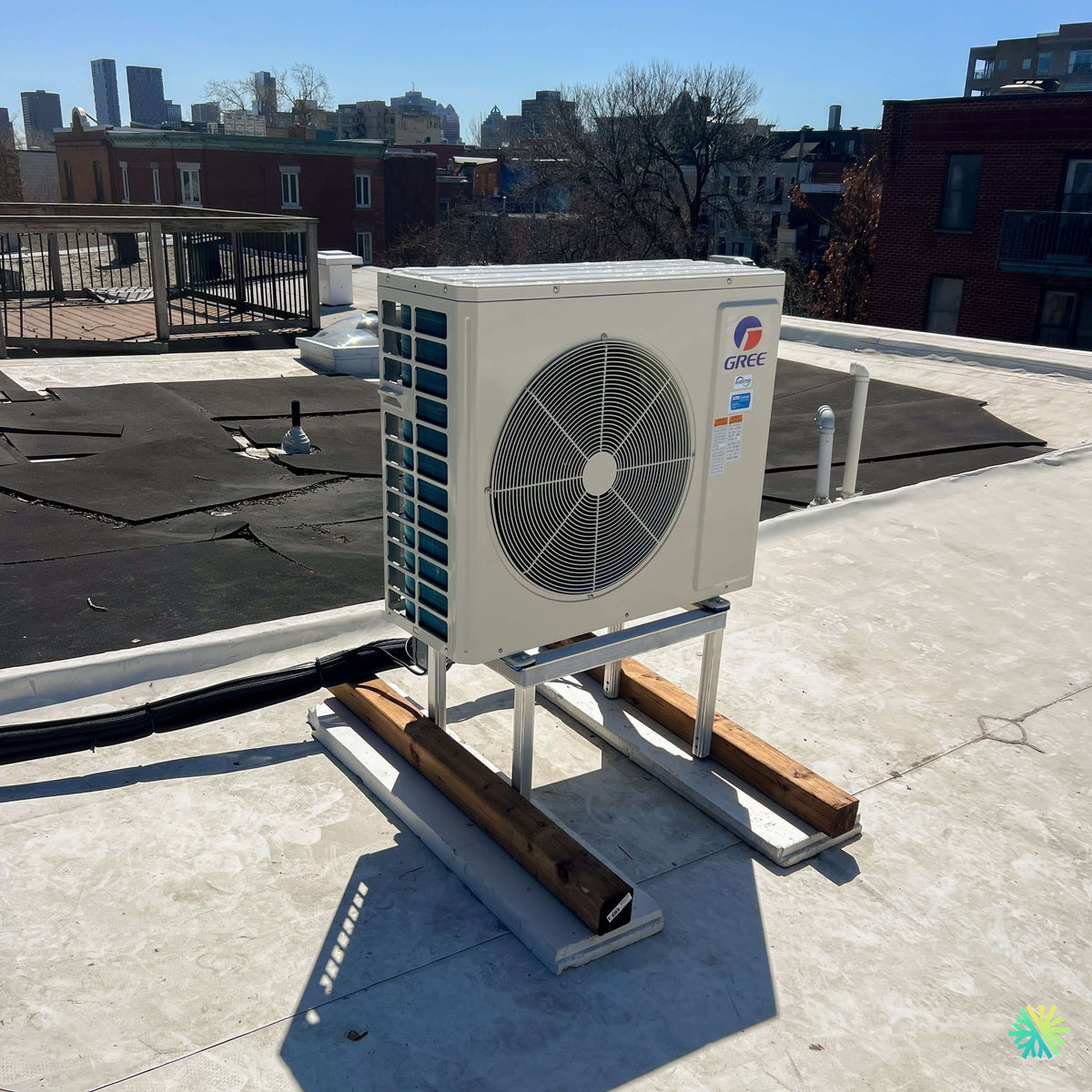
In Montreal, our AirGreen team carried out the installation of a GREE FREE MATCH R32 TripleZone heat pump, configured with 3 zones with 3 indoor heads, on a typical flat roof of Montreal's urban fabric. The photo perfectly illustrates a context we often encounter in central neighborhoods: a white roof, closely neighboring buildings, an unobstructed city view, access constraints, neatly organized piping routes, and an outdoor unit that must remain stable without compromising the membrane's integrity.
This project was not a simple outdoor unit installation. In a Montreal building, especially when a multizone system is installed on a flat roof, every technical decision influences the durability of the installation: the unit's height, its support, weight distribution, routing of refrigerant lines, roof protection, access for HVAC maintenance, vibration, air clearance, and coordination with the three indoor heads.
The outdoor unit GREE was installed on an elevated aluminum structure, resting on bases adapted to the roof, with beams used to distribute the load and provide a stable base. This type of installation prevents the unit from resting directly on the membrane while ensuring sufficient height to facilitate drainage, limit exposure to standing water, and simplify future maintenance.
Why a GREE FREE MATCH R32 TripleZone heat pump was suitable for this building
The GREE FREE MATCH R32 is a multizone solution particularly suitable when you want to heat and cool several spaces with a single outdoor unit. In this project, the TripleZone – 3 zones – 3 heads configuration allows serving three distinct rooms or sectors of the building without multiplying the units on the roof.
In Montreal, this approach is very advantageous. Flat roofs are often shared with other equipment, vents, mechanical outlets, guardrails, terraces, technical accesses, or constraints imposed by the building structure. Reducing the number of outdoor units therefore helps maintain a neater, easier-to-maintain, and less cluttered roof.
The multizone system also allows for much finer comfort management. A room facing full sun does not have the same needs as an interior bedroom, an office, a living room, or an area under the roof. With three indoor heads, each space can be adjusted according to its actual use. This flexibility is one of the great advantages of a heat pump multizone compared to a system that treats the entire building uniformly.
Choosing the flat roof: a common solution in Montreal, but never improvised
Installing an outdoor unit on a flat roof in Montreal may seem natural, but this choice requires a rigorous method. Unlike a ground or wall-mounted installation, the roof imposes particular constraints: membrane protection, weight distribution, wind resistance, safe access, roof drainage, vibrations, and clearances around the unit.
In the photo, the unit is installed on an independent structure, with a base that avoids direct contact with the membrane. This approach helps protect the roof and stabilize the equipment. The beams visible under the structure help distribute the load over a larger surface, an important detail when working on a flat roof where support points must be chosen carefully.
We must also consider the urban environment. The roofs of Montreal are exposed to wind, rapid temperature changes, solar radiation, snow accumulation, and freeze-thaw cycles. An outdoor unit must therefore be positioned to breathe properly, remain accessible, and not become an obstacle to roof maintenance work.
The pipe route: a key element in a 3-zone installation
The image shows a grouped and protected pipe route, neatly routed on the roof. In a 3 zones, 3 heads installation, this point is crucial. The refrigerant pipes, communication wiring, and system-related elements must be organized clearly, safely, and durably.
A poor pipe routing can create several problems: premature wear, difficult access, risk of damage during roof work, loss of aesthetics, unnecessary stress on connections, or complications during future service. Our goal is to design a clear, compact, and protected routing while respecting the maximum lengths and height differences allowed by the manufacturer.
In a Montreal building, the pipes may need to pass through masonry walls, ceilings, technical shafts, or tight spaces before reaching the three indoor heads. Planning must therefore be done before the work, not as it progresses. This preparation is what allows for a clean, stable, and reliable result.
An outdoor unit that must remain accessible in all seasons
A heat pump installed on a roof should not be placed solely based on available space. It must also remain accessible for technicians. HVAC maintenance requires being able to inspect the unit, clean the exchanger, check connections, validate pressures, diagnose components, and intervene on electrical connections if needed.
In this project, the unit is cleared around its main faces, which facilitates interventions. The elevated support also improves access under the device and limits risks related to water, snow, or accumulated debris. In Montreal, this detail can make a big difference over the seasons, especially after heavy snow episodes, ice storms, or rain followed by rapid freezing.
The role of Inverter technology and R32 refrigerant
The GREE FREE MATCH R32 system operates with Inverter technology, which allows the unit to adjust its capacity according to the actual demand of the indoor zones. Instead of operating only by on-off cycles, the device modulates its speed. This modulation contributes to a more stable temperature, better energy management, and smoother operation when the installation is properly sized.
The refrigerant R32 is also an important element of this generation of equipment. It is used in many recent heat pump and wall air conditioner systems, especially to meet the new HVAC market requirements. However, its handling requires professional procedures: careful connections, complete vacuuming, leak testing, adherence to manufacturer methods, and precise commissioning.
At AirGreen, we place great importance on these steps. A multizone system can be excellent on paper, but its performance directly depends on the quality of the installation.
AirGreen expertise adapted to flat roofs, urban buildings, and multizone systems
Coordinating the three indoor heads
In a TripleZone installation, final comfort depends as much on the indoor heads as on the outdoor unit. Each head must be positioned in a zone where air diffusion will be effective, noise will remain comfortable, drainage will be possible, and the device will remain accessible for filter cleaning.
For this project in Montreal, the logic of the three zones had to take into account the actual uses of the building. One zone can serve as a living area, another as a bedroom or office, and a third as a space more exposed to heat gains. Each head must be chosen and placed according to the thermal load of its room, not simply according to the easiest place to drill.
We specifically evaluate:
- the area of each zone;
- sun exposure;
- the ceiling height;
- the building's insulation;
- the presence of large windows;
- the desired noise level;
- drainage possibilities;
- the distance between each head and the outdoor unit;
- the final appearance of the ducts.
This analysis is particularly important in Montreal buildings, where rooms can be narrow, walls thicker, access more complex, and routes longer than in a recent single-family home.
Essential precautions to protect the roof membrane
An installation on a flat roof must always respect the roofing. The membrane should not be unnecessarily punctured or exposed to uneven pressure points. The support shown in the photo illustrates a thoughtful approach: the unit is installed on a base that distributes the load and limits the risk of localized damage.
Water must also be considered. On a flat roof, even a slight depression can promote water accumulation. The unit must not block natural drainage paths or prevent access to drains. It also must not be placed too close to an edge, vent, or obstacle that could hinder air circulation.
These precautions are essential to ensure a durable installation. A successful HVAC installation should never solve a comfort problem by creating a roofing problem.
Common mistakes to avoid when installing a heat pump on a roof
Flat roof installations require particular expertise. Among the most common errors are:
- placing the unit directly on the membrane;
- neglecting weight distribution;
- installing the device too close to an obstacle;
- leaving pipes exposed without adequate protection;
- forgetting future access for maintenance;
- choosing a location exposed to excessive snow accumulation;
- underestimating vibrations;
- poorly coordinating the pipe lengths between the three zones.
In this project, our team worked to avoid these pitfalls from the planning stage. Elevated mounting, clearance around the unit, clean routing of the pipes, and base stability all contribute to the final quality of the installation.
Subsidies and eligibility: the importance of validating the exact combination
For many owners in Montreal, Laval, Longueuil, on the North Shore or the South Shore, the question of subsidies related to heat pumps is important. In the case of a multizone system like the GREE FREE MATCH R32, eligibility generally depends on the exact combination installed: outdoor unit, models of the three indoor heads, capacities, certified efficiencies, and applicable technical reference.
The BTU capacity must be evaluated according to the needs of the three zones. For this project, the configuration was designed as a 3 zones, 3 heads system, with capacities adapted to the rooms served. In a multizone system, it would be unwise to rely solely on the series name; the complete set must be verified.
AirGreen supports its customers with the necessary documents after installation: detailed invoice, model identification, technical information, and advice to prepare the application when the system is eligible. This approach helps avoid unpleasant surprises and assists the customer in clearly understanding the steps.
Why the unit's positioning affects indoor comfort
Even though the outdoor unit is on the roof, its location directly influences the system's operation. A poorly ventilated unit can lose efficiency. A unit that is hard to access can make maintenance more costly. A unit installed on an unstable base can transmit vibrations. A unit placed in an area too exposed to snow accumulation may require more attention in winter.
In this Montreal installation, the unit is placed in an open space, with good airflow and a stable base. This decision helps the system operate under better conditions. For a TripleZone heat pump, this is even more important since the outdoor unit must meet the demands of three indoor heads.
HVAC maintenance after installation
Once the installation is complete, regular maintenance helps preserve the system's performance. The indoor heads must be cleaned periodically, especially the filters. The outdoor unit must remain clear, particularly after autumn and winter. On a flat roof, it is also necessary to ensure that the pipes remain well protected and that nothing obstructs the airflow around the unit.
We always explain to the client the simple actions to take and the signs that warrant intervention: performance drop, unusual noise, water leakage, ice buildup, error light, or significant difference between zones. A well-maintained multizone system offers more stable comfort and better longevity.
A clean, stable, and adapted result for Montreal
This installation of a GREE FREE MATCH R32 TripleZone heat pump in Montreal demonstrates the importance of a professional approach for rooftop projects. The outdoor unit is elevated, well cleared, installed on a base designed to protect the roof, and connected by an organized piping route. The whole system meets the needs of a 3 zones, 3 heads system, while respecting the constraints of an urban flat roof.
For the client, the result translates into better comfort in three distinct spaces, a single outdoor unit, a clean integration on the roof, and a modern solution adapted to Quebec seasons. For AirGreen, this project exactly represents our way of working: analyzing the building, choosing a coherent technical solution, protecting the building envelope, and delivering a reliable, durable, and neat HVAC installation.
How it goes, from the first call to the end
The main steps of this kind of job at AirGreen. Every house has its quirks: the estimate brings them out.
We look at the room, the outside wall, the line route and where the outdoor unit will go. That is where the capacity gets chosen.
Model, capacity and price, in writing. We also check whether the model qualifies for assistance programs.
Floors and furniture protected, wall plate position marked level, wall opening located.
A single opening, with the slope the drain needs to flow outside.
Set on a stand raised above the snow, with the clearances the manufacturer requires.
Connected, insulated and protected. The opening is then sealed against water, cold air and insects.
A dedicated circuit and an accessible disconnect near the outdoor unit.
Leak test, vacuum, then start-up and a check of heating and cooling.
Remote, modes, filters: we show you the essentials before we leave.
- The on-site estimateWe look at the room, the outside wall, the line route and where the outdoor unit will go. That is where the capacity gets chosen.
- The quoteModel, capacity and price, in writing. We also check whether the model qualifies for assistance programs.
- Getting readyFloors and furniture protected, wall plate position marked level, wall opening located.
- The wall openingA single opening, with the slope the drain needs to flow outside.
- The outdoor unitSet on a stand raised above the snow, with the clearances the manufacturer requires.
- Lines, cable and drainConnected, insulated and protected. The opening is then sealed against water, cold air and insects.
- The electrical workA dedicated circuit and an accessible disconnect near the outdoor unit.
- Tests and start-upLeak test, vacuum, then start-up and a check of heating and cooling.
- The walkthroughRemote, modes, filters: we show you the essentials before we leave.
And at your place?
Two quick checks with real numbers: what heat costs, and what your current heaters add up to in BTU/h.
Conversion: 1 W = 3.412 BTU/h. An indication, not a load calculation: baseboards and furnaces are often stronger than the real need, and they can stay as backup. AirGreen confirms the capacity on site.
What to do, season by season
Three habits per season for this unit. They take a few minutes and prevent many calls.
- Clean the indoor unit's filters.
- Clear leaves and debris left on the outdoor unit by winter.
- Test cooling before the first hot days.
- Clean the filters more often when the unit runs a lot.
- Keep plants away from the outdoor unit.
- Check that no water drips from the indoor unit.
- Rake the leaves around the outdoor unit.
- Test heating before the first cold days.
- Book periodic maintenance before winter.
- Keep snow away from the stand and the front of the unit.
- Let the unit defrost: it is normal.
- Never hit the ice on the fins; call us if the unit stays iced up.
Which type of equipment for your project?
Pick what looks like your need.
Four mistakes we do not make
Flip each card to see what we do instead.
What people ask us about this kind of work
Does a wall-mounted heat pump heat in winter?
Wall-mounted or multi-zone: how do I choose?
Where does the outdoor unit go?
Are there grants?
Do I need a permit?
How cold can it heat?
How much can I save?
How is the LogisVert assistance calculated?
Is it noisy?
The outdoor unit is covered in ice: is that normal?
Does AirGreen hold the required licences?
Is the estimate free?
No question matches. Write to us: we answer.
Useful pages for what comes next
More jobs to see, near you
By town, by equipment or by region: browse more than 4,700 published projects.
Each dot: a town where AirGreen has published projects. The glowing dot: this job.
Tell us about your house. We come and see it for free.
The on-site estimate is free and the quote follows within 24 hours.
Text and photo: a real AirGreen Climatisation & Chauffage job. The diagrams are generic illustrations of the type of installation, not a survey of this job site. Sources of the added figures: airgreen.ca product pages (NEEP / AHRI performance), Hydro-Québec (Heat pumps page, LogisVert, read on 13 October 2026), Régie de l’énergie (rate D as of 1 April 2026).