
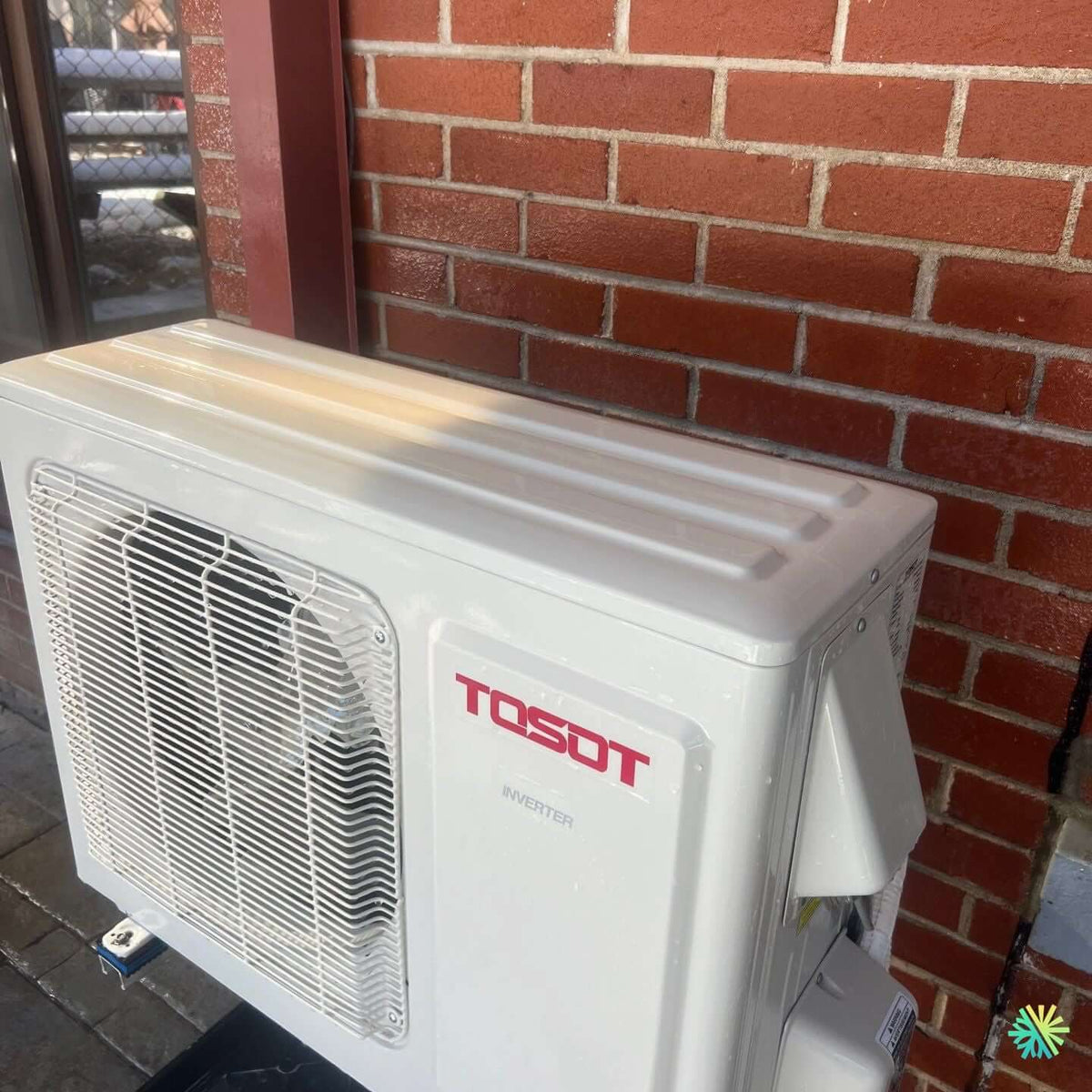
Installation of a Tosot (Inverter series) wall-mounted heat pump in Rosemont–La Petite-Patrie
AirGreen installs a Tosot wall-mounted heat pump (Inverter series) in Rosemont: brick facade, short connections, snow clearance, and simplified maintenance. Four-season comfort and sustainable HVAC installation for Greater Montreal.
- City
- Region
- Equipment
- Brand
- Challenges
- Published
The job on one screen
The article, chapter by chapter
Precise HVAC installation on brick facade for 4-season comfort — by AirGreen
Project background
In a typical Rosemont–La Petite-Patrie plex, the owner wanted to replace an old portable air conditioner with a cleaner, quieter HVAC solution that would provide a real heating boost in the spring and fall. The goal: to stabilize the temperature in an open living room-kitchen area, reduce humidity on muggy days, and consume less energy than fixed-speed units.
We proposed a Tosot wall-mounted heat pump (Inverter series) , known for its fine modulation, compactness and reliability. The chosen configuration favors a short and straight route for the connections, an exterior installation clear of snow and a discreet integration on the brick wall on the courtyard side.
Why a Tosot wall-mounted heat pump?
-
Inverter : Power adjusts to actual load — fewer stops/starts, better seasonal efficiency and stable comfort.
-
Cooling and heating in a single unit: ideal for Greater Montreal where needs vary greatly.
-
Low indoor/outdoor noise level , appreciated in the narrow alleys and backyards typical of Montreal.
-
Simplified HVAC maintenance : accessible filters, well-protected electronics, parts available from our distributors.
For homes in Montreal , Laval , Longueuil , North Shore and South Shore , Tosot offers a wall-mounted heat pump with a solid quality/price ratio, with a high-performance compressor and an exchanger sized for our humid summers.
Visible details of the exterior installation
Implementation and support
The Tosot condenser is installed against a brick wall on a rigid support structure, fixed in the masonry with appropriate anchors. Raising the unit:
-
protects the device from snow accumulations and defrosting puddles;
-
limits the absorption of dust and water during operation;
-
facilitates access for the service .
We use silent blocks to filter vibrations and prevent resonances in the brickwork—a crucial point for the peace and quiet of occupants and neighbors.
Refrigerant connections and power supply
The insulated copper tubes and the power/communication cable follow a short route from the interior head, which reduces pressure losses and optimizes efficiency . Penetrations in the brick are sealed (fire-resistant foam + exterior sealant) to prevent air and water infiltration.
Outside, a discreet protective trunking protects the connections from UV rays and shocks. A proximity disconnect switch is positioned in the technical area to secure maintenance work.
Condensate and frost management
Condensate drainage in air conditioning mode is carried out by gravity when the slope allows; otherwise, we provide a small, reliable and accessible pump. In heating mode, the unit is clear at the rear and sides to allow air to circulate freely—this promotes efficient defrosting and limits ice on the ground.
Interior integration and comfort achieved
The wall-mounted fan is positioned high up, centered over the living area, with no obstructions within 15–20 cm on the sides and above. The automatic sweep directs the airflow to cover the room evenly and avoid direct drafts onto the sofa and dining table.
Result for the customer:
-
Stable temperature without yo-yo;
-
Better controlled humidity thanks to Dry mode, very useful on stormy days;
-
Very low noise levels, compatible with teleworking and family life.
AirGreen Site Challenges and Solutions
1) Brick facade and vibrating bridges
Hollow brick requires suitable fixings. We used properly sized mechanical anchors , anti-crushing spacers and anti-vibration pads . This ensures that no vibration is transmitted to the structure from the inside.
2) Montreal winter and snow removal
The unit is located in a yard where snow settles quickly. The installation height and off-axis positioning of the shoveling areas prevent burial. The customer benefits from sufficient clearance in front of the gate for winter maintenance.
3) Short and clean route
The choice of the rear wall allowed for a single drilling , a bending radius respected for the copper, and a total length of only around 2 to 3 m — a direct gain in performance and reliability.
Good usage practices
-
Summer : setpoint 23–24°C, Cool or Auto mode; leave the fan on auto for fine modulation.
-
Mid-season / winter : Heat mode with setpoint 20–21 °C; do not cover the outdoor unit; clear snow around it to ensure air intake .
-
Dehumidification : Activate Dry mode during humidity spikes for comfort without overcooling.
-
Energy saving : open interior doors during the day to standardize; close rooms that are rarely used to speed up reaching the setpoint.
Recommended HVAC maintenance
-
Filters : Clean every 4–6 weeks during periods of heavy use.
-
Indoor battery : annual dusting and disinfection by our technicians.
-
Condenser : remove leaves and dust, check that condensates flow freely.
-
Refrigeration checks : periodic pressure/superheat/subcooling checks, electrical tightening and visual inspection of insulation.
-
Winter : Clear snow and ice from under the unit; avoid redirecting a snowblower toward the condenser.
Eligibility for assistance programs
Recent high-efficiency wall-mounted heat pumps may be eligible for provincial subsidies . Eligibility depends on the exact model and the declared performance. At AirGreen, we support each application— Montreal , Laval , Longueuil , North Shore , South Shore —to validate the criteria and develop the application with the client.
What the customer gains with this installation
-
4-season comfort in the open area, without sudden changes.
-
Lower consumption thanks to inverter modulation and optimized refrigeration path.
-
Visual and sound discretion on a busy brick facade.
-
Easy maintenance : accessible chute, nearby disconnect switch, solid anchors and service space.
AirGreen advice for a similar project in Rosemont, Villeray or HoMa
-
Location selection : Aim for a wall that allows for minimal line length and compliant clearances.
-
Winter management : raise, move away from shoveling areas, provide draining soil.
-
Sealing of drillings : essential in masonry to prevent infiltration.
-
BTU sizing : base on surface area, insulation, sunlight, and air permeability—avoid oversizing , which affects comfort and efficiency.
-
HVAC maintenance : an annual visit ensures consistent performance and extends lifespan .
AirGreen, your HVAC partner in Greater Montreal
At AirGreen , we design, install and maintain wall-mounted heat pumps , wall-mounted air conditioners and central systems adapted to the architectural characteristics of our neighborhoods. Our approach: precise diagnosis , careful installation and long-term support . For a Tosot or any other high-performance solution, our team is ready to intervene quickly in Montreal , Laval , Longueuil , on the North Shore and the South Shore .
The job tools
Two quick checks with real numbers: what heat costs, and what your current heaters add up to in BTU/h.
Conversion: 1 W = 3.412 BTU/h. An indication, not a load calculation: baseboards and furnaces are often stronger than the real need, and they can stay as backup. AirGreen confirms the capacity on site.
How the job unfolds
The main steps of this kind of job at AirGreen. Every house has its quirks: the estimate brings them out.
We look at the room, the outside wall, the line route and where the outdoor unit will go. That is where the capacity gets chosen.
Model, capacity and price, in writing. We also check whether the model qualifies for assistance programs.
Floors and furniture protected, wall plate position marked level, wall opening located.
A single opening, with the slope the drain needs to flow outside.
Set on a stand raised above the snow, with the clearances the manufacturer requires.
Connected, insulated and protected. The opening is then sealed against water, cold air and insects.
A dedicated circuit and an accessible disconnect near the outdoor unit.
Leak test, vacuum, then start-up and a check of heating and cooling.
Remote, modes, filters: we show you the essentials before we leave.
- The on-site estimateWe look at the room, the outside wall, the line route and where the outdoor unit will go. That is where the capacity gets chosen.
- The quoteModel, capacity and price, in writing. We also check whether the model qualifies for assistance programs.
- Getting readyFloors and furniture protected, wall plate position marked level, wall opening located.
- The wall openingA single opening, with the slope the drain needs to flow outside.
- The outdoor unitSet on a stand raised above the snow, with the clearances the manufacturer requires.
- Lines, cable and drainConnected, insulated and protected. The opening is then sealed against water, cold air and insects.
- The electrical workA dedicated circuit and an accessible disconnect near the outdoor unit.
- Tests and start-upLeak test, vacuum, then start-up and a check of heating and cooling.
- The walkthroughRemote, modes, filters: we show you the essentials before we leave.
What we check on a job like this one
Each number is a point we check on site. Switch between summer and winter to watch air and heat move.
In summer, the outdoor unit rejects the house's heat outside.
Generic illustration of this type of installation, not a survey of this job site. Tap a number.
Mounted level on a wall plate, high enough for the air to reach the whole room, with enough space around it to slide the filters out easily.
The refrigerant lines, the communication cable and the drain go through the wall in a single opening, sealed against water, cold air and insects.
Two insulated copper pipes connect the two units. Outside, a line cover can protect them from sun, knocks and weather.
A shut-off switch near the outdoor unit isolates it safely for service. It must stay accessible at all times.
The compressor and the fan. In heating mode it captures heat from the outdoor air, even in winter, and moves it inside.
On the ground or on the wall, it keeps the unit above accumulated snow. The unit stays clear and defrost water can drain away.
The fan needs to blow freely. Storage, a fence or a wall too close, and efficiency drops while noise goes up.
Is your home ready?
Check what applies at your place. A "no" is not a refusal: it is what we sort out during the estimate.
Good habits, once the unit is in place
Six simple habits that keep the unit going. Your list stays on this device.
What to do, season by season
Three habits per season for this unit. They take a few minutes and prevent many calls.
- Clean the indoor unit's filters.
- Clear leaves and debris left on the outdoor unit by winter.
- Test cooling before the first hot days.
- Clean the filters more often when the unit runs a lot.
- Keep plants away from the outdoor unit.
- Check that no water drips from the indoor unit.
- Rake the leaves around the outdoor unit.
- Test heating before the first cold days.
- Book periodic maintenance before winter.
- Keep snow away from the stand and the front of the unit.
- Let the unit defrost: it is normal.
- Never hit the ice on the fins; call us if the unit stays iced up.
The right pages, at the right time
Four statements: true or false?
It all comes down to details you have just seen.
1. In heating mode, the outdoor unit can produce water.
During defrost cycles. That water must drain away without forming ice.
2. You pick the capacity with a simple square-footage rule.
Windows, insulation, orientation and how the room is used all count. Capacity is chosen on site.
3. A multi-zone connects several indoor heads to a single condenser.
One head per room, all on the same condenser. Each room keeps its own temperature.
4. The disconnect can sit behind the patio furniture.
It must stay accessible: it is what shuts the unit off for service.
0 / 4 right answers
What people ask us about this kind of work
Does a wall-mounted heat pump heat in winter?
Wall-mounted or multi-zone: how do I choose?
Where does the outdoor unit go?
Are there grants?
Do I need a permit?
How cold can it heat?
How much can I save?
How is the LogisVert assistance calculated?
Is it noisy?
The outdoor unit is covered in ice: is that normal?
Does AirGreen hold the required licences?
Is the estimate free?
No question matches. Write to us: we answer.
More jobs to see, near you
By town, by equipment or by region: browse more than 4,700 published projects.
Each dot: a town where AirGreen has published projects. The glowing dot: this job.
An on-site estimate, the right capacity, the right equipment.
The on-site estimate is free and the quote follows within 24 hours.
Text and photo: a real AirGreen Climatisation & Chauffage job. The diagrams are generic illustrations of the type of installation, not a survey of this job site. Sources of the added figures: airgreen.ca product pages (NEEP / AHRI performance), Hydro-Québec (Heat pumps page, LogisVert, read on 13 October 2026), Régie de l’énergie (rate D as of 1 April 2026).