
Installation of a Zephyr Mono-Zone wall-mounted heat pump in Vimont (Laval)
AirGreen installs a Zephyr wall-mounted heat pump in Vimont, Laval: optimal positioning, short connections, gravity evacuation and simplified HVAC maintenance for four-season comfort in Greater Montreal.
- City
- Region
- Equipment
- Brand
- Challenges
- Published
The job on one screen
The article, chapter by chapter
A careful installation, designed for longevity and silence
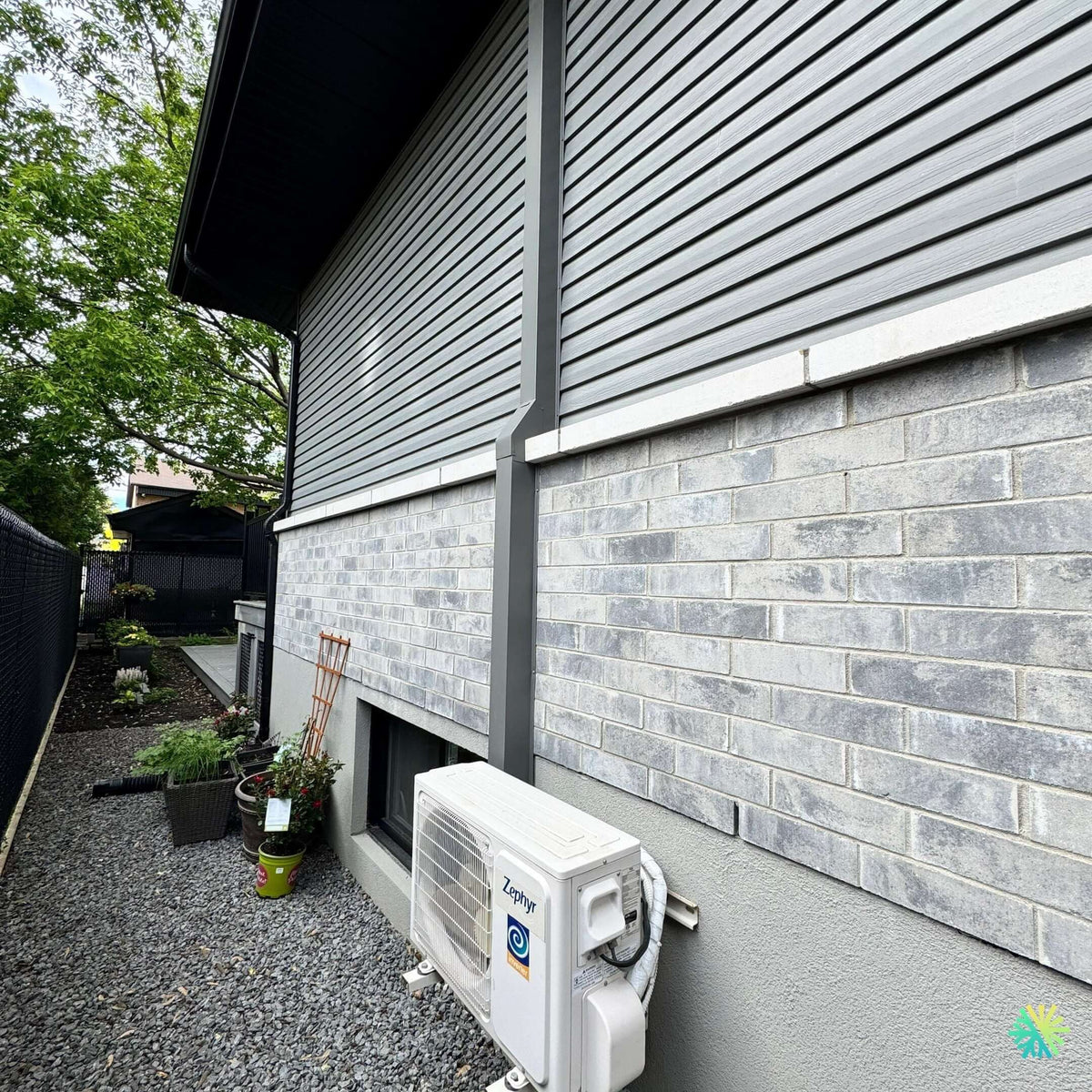
In the residential neighborhood of Vimont (Laval) , we are installing a Zephyr wall-mounted heat pump designed to provide four-season comfort for a single-family home. The site features a clean, clear side driveway, light brick cladding on joists, a crushed stone bed for water drainage, and a wire mesh fence providing natural protection against impacts. This context allows us to optimize the layout of the condenser , ensure exemplary air circulation, and guarantee a very low noise level , essential in a quiet neighborhood.
The choice of the Zephyr: reliable simplicity and controlled operating costs
The Zephyr single-zone heat pump meets the typical needs of a Laval family: efficient heating at low temperatures and precise cooling in summer, without overconsumption. The inverter electronics adjust the compressor speed according to actual demand, which reduces on/off cycles, stabilizes the indoor temperature and lowers the electricity bill . The Zephyr range benefits from a maintenance-oriented design: easy access to filters, well-cleared components, and refrigeration circuits designed to minimize pressure losses.
For this project, the single-zone configuration is consistent: a main living room to be air-conditioned/heated, interior doors generally open, and good air circulation. The machine largely covers the thermal needs of the ground floor, while offering fine modulation for mid-seasons.
Our HVAC Installation Method in a Narrow Side Yard
1) Strategic positioning of the condenser
The Zephyr condenser is set back from the passage on the gravel area, well away from the wall to respect rear and side clearances. We place it on rigid anti-vibration pads (raisers) to prevent dirt from rising, promote drainage and decouple ground vibrations . This elevation also protects the unit during episodes of heavy rain and spring thaw.
-
Height and Clearances : The fan shaft is at an optimal height for undisturbed air intakes .
-
Orientation : the unit blows towards the clear path, away from obstacles and plantations, which optimizes heat exchange and prevents the recycling of hot air in heating mode.
2) Discreet drilling, connections and capping
We drill a hole inclined outwards to promote the gravity flow of condensate . The refrigerant connections (UV insulated copper) and the communication cable are covered in a weather-resistant white capping . The service loop is tight, clean and stress-free, limiting any risk of friction on the facing.
-
Waterproofing : fire-retardant foam and exterior sealant for an impeccable air-water barrier.
-
Bend radius : respected to avoid bends that are too tight and keep the pressure loss very low .
-
Visible length : short and straight, a guarantee of performance and aesthetics.
3) Power supply and compliance
The power supply is provided by a dedicated circuit compliant with RBQ and CSA requirements, with a disconnection near the condenser for safe maintenance. The connections are protected from water splashes and the route is securely anchored to the cladding, without crossing existing downspouts. Each tightening, torque and marking is checked and recorded.
4) Vacuuming, charging and quality controls
We carry out a deep vacuum (≤ 500 microns) with ascent control, then the load release planned by the manufacturer. This is followed by leak tests (preliminary nitrogen pressure), current measurement , temperature readings and superheat/subcool to confirm the balance of the circuit. The defrost probe and compensation parameters are validated for Laval winter conditions.
5) Condensate management: gravity first
In this configuration, the natural slope towards the outside allows gravity drainage , therefore without a pump (less maintenance, no additional noise). We take care to keep the drainage away from the foundations and paths, and to prevent winter icing by a clear outlet and sufficient ground clearance. In areas of heavy snow, we recommend a raising kit or wall brackets to gain a few extra centimeters if necessary.
Air quality and comfort: much more than temperature
A properly sized heat pump contributes as much to hygrometric comfort as it does to temperature. In cooling mode, the Zephyr lowers ambient humidity , making the feeling of freshness faster. In heating mode, fine modulation avoids fluctuations and drafts common with on/off systems. The result: silence , stability , and improved air quality thanks to easily cleanable filters.
HVAC maintenance: maintaining performance over time
Regular HVAC maintenance extends lifespan and maintains original performance :
-
Clean the indoor unit filters every 4 to 8 weeks during periods of intensive use.
-
Annual inspection : static pressure, current, cleanliness of the evaporator/condenser, tightness of the terminals, condition of the silent blocks, clearances and condensate drainage.
-
Winter clearance : Keep 50 to 60 cm clear around the condenser after snowfall to avoid ice bridges and defrosting errors.
-
Capping : check the UV integrity of the sheath and the sealing joints.
Site planning advice for homes in Laval, North Shore and South Shore
The single-family homes of Laval, the North Shore and the South Shore share common constraints: narrow side passages , nearby downspouts , low windows . Here are our guidelines:
-
Prioritize air evacuation : avoid recesses, tight corners and high obstacles.
-
Ensure the ground is well-drained : gravel or perforated slabs to avoid creating puddles.
-
Anticipate winter : extension, snow deflector if the orientation requires it, and clearance in front of the grille.
-
Reduce the length of connections : performance and refrigeration balances are improved.
-
Protect the aesthetics : capping aligned with the brick joints, passage as short and straight as possible.
What the owner earns
-
Four-season comfort without sudden changes.
-
Controlled energy bills thanks to the inverter and an optimized installation .
-
Silence on the side facade, robust for neighborhood life .
-
Simple maintenance and clear access for future interventions.
-
Real estate value enhanced by modern, discreet and well-integrated equipment.
AirGreen: a local team that knows the terrain
Our teams operate weekly in Montreal , Laval , Longueuil , on the North Shore and the South Shore . We adapt each HVAC installation to the architecture and micro-constraints of the site: choice of support (pads, brackets, slab), condensate strategy, clean wiring , and optimization of refrigeration connections . We also support our customers with manufacturer warranties and assistance programs when the range and performance allow it.
Good practices to remember
-
Avoid the immediate proximity of a water outlet : the air circulation must not recycle the humidity.
-
Raise the condenser in snowy areas: guaranteed defrosting efficiency, limited corrosion.
-
Maintain access for service: no bulky objects in front of the panels.
-
Check the lock, seals and condition of the capping annually to maintain perfect sealing .
Conclusion: a clean, durable installation designed for winter
This Zephyr heat pump installation in Vimont (Laval) illustrates our approach: simple and precise engineering , attention to detail, and anticipation of real-life operating conditions in Quebec. The result: an efficient and discreet system, ready to offer stable comfort throughout the year, with reduced operating costs and easier HVAC maintenance .
The job tools
Two quick checks with real numbers: what heat costs, and what your current heaters add up to in BTU/h.
Conversion: 1 W = 3.412 BTU/h. An indication, not a load calculation: baseboards and furnaces are often stronger than the real need, and they can stay as backup. AirGreen confirms the capacity on site.
How the job unfolds
The main steps of this kind of job at AirGreen. Every house has its quirks: the estimate brings them out.
We look at the room, the outside wall, the line route and where the outdoor unit will go. That is where the capacity gets chosen.
Model, capacity and price, in writing. We also check whether the model qualifies for assistance programs.
Floors and furniture protected, wall plate position marked level, wall opening located.
A single opening, with the slope the drain needs to flow outside.
Set on a stand raised above the snow, with the clearances the manufacturer requires.
Connected, insulated and protected. The opening is then sealed against water, cold air and insects.
A dedicated circuit and an accessible disconnect near the outdoor unit.
Leak test, vacuum, then start-up and a check of heating and cooling.
Remote, modes, filters: we show you the essentials before we leave.
- The on-site estimateWe look at the room, the outside wall, the line route and where the outdoor unit will go. That is where the capacity gets chosen.
- The quoteModel, capacity and price, in writing. We also check whether the model qualifies for assistance programs.
- Getting readyFloors and furniture protected, wall plate position marked level, wall opening located.
- The wall openingA single opening, with the slope the drain needs to flow outside.
- The outdoor unitSet on a stand raised above the snow, with the clearances the manufacturer requires.
- Lines, cable and drainConnected, insulated and protected. The opening is then sealed against water, cold air and insects.
- The electrical workA dedicated circuit and an accessible disconnect near the outdoor unit.
- Tests and start-upLeak test, vacuum, then start-up and a check of heating and cooling.
- The walkthroughRemote, modes, filters: we show you the essentials before we leave.
What we check on a job like this one
Each number is a point we check on site. Switch between summer and winter to watch air and heat move.
In summer, the outdoor unit rejects the house's heat outside.
Generic illustration of this type of installation, not a survey of this job site. Tap a number.
Mounted level on a wall plate, high enough for the air to reach the whole room, with enough space around it to slide the filters out easily.
The refrigerant lines, the communication cable and the drain go through the wall in a single opening, sealed against water, cold air and insects.
Two insulated copper pipes connect the two units. Outside, a line cover can protect them from sun, knocks and weather.
A shut-off switch near the outdoor unit isolates it safely for service. It must stay accessible at all times.
The compressor and the fan. In heating mode it captures heat from the outdoor air, even in winter, and moves it inside.
On the ground or on the wall, it keeps the unit above accumulated snow. The unit stays clear and defrost water can drain away.
The fan needs to blow freely. Storage, a fence or a wall too close, and efficiency drops while noise goes up.
Is your home ready?
Check what applies at your place. A "no" is not a refusal: it is what we sort out during the estimate.
Good habits, once the unit is in place
Six simple habits that keep the unit going. Your list stays on this device.
What to do, season by season
Three habits per season for this unit. They take a few minutes and prevent many calls.
- Clean the indoor unit's filters.
- Clear leaves and debris left on the outdoor unit by winter.
- Test cooling before the first hot days.
- Clean the filters more often when the unit runs a lot.
- Keep plants away from the outdoor unit.
- Check that no water drips from the indoor unit.
- Rake the leaves around the outdoor unit.
- Test heating before the first cold days.
- Book periodic maintenance before winter.
- Keep snow away from the stand and the front of the unit.
- Let the unit defrost: it is normal.
- Never hit the ice on the fins; call us if the unit stays iced up.
The right pages, at the right time
Four statements: true or false?
It all comes down to details you have just seen.
1. In heating mode, the outdoor unit can produce water.
During defrost cycles. That water must drain away without forming ice.
2. You pick the capacity with a simple square-footage rule.
Windows, insulation, orientation and how the room is used all count. Capacity is chosen on site.
3. A multi-zone connects several indoor heads to a single condenser.
One head per room, all on the same condenser. Each room keeps its own temperature.
4. The disconnect can sit behind the patio furniture.
It must stay accessible: it is what shuts the unit off for service.
0 / 4 right answers
What people ask us about this kind of work
Does a wall-mounted heat pump heat in winter?
Wall-mounted or multi-zone: how do I choose?
Where does the outdoor unit go?
Are there grants?
Do I need a permit?
How cold can it heat?
How much can I save?
How is the LogisVert assistance calculated?
Is it noisy?
The outdoor unit is covered in ice: is that normal?
Does AirGreen hold the required licences?
Is the estimate free?
No question matches. Write to us: we answer.
More jobs to see, near you
By town, by equipment or by region: browse more than 4,700 published projects.
Each dot: a town where AirGreen has published projects. The glowing dot: this job.
An on-site estimate, the right capacity, the right equipment.
The on-site estimate is free and the quote follows within 24 hours.
Text and photo: a real AirGreen Climatisation & Chauffage job. The diagrams are generic illustrations of the type of installation, not a survey of this job site. Sources of the added figures: airgreen.ca product pages (NEEP / AHRI performance), Hydro-Québec (Heat pumps page, LogisVert, read on 13 October 2026), Régie de l’énergie (rate D as of 1 April 2026).