
Installation of a Zephyr R-32 wall-mounted heat pump in Plateau-Mont-Royal
Installation of a Zephyr R-32 wall-mounted heat pump on a flat roof in Plateau-Mont-Royal: raised support, UV channels, gravity drain, rigorous commissioning. AirGreen, HVAC expert in Montreal, Laval, Longueuil, North Shore and South Shore.
- City
- Region
- Equipment
- Brand
- Challenges
- Published
The job on one screen
The article, chapter by chapter
Four-season comfort with a flat-roof HVAC system designed for the reality of Montreal plexes
Context of intervention
At AirGreen , we often encounter condominiums and plexes in the Plateau-Mont-Royal region where floor and backyard space is scarce. For this project, our client wanted a compact, efficient, and discreet system that cools in the summer and provides additional heat in the mid-season, while preserving the building's architecture. We recommend a new-generation Zephyr R-32 wall- mounted heat pump, with the outdoor unit installed on a flat roof to free up the facade and avoid encroachment into the alley. This solution is ideal for Montreal, Laval , Longueuil , the North Shore , and the South Shore .
The equipment chosen and its advantages for an urban plex
Why a Zephyr with R-32?
-
High seasonal efficiencies : R-32 offers better performance than older refrigerants while reducing the total fluid charge.
-
Inverter : fine modulation of power, long and stable cycles , concrete energy savings in air conditioning and additional heating.
-
Silence : controlled acoustic profile, crucial for shared roofs and party walls.
-
Compactness : size suitable for raising the roof and respecting clearances around the fan.
Capacity and areas served
After a simplified load calculation (surface area, glazing, orientation, infiltration), we selected a single-zone configuration between 9,000 and 12,000 BTU for the main living area. This range covers the majority of open-plan rooms in the Plateau apartments, with a margin for summer humidity peaks.
Flat Roof HVAC Installation Details
Support and anchoring: stability without compromising the membrane
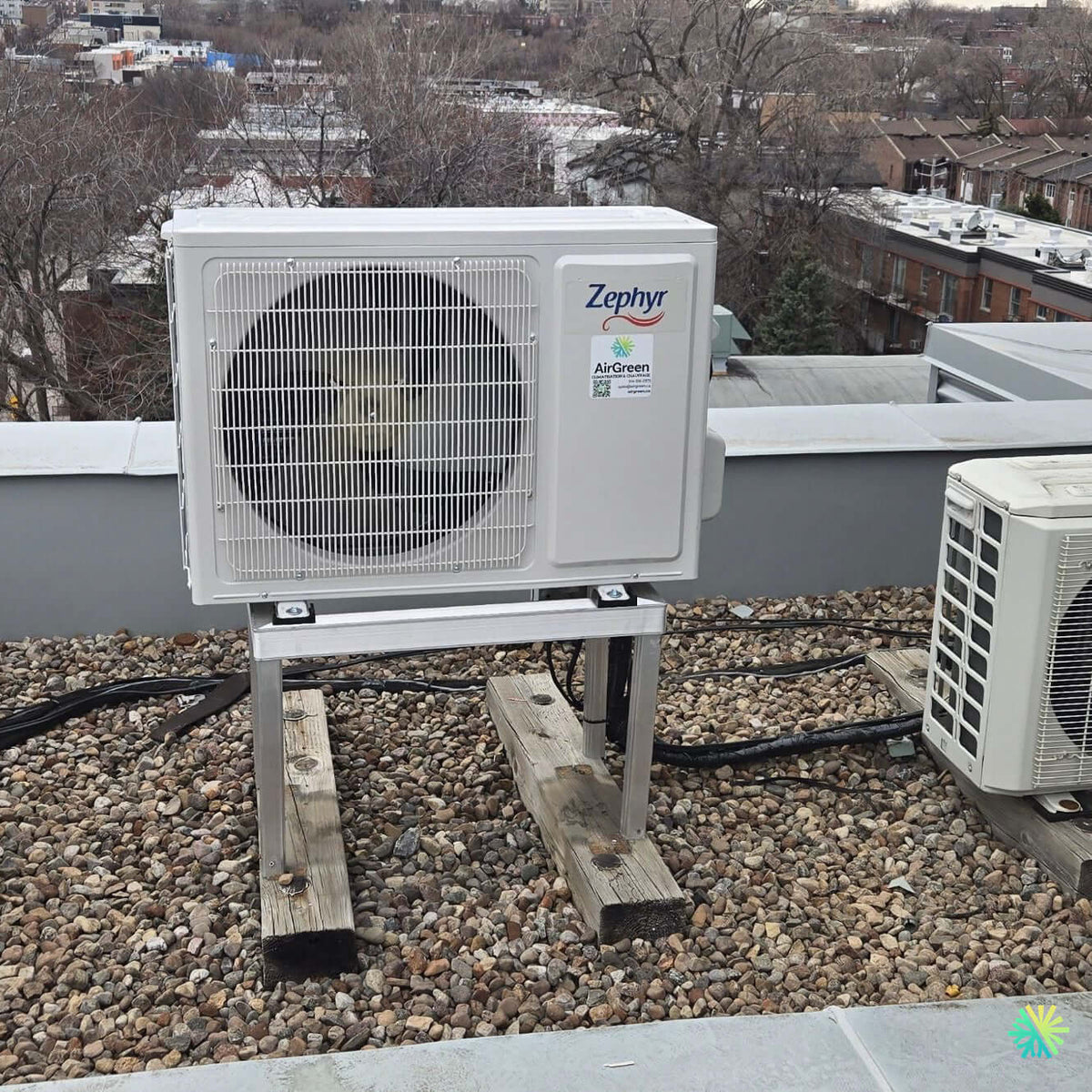
The Zephyr condenser is raised on an aluminum frame placed on skids/soles resting on treated wooden crosspieces . This configuration:
-
protects the elastomer membrane from punctures;
-
promotes drainage and prevents the accumulation of water and blown snow ;
-
limits the absorption of vibrations thanks to the anti-vibration pads under the plates.
The fasteners are tightened to the torque, with neoprene washers to preserve the structure. The fan orientation respects the recommended clearances (free front of at least 1 m and lateral ≥ 30–45 cm) to guarantee heat exchange and the longevity of the compressor.
Refrigeration path: cleanliness, performance and sustainability
-
Rooftop routing in high-density insulated copper connections (UV protection), tied and raised to prevent any water stagnation.
-
Waterproof passage at the parapet drop via a sheath and membrane-compatible mastic; air barrier restored on the interior side.
-
Clean vertical descent in UV-resistant chute to the interior wall head (short back-to-back configuration to minimize pressure losses).
Condensate management and electricity
-
Gravity drain from the indoor unit, controlled slope to the discharge point; no condensate pump required, guaranteeing silence and reliability.
-
Power wiring on a dedicated circuit, rated circuit breaker and external proximity disconnect for safety and maintenance. Connections are labeled and tested.
Commissioning: rigorous method
-
Nitrogen flushing in brazing, pressure test , then deep vacuum draw until stability (control of the rate of rise) to eliminate humidity and non-condensables.
-
Weighing of the fluid according to actual lengths, opening of the valves, verification of the intensities and blowing temperatures .
-
Remote control settings (modes, speed, swing , setpoint lock) and usage instructions.
Challenges of a Montreal flat roof… and our solutions
1) Wind and structural noise
Exposed roofs generate wind loads and noise transmission. Our raised frame, combined with anti-vibration pads and verified propeller alignment , prevents resonance within the structure. The fan is oriented so that the air discharge does not follow a parapet.
2) Defrosting and snow removal
The raised area ensures free flow during defrost cycles and prevents snow from accumulating on the coil. We maintain perimeter clearance for winter service and recommend manual de-icing if a persistent snowdrift forms after a storm.
3) Membrane integrity
No unnecessary through-fastening: loads are distributed via the cross members, and any technical penetrations are treated with compatible flashings and sealants. This approach protects the roof warranty and simplifies subsequent inspections.
Results obtained
Comfort felt
-
Rapid drop in indoor temperature in air conditioning, even during urban heat waves.
-
In mid-season, stable additional heating without overconsumption thanks to the inverter.
-
Low noise level at low speed, suitable for teleworking and quiet nights.
Efficiency and savings
-
Continuous modulation → less jolts , less wasted energy.
-
Effective dehumidification : a moderate setting provides tangible freshness.
Good usage practices
Recommended settings
-
In air conditioning, aim for 23–24°C with AUTO speed to let the inverter optimize the cycles.
-
For additional heating, maintain a stable setting (avoid large day/night variations).
-
Activate the swing to distribute the air in the open area.
HVAC Maintenance
-
Indoor unit filters : rinse every 4 to 8 weeks during use.
-
Roof: keep 1 m free in front of the battery, clear leaves and snow.
-
Annual AirGreen visit : electrical inspection, pressure/temperature measurement, leak test, battery cleaning and parameter updates.
Security, Compliance and Documentation
Standards followed
-
Tightening torques and flares comply with R-32 ; certified tools.
-
Clear labeling of circuits, route diagram, before/after photo file .
-
Dedicated outdoor disconnector and circuit breaker in accordance with local requirements.
Grants and programs
High-efficiency R-32 wall-mounted heat pumps may be eligible for assistance programs in Quebec (e.g., LogisVert or municipal initiatives, depending on the criteria). Our team supports:
-
eligibility verification (performance, operating temperature, approvals);
-
preparation of parts (detailed estimate, invoice, proof of installation);
-
filing and tracking for Montreal, Laval , Longueuil , North Shore and South Shore .
What this rooftop configuration brings to the owner
Key Benefits
-
Zero footprint in the yard or on the facade: aesthetics preserved, co-ownership satisfied.
-
Performance maintained in winter thanks to the raising and clearing of the battery.
-
Easy maintenance : clear technical access, disconnect switch within reach, legible route.
-
Durability : UV-resistant materials, stainless steel/galvanized fixings, protection against stagnant water.
Pitfalls Avoided (and How We Avoid Them)
-
Defrosting ineffective if the unit is too low → sufficient elevation.
-
Membrane punching by concentrated feet → wooden sleepers + wide plates.
-
Vibrations transmitted to structures → buffers and turbine/fan balancing.
-
Counter-slope of the interior drain → laser verification and water test.
Typical steps of an AirGreen project on a flat roof
-
Technical visit : surveys, photos, access constraints, co-ownership rules.
-
Sizing and selection of BTU capacity .
-
Route plan (ducts, penetrations, position of the disconnector).
-
Installation : supports, connections, power supply, seals.
-
Commissioning : nitrogen, vacuum, loads, measurements, settings.
-
Submission of the end of work file and HVAC maintenance recommendations.
AirGreen, your HVAC partner on the Plateau and throughout Greater Montreal
We design and install heat pumps , wall-mounted air conditioners , central and multi-zone systems in Montreal, Laval, Longueuil, on the North Shore and the South Shore . Our promise: honest advice , clear quotes, clean execution and real after-sales follow-up . Whether it's a flat roof like this one or a backyard, we adapt our supports (wall, slab, roof), our chutes and our routes to combine performance and aesthetics .
Quick Questions
Is a flat roof always better?
When a yard is cramped or regulated, yes. However, we validate the loads , prevailing winds and the membrane before confirming.
Is a condensate pump necessary?
In this back-to-back configuration with controlled slope, no . We favor the gravity drain for reliability and silence.
How long does an installation of this type take?
Generally one day , depending on the accessibility of the roof and the length of the route.
Conclusion
This Zephyr R-32 wall-mounted heat pump installation on a flat roof in Plateau-Mont-Royal demonstrates our expertise: raised supports, clean refrigeration path , controlled sealing and rigorous commissioning. The customer benefits from lasting comfort , quiet operation and optimized consumption , with a system ready for assistance programs applicable throughout Greater Montreal .
The job tools
Two quick checks with real numbers: what heat costs, and what your current heaters add up to in BTU/h.
Conversion: 1 W = 3.412 BTU/h. An indication, not a load calculation: baseboards and furnaces are often stronger than the real need, and they can stay as backup. AirGreen confirms the capacity on site.
How the job unfolds
The main steps of this kind of job at AirGreen. Every house has its quirks: the estimate brings them out.
We look at the room, the outside wall, the line route and where the outdoor unit will go. That is where the capacity gets chosen.
Model, capacity and price, in writing. We also check whether the model qualifies for assistance programs.
Floors and furniture protected, wall plate position marked level, wall opening located.
A single opening, with the slope the drain needs to flow outside.
Set on a stand raised above the snow, with the clearances the manufacturer requires.
Connected, insulated and protected. The opening is then sealed against water, cold air and insects.
A dedicated circuit and an accessible disconnect near the outdoor unit.
Leak test, vacuum, then start-up and a check of heating and cooling.
Remote, modes, filters: we show you the essentials before we leave.
- The on-site estimateWe look at the room, the outside wall, the line route and where the outdoor unit will go. That is where the capacity gets chosen.
- The quoteModel, capacity and price, in writing. We also check whether the model qualifies for assistance programs.
- Getting readyFloors and furniture protected, wall plate position marked level, wall opening located.
- The wall openingA single opening, with the slope the drain needs to flow outside.
- The outdoor unitSet on a stand raised above the snow, with the clearances the manufacturer requires.
- Lines, cable and drainConnected, insulated and protected. The opening is then sealed against water, cold air and insects.
- The electrical workA dedicated circuit and an accessible disconnect near the outdoor unit.
- Tests and start-upLeak test, vacuum, then start-up and a check of heating and cooling.
- The walkthroughRemote, modes, filters: we show you the essentials before we leave.
What we check on a job like this one
Each number is a point we check on site. Switch between summer and winter to watch air and heat move.
In summer, the outdoor unit rejects the house's heat outside.
Generic illustration of this type of installation, not a survey of this job site. Tap a number.
Mounted level on a wall plate, high enough for the air to reach the whole room, with enough space around it to slide the filters out easily.
The refrigerant lines, the communication cable and the drain go through the wall in a single opening, sealed against water, cold air and insects.
Two insulated copper pipes connect the two units. Outside, a line cover can protect them from sun, knocks and weather.
A shut-off switch near the outdoor unit isolates it safely for service. It must stay accessible at all times.
The compressor and the fan. In heating mode it captures heat from the outdoor air, even in winter, and moves it inside.
On the ground or on the wall, it keeps the unit above accumulated snow. The unit stays clear and defrost water can drain away.
The fan needs to blow freely. Storage, a fence or a wall too close, and efficiency drops while noise goes up.
Is your home ready?
Check what applies at your place. A "no" is not a refusal: it is what we sort out during the estimate.
Good habits, once the unit is in place
Six simple habits that keep the unit going. Your list stays on this device.
What to do, season by season
Three habits per season for this unit. They take a few minutes and prevent many calls.
- Clean the indoor unit's filters.
- Clear leaves and debris left on the outdoor unit by winter.
- Test cooling before the first hot days.
- Clean the filters more often when the unit runs a lot.
- Keep plants away from the outdoor unit.
- Check that no water drips from the indoor unit.
- Rake the leaves around the outdoor unit.
- Test heating before the first cold days.
- Book periodic maintenance before winter.
- Keep snow away from the stand and the front of the unit.
- Let the unit defrost: it is normal.
- Never hit the ice on the fins; call us if the unit stays iced up.
The right pages, at the right time
Four statements: true or false?
It all comes down to details you have just seen.
1. In heating mode, the outdoor unit can produce water.
During defrost cycles. That water must drain away without forming ice.
2. You pick the capacity with a simple square-footage rule.
Windows, insulation, orientation and how the room is used all count. Capacity is chosen on site.
3. A multi-zone connects several indoor heads to a single condenser.
One head per room, all on the same condenser. Each room keeps its own temperature.
4. The disconnect can sit behind the patio furniture.
It must stay accessible: it is what shuts the unit off for service.
0 / 4 right answers
What people ask us about this kind of work
Does a wall-mounted heat pump heat in winter?
Wall-mounted or multi-zone: how do I choose?
Where does the outdoor unit go?
Are there grants?
Do I need a permit?
How cold can it heat?
How much can I save?
How is the LogisVert assistance calculated?
Is it noisy?
The outdoor unit is covered in ice: is that normal?
Does AirGreen hold the required licences?
Is the estimate free?
No question matches. Write to us: we answer.
More jobs to see, near you
By town, by equipment or by region: browse more than 4,700 published projects.
Each dot: a town where AirGreen has published projects. The glowing dot: this job.
An on-site estimate, the right capacity, the right equipment.
The on-site estimate is free and the quote follows within 24 hours.
Text and photo: a real AirGreen Climatisation & Chauffage job. The diagrams are generic illustrations of the type of installation, not a survey of this job site. Sources of the added figures: airgreen.ca product pages (NEEP / AHRI performance), Hydro-Québec (Heat pumps page, LogisVert, read on 13 October 2026), Régie de l’énergie (rate D as of 1 April 2026).