
Installation of a Broan-NuTone AI Series V180H75RT air exchanger in Notre-Dame-de-l'Île-Perrot
No mechanical basement, no furnace ductwork, just a finished closet: here’s how we designed, installed, and tested a Broan-NuTone V180H75RT heat recovery ventilator in Notre-Dame-de-l’Île-Perrot, with a fully dedicated duct system and measured airflow.
Generic illustration of this type of installation, not a survey of this job site. Tap a number.
It removes stale air and brings in fresh air. The two airflows cross in the core without mixing.
It recovers part of the heat from the outgoing air to temper the incoming air. Depending on the model, it also manages humidity.
An outdoor hood, kept away from the exhaust so the house does not pull back the air it just removed.
Humid, stale air leaves through its own hood, fitted with a damper.
The ducts that connect to the outside are insulated to prevent condensation inside the house.
Stale air is drawn from humid rooms and fresh air is sent to living areas. The airflows are balanced.
It sets the mode and speed. You use it more when the house is humid or full of people.
Depending on the model and the season, the core produces condensation, removed through a drain with its loop.
Ventilating a house without a basement mechanical room: the case of a mechanical closet in Notre-Dame-de-l'Île-Perrot
On Île Perrot, water is everywhere. Lake Saint-Louis on one side, Lake des Deux Montagnes on the other, and between them, residential neighborhoods built densely over the past fifteen years or so. This geography has a direct effect on homes: outdoor humidity is high for much of the year, and recent construction is airtight enough that indoor air no longer renews itself.
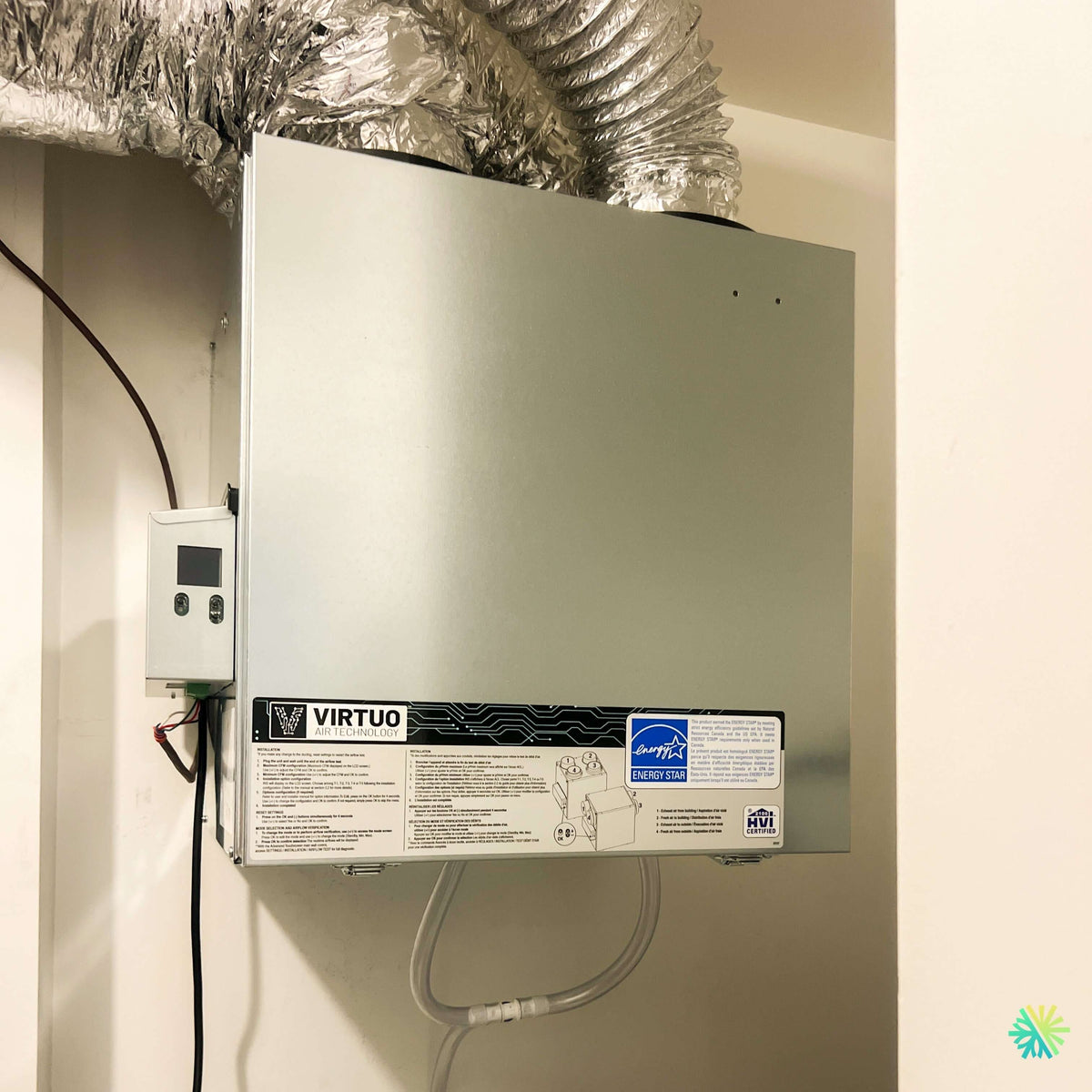
At AirGreen, we installed a Broan-NuTone AI Series V180H75RT air exchanger in a residence in Notre-Dame-de-l'Île-Perrot where the challenge was not technical in the usual sense: it was geometric. There was no finished basement mechanical room, no forced-air furnace available for sharing a network of ducts, and only one available space—a finished closet right in the heart of the living area. Here is how we approached it.
A house heated without a forced-air system: what changes
Many homeowners assume that an air exchanger must be connected to a furnace. In a large part of the residential housing stock in the South Shore and Vaudreuil-Soulanges, this simply is not possible: electric baseboard heating, radiant floors, or wall-mounted heat pumps without central distribution. There is then no existing network to use.
In these cases, only one approach really works: the fully dedicated system, programmed in the unit under the T1 configuration. The heat exchanger has its own ducts for intake and its own ducts for distribution, independent of any other equipment.
The logic behind the grilles, room by room
The principle is simple to state and demanding to execute:
- Exhausting stale air from rooms that produce moisture and contaminants: bathrooms, laundry rooms, and one point near the kitchen, never capturing cooking vapors directly, as those are handled by the range hood.
- Fresh-air distribution in rooms occupied for long periods: bedrooms, living room, office. At least one point per floor, positioned high so it can sweep through the space before the air descends again.
- Short, direct runs, with as few elbows as possible. Every tight elbow reduces airflow, and lost airflow never comes back.
On this project, the 6-inch insulated flexible ducts run directly from the top of the unit to the ceiling space, which made it possible to keep the lengths reasonable and avoid the typical crushing found in improvised installations.
The Broan-NuTone AI Series V180H75RT in detail
The model was chosen based on figures, not on a product range. The specifications of the V180H75RT :
- Airflow range of 65 to 193 CFM (31 to 91 L/s) at 0.4 in. w.g., and 65 to 184 CFM at 0.6 in. w.g. This second value matters: it indicates what the unit still delivers when the ductwork presents greater resistance.
- Sensible recovery efficiency (SRE) of 78% at 0 °C (at 64 CFM) and 68% at -25 °C (at 83 CFM). Apparent sensible efficiency reaches 82% at 0 °C.
- ENERGY STAR certification and HVI certification, with Novoclimat compliance when the unit is paired with the advanced touchscreen wall control.
- PMSM ECM motors, 120 V / 60 Hz / 3 A / 200 W power supply.
- 6-inch top outlets, included washable MERV 8 filter, and MERV 13 option for households sensitive to pollen and fine particles.
- Homeshield defrost, which engages at -5 °C and below.
- Assembled weight of approximately 47 lb (21.4 kg), with installation using the supplied chains or wall brackets.
We programmed a continuous airflow of 130 CFM, or approximately 62 L/s, based on the room-by-room calculation prescribed by the CSA F326 standard. The unit therefore has a comfortable reserve for periods of increased ventilation, without constantly running at a level that would serve no purpose.
What self-balancing changes in practice
An air exchanger only performs its function if the volume of incoming fresh air equals the volume of outgoing stale air. An imbalance in favor of exhaust depressurizes the house and draws air in through cracks, electrical outlets, and, in the worst case, through the floor drain. The opposite imbalance pushes humid air into the walls.
The classic method is to balance manually at commissioning, then hope for the best. The Virtuo Air Technology platform continuously measures actual airflow and adjusts the motors to maintain the setpoint despite fouling of the indoor filters, frost on an outdoor hood, or the gradual sagging of a flexible duct. In a house without a furnace duct network, where the heat exchanger is the only source of mechanical air movement, this stability is not a refinement: it is what ensures the installation remains compliant over time.
The line on the label that almost nobody reads
On the unit's access door, the first instruction in the installation section is explicit: if the ducts are modified, the settings must be reset and the airflow test rerun.
This is the most useful sentence on the entire label, and the one most often ignored. A homeowner who has a grille added in a new basement office, a renovator who moves a duct to fit a beam, or an installer from another trade who shortens a line: each of these actions changes the resistance of the network. Without a new test, the unit continues targeting a setpoint established for a network that no longer exists.
On our job sites, the commissioning sequence is always performed with windows and doors closed, the entire network sealed, and the exterior hoods installed. The display then shows the maximum airflow actually achievable and indicates which side is limiting the system. With the advanced touchscreen wall control, the Settings / Installation / Airflow Test menu lets you rerun this complete diagnostic at any time.
Installing an air exchanger in an occupied space
Placing the unit in a finished closet rather than an unfinished basement imposes three additional constraints.
Noise. An HRV rigidly mounted against a drywall partition turns that partition into a membrane. We mount the unit on wall brackets anchored to the structure, never in drywall alone—which the 47 lb weight makes mandatory anyway—and retain sections of insulated flexible duct at the connections to break the transmission of vibrations.
Clearances. The manufacturer requires 3 inches of clearance for repairs and 13 inches for routine maintenance. The second figure is the one that matters day to day: it is the space required to remove the core and filters. A closet whose door opens only 45 degrees condemns the homeowner to never performing maintenance and condemns the unit to losing its efficiency within two winters.
The condensate drain. An HRV produces water: that is a sign it is recovering heat. The tube must slope downward with a trap-forming loop, keeping at least 2 inches between the unit and the loop. Without a trap, the unit draws odors from the drain, and the homeowner blames the exchanger itself for the smell. This is one of the most common causes of HVAC service calls for otherwise perfectly functional units.
Actual consumption and performance in extreme cold
The 200 W indicated corresponds to maximum operation. During continuous operation at the programmed setting, consumption is significantly lower thanks to the ECM PMSM motors. On an annual basis, a unit in this class set to continuous residential airflow consumes approximately 700 to 900 kWh per year. The cost depends on your electricity rate, but the order of magnitude is similar to that of a recent refrigerator—for complete air exchange throughout the house, 24 hours a day.
In winter, Homeshield defrosting activates at -5°C and below. The principle is to periodically circulate indoor air through the core to melt accumulated frost, rather than shutting off ventilation. In Notre-Dame-de-l'Île-Perrot, where winds from the lake intensify cooling, this operation prevents episodes in which the unit stops during a cold snap, precisely when the house is most tightly sealed.
The errors we correct most often
During ventilation service calls in the Île Perrot, Vaudreuil-Dorion and Pincourt areas, the same causes keep coming up:
- Exterior hoods too close together, or too low relative to snow accumulation, causing exhausted air to be drawn back in.
- Intake hood installed near a dryer exhaust, plumbing vent or chimney.
- No drain trap, resulting in unpleasant odours.
- Flexible ducts that are too long and improperly stretched, causing the actual airflow to fall well below the programmed value.
- Airflow test never repeated after a system modification.
- Filters never washed. Vacuum them first, then wash them with warm, soapy water and allow them to dry completely, four times a year. Clean the core once a year.
- Distribution grilles closed or obstructed by furniture, unbalancing a system designed according to calculated specifications.
Construction Code, Novoclimat and financial assistance
Since 2012, the Quebec Construction Code has required a balanced mechanical ventilation system in applicable homes, with heat recovery of at least 54% at -25°C. The V180H75RT, certified at 68% at -25°C, comfortably exceeds this threshold and also meets the 60% requirement of the Novoclimat program—provided, and this detail is important, that the unit is paired with the advanced touchscreen wall control.
Regarding subsidies, we repeat what we tell every client: in Quebec, an air exchanger installed as part of a renovation is generally not eligible for direct financial assistance comparable to that offered for heat pumps. Its performance is measured differently—regulatory compliance, verifiable air quality, protection of the building envelope against moisture-related damage, and an improved rating during an energy assessment under Rénoclimat. A contractor who promises a subsidy for a simple air exchanger should be able to name the exact program and component.
AirGreen, from Île Perrot to Montreal: ventilation treated as a discipline
Residential ventilation suffers from being treated as an accessory sold at the end of a quote. At AirGreen, it is handled with the same rigor as a HVAC installation for heating or air conditioning: documented airflow calculations, a ductwork system designed before installation, and measured, recorded commissioning.
We work on HRVs and ERVs in single-family homes in Notre-Dame-de-l'Île-Perrot, Pincourt, and Vaudreuil-Dorion, in cottages in Laval and on the North Shore, in plexes in Montreal, as well as in newer developments in Longueuil, Brossard, and Saint-Hubert, on the South Shore.
What we systematically provide to the homeowner at the end of a ventilation project:
- The airflow calculation according to CSA F326, with a room-by-room breakdown.
- The result of the airflow test, including the minimum and maximum values actually achieved in the installed ductwork.
- The installation configuration programmed into the unit and what it means.
- Photos showing the positioning of the exterior hoods and the clearances that were maintained.
- A complete demonstration of how to maintain the interior filters and core, so routine maintenance does not depend on a service call.
A properly sized, correctly configured, and thoroughly tested air exchanger goes unnoticed. That is exactly what is expected of it. For an assessment of your ventilation system, a replacement, or a new installation in Montreal, Laval, Longueuil, on the North Shore, the South Shore, or in Vaudreuil-Soulanges, contact us. We measure before making recommendations.
How it goes, from the first call to the end
The main steps of this kind of job at AirGreen. Every house has its quirks: the estimate brings them out.
We locate the wall for the two outdoor hoods, the unit's spot, service access and the drain.
The unit, its location and the price, in writing.
Hung or set level, with clear access to the filters and the core.
Fresh air intake and exhaust, kept apart and sealed.
The ones connected to the outside are insulated to prevent condensation inside the house.
Connected with its loop, when the unit needs one.
Installed where you will see it and use it.
Incoming and outgoing airflows are adjusted so the house is neither pressurized nor depressurized.
Speeds, filters, core: how to use it through the seasons.
- The on-site estimateWe locate the wall for the two outdoor hoods, the unit's spot, service access and the drain.
- The quoteThe unit, its location and the price, in writing.
- The unitHung or set level, with clear access to the filters and the core.
- The outdoor hoodsFresh air intake and exhaust, kept apart and sealed.
- The ductsThe ones connected to the outside are insulated to prevent condensation inside the house.
- The drainConnected with its loop, when the unit needs one.
- The wall controlInstalled where you will see it and use it.
- BalancingIncoming and outgoing airflows are adjusted so the house is neither pressurized nor depressurized.
- The walkthroughSpeeds, filters, core: how to use it through the seasons.
What to do, season by season
Three habits per season for this unit. They take a few minutes and prevent many calls.
- Clean the filters and core as the manufacturer specifies.
- Check the outdoor hoods: nests, debris, dampers.
- Lower the speed if the outdoor air gets humid.
- Adjust the speed to the humidity in the house.
- Check that the drain flows.
- Keep the outdoor hoods clear.
- Clean the filters before the closed-house season.
- Check the exhaust damper.
- Book a full cleaning if the unit has not had one in a long time.
- Clear snow from both outdoor hoods.
- Raise the speed if condensation appears on windows.
- Let the unit run: with the house closed, humidity builds up.
Which type of equipment for your project?
Pick what looks like your need.
Four mistakes we do not make
Flip each card to see what we do instead.
What people ask us about this kind of work
What does an air exchanger do?
Does fresh air cool the house in winter?
What speed should it run at?
Does an exchanger need cleaning?
What are the signs of poor ventilation?
HRV or ERV: what is the difference?
Should it run in winter?
Does AirGreen hold the required licences?
Is the estimate free?
No question matches. Write to us: we answer.
Useful pages for what comes next
More jobs to see, near you
By town, by equipment or by region: browse more than 4,700 published projects.
Each dot: a town where AirGreen has published projects. The glowing dot: this job.
Tell us about your house. We come and see it for free.
The on-site estimate is free and the quote follows within 24 hours.
Text and photo: a real AirGreen Climatisation & Chauffage job. The diagrams are generic illustrations of the type of installation, not a survey of this job site. Sources of the added figures: airgreen.ca product pages (NEEP / AHRI performance), Hydro-Québec (Heat pumps page, LogisVert, read on 13 October 2026), Régie de l’énergie (rate D as of 1 April 2026).