
Installation of a Broan-NuTone HRV200 ECM air exchanger (HRV200TE model, HE series) in L'Île-Cadieux, Montérégie
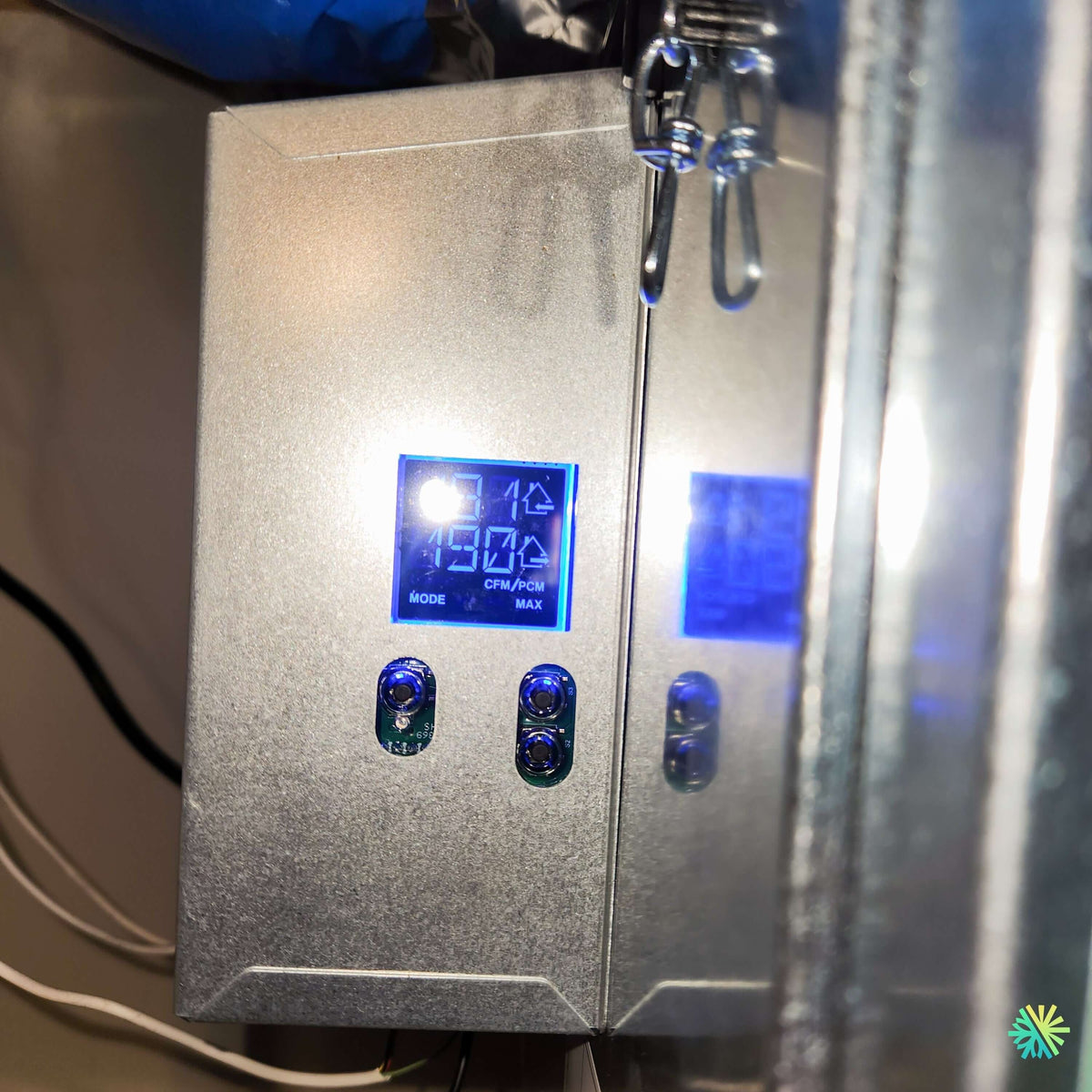
Two numbers on the display—one for incoming fresh air and one for outgoing stale air: here's why they need to converge. Installation of a Broan-NuTone HRV200 ECM in L'Île-Cadieux — 73% recovery at -25 °C, acoustic design, and documented commissioning.
Take a tour of the installation
Each number is a point we check on site. Switch between summer and winter to watch air and heat move.
Generic illustration of this type of installation, not a survey of this job site. Tap a number.
It removes stale air and brings in fresh air. The two airflows cross in the core without mixing.
It recovers part of the heat from the outgoing air to temper the incoming air. Depending on the model, it also manages humidity.
An outdoor hood, kept away from the exhaust so the house does not pull back the air it just removed.
Humid, stale air leaves through its own hood, fitted with a damper.
The ducts that connect to the outside are insulated to prevent condensation inside the house.
Stale air is drawn from humid rooms and fresh air is sent to living areas. The airflows are balanced.
It sets the mode and speed. You use it more when the house is humid or full of people.
Depending on the model and the season, the core produces condensation, removed through a drain with its loop.
Two figures on the screen, and why they must eventually converge
L'Île-Cadieux is one of Quebec's smallest municipalities: a residential island in Lac des Deux Montagnes, connected to Vaudreuil-Dorion by a bridge, in the Vaudreuil-Soulanges RCM. A few dozen residences, no businesses, mature wooded lots, and water on all four sides.
For an HVAC team, this context imposes three constraints not encountered in a neighborhood of Laval or Longueuil: access logistics with no room for error, high ambient humidity year-round, and clients who immediately notice the slightest mechanical noise in a house designed to be quiet.
The assignment: a large residence, heavy air, and a demand for silence
The house is spacious, built on two floors plus a finished basement, with approximately 4,000 sq. ft. of living space and five bedrooms. Forced-air heating, a central heat pump, and a gas fireplace. The building had been made very airtight during a major renovation: windows replaced, envelope sealed, insulation redone.
The owners described three observations to us, in this order:
- Air that stagnated on the upper floors, particularly in the rear bedrooms, despite a heat pump that maintained the temperature perfectly.
- A perceptible stale odor upon returning from a two-week stay.
- One explicit request: no noise was to be added to the already minimal noise from the existing system.
On-site readings: 55% relative humidity in April on the main floor, 1,250 ppm of CO₂ in the primary bedroom after a night with the doors closed, and no continuous mechanical ventilation apart from three timer-controlled bathroom fans.
The building had no defect. It simply lacked the component that renews its air.
The selected unit: Broan-NuTone HRV200 ECM
| Feature | Broan-NuTone HRV200 ECM |
|---|---|
| Model number | HRV200TE |
| Series | HE (high efficiency) |
| Min/max continuous airflow at 0.2 in. w.g. | 50 to 245 ft³/min |
| Min/max continuous airflow at 0.4 in. w.g. | 50 to 226 ft³/min |
| Apparent sensible efficiency at 0°C | 85 % |
| Recovered sensible efficiency (SRE) at 0°C | 81 % |
| Recovered sensible efficiency at -25°C | 73 % |
| Fan efficiency at 0°C | 3.4 ft³/min per watt |
| Filtration | MERV 6, HEPA option |
| Replacement filters | SV63426 / V21996 |
| Certifications | ENERGY STAR, HVI certified |
| Connections | 6 in., on top |
| Dimensions (H × W × D) | 31 × 32 × 20 in. |
| Weight | 82 lb |
| Core technology | Venmar Core Technology |
73% at -25 °C: the figure that really matters in Quebec
Most technical data sheets highlight efficiency measured at 0 °C. This is a useful value for comparing units, but it describes a November day, not a January night.
The figure that matters in our climate is the sensible recovery efficiency at -25 °C. This is where cores truly differ, because frost begins to form and defrost cycles reduce performance.
The HRV200 ECM maintains 73% recovery at -25 °C. For reference, several standard-range units drop to 60% under the same conditions. In a continuously ventilated 4,000 sq. ft. home, this thirteen-point difference translates into kilowatt-hours every day of winter.
The HEPA option, and when it is justified
The HRV200 ECM comes with MERV 6 filtration and accepts an optional HEPA filter capable of capturing 99.97% of particles 0.3 microns and larger.
We do not systematically recommend HEPA. It increases the pressure drop in the system, requires more frequent replacement, and offers no decisive benefit in a home without a sensitive occupant. We recommend it in three situations: documented respiratory allergies in an occupant, proximity to a constant outdoor particle source, or an explicit request from a customer who understands the recurring maintenance cost. At L'Île-Cadieux, the option was presented and quoted, and the customer chose the standard configuration with the possibility of adding it later.
Why there are two airflow ranges, and which one to trust
Technical data sheets publish two airflow ranges: one at 0.2 in. of water column and one at 0.4 in. w.c.. The difference is not cosmetic.
Water column measures the resistance that the duct system presents to airflow. The longer, more convoluted, more restricted, or dirtier the system, the more this resistance increases, and the lower the actual delivered airflow.
- 0.2 in. w.c. corresponds to a short, generously sized duct system — a laboratory scenario or a very small home.
- 0.4 in. w.c. corresponds to a real residential duct system, with its lengths, elbows, and dampers.
This is the 0.4 in. w.c. value we use for sizing. On the HRV200 ECM, that gives 50 to 226 cfm rather than 50 to 245. The 19 cfm difference may seem minor; it is not when an installer has selected the unit while targeting the top of the first range.
The airflow calculated for this house
Two methods, of which we always retain the more demanding result.
Using the formula:
Airflow (cu ft/min) = 0.01 × floor area + 7.5 × (number of bedrooms + 1)
- 0.01 × 4,000 = 40
- 7.5 × (5 + 1) = 45
- Total: 85 cu ft/min in continuous ventilation
According to the reference table (3,001 to 4,500 sq ft, 4 to 5 bedrooms): 90 cu ft/min.
Selected setpoint: 90 cu ft/min in continuous operation, with a maximum speed programmed at around 150 cu ft/min for periods of high occupancy, successive showers, and extensive cooking.
These two values place the unit at one-third of its useful range. It never strains, remains quiet, and retains a comfortable reserve for days when the filters are nearing replacement.
Reading the unit's display as a dashboard
This is the part of the project that deserves a detailed explanation, because it changes how a homeowner can monitor their own system.
The electronic module mounted on the unit displays two values simultaneously, each accompanied by a house icon and an arrow:
- The incoming arrow: the flow of fresh air delivered to the house, in cu ft/min.
- The outgoing arrow: the flow of stale air expelled outdoors, in cu ft/min.
The MODE label indicates the current operating setting — minimum, maximum, or standby — and the CFM/PCM label confirms that the displayed values are airflow rates.
Why the two figures differ at first
At initial startup, the two values are rarely identical. This is normal and expected: the two circuits do not offer the same resistance. The exhaust circuit passes through multiple transitions and is often longer; the supply circuit opens into a different plenum or distribution network.
The unit's electronics then independently adjust the speed of each motor to bring both values toward the programmed setpoint. What the technician observes during commissioning is this convergence.
The five causes of a persistent difference
When the difference does not close, the cause is always physical, never electronic. In order of frequency:
- An obstructed exterior hood — clogged screen, ice, leaves, insect nest. By far the most common cause.
- A crushed or collapsed duct between two supports, or bent at too tight a radius.
- An interior filter saturated on one side of the core.
- A balancing damper left closed or partially obstructed.
- A significantly longer run on one side than the other, without a compensating increase in diameter during design.
Each can be corrected. None can be adjusted by changing a setting on the screen.
The threshold we accept at delivery
A balanced system does not mean two figures that are rigorously identical down to the last unit. Our delivery criterion: a maximum difference of 10% between supply and exhaust, in each programmed mode, measured after the system has stabilized.
Beyond that, the house shifts into an imbalance:
- Negative imbalance — more exhaust than supply: the house becomes depressurized, air infiltrates through the building envelope, moisture migrates into the walls, and a combustion appliance risks backdrafting its gases. In this home, equipped with a gas fireplace, this was a safety constraint, not a comfort issue.
- Positive imbalance — more supply than exhaust: the home's warm, humid air is pushed into the wall cavities, where it condenses against the cold cladding.
The two final values were recorded, dated, and provided to the client in writing for each operating mode. This is the reference that will make it possible to objectively determine, in five years, whether the system has drifted.
The project: what a large residence on an island requires
Silence treated as a design requirement
The unit is suspended with chains and carabiners in an independent frame, never screwed directly to the structure. The unit's 82 lb are thus decoupled from the framing, and continuous operation at 90 ft³/min — approximately one-third of capacity — remains imperceptible from the occupied rooms.
The first few feet of duct at each connection are made of insulated flexible duct, which interrupts vibration transmission to the rigid downstream network. This is a detail we now apply to all our installations where silence is an explicit requirement.
Long distances, accounted for in the design
In a residence of this size, some runs are considerably longer than those in a bungalow. Our method:
- The diameter is increased on long runs rather than relying on the motor to compensate.
- Elbows are taken into account — each tight elbow creates pressure loss equivalent to several feet of straight duct.
- The ducts are taut and supported at intervals of no more than 1.2 m, using wide straps.
- All exterior ducts are insulated with a vapor barrier and sealed with aluminum tape.
The outdoor hoods beneath a canopy of mature trees
The island is wooded, and the residences are surrounded by mature trees. Two direct consequences for positioning:
- Fine-mesh screening mandatory on the intake, with a 6 in. anti-gust hood.
- Inspection twice a year, including one inspection carried out immediately after the leaves have fallen. An intake hood clogged with leaves is exactly what causes the two figures on the display to diverge.
- At least 1.8 m of separation between intake and exhaust, away from the dryer exhaust and range hood.
Island logistics
A single bridge, narrow streets, and no nearby suppliers. We deliver this type of project with all the material calculated in advance, plus a margin, because an improvised round trip costs half a day. The preliminary survey and material list are checked twice before the truck leaves.
Errors to avoid
- Sizing for the 0.2 in. w.g. range, then discovering that the actual ductwork does not deliver the advertised airflow rates.
- Considering commissioning complete as soon as the unit is running, without checking that the two airflow rates converge.
- Ignoring a persistent discrepancy between supply and exhaust, assuming the electronics will correct it on their own.
- Bolting the unit to the structure in a house where silence is a requirement.
- Connecting the dryer or range hood to the air exchanger's ductwork. Lint and grease destroy the core. Dedicated exhaust, without exception.
- Neglecting the fall inspection of the hoods in a wooded environment.
- Choosing HEPA by reflex, without calculating the additional pressure drop and recurring maintenance cost.
What we apply from this project to large residences in Greater Montréal
Six months after commissioning, relative humidity remained between 35% and 41% depending on the season, and the CO₂ measured in the primary bedroom after a night with the doors closed had dropped back below 800 ppm. The homeowners confirmed that they had never heard the unit from the occupied rooms.
Applicable subsidies
The Québec government's Rénoclimat program provides financial assistance of approximately $500 for installing or replacing an HRV or ERV, provided that the unit is listed in the Home Ventilating Institute (HVI) certified products directory. The HRV200 ECM carries this certification as well as ENERGY STAR certification, applicable when the unit is used in Canada.
Two critical procedural conditions:
- The initial energy evaluation must take place before the work. An evaluation carried out afterward makes the application ineligible.
- A post-work assessment is required to trigger payment.
Amounts and criteria are reviewed periodically. We confirm eligibility at the time of quotation rather than announcing a figure that may have changed.
Maintenance, with an objective indicator
The advantage of a unit that displays both airflow rates is that maintenance is no longer a matter of guesswork.
- Every 3 months: clean or replace the indoor filters (SV63426 / V21996). Then check both values on the display: a return to the setpoint confirms that the network is clear.
- Once a year: rinse the recovery core, reprime the drain trap, and inspect chains and carabiners.
- Twice a year, including once after the leaves have fallen: clean the exterior hoods.
- Whenever a difference of more than 10% appears between the two figures: look for a physical obstruction, starting outside.
Why entrust your ventilation to AirGreen
We design, install, and maintain heating, ventilation, and air-conditioning systems in Greater Montreal with more than fifteen teams on the road. Our service area covers Montreal, Laval, Longueuil, the North Shore, the South Shore, and all of Montérégie, including Vaudreuil-Soulanges: Île-Cadieux, Vaudreuil-Dorion, Vaudreuil-sur-le-Lac, Hudson, Saint-Lazare, and Île-Perrot.
What we bring to a residential ventilation HVAC installation:
- A measured assessment—humidity, CO₂, existing airflow rates—before any recommendation.
- Sizing calculated over the 0.4 in. w.g. range, the one that corresponds to a real duct network.
- Acoustic design in homes where silence is a requirement.
- Commissioning verified at both airflow rates, with a written deviation criterion that is observed.
- A delivery sheet provided to the customer: airflow rates, operating modes, filter references, and maintenance schedule.
- An RBQ-licensed team and full support with grant applications.
- HVAC maintenance and repair service in the years that follow.
If the air in your home remains stagnant despite a flawless heating and air-conditioning system, or if you want to know what your air exchanger is actually delivering rather than what it should deliver, contact AirGreen. We measure, document, and provide you with the figures.
The big day, step by step
The main steps of this kind of job at AirGreen. Every house has its quirks: the estimate brings them out.
We locate the wall for the two outdoor hoods, the unit's spot, service access and the drain.
The unit, its location and the price, in writing.
Hung or set level, with clear access to the filters and the core.
Fresh air intake and exhaust, kept apart and sealed.
The ones connected to the outside are insulated to prevent condensation inside the house.
Connected with its loop, when the unit needs one.
Installed where you will see it and use it.
Incoming and outgoing airflows are adjusted so the house is neither pressurized nor depressurized.
Speeds, filters, core: how to use it through the seasons.
- The on-site estimateWe locate the wall for the two outdoor hoods, the unit's spot, service access and the drain.
- The quoteThe unit, its location and the price, in writing.
- The unitHung or set level, with clear access to the filters and the core.
- The outdoor hoodsFresh air intake and exhaust, kept apart and sealed.
- The ductsThe ones connected to the outside are insulated to prevent condensation inside the house.
- The drainConnected with its loop, when the unit needs one.
- The wall controlInstalled where you will see it and use it.
- BalancingIncoming and outgoing airflows are adjusted so the house is neither pressurized nor depressurized.
- The walkthroughSpeeds, filters, core: how to use it through the seasons.
Four mistakes we do not make
Flip each card to see what we do instead.
Your own project, step by step
What to do, season by season
Three habits per season for this unit. They take a few minutes and prevent many calls.
- Clean the filters and core as the manufacturer specifies.
- Check the outdoor hoods: nests, debris, dampers.
- Lower the speed if the outdoor air gets humid.
- Adjust the speed to the humidity in the house.
- Check that the drain flows.
- Keep the outdoor hoods clear.
- Clean the filters before the closed-house season.
- Check the exhaust damper.
- Book a full cleaning if the unit has not had one in a long time.
- Clear snow from both outdoor hoods.
- Raise the speed if condensation appears on windows.
- Let the unit run: with the house closed, humidity builds up.
Is your home ready?
Check what applies at your place. A "no" is not a refusal: it is what we sort out during the estimate.
Four statements: true or false?
It all comes down to details you have just seen.
1. In an air exchanger, fresh air and stale air mix.
The two airflows cross in the core without mixing.
2. The two outdoor hoods must be kept apart.
Otherwise the exchanger pulls back the air it just removed.
3. An air exchanger can help with condensation on windows.
It renews the air and helps keep humidity in the right range.
4. An exchanger never needs maintenance.
Filters and core get dirty and need regular cleaning.
0 / 4 right answers
What people ask us about this kind of work
What does an air exchanger do?
Does fresh air cool the house in winter?
What speed should it run at?
Does an exchanger need cleaning?
What are the signs of poor ventilation?
HRV or ERV: what is the difference?
Should it run in winter?
Does AirGreen hold the required licences?
Is the estimate free?
No question matches. Write to us: we answer.
More jobs to see, near you
By town, by equipment or by region: browse more than 4,700 published projects.
Each dot: a town where AirGreen has published projects. The glowing dot: this job.
Every house has its constraints. We see them before we install.
The on-site estimate is free and the quote follows within 24 hours.
Text and photo: a real AirGreen Climatisation & Chauffage job. The diagrams are generic illustrations of the type of installation, not a survey of this job site. Sources of the added figures: airgreen.ca product pages (NEEP / AHRI performance), Hydro-Québec (Heat pumps page, LogisVert, read on 13 October 2026), Régie de l’énergie (rate D as of 1 April 2026).