
Installation of a Broan-NuTone AI Series air exchanger with Virtuo technology, side-port HRV, in Saint-Polycarpe
Open house on a Broan-NuTone AI Series HRV installed in Saint-Polycarpe: why the core is mounted diagonally, what the second filter is for, and the complete maintenance procedure any homeowner can do themselves in fifteen minutes.
- City
- Region
- Equipment
- Brand
- Challenges
- Published
The job on one screen
The article, chapter by chapter
Door Open door: the anatomy of an HRV, and why its core is mounted on the point
Most homeowners will never open their air exchanger. They know that it exists, they sometimes hear it fan change speed, and they call a technician when something something is wrong. It's a shame, because inside a HRV is one of the simplest and most logical parts of the entire building mechanics—and because half of its maintenance can be performed by anyone, without tools.
On this job site to We serve, we we took advantage of the commissioning to open the cabinet in front of owners and show them, room by room, per piece, what they had come to to buy. This article revisits that visit.
Saint-Polycarpe: seventy square kilometers of agricultural plain
We serve covers 70.73 km², of which 70.01 km² is mainland, in the RCM of Vaudreuil-Soulanges, in southwestern Quebec, not far from the border belongs to Ontario. The territory to the St. Lawrence Lowlands: flat, drained, and crossed through its center by the Delisle River, which runs northwest to southeast before reaching the river.
Theeconomy is agricultural. Crops are grown on a large scale, and farming operations local market gardeners produce a about a hundred varieties of fruit, vegetables and herbs intended for to regional markets. The village preserves its heritage church and a microbrewery established since the beginning from the 2000s.
This reality agricultural has a direct impact on air residents breathe. Between the spring work and the fall harvests, the load of dust, pollen, and spores carried by the wind is significantly higher than in an urban environment. A air exchanger installed in We serve does not operate under the same conditions as a unit installed in a condo our service area or a semi-detached house with a Montreal. Its filtration matters more, and its maintenance schedule must be more tight. We will return to this.
The installation context
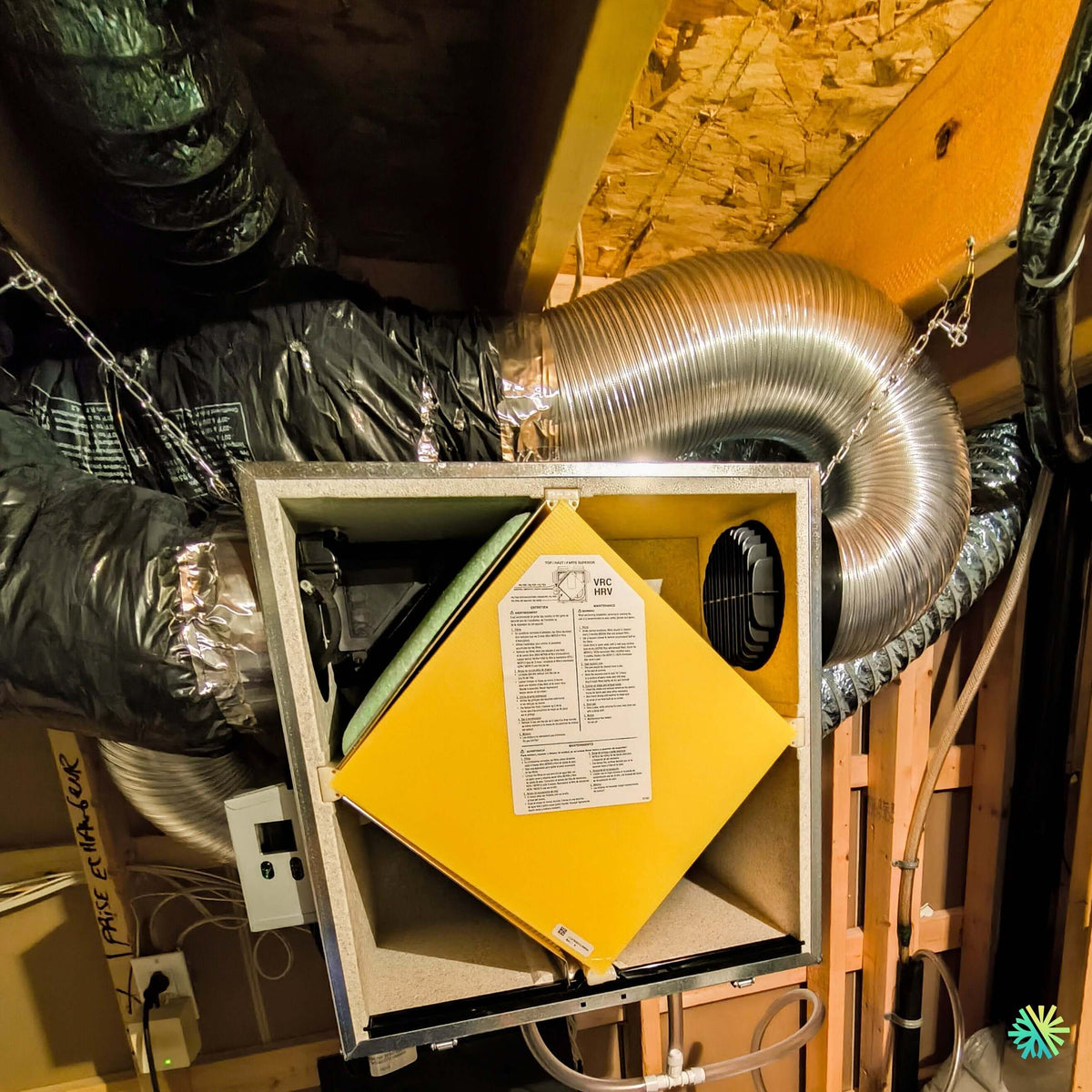
The unit is suspended by chains in the utility basement, beneath a subfloor in OSB panels, between the joists. It this is a side-vented HRV of the AI series, to Virtuo technology, connected to a dedicated duct network: flexible insulated with black sheathing for the branches in contact with the outdoor air, aluminum conduit for the short connection to the wall.
The power supply electrical power is supplied through a dedicated dedicated, and the wooden stud that door has been identified by hand by our technician calls it: “heat-exchanger outlet.” This kind of detail costs nothing and prevents a future electrician, a plumber or owner themselves cannot cuts off the wrong circuit ten years from now. We apply this systematically.
reversed. wall control was installed at immediate vicinity, on the framing, with its display visible from the unit—the logical position for for commissioning and maintenance. AI series units accept in addition to the secondary controls installed in living areas and bathroom timers, which trigger boost ventilation without anyone having to go down to the basement.
What can be seen when the door opens
The casing door tilts and is held by fasteners at the four corners. No tool is necessary. Here, from left to right and from top to bottom, as shown.
The heat-recovery core, mounted on the tip
It is the centerpiece, and its position always comes as a surprise: the core is a square block inserted diagonally, resting on a tip, at the center of the casing.
This is not is not a designer's whim. The core of a HRV operates at cross-flow : the stale air leaving from the house and the fresh air entering it pass perpendicularly through the block, through alternating layers separated by thin walls. The two airflows exchange heat through these walls, without ever mixing. No odors, no pollutants, no moisture passes from one side to the other.
The diagonal installation meets three simultaneous requirements:
- It inscribes the greatest possible diagonal of the block in a square casing, which maximizes the exchange surface for a given footprint.
- It directs the four sides of the core toward the four the unit's openings, which simplifies the internal circulation.
- It places a points downward, so that the condensation that forms on the cold walls flows by gravity toward the collection tray, instead of to lie flat in the enclosure.
Ce This last point is the one that explains the longevity of well-designed units. One core where water stagnates becomes a substrate for biological growth in just
a few seasons. The filters—
there are two, not one The mistake most common among homeowners air exchanger is to believe that one has only one filter, the one for
incoming air. diagonally on either side of the There are two, mounted
- The core, each upstream of an airflow: supply filter cleans fresh air from outside before before it enters the house. This is
- The the one everyone thinks of. exhaust filter cleans the air stale air extracted from the house before it does not pass through the core. Its role is not to protect occupants, but to protect the core against household dust, dryer lint dryer, pet hair, and cooking residue. It is the least most neglected, and most responsible for premature fouling of the cores that
we take apart. The units in the AI series units come withwashable MERV 8 filters We we discuss the issue of leveling in more detail later.
leveling. The two
fans and the motorized damper On on either side of the core are two independent fans, driven by — synchronous permanent-magnet motors electronically commutated permanent One fan pushes fresh air toward the house, while the other expels stale air.
The unit also includes a motorized damper which manages the cycle defrost cycle. In very cold weather, moisture in the outgoing air freezes on the core walls. The damper temporarily modifies the airflow to melt this frost, then restores normal operation. This cycle is automatic and requires no no intervention.
The pan and the condensate drain
At the bottom of the cabinet, a pan collects the water that flows from the lower tip of the core. A drain fitting carries it away by a flexible hose, visible beneath the unit, connected with a continuous slope to a drain.
The volume of water product often surprises people. In very very cold, an HRV that ventilates a an occupied home can evacuate several liters per day. This is not a defect : this is exactly the humidity excess moisture that we want to remove from the building.
The TOP marking: the detail that makes maintenance reversible
A label is affixed directly on the core. It bears the maintenance instructions in three the mention HRV / HRV, and above all, a position indicator: TOP / TOP / TOP.
This arrow is not decorative. A core reinserted backward or rotated a quarter turn:
- sends the condensation toward a corner without drainage, where it accumulates;
- misaligns the air channels relative to the vents, which collapses the airflow;
- can, in some configurations, put both airflows into communication.
We always insist on this point with homeowners: take a photo of the core in place before removing it. Three seconds that avoid a service call.
The maintenance you can do yourself, and what you should leave to us leave
The step-by-step procedure
WeHere is exactly what we show our customers at the end of every HVAC installation of ventilation. Count fifteen minutes the first time once, five times thereafter.
- Unplug the unit. The outlet dedicated outlet is within reach — this is exactly why we install it why it is there and why we identify it. Do not do not rely on the wall control's standby mode. wall control.
- Open the door and let it rest on its brackets.
- Take a photo of the interior before before touching anything.
- Remove both filters. They slide out of their guides diagonal.
- Clean them. Vacuum for dry dust, then rinse with warm water and mild soap if necessary. Dry them completely before a damp filter put back in place putting them back in place creates a breeding ground.
- Remove the core by pulling it by its handle, keeping the TOP marking.
- Clean the core with warm water and mild soap, then rinsing in the direction of the channels. Let it drain.
- Check the pan and the drain. The water must drain freely. A hose a pinched or clogged hose is easy to spot immediately.
- Reinstall filters and core in the correct orientation, close it, plug it back in.
The motors require no lubrication. They are sealed. Any oil added causes more harm than good. properly.
What you should never do
- Do not use a dishwasher. reversed. heat deforms the walls of the core irreversibly.
- No high-pressure spray. It crushes the channels and punctures the walls.
- No solvent, bleach, or abrasive cleaner.
- No operation without filters, even “just a few days.” All the dust goes directly into the core, where it is much more difficult to remove.
- No deodorizing block in the housing or ducts.
MERV 8 or MERV 13: the trade-off real-world impact in agricultural areas
This is the question that customers in We serve and sectors rural areas South Shore ask us most often, and the answer deserves needs to be qualified rather than marketed.
The MERV 8 included as standard retains effectively captures large particles: dust, large pollen particles, fibers and hair. It washable, so its operating cost is zero.
The MERV 13 also captures fine particles, a significant portion of which aerosols and spores. On paper, it is better. In practice, three consequences must be weighed :
- It is not washable. That's a pleated filter to replace, and therefore a recurring cost — higher in agricultural areas agricultural area, where it loads up quickly.
- It offers greater resistance to airflow. ECM motors automatically compensate up to a to some extent, but they do so by consuming more.
- The airflow must be rechecked after the upgrade. A unit set with an MERV 8 and upgraded to MERV 13 without a new verification may end up below the required ventilation airflow for the home. It is the step that no one does, and it is the one that matters.
Our position: the MERV 13 is warranted when an occupant has respiratory sensitivity known, or when the house borders directly borders a cultivated field intensive. Otherwise, a MERV 8 washed at the proper interval performs better actual work than a MERV 13 left for six months too long in its frame.
The signs that indicate you should call a technician
Routine maintenance belongs to you. The following situations are our responsibility:
- Water anywhere other than in the pan — unit out of level, blocked drain, or core reassembled incorrectly.
- Visible ice on the core in outside a defrost cycle, or a defrost cycle that does not finish not.
- A displayed airflow that no longer matches the setting, or a unit that tourne constamment à plein régime.
- Un bruit nouveau runs constantly at full capacity. A new noise : whistling,
- clicking, vibration transmitted to the floor. From condensation on windows that persists despite ventilation in running—classic sign of an
- imbalance or a connection
reversed. Any intervention on the dampers, motors, installation configuration, or balancing. The technology Virtuo recalibrates the continuous airflow, which resolves a corrects most slow deviations. It
does not correct a connection defect or a crushed duct. The schedule, adapted to the agricultural
| agricultural | Period |
|---|---|
| Intervention April–May (farm work in | September–October (harvest) spring) Exterior grilles: removal of |
| debris. | July Filters: |
| visual inspection, cleaning if loaded. | September–October (harvest) March Filters: cleaning. : outlet |
| and rinsing. Drain: inspection. | December–January Exterior grilles : snow and ice removal |
| ice. | March Core : second annual rinse, at the end of the heating season |
heating. In urban areas, two filter cleanings per year We serveare generally sufficient. At , we recommend
four.
Financially A In short, because the question comes back. No Quebec program currently provides assistance intended air exchanger specifically for a in an existing home, nor to an upgrade filtration level. The remaining leverRénoclimat , whose assessment energy efficiency opens the door to amounts for insulation and airtightness—work that, in turn, make mechanical ventilation all the more necessary. We verify eligibility on a case-by-case basis rather than announcing a
quotes the price in advance.
AirGreen in Vaudreuil-Soulanges We serveSaint-Polycarpe , Les Coteaux, Coteau-du-Lac, Saint-Zotique, Rigaud, Pointe-Fortune, Vaudreuil-Dorion and throughout the MRC, in addition to our service area, Montreal, LavalLongueuil North Shore and the South Shore.
Noinstallationsair exchanger, of heat pump and air conditioning all end the same way: door open, explained equipment, maintenance scheduleHVAC maintenance handed over clean. An owner who understands maintains its equipment. A owner to whom nothing was shown call a technician three years later too late for a clogged filter.
How the job unfolds
The main steps of this kind of job at AirGreen. Every house has its quirks: the estimate brings them out.
We locate the wall for the two outdoor hoods, the unit's spot, service access and the drain.
The unit, its location and the price, in writing.
Hung or set level, with clear access to the filters and the core.
Fresh air intake and exhaust, kept apart and sealed.
The ones connected to the outside are insulated to prevent condensation inside the house.
Connected with its loop, when the unit needs one.
Installed where you will see it and use it.
Incoming and outgoing airflows are adjusted so the house is neither pressurized nor depressurized.
Speeds, filters, core: how to use it through the seasons.
- The on-site estimateWe locate the wall for the two outdoor hoods, the unit's spot, service access and the drain.
- The quoteThe unit, its location and the price, in writing.
- The unitHung or set level, with clear access to the filters and the core.
- The outdoor hoodsFresh air intake and exhaust, kept apart and sealed.
- The ductsThe ones connected to the outside are insulated to prevent condensation inside the house.
- The drainConnected with its loop, when the unit needs one.
- The wall controlInstalled where you will see it and use it.
- BalancingIncoming and outgoing airflows are adjusted so the house is neither pressurized nor depressurized.
- The walkthroughSpeeds, filters, core: how to use it through the seasons.
What we check on a job like this one
Each number is a point we check on site. Switch between summer and winter to watch air and heat move.
Generic illustration of this type of installation, not a survey of this job site. Tap a number.
It removes stale air and brings in fresh air. The two airflows cross in the core without mixing.
It recovers part of the heat from the outgoing air to temper the incoming air. Depending on the model, it also manages humidity.
An outdoor hood, kept away from the exhaust so the house does not pull back the air it just removed.
Humid, stale air leaves through its own hood, fitted with a damper.
The ducts that connect to the outside are insulated to prevent condensation inside the house.
Stale air is drawn from humid rooms and fresh air is sent to living areas. The airflows are balanced.
It sets the mode and speed. You use it more when the house is humid or full of people.
Depending on the model and the season, the core produces condensation, removed through a drain with its loop.
Is your home ready?
Check what applies at your place. A "no" is not a refusal: it is what we sort out during the estimate.
Good habits, once the unit is in place
Six simple habits that keep the unit going. Your list stays on this device.
What to do, season by season
Three habits per season for this unit. They take a few minutes and prevent many calls.
- Clean the filters and core as the manufacturer specifies.
- Check the outdoor hoods: nests, debris, dampers.
- Lower the speed if the outdoor air gets humid.
- Adjust the speed to the humidity in the house.
- Check that the drain flows.
- Keep the outdoor hoods clear.
- Clean the filters before the closed-house season.
- Check the exhaust damper.
- Book a full cleaning if the unit has not had one in a long time.
- Clear snow from both outdoor hoods.
- Raise the speed if condensation appears on windows.
- Let the unit run: with the house closed, humidity builds up.
The right pages, at the right time
Four statements: true or false?
It all comes down to details you have just seen.
1. In an air exchanger, fresh air and stale air mix.
The two airflows cross in the core without mixing.
2. The two outdoor hoods must be kept apart.
Otherwise the exchanger pulls back the air it just removed.
3. An air exchanger can help with condensation on windows.
It renews the air and helps keep humidity in the right range.
4. An exchanger never needs maintenance.
Filters and core get dirty and need regular cleaning.
0 / 4 right answers
What people ask us about this kind of work
What does an air exchanger do?
Does fresh air cool the house in winter?
What speed should it run at?
Does an exchanger need cleaning?
What are the signs of poor ventilation?
HRV or ERV: what is the difference?
Should it run in winter?
Does AirGreen hold the required licences?
Is the estimate free?
No question matches. Write to us: we answer.
More jobs to see, near you
By town, by equipment or by region: browse more than 4,700 published projects.
Each dot: a town where AirGreen has published projects. The glowing dot: this job.
An on-site estimate, the right capacity, the right equipment.
The on-site estimate is free and the quote follows within 24 hours.
Text and photo: a real AirGreen Climatisation & Chauffage job. The diagrams are generic illustrations of the type of installation, not a survey of this job site. Sources of the added figures: airgreen.ca product pages (NEEP / AHRI performance), Hydro-Québec (Heat pumps page, LogisVert, read on 13 October 2026), Régie de l’énergie (rate D as of 1 April 2026).