
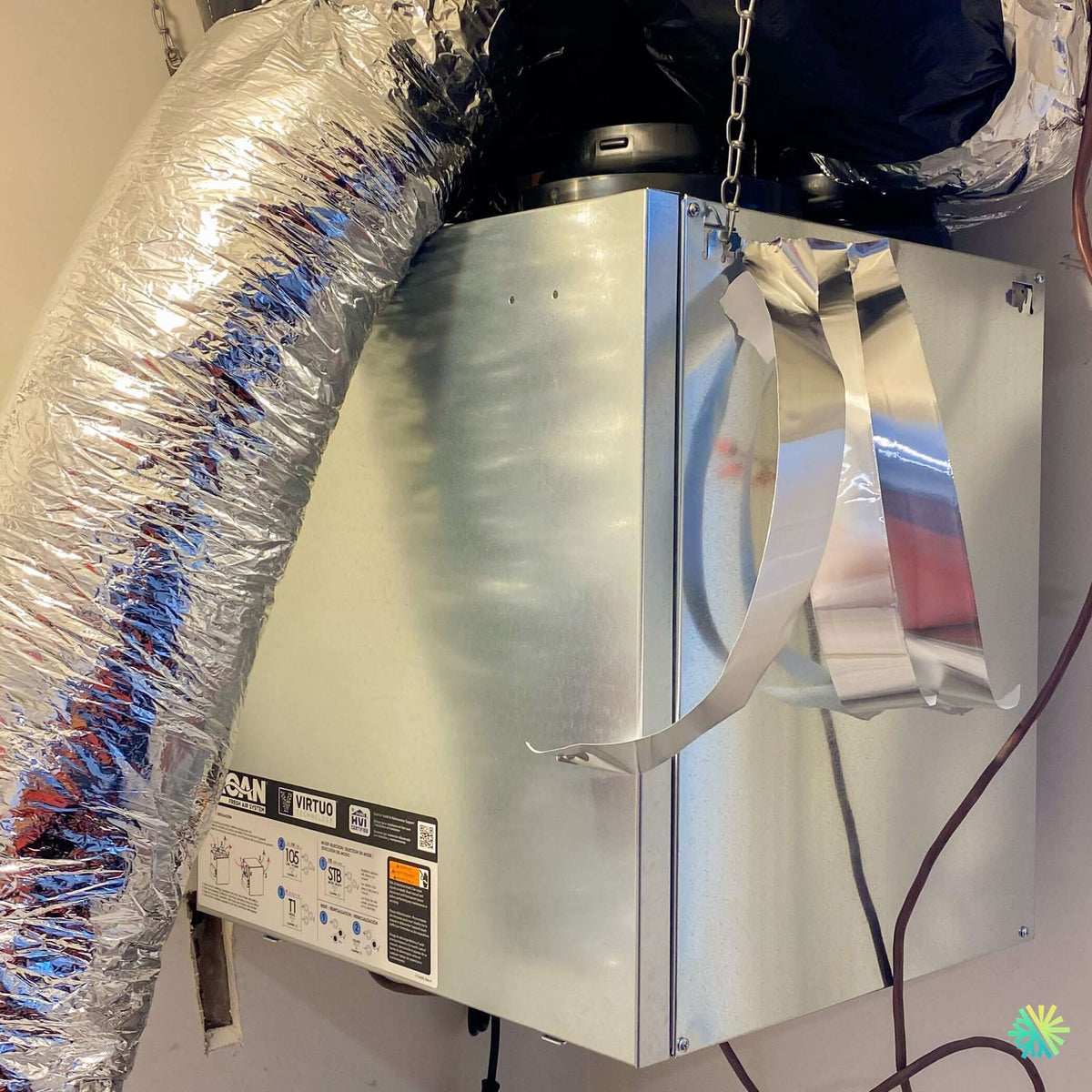
Installation of a Broan-NuTone AI Series air exchanger (Virtuo technology) in Salaberry-de-Valleyfield
Replacement of an aging HRV with a Broan-NuTone AI Series air exchanger featuring Virtuo technology in Salaberry-de-Valleyfield: chain suspension, insulated ducts, a trapped drain, and measured balancing. The complete details of a properly executed HVAC installation.
Take a tour of the installation
Each number is a point we check on site. Switch between summer and winter to watch air and heat move.
Generic illustration of this type of installation, not a survey of this job site. Tap a number.
It removes stale air and brings in fresh air. The two airflows cross in the core without mixing.
It recovers part of the heat from the outgoing air to temper the incoming air. Depending on the model, it also manages humidity.
An outdoor hood, kept away from the exhaust so the house does not pull back the air it just removed.
Humid, stale air leaves through its own hood, fitted with a damper.
The ducts that connect to the outside are insulated to prevent condensation inside the house.
Stale air is drawn from humid rooms and fresh air is sent to living areas. The airflows are balanced.
It sets the mode and speed. You use it more when the house is humid or full of people.
Depending on the model and the season, the core produces condensation, removed through a drain with its loop.
A Valleyfield home that was not breathing properly—and the HRV that restored the balance
There is one detail that homeowners from Salaberry-de-Valleyfield rarely notice before it becomes a problem: the city is surrounded by water. Lake Saint-François on one side, the Beauharnois Canal on the other, and Saint-François Bay in the center. This geography gives the region its beauty, but it also creates a humidity load that few areas of Montérégie experience with the same intensity. Add to that a housing stock in which many homes have been tightened up over the course of renovations—windows replaced, spray foam applied in the basement, doors caulked—and you get buildings that retain everything: water vapor, volatile organic compounds, and the occupants' CO₂.
That is exactly the situation we found on this job. The owners contacted us for a very concrete reason: persistent condensation in the second-floor window corners in January, a musty smell in the basement, and an original air exchanger that hummed away without anyone really knowing whether it was doing anything.
The pre-sale assessment
At AirGreen, we never install an HRV based solely on a phone call. Our technician visited the property, and the situation quickly became clear.
The existing unit, installed during construction, was more than twenty years old. Its recovery core was so clogged that light could no longer pass through it. The two filters, which the owners said had never been replaced, had collapsed in their tracks. Above all, the unit had never been balanced: the exhaust airflow greatly exceeded the supply airflow, leaving the house under constant negative pressure. The practical result: cold air drawn in through cracks in the building envelope, a perpetually chilly basement floor, and a real risk of backdrafting for any combustion appliance.
We also identified a classic problem in installations from that era: the exhaust duct ran through an unheated space without adequate insulation. In winter, the expelled water vapor condensed there and then froze again, progressively reducing the duct's effective cross-sectional area.
An improperly balanced air exchanger does more than fail at its job. It actively works against the building envelope.
Why we chose a Broan-NuTone AI series unit
Choosing a unit should never come down to a single figure on a specification sheet. Here is the reasoning we presented to the homeowners.
A heat recovery ventilator, not an energy recovery ventilator
A fundamental distinction, and one that sellers too often gloss over. An HRV (heat recovery ventilator) transfers heat between the two air streams but allows moisture to escape outdoors. An ERV (energy recovery ventilator) also transfers some moisture, making it well suited to hot, humid climates—the Florida and Texas climates—or to homes that are very dry in winter.
In a Valleyfield home whose main problem is excess winter humidity, an ERV would have returned some of the moisture we were specifically trying to exhaust indoors. The HRV was the right tool. We apply the same logic in Montreal, Laval, Longueuil, and throughout the North Shore and South Shore: Quebec's climate favors HRVs in the vast majority of single-family homes.
The Broan-NuTone Virtuo platform
The selected unit belongs to the Broan-NuTone AI series, built on the Virtuo platform. Three factors influenced the decision:
- Electronically commutated motors (ECM). They consume significantly less than a traditional PSC motor and, above all, maintain their airflow even when the filters begin to load up. On a unit that runs continuously twelve months a year, the difference in annual energy consumption is far from theoretical.
- HVI certification. The Home Ventilating Institute verifies the stated airflow rates and recovery efficiencies in an independent laboratory. It is the only credible benchmark for comparing two units, and it is clearly shown on the nameplate of the installed unit.
- Access through two front panels. A seemingly ordinary detail that determines whether a homeowner will actually clean the core twice a year or forget about it for twenty years, as with the previous unit.
The galvanized housing, the collars on top, and the compact size also made it possible to reuse much of the existing layout—an actual financial benefit for homeowners.
The HVAC installation process
Dismantling and upgrading the support
The old unit rested on an improvised wall shelf that transmitted its vibrations into the structure. We installed a plywood panel secured to the studs, then suspended the new unit using adjustable chains. This dual approach—wall support and suspension—mechanically decouples the housing from the building. The noise perceived in the room above dropped immediately and noticeably.
The unit was checked for level along both axes. This is not merely cosmetic: an air exchanger installed out of level drains condensate poorly, and the water eventually finds another path.
Duct connections
We retained the existing wall penetration, requalified and sealed it, for the exterior pass-through. The connections were made with insulated flexible ducts featuring a continuous vapor barrier, which is non-negotiable on branches carrying cold outdoor air or humid stale air.
Each joint was tightened with a clamp and then sealed with approved aluminum tape. Cloth duct tape—the famous “duct tape”—dries out and peels off within three to five years in a mechanical room. We never use it on an air-exchanger connection.
Outside, we maintained the required separation distances between the fresh-air intake and the exhaust outlet, and positioned the intake high enough above ground level that a buildup of snow—common in the area—would not obstruct it in February. We also kept it away from the dryer vent and combustion-appliance vents.
The condensate drain
A critical point and a recurring source of service calls. An HRV produces water—lots of it in cold weather. The drain must be connected with a properly filled trap; otherwise, the unit draws air through the drain or, conversely, forces water back into the housing.
We also routed this drain to a proper drain connection—never into a water-heater pan, and never onto a simple concrete slab. It is a mistake we regularly correct for clients on the South Shore and North Shore, and it sometimes ends in water damage.
Balancing: the step too many installers skip
An unbalanced air exchanger is only half installed. We measured the supply and exhaust airflow rates at the pressure taps provided for this purpose, then adjusted the dampers until we achieved matched airflow rates, in accordance with the configuration shown on the unit's installation label.
The margin for error is narrow. An overpressurized home pushes indoor humidity into the walls, where it condenses. An underpressurized home draws in outdoor air—and everything it carries—through every air leak. Neutral balance is the only acceptable condition.
We then programmed the wall control: continuous low-speed ventilation, an intermittent boost cycle, dehumidification mode for the heating season, and bathroom boosters for peak periods.
The result, six weeks later
We followed up with the homeowners. Their feedback, summarized: the condensation on the windows had disappeared, as had the basement odor, and the living room hygrometer stayed between 40 and 50% instead of flirting with 60%. The unit is quiet enough that they forget it exists—which, for an air exchanger, is the best compliment possible.
What this Salaberry-de-Valleyfield project should teach you
The four mistakes we see most often
- Choosing an HRV by default. In the vast majority of Quebec homes, an HRV is the right choice. A salesperson who recommends an ERV without asking about your home's winter humidity is not doing their job.
- Never balancing the system. Ask for the measured airflow rates in writing. A reputable installer will provide them without hesitation.
- Neglecting to insulate exterior ducts. Every uninsulated section becomes a point of condensation, then ice, then mold.
- Neglecting maintenance. Filters should be cleaned or replaced every three to six months, depending on the environment. The heat-recovery core should be rinsed twice a year. Five minutes of work that extends the unit's life by several years.
About grants: an honest clarification
We prefer to be clear, even when it doesn't help make the sale. No Quebec program currently provides an amount dedicated solely to replacing an air exchanger in an existing home. What you need to know:
- Rénoclimat funds your home's energy assessment. This assessment includes ventilation in its overall profile, and the resulting insulation or air-sealing measures are eligible for rebates.
- Novoclimat requires balanced mechanical ventilation in new construction. An HRV is not optional—it is a condition.
- Hydro-Québec programs primarily target heat pumps, insulation, and windows.
If a contractor promises you a direct rebate for your HRV alone, ask for the exact name of the program and the measure number. We regularly assist clients in Montréal, Laval, Longueuil, the North Shore, and the South Shore with these applications, and we would rather announce a truthful zero than an imaginary amount.
A heat recovery ventilator does not replace a heat pump—and the reverse is also true
In this home, a wall-mounted heat pump provides thermal comfort in the main rooms. The HRV, meanwhile, operates on its own dedicated duct network: extraction from the bathrooms and kitchen, and supply to the bedrooms and living areas.
These are two complementary systems, never interchangeable. A heat pump recirculates the air already in the home. It does not renew the air, remove CO₂, or solve any indoor air quality issue. We still meet homeowners who believe otherwise, often because no one explained the difference to them at the time of purchase.
AirGreen in Salaberry-de-Valleyfield and Montérégie
We serve Salaberry-de-Valleyfield, Beauharnois, Châteauguay, Vaudreuil-Dorion, and all of Montérégie, in addition to our usual service area of Montréal, Laval, Longueuil, the North Shore, and the South Shore. Our teams travel with the equipment needed for genuine balancing—not a visual estimate.
Whether your project involves a first heat recovery ventilator, replacing an end-of-life unit, a complete HVAC installation, or simply HVAC maintenance to bring your system up to date, we assess the situation before recommending a unit. Always in that order.
The big day, step by step
The main steps of this kind of job at AirGreen. Every house has its quirks: the estimate brings them out.
We locate the wall for the two outdoor hoods, the unit's spot, service access and the drain.
The unit, its location and the price, in writing.
Hung or set level, with clear access to the filters and the core.
Fresh air intake and exhaust, kept apart and sealed.
The ones connected to the outside are insulated to prevent condensation inside the house.
Connected with its loop, when the unit needs one.
Installed where you will see it and use it.
Incoming and outgoing airflows are adjusted so the house is neither pressurized nor depressurized.
Speeds, filters, core: how to use it through the seasons.
- The on-site estimateWe locate the wall for the two outdoor hoods, the unit's spot, service access and the drain.
- The quoteThe unit, its location and the price, in writing.
- The unitHung or set level, with clear access to the filters and the core.
- The outdoor hoodsFresh air intake and exhaust, kept apart and sealed.
- The ductsThe ones connected to the outside are insulated to prevent condensation inside the house.
- The drainConnected with its loop, when the unit needs one.
- The wall controlInstalled where you will see it and use it.
- BalancingIncoming and outgoing airflows are adjusted so the house is neither pressurized nor depressurized.
- The walkthroughSpeeds, filters, core: how to use it through the seasons.
Four mistakes we do not make
Flip each card to see what we do instead.
Your own project, step by step
What to do, season by season
Three habits per season for this unit. They take a few minutes and prevent many calls.
- Clean the filters and core as the manufacturer specifies.
- Check the outdoor hoods: nests, debris, dampers.
- Lower the speed if the outdoor air gets humid.
- Adjust the speed to the humidity in the house.
- Check that the drain flows.
- Keep the outdoor hoods clear.
- Clean the filters before the closed-house season.
- Check the exhaust damper.
- Book a full cleaning if the unit has not had one in a long time.
- Clear snow from both outdoor hoods.
- Raise the speed if condensation appears on windows.
- Let the unit run: with the house closed, humidity builds up.
Is your home ready?
Check what applies at your place. A "no" is not a refusal: it is what we sort out during the estimate.
Four statements: true or false?
It all comes down to details you have just seen.
1. In an air exchanger, fresh air and stale air mix.
The two airflows cross in the core without mixing.
2. The two outdoor hoods must be kept apart.
Otherwise the exchanger pulls back the air it just removed.
3. An air exchanger can help with condensation on windows.
It renews the air and helps keep humidity in the right range.
4. An exchanger never needs maintenance.
Filters and core get dirty and need regular cleaning.
0 / 4 right answers
What people ask us about this kind of work
What does an air exchanger do?
Does fresh air cool the house in winter?
What speed should it run at?
Does an exchanger need cleaning?
What are the signs of poor ventilation?
HRV or ERV: what is the difference?
Should it run in winter?
Does AirGreen hold the required licences?
Is the estimate free?
No question matches. Write to us: we answer.
More jobs to see, near you
By town, by equipment or by region: browse more than 4,700 published projects.
Each dot: a town where AirGreen has published projects. The glowing dot: this job.
Every house has its constraints. We see them before we install.
The on-site estimate is free and the quote follows within 24 hours.
Text and photo: a real AirGreen Climatisation & Chauffage job. The diagrams are generic illustrations of the type of installation, not a survey of this job site. Sources of the added figures: airgreen.ca product pages (NEEP / AHRI performance), Hydro-Québec (Heat pumps page, LogisVert, read on 13 October 2026), Régie de l’énergie (rate D as of 1 April 2026).