
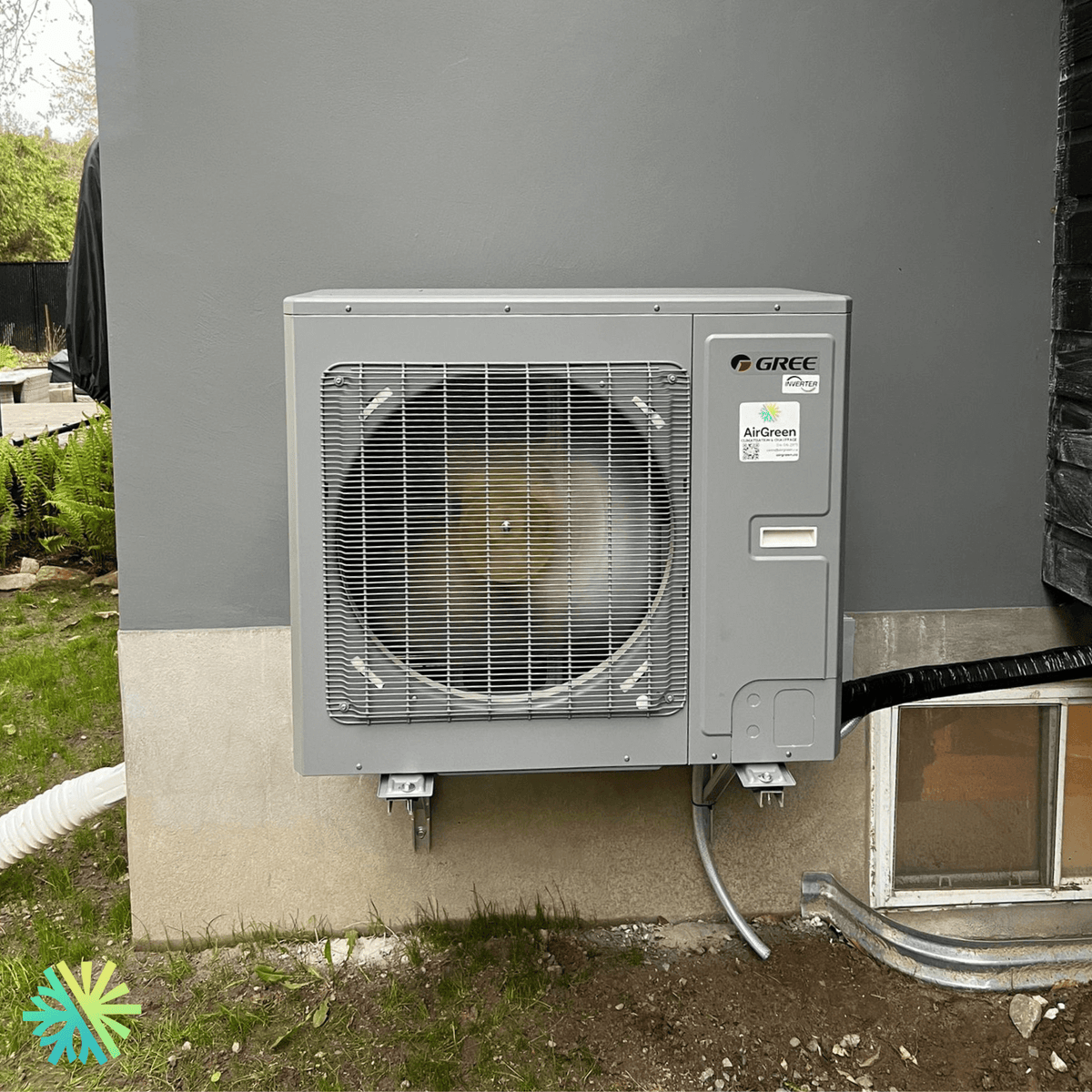
Installation of a Gree Flexx Central Heat Pump in Côte Saint-Luc, Montreal
Feel the breeze of superior comfort with AirGreen’s latest Gree Flexx installation in Côte Saint-Luc – Quiet, efficient, and tailored for you!
- City
- Region
- Equipment
- Brand
- Challenges
- Published
The job on one screen
The article, chapter by chapter
A Comfort Revolution: Why AirGreen is Your Best Choice for Heat Pump Installation
The Prelude to Unparalleled Comfort
In the tranquil neighborhood of Côte Saint-Luc, Montreal, a home just received a significant upgrade to its heating and cooling system that promises not only enhanced comfort but also impressive energy savings. AirGreen, a distinguished HVAC service provider in Montreal, Laval, Longueuil, North Shore, and South Shore, is proud to showcase a recent installation that highlights our expertise and commitment to quality. The project involved installing a Gree Flexx Central Heat Pump, renowned for its advanced technology and robust performance.
Spotlight on Gree Flexx: A Synonym for Reliability and Efficiency
Key Specifications:
- Type: Central Heat Pump
- Brand: Gree
- Model: Flexx
- Capacity: 3 Tons (36,000 BTU)
- Heating Capacity: Operative down to -30°C
- Efficiency Ratings: 18.0 SEER, 11.0 HSPF, 10.0 EER
- Sound Pressure Level: Minimal noise at 57 dB(A)
- Energy-Saving Features: Includes a washable air filter and scheduled drying function
- Connectivity: Wi-Fi thermostat control option for ease of use
The choice of the Gree Flexx model was influenced by its ability to consistently regulate temperature throughout the year, ensuring flawless comfort regardless of the season. The technology used in this heat pump significantly reduces energy consumption while maintaining optimal performance, a critical factor given the climate peculiarities of Montreal.
Installation Journey: Precision Meets Expertise
The installation process began with a meticulous evaluation of the specific needs of the residence to ensure the heat pump's capacity was perfectly matched to the space requirements. Here’s how AirGreen handled the project:
- Needs Assessment: Our specialized technicians conducted a detailed analysis to tailor the installation to the unique attributes of the home.
- Technical Setup: The installation involved precise coordination to position the outdoor unit and connect it to the existing duct systems seamlessly.
- Operational Testing: Following the setup, a series of performance and safety tests were executed to guarantee efficient and secure operation of the unit.
Client Feedback: Comfort and Savings Unlocked
Our clients have expressed immense satisfaction with their new Gree Flexx heat pump. They particularly appreciate how the unit operates quietly, enhancing their home environment without the disturbance of loud mechanical noises. Moreover, the significant reduction in energy bills has been a welcome advantage, reinforcing their decision to choose AirGreen for their HVAC needs.
Conclusion: AirGreen Delivers More Than Just Air
This successful installation at Côte Saint-Luc underscores our dedication to providing top-tier heating and cooling solutions that not only meet but exceed our clients' expectations. Our customers enjoy a reliable, economical system that ensures enduring comfort throughout the year, making AirGreen their preferred choice for HVAC projects.
The job tools
Two quick checks with real numbers: what heat costs, and what your current heaters add up to in BTU/h.
Conversion: 1 W = 3.412 BTU/h. An indication, not a load calculation: baseboards and furnaces are often stronger than the real need, and they can stay as backup. AirGreen confirms the capacity on site.
How the job unfolds
The main steps of this kind of job at AirGreen. Every house has its quirks: the estimate brings them out.
We look at the ducts, the current indoor module, the electrical panel and the planned spot for the outdoor unit.
The equipment combination, capacity and price, in writing. We check whether the combination qualifies for assistance programs.
Access protected, old unit disconnected and removed when it is being replaced.
Electric furnace or air handler, with its coil, connected to the supply and return ducts.
On a level base, raised above the snow, with free space all around.
Insulated, they enter through a sealed opening and run to the indoor coil.
Dedicated circuits, accessible disconnect, a thermostat that works with the heat pump and the backup heat.
Leak test, vacuum, start-up, airflow check and a test of both modes.
Filter, thermostat, backup heat in extreme cold: what to know before winter.
- The on-site estimateWe look at the ducts, the current indoor module, the electrical panel and the planned spot for the outdoor unit.
- The quoteThe equipment combination, capacity and price, in writing. We check whether the combination qualifies for assistance programs.
- Getting readyAccess protected, old unit disconnected and removed when it is being replaced.
- The indoor moduleElectric furnace or air handler, with its coil, connected to the supply and return ducts.
- The outdoor unitOn a level base, raised above the snow, with free space all around.
- The refrigerant linesInsulated, they enter through a sealed opening and run to the indoor coil.
- Electrical and thermostatDedicated circuits, accessible disconnect, a thermostat that works with the heat pump and the backup heat.
- Tests and start-upLeak test, vacuum, start-up, airflow check and a test of both modes.
- The walkthroughFilter, thermostat, backup heat in extreme cold: what to know before winter.
What we check on a job like this one
Each number is a point we check on site. Switch between summer and winter to watch air and heat move.
In summer, the outdoor unit rejects the house's heat outside.
Generic illustration of this type of installation, not a survey of this job site. Tap a number.
It captures or rejects heat outside. It sits on a level base, above the snow, with free space all around.
The insulated refrigerant lines enter the house through a sealed opening and run to the indoor coil.
A shut-off switch near the outdoor unit isolates it safely for service.
Sitting on the indoor module, it moves heat between the house air and the refrigerant.
Electric furnace or air handler: its fan pushes air through the ducts. The electric backup takes over in extreme cold.
Supply ducts bring air to the rooms; returns bring it back to the unit. Their condition matters as much as the unit's.
It protects the coil and the fan. A dirty filter cuts airflow, so it gets checked regularly.
It runs the heat pump and the backup heat. It must be compatible with the installed system.
Is your home ready?
Check what applies at your place. A "no" is not a refusal: it is what we sort out during the estimate.
Good habits, once the unit is in place
Six simple habits that keep the unit going. Your list stays on this device.
What to do, season by season
Three habits per season for this unit. They take a few minutes and prevent many calls.
- Check the indoor module's filter.
- Clear winter debris from the outdoor unit.
- Test cooling before the heat arrives.
- Check the filter more often in peak season.
- Keep registers and returns clear.
- Watch condensate drainage near the coil.
- Change or clean the filter.
- Test heating and backup heat before the cold.
- Book periodic maintenance.
- Clear snow around the outdoor unit.
- Store nothing in front of the indoor module.
- Note any unusual noise or smell and call us.
The right pages, at the right time
Four statements: true or false?
It all comes down to details you have just seen.
1. A central heat pump uses the house's ducts.
It connects to the existing ducts to heat and cool everywhere.
2. In extreme cold, electric backup heat can take over.
The indoor module (furnace or air handler) works with the heat pump and takes over in extreme cold.
3. The filter only gets changed when the unit breaks down.
A dirty filter cuts airflow. It gets checked regularly.
4. You can reuse the old unit's size without checking.
The house may have changed: insulation, windows, added rooms. Capacity is confirmed on site.
0 / 4 right answers
What people ask us about this kind of work
Can I keep my current ducts?
What happens in extreme cold?
Furnace, air handler, ducted: what is the difference?
Are there grants?
Do I need a permit?
How much can I save?
How is the LogisVert assistance calculated?
Will my current thermostat work?
Central or wall units: which one?
Does AirGreen hold the required licences?
Is the estimate free?
No question matches. Write to us: we answer.
More jobs to see, near you
By town, by equipment or by region: browse more than 4,700 published projects.
Each dot: a town where AirGreen has published projects. The glowing dot: this job.
An on-site estimate, the right capacity, the right equipment.
The on-site estimate is free and the quote follows within 24 hours.
Text and photo: a real AirGreen Climatisation & Chauffage job. The diagrams are generic illustrations of the type of installation, not a survey of this job site. Sources of the added figures: airgreen.ca product pages (NEEP / AHRI performance), Hydro-Québec (Heat pumps page, LogisVert, read on 13 October 2026), Régie de l’énergie (rate D as of 1 April 2026).