
Installation of a 2-ton GREE FLEXX ULTRA R32 central heat pump in Saint-Ours, in the Pierre-De Saurel RCM
Why did we replace a large York system with a smaller GREE FLEXX ULTRA R32 central heat pump in Saint-Ours? Load calculation, modulation from 12,000 to 30,000 BTU, new refrigerant line, refrigerant recovery in accordance with the Halocarbon Regulation.
- City
- Region
- Equipment
- Brand
- Challenges
- Published
The job on one screen
The article, chapter by chapter
Replacing a Large Unit with a Smaller One: The Calculation That Surprised the Homeowner
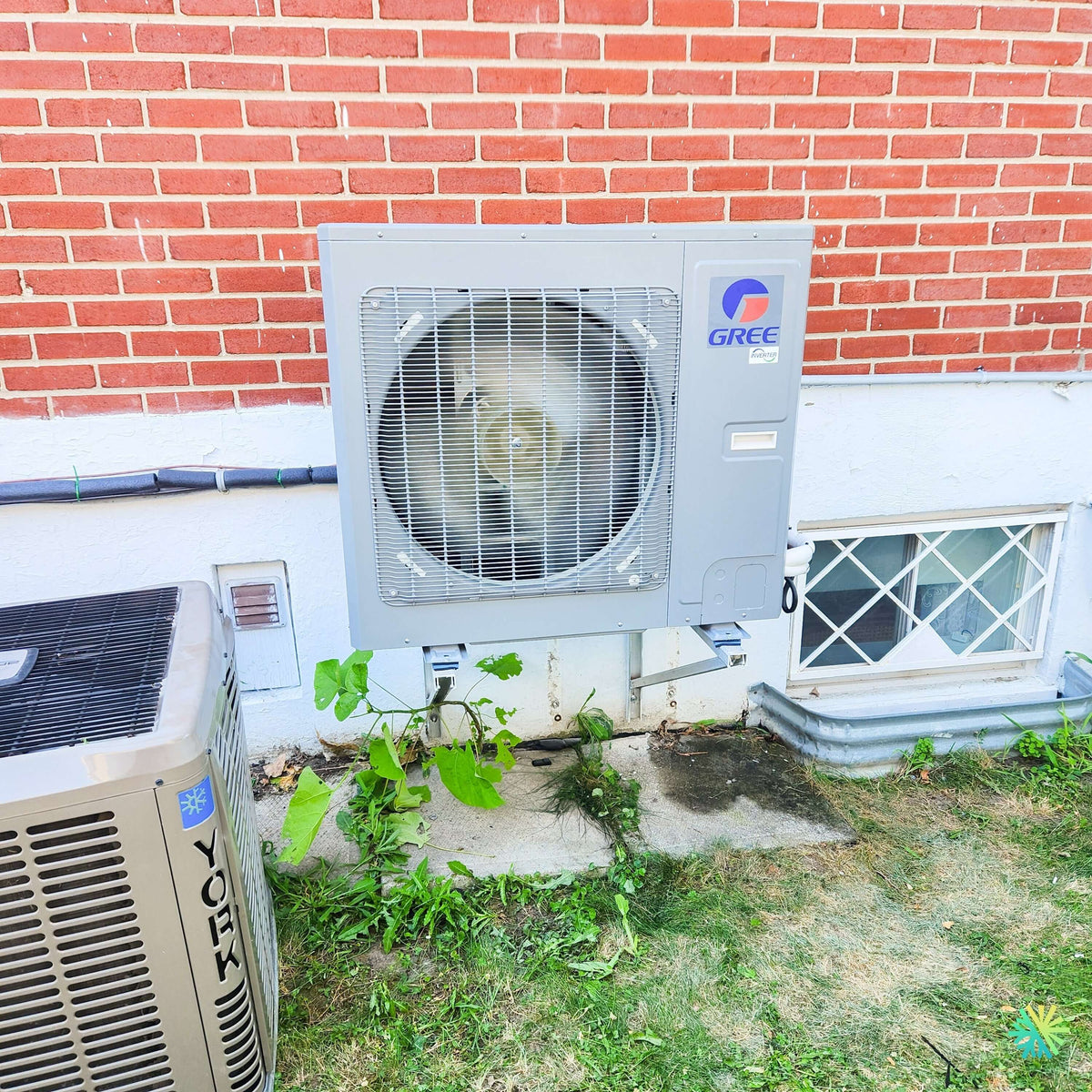
In the end-of-job photo taken in Saint-Ours, two units stand side by side against the same foundation: an old beige YORK condenser sitting on the slab, and the new 2-ton GREE FLEXX ULTRA R32 central heat pump, mounted on a bracket a few inches above the concrete. The new unit is visibly more compact than the old one.
That was the customer’s initial request in the town of Saint-Ours, along the Richelieu, in the MRC of Pierre-De Saurel: replace an aging central air conditioner with a heat pump capable of heating as well. When he saw the unit being unloaded from the truck, his question was direct: why is the new one smaller than the old one?
What the Old Unit Was Really Doing
The YORK unit in place was a fixed-speed central air conditioner. This type of unit knows only two states: off or operating at full capacity. If it is larger than what the house requires—and that is the case with most residential installations completed twenty years ago—it reaches the thermostat setpoint within a few minutes, shuts off, then starts up again. A short cycle.
Three tangible consequences the customer was experiencing without putting them into words:
- A cold but muggy house in July. A coil that does not run long enough cannot dehumidify. The temperature drops, but the humidity remains. That is what creates the feeling of a “cool but sticky” house.
- Temperature differences between rooms. Short cycles do not allow enough time for air to distribute through the ductwork.
- Accelerated wear. Every compressor startup is the most demanding moment of its life cycle.
Why 2 Tons, Not 3
We performed a room-by-room load calculation rather than carrying over the capacity of the old unit—the industry’s most common, and least defensible, method. Actual volumes, window orientation, insulation condition, internal gains, infiltration.
This home's summer peak load came in comfortably below 24,000 BTU/h. The old YORK unit's capacity was therefore surplus paid for twice: once at purchase, and then every month in operation.
The installed GREE FLEXX ULTRA R32 modulates from 12,000 to 30,000 BTU/h. In other words, it drops to half its rated capacity in mild weather — an operating range the old appliance simply did not have access to — and exceeds its rated capacity during heat peaks. The right way to compare the two appliances is not their nominal tonnage, but their modulation floor.
The appliance: GREE FLEXX ULTRA R32, 2 tons
The FLEXX series, distributed in Quebec by Dettson, is a horizontal (side-discharge) airflow central system powered by 24 VAC and controlled by a conventional thermostat. The configuration installed in Saint-Ours:
- Indoor unit: GUD24AH2/G-D(U)
- Outdoor unit: GUD36W2/NhE-D(U)
- Rated capacity : 24,000 BTU/h in cooling, 23,000 BTU/h in heating
- Modulation range: 12,000 to 30,000 BTU/h
- Efficiency: 18 TRÉ2 (SEER2), 12.5 TRÉ2 (EER2), and COP of 3.6 — the highest values in the entire FLEXX range for these two ratings, 10 CPSC2 (HSPF2)
- AHRI number : 217120759
- ENERGY STAR certification
- Heating range: down to -30 °C; cooling range: -15 °C to 54 °C
- R32 refrigerant, 2.5 lb factory charge, precharge covering 24.6 ft of piping, additional 0.32 oz per foot beyond that
- Diameters: 3/8 in liquid, 3/4 in gas
- Electrical: 208–230 V, MCA 4.7 A on the indoor side, MCA 27.7 A and MOCP 30 A on the outdoor side
- Indoor unit: 18 1/8 x 43 1/2 x 21 1/4 in, 135.6 lb
- Outdoor unit: 39 x 37 13/16 x 14 2/3 in, 187.5 lb, 1/6 HP fan motor
- A2L leak detection sensor and Wi-Fi factory-installed
The fact that the 2-ton model displays the best TRÉ2 and the best COP in the range is no coincidence: the GUD36W2 outdoor unit serves both the 2- and 3-ton models. The smaller of the two therefore operates with excess condenser capacity, resulting in higher efficiency at partial load.
What becomes of the old appliance: the part of the contract that almost nobody reads
Refrigerant recovery is not optional
A central air conditioner at the end of its service life still contains refrigerant. Depending on its year of manufacture, the old YORK unit may have contained R-22 or R-410A. In both cases, Quebec's Halocarbons Regulation prohibits releasing it into the atmosphere and requires refrigerant recovery before the equipment is discarded, by a person holding the required certification.
What happens too often on rushed jobs: the line is cut, the hissing is heard, and the equipment is sent to the scrapyard. It is illegal, and it is also why some quotes are lower than ours. On this job, the refrigerant was recovered into a dedicated cylinder, weighed, and the equipment was sent to a recovery facility.
We record this step in the customer's file. It may seem administrative; it is the record proving that the work was done.
Why we did not reuse the old refrigerant line
Reusing the existing piping saves two hours and a few hundred dollars. It is also one of the most common causes of premature compressor failure in new equipment.
- Oil incompatibility. An R-22 circuit operated with mineral oil. An R32 system operates with POE oil. The two are not miscible: mineral oil residues left on the tube walls accumulate, fail to return to the compressor, and deprive it of lubrication.
- Diameters. The FLEXX requires 3/8 in. on the liquid line and 3/4 in. on the gas line. An old line with a different diameter changes refrigerant velocity and oil return.
- Internal condition. A tube left open to the air for a few hours, or punctured by an old leak, contains moisture and contaminants that no vacuum procedure can completely remove.
- Calculated charge. The actual length of the run determines the additional refrigerant charge. Working on an existing line whose exact routing is unknown means charging blindly.
A new line was therefore installed, brazed under nitrogen, placed under deep vacuum with validation through a standing vacuum test, and its length was measured and recorded in the file.
What surrounds the equipment matters just as much as the equipment itself
The photo shows three elements we had to address:
The dryer vent
An exhaust grille is located on the same wall, to the left of the unit. Dryer lint is an outdoor coil's worst enemy: it is light, sticky when damp, and forms a felt-like layer that clogs the fins in a single season. We positioned the unit outside the exhaust plume and noted in the file that the coil must be checked during every annual HVAC maintenance.
The basement window
A window is immediately to the right of the unit. Two considerations: the airflow must not be directed toward the opening, and the compressor must not transmit its vibrations into the frame. The unit was oriented accordingly and installed on anti-vibration pads.
The cracked slab
The existing concrete, overgrown with vegetation and cracked, was no longer a reliable base. Rather than pour a new slab, we mounted the unit on a low support secured to the foundation, separating it from ground movement, keeping it above defrost water and snow, and leaving the underside accessible for maintenance. Vegetation that grows back every summer no longer touches the coil.
R32, A2L labeling, and electrical systems
R32 is classified as A2L, slightly flammable. The FLEXX incorporates a leak detection sensor whose location depends on the indoor unit's discharge direction. On a configurable left- or right-hand horizontal-flow unit, a conversion performed without repositioning the sensor renders the protection inoperative. We verify its position and test the shutdown logic during commissioning.
On the electrical side, the existing circuit that powered the YORK was verified rather than assumed: conductor size, panel protection, condition of the disconnect switch, and grounding. A 30 A MOCP leaves no room for assumptions.
Mistakes to avoid when replacing a central unit
- Matching the old unit's tonnage. This is the most common source of discomfort in Quebec.
- Reusing the refrigerant line without knowing its history.
- Neglecting the ductwork. We measure static pressure before the sale: a modern unit with low discharge temperatures needs an airflow that many older duct systems cannot provide.
- Forgetting the balance point. It is the heating load calculation—not intuition—that determines at what temperature the supplemental heating must take over.
- Accepting a quote that does not mention refrigerant recovery or what will happen to the old unit.
Rebates
The Chauffez vert program ended on March 31, 2026, and applied only to conversions from oil and propane. Hydro-Québec's LogisVert program remains the main source of assistance for a central heat pump. Three requirements apply every time: an ENERGY STAR appliance with a valid AHRI number that exactly matches the installed indoor/outdoor combination, a contractor holding an RBQ licence and registered with the program, and an application submitted within the prescribed period after the invoice. The assistance is paid as a rebate, and the amounts vary according to the appliance and configuration.
A detail that often causes problems during a replacement: the AHRI number must match the actual pair installed, not just the outdoor unit. Here, the GUD24AH2/G-D(U) + GUD36W2/NhE-D(U) combination bears AHRI number 217120759, provided to the customer with the commissioning report.
Why homeowners in Bas-Richelieu call us
At AirGreen, we install central heat pumps, wall-mounted heat pumps, mini split systems, air conditioners, and air exchangers in Montreal, Laval, Longueuil, on the North Shore, on the South Shore, and in municipalities in Montérégie far from the major routes — Saint-Ours, Sorel-Tracy, Saint-Roch-de-Richelieu, Saint-Denis-sur-Richelieu, and the rural roads connecting them.
A job well done is not judged when the system is first turned on. It is judged during the first heat wave, the first night at -25 °C, and the day another technician opens the unit and finds a complete file. If you are considering replacing a central air conditioner or an aging heat pump, call us: we will come to your home, calculate the load, measure the ductwork, and provide you with a clear proposal showing the actual efficiency ratings, the AHRI number, and your eligibility for available rebates, already verified.
AirGreen — Air Conditioning & Heating. RBQ 5645-9605-01. (514) 316-2973
The job tools
Two quick checks with real numbers: what heat costs, and what your current heaters add up to in BTU/h.
Conversion: 1 W = 3.412 BTU/h. An indication, not a load calculation: baseboards and furnaces are often stronger than the real need, and they can stay as backup. AirGreen confirms the capacity on site.
How the job unfolds
The main steps of this kind of job at AirGreen. Every house has its quirks: the estimate brings them out.
We look at the ducts, the current indoor module, the electrical panel and the planned spot for the outdoor unit.
The equipment combination, capacity and price, in writing. We check whether the combination qualifies for assistance programs.
Access protected, old unit disconnected and removed when it is being replaced.
Electric furnace or air handler, with its coil, connected to the supply and return ducts.
On a level base, raised above the snow, with free space all around.
Insulated, they enter through a sealed opening and run to the indoor coil.
Dedicated circuits, accessible disconnect, a thermostat that works with the heat pump and the backup heat.
Leak test, vacuum, start-up, airflow check and a test of both modes.
Filter, thermostat, backup heat in extreme cold: what to know before winter.
- The on-site estimateWe look at the ducts, the current indoor module, the electrical panel and the planned spot for the outdoor unit.
- The quoteThe equipment combination, capacity and price, in writing. We check whether the combination qualifies for assistance programs.
- Getting readyAccess protected, old unit disconnected and removed when it is being replaced.
- The indoor moduleElectric furnace or air handler, with its coil, connected to the supply and return ducts.
- The outdoor unitOn a level base, raised above the snow, with free space all around.
- The refrigerant linesInsulated, they enter through a sealed opening and run to the indoor coil.
- Electrical and thermostatDedicated circuits, accessible disconnect, a thermostat that works with the heat pump and the backup heat.
- Tests and start-upLeak test, vacuum, start-up, airflow check and a test of both modes.
- The walkthroughFilter, thermostat, backup heat in extreme cold: what to know before winter.
What we check on a job like this one
Each number is a point we check on site. Switch between summer and winter to watch air and heat move.
In summer, the outdoor unit rejects the house's heat outside.
Generic illustration of this type of installation, not a survey of this job site. Tap a number.
It captures or rejects heat outside. It sits on a level base, above the snow, with free space all around.
The insulated refrigerant lines enter the house through a sealed opening and run to the indoor coil.
A shut-off switch near the outdoor unit isolates it safely for service.
Sitting on the indoor module, it moves heat between the house air and the refrigerant.
Electric furnace or air handler: its fan pushes air through the ducts. The electric backup takes over in extreme cold.
Supply ducts bring air to the rooms; returns bring it back to the unit. Their condition matters as much as the unit's.
It protects the coil and the fan. A dirty filter cuts airflow, so it gets checked regularly.
It runs the heat pump and the backup heat. It must be compatible with the installed system.
Is your home ready?
Check what applies at your place. A "no" is not a refusal: it is what we sort out during the estimate.
Good habits, once the unit is in place
Six simple habits that keep the unit going. Your list stays on this device.
What to do, season by season
Three habits per season for this unit. They take a few minutes and prevent many calls.
- Check the indoor module's filter.
- Clear winter debris from the outdoor unit.
- Test cooling before the heat arrives.
- Check the filter more often in peak season.
- Keep registers and returns clear.
- Watch condensate drainage near the coil.
- Change or clean the filter.
- Test heating and backup heat before the cold.
- Book periodic maintenance.
- Clear snow around the outdoor unit.
- Store nothing in front of the indoor module.
- Note any unusual noise or smell and call us.
The right pages, at the right time
Four statements: true or false?
It all comes down to details you have just seen.
1. A central heat pump uses the house's ducts.
It connects to the existing ducts to heat and cool everywhere.
2. In extreme cold, electric backup heat can take over.
The indoor module (furnace or air handler) works with the heat pump and takes over in extreme cold.
3. The filter only gets changed when the unit breaks down.
A dirty filter cuts airflow. It gets checked regularly.
4. You can reuse the old unit's size without checking.
The house may have changed: insulation, windows, added rooms. Capacity is confirmed on site.
0 / 4 right answers
What people ask us about this kind of work
Can I keep my current ducts?
What happens in extreme cold?
Furnace, air handler, ducted: what is the difference?
Are there grants?
Do I need a permit?
How much can I save?
How is the LogisVert assistance calculated?
Will my current thermostat work?
Central or wall units: which one?
Does AirGreen hold the required licences?
Is the estimate free?
No question matches. Write to us: we answer.
More jobs to see, near you
By town, by equipment or by region: browse more than 4,700 published projects.
Each dot: a town where AirGreen has published projects. The glowing dot: this job.
An on-site estimate, the right capacity, the right equipment.
The on-site estimate is free and the quote follows within 24 hours.
Text and photo: a real AirGreen Climatisation & Chauffage job. The diagrams are generic illustrations of the type of installation, not a survey of this job site. Sources of the added figures: airgreen.ca product pages (NEEP / AHRI performance), Hydro-Québec (Heat pumps page, LogisVert, read on 13 October 2026), Régie de l’énergie (rate D as of 1 April 2026).