
Installation of a Sharp ZHU 12,000 BTU Heat Pump in Montréal
See how AirGreen installed a Sharp ZHU 12,000 BTU heat pump in Montréal. This eco-friendly system offers top performance in extreme climates and qualifies for Hydro-Québec's highest grant.
- City
- Region
- Equipment
- Brand
- Challenges
- Published
The job on one screen
The article, chapter by chapter
A Cutting-Edge Solution for Year-Round Comfort
When it comes to providing the ultimate heating and cooling solution for homes across Montréal, Laval, Longueuil, and the surrounding areas, AirGreen prides itself on installing only the most reliable and efficient systems. This time, we are thrilled to showcase the installation of a Sharp ZHU 12,000 BTU Wall-Mounted Heat Pump in Montréal, which not only enhances the homeowner’s comfort but also offers incredible energy efficiency, earning a hefty $2,268 LogisVert Grant by Hydro-Québec.
Meeting the Homeowner’s Needs
The installation site was an urban home in Montréal, where both winter's biting cold and summer's sweltering heat demand a robust system that can seamlessly handle temperature extremes. This Sharp ZHU model was chosen for its advanced features, such as its ability to perform efficiently in temperatures as low as -27°C. This capability makes it a perfect fit for Québec’s unpredictable and sometimes harsh climate, ensuring that the homeowner is never left in discomfort, no matter the weather.
Installation Challenges and Solutions
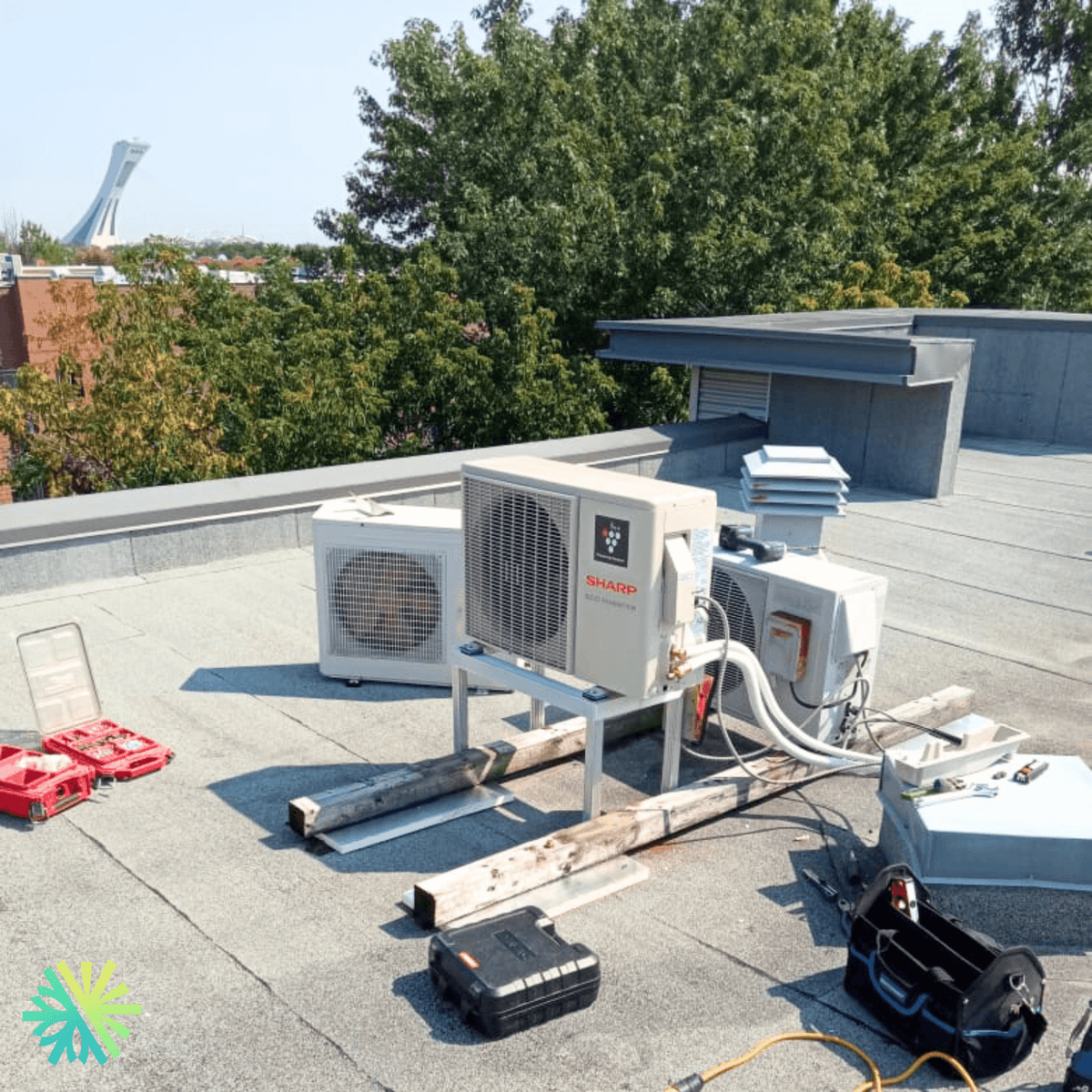
Installing HVAC equipment on a rooftop presents its own unique challenges, including accessibility, weatherproofing, and ensuring proper drainage. Our experienced AirGreen team expertly handled the setup by using elevated brackets to ensure that the outdoor unit was securely positioned, allowing for proper airflow and drainage during the winter months when ice buildup can be a concern.
By choosing a rooftop installation, we ensured that the Sharp ZHU outdoor unit was out of sight, maintaining the aesthetic of the property while maximizing the system's operational efficiency. With careful planning and precision, we connected the indoor and outdoor units using high-quality 1/4 - 3/8 refrigerant piping, ensuring that the system functions flawlessly.

Why the Sharp ZHU Series Stands Out
Sharp has long been known for integrating innovative technology with energy efficiency, and the ZHU series is no exception. This system uses the eco-friendly R-32 refrigerant, which not only reduces the system’s environmental impact but also improves its energy efficiency by around 10% compared to older refrigerants like R-22. This innovation helps reduce greenhouse gas emissions while lowering electricity bills—making it a win-win for the environment and the homeowner's wallet.
Additionally, the Energy Star® certification further assures customers of its top-tier performance. With a SEER rating of 25.0, this system is designed to consume less energy while providing consistent cooling in the summer and heating in the winter.
Superior Air Quality with Sharp’s Plasmacluster Technology
What sets the Sharp ZHU heat pump apart from its competitors is its Plasmacluster technology. This advanced air purification system works to neutralize airborne viruses, allergens, and odors, making it an excellent choice for homeowners concerned with indoor air quality. The Plasmacluster ions emitted by the system eliminate harmful particles in the air, contributing to a healthier living environment.
In the case of this installation, the homeowner was particularly interested in improving indoor air quality as their household included young children prone to allergies. The Plasmacluster air purification system was a game changer, providing peace of mind by filtering out allergens, mold, and other pollutants from the indoor air.
The Coanda Airflow Control: Comfort in Every Corner
One of the key features of the Sharp ZHU series is the Coanda Airflow Control. This system ensures that airflow is distributed evenly throughout the room, preventing hot or cold spots. Whether it's cooling in the summer or heating in the winter, the air is redirected along walls and ceilings to ensure that the entire room maintains a comfortable and uniform temperature.
This technology is particularly useful in homes like this one, where open-concept spaces can sometimes struggle to maintain even heating or cooling. By using the Coanda effect, we ensure that the homeowner will enjoy consistent comfort throughout their home, without having to deal with the discomfort of uneven temperatures.
SHARP Connectivity: Smart, User-Friendly Operation
The Sharp ZHU heat pump comes equipped with smart connectivity features, including a WiFi-enabled control system that allows the homeowner to manage their heat pump remotely via a smartphone app. The app provides real-time updates on the system’s performance, enabling them to adjust settings such as temperature and fan speed at the touch of a button.
For the Montréal homeowner, this feature was a major selling point. Not only can they monitor their energy usage, but the app also provides notifications when no one is home, allowing them to conserve energy by adjusting the system remotely. This kind of smart operation makes the Sharp ZHU heat pump an ideal choice for those looking to optimize energy efficiency and lower their utility bills.
Energy Savings and Financial Incentives
One of the biggest advantages of choosing the Sharp ZHU heat pump is the financial savings it offers. Beyond the immediate reduction in energy costs due to its high efficiency, the homeowner in this installation also qualified for several grants. The system’s Energy Star® Cold Climate certification made it eligible for a $2,268 LogisVert Grant from Hydro-Québec, the highest grant available for a 12,000 BTU mini split.
Additionally, the homeowner was able to claim a $2,500 federal grant for further savings, making this installation not only an upgrade in comfort but also a financially smart decision.
Built for Extreme Cold: Sharp’s Advanced Heating Capacity
Unlike many heat pumps that struggle in freezing conditions, the Sharp ZHU excels in extreme climates. With the ability to heat effectively even in temperatures as low as -27°C, this system is truly built for Québec winters. This makes it one of the most reliable options on the market for homeowners who need dependable heating during the coldest months of the year.
In this particular installation, we ensured that the system was optimized to handle the frigid Montréal winters, providing the homeowner with peace of mind knowing that their home would stay warm no matter how cold it gets outside.
Quiet, Durable, and Backed by a Solid Warranty
Another critical consideration for this installation was noise. The Sharp ZHU series is known for its quiet operation, with an outdoor sound pressure level of just 49.0 dB(A) and an indoor level ranging between 22-44 dB(A), depending on the fan speed. This ensures that the system runs quietly, even when operating at full capacity.
To ensure long-term reliability, the system is backed by an extensive 10-10-10 warranty (10 years on the compressor, parts, and labor), providing the homeowner with added assurance of its durability.
Conclusion: An Investment in Comfort and Efficiency
At AirGreen, we are proud to offer high-quality installations like this Sharp ZHU 12,000 BTU Heat Pump in Montréal. This system combines cutting-edge technology, energy efficiency, and superior air quality to provide the homeowner with year-round comfort. Thanks to its advanced features like Plasmacluster air purification and Coanda Airflow Control, along with the added financial benefits of multiple grants, this installation represents a sound investment for any homeowner looking to enhance their living environment.
If you are considering upgrading your home’s heating and cooling system, contact us today to learn more about how the Sharp ZHU series can benefit you.
The job tools
Two quick checks with real numbers: what heat costs, and what your current heaters add up to in BTU/h.
Conversion: 1 W = 3.412 BTU/h. An indication, not a load calculation: baseboards and furnaces are often stronger than the real need, and they can stay as backup. AirGreen confirms the capacity on site.
How the job unfolds
The main steps of this kind of job at AirGreen. Every house has its quirks: the estimate brings them out.
We look at the room, the outside wall, the line route and where the outdoor unit will go. That is where the capacity gets chosen.
Model, capacity and price, in writing. We also check whether the model qualifies for assistance programs.
Floors and furniture protected, wall plate position marked level, wall opening located.
A single opening, with the slope the drain needs to flow outside.
Set on a stand raised above the snow, with the clearances the manufacturer requires.
Connected, insulated and protected. The opening is then sealed against water, cold air and insects.
A dedicated circuit and an accessible disconnect near the outdoor unit.
Leak test, vacuum, then start-up and a check of heating and cooling.
Remote, modes, filters: we show you the essentials before we leave.
- The on-site estimateWe look at the room, the outside wall, the line route and where the outdoor unit will go. That is where the capacity gets chosen.
- The quoteModel, capacity and price, in writing. We also check whether the model qualifies for assistance programs.
- Getting readyFloors and furniture protected, wall plate position marked level, wall opening located.
- The wall openingA single opening, with the slope the drain needs to flow outside.
- The outdoor unitSet on a stand raised above the snow, with the clearances the manufacturer requires.
- Lines, cable and drainConnected, insulated and protected. The opening is then sealed against water, cold air and insects.
- The electrical workA dedicated circuit and an accessible disconnect near the outdoor unit.
- Tests and start-upLeak test, vacuum, then start-up and a check of heating and cooling.
- The walkthroughRemote, modes, filters: we show you the essentials before we leave.
What we check on a job like this one
Each number is a point we check on site. Switch between summer and winter to watch air and heat move.
In summer, the outdoor unit rejects the house's heat outside.
Generic illustration of this type of installation, not a survey of this job site. Tap a number.
Mounted level on a wall plate, high enough for the air to reach the whole room, with enough space around it to slide the filters out easily.
The refrigerant lines, the communication cable and the drain go through the wall in a single opening, sealed against water, cold air and insects.
Two insulated copper pipes connect the two units. Outside, a line cover can protect them from sun, knocks and weather.
A shut-off switch near the outdoor unit isolates it safely for service. It must stay accessible at all times.
The compressor and the fan. In heating mode it captures heat from the outdoor air, even in winter, and moves it inside.
On the ground or on the wall, it keeps the unit above accumulated snow. The unit stays clear and defrost water can drain away.
The fan needs to blow freely. Storage, a fence or a wall too close, and efficiency drops while noise goes up.
Is your home ready?
Check what applies at your place. A "no" is not a refusal: it is what we sort out during the estimate.
Good habits, once the unit is in place
Six simple habits that keep the unit going. Your list stays on this device.
What to do, season by season
Three habits per season for this unit. They take a few minutes and prevent many calls.
- Clean the indoor unit's filters.
- Clear leaves and debris left on the outdoor unit by winter.
- Test cooling before the first hot days.
- Clean the filters more often when the unit runs a lot.
- Keep plants away from the outdoor unit.
- Check that no water drips from the indoor unit.
- Rake the leaves around the outdoor unit.
- Test heating before the first cold days.
- Book periodic maintenance before winter.
- Keep snow away from the stand and the front of the unit.
- Let the unit defrost: it is normal.
- Never hit the ice on the fins; call us if the unit stays iced up.
The right pages, at the right time
Four statements: true or false?
It all comes down to details you have just seen.
1. In heating mode, the outdoor unit can produce water.
During defrost cycles. That water must drain away without forming ice.
2. You pick the capacity with a simple square-footage rule.
Windows, insulation, orientation and how the room is used all count. Capacity is chosen on site.
3. A multi-zone connects several indoor heads to a single condenser.
One head per room, all on the same condenser. Each room keeps its own temperature.
4. The disconnect can sit behind the patio furniture.
It must stay accessible: it is what shuts the unit off for service.
0 / 4 right answers
What people ask us about this kind of work
Does a wall-mounted heat pump heat in winter?
Wall-mounted or multi-zone: how do I choose?
Where does the outdoor unit go?
Are there grants?
Do I need a permit?
How cold can it heat?
How much can I save?
How is the LogisVert assistance calculated?
Is it noisy?
The outdoor unit is covered in ice: is that normal?
Does AirGreen hold the required licences?
Is the estimate free?
No question matches. Write to us: we answer.
More jobs to see, near you
By town, by equipment or by region: browse more than 4,700 published projects.
Each dot: a town where AirGreen has published projects. The glowing dot: this job.
An on-site estimate, the right capacity, the right equipment.
The on-site estimate is free and the quote follows within 24 hours.
Text and photo: a real AirGreen Climatisation & Chauffage job. The diagrams are generic illustrations of the type of installation, not a survey of this job site. Sources of the added figures: airgreen.ca product pages (NEEP / AHRI performance), Hydro-Québec (Heat pumps page, LogisVert, read on 13 October 2026), Régie de l’énergie (rate D as of 1 April 2026).