
Complete guide
Gree wall-mounted heat pump service and maintenance in Ville-Marie (Montreal)
—chapters
7min in total
October 2026edition

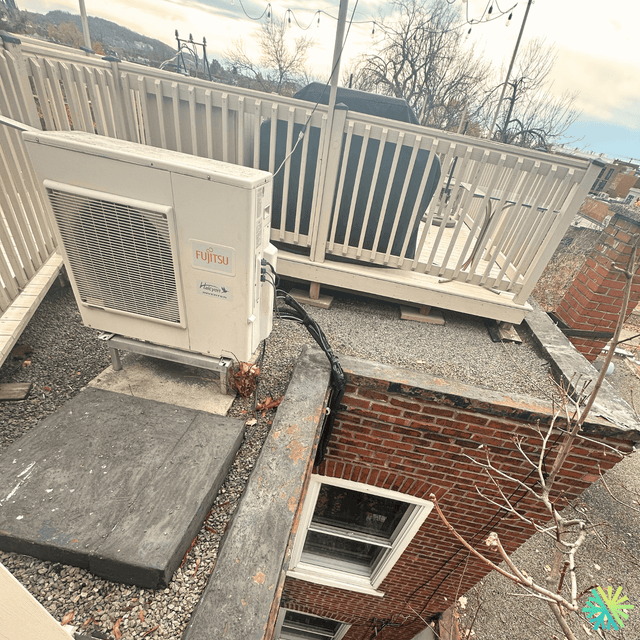
In several buildings in Ville-Marie , HVAC installations take place in conditions typical of "urban condos": narrow balconies, brick walls, metal railings, limited clearance, and sometimes difficult access. This is precisely the context of the intervention presented here: a Gree outdoor unit installed on a ground-mounted bracket on a balcony, in close proximity to the walls and railing.
At AirGreen , we understand that this type of environment requires a different service approach than a backyard installation. The proper functioning of a heat pump depends as much on the unit itself as on its airflow , mechanical stability , the cleanliness of the heat exchanger , the quality of the electrical connections , and adherence to clearance requirements. Rigorous maintenance helps preserve performance, prevent costly breakdowns, and extend the system's lifespan—especially in a climate like that of Greater Montreal.
The system in place: Gree wall-mounted heat pump (outdoor unit on balcony)
The visible equipment is a wall-mounted heat pump (mini-split) : a compact outdoor unit with an axial fan, installed on a floor-mounted chassis. In this type of configuration, indoor comfort depends on a combination of components: the indoor unit (wall-mounted head), the refrigerant lines (piping), the condensate drainage, the power supply, and the ventilation/air exhaust at the outdoor unit.
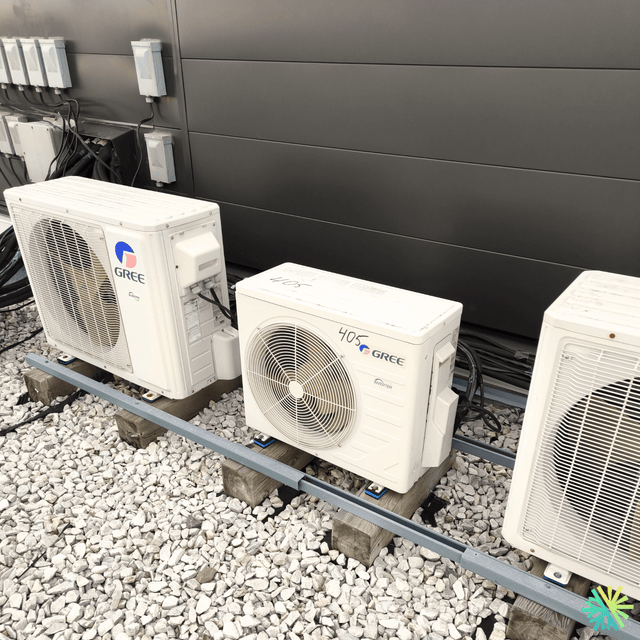
For this case, the brand to consider is Gree (and that is indeed the one we retain and use throughout the article).
Model: When the exact model is not visible in the photo, we intentionally remain consistent and realistic. Here, we are referring to a Gree residential-grade wall-mounted heat pump (Livo type / equivalent), commonly found in Montreal.
Why maintenance is even more important on a narrow balcony
An outdoor unit installed on a balcony operates in an "air corridor." However, a heat pump needs to breathe : it draws in and expels a significant volume of air. When the space is confined, several risks increase:
-
Air recirculation : the expelled air (colder in heating, warmer in air conditioning) can be drawn back in, which reduces efficiency.
-
Accumulation of dust and debris : balconies often retain leaves, urban soot, sand, particles.
-
Vibration and noise : rigid surfaces and confined spaces amplify resonances if the supports are not optimized.
-
Insufficient clearance : a lack of space around the unit can cause reduced efficiency, longer cycles, and accelerated wear.
-
Water management : in heating mode, defrosting produces water; if the flow is poorly managed, there can be frost, puddles, ice and risks for the balcony.
Our role at AirGreen is to evaluate these parameters as a whole — not just to “quickly clean” the device.
Key service details observed on site
Several elements in the photo clearly guide our method:
-
Outdoor unit on ground support : good point for accessibility and stability, but requires checking the pads/insulation , leveling and anchor points.
-
Narrow balcony with side walls : pay attention to lateral clearance and recirculation. We analyze the airflow path and any obstacles.
-
Visible electrical box/disconnector near the unit: excellent for service; we check tightness, condition, protection, sealing and conformity.
-
Urban environment (brick, balcony corridor): exposure to fine dust, humidity, and sometimes grease deposits (pollution). This justifies more thorough cleaning of the heat exchanger.
Our AirGreen protocol: complete service for a Gree wall-mounted heat pump
1) Performance diagnosis and symptom reading
Before any intervention, we seek to understand the system's behavior:
-
Heating/cooling response time
-
Stability of the indoor temperature
-
Abnormal noises (vibration, whistling, rubbing)
-
Short cycles or overly frequent defrosting
-
Signs of decreased efficiency (electricity bill, inconsistent comfort)
The objective: to distinguish a simple lack of maintenance from a problem with airflow, sensors, drainage, or a refrigeration issue.
2) Visual and mechanical inspection of the outdoor unit
On a balcony installation, this step is crucial. We check:
-
The condition of the heat exchanger fins (deformation, obstruction, dirt)
-
Clearances around the unit (front/rear/sides)
-
The stability of the support (level, corrosion, mechanical play)
-
Potential points of contact (pipes rubbing together, transmitted vibrations)
-
The presence of debris under the unit can impede defrosting and drainage.
Expected result: a stable, well-cleared, clean unit, free from mechanical constraints.
3) Technical cleaning: coils, fan and chassis
"External" cleaning is not enough. Effective maintenance targets the areas that directly impact performance:
-
Controlled cleaning of the external heat exchanger (coil) to restore heat transfer
-
Dust removal from critical areas (grilles, perimeter, base)
-
Checking/cleaning the water drainage system (important for heating)
-
Fan inspection: play, dirt, visual balancing
In a balcony corridor, a dirty heat exchanger often causes a heat pump to work harder: noise, longer cycles, reduced performance, and sometimes more aggressive defrosting.
4) Electrical checks and safety
The visible disconnect box facilitates clean and safe service. Specifically, we offer:
-
Checking the tightness of the connections (preventing overheating)
-
Inspection of the condition of cables, sheaths and entries (humidity, abrasion)
-
Verification of proper functioning of the power supply and protection systems
-
General visual inspection for compliance and safety
In urban environments, humidity and temperature variations can accelerate oxidation; regular electrical monitoring is a preventative investment.
5) Refrigeration checks (without unnecessary actions)
A heat pump is a refrigeration system: any intervention must be justified . During servicing, we prioritize a rigorous approach:
-
Operating measurements (temperatures, compressor behavior, stability)
-
Searching for signs of leakage without unnecessarily opening the circuit
-
Validation of basic parameters according to observed operation
We avoid actions that create uncertainty. A good diagnosis is based on measurements and understanding of the system, not on approximate "tests".
6) Indoor unit: filters, heat exchanger, drainage and air quality
Even though the photo shows the exterior, a full service includes the interior:
-
Cleaning or replacing the filters
-
Inspection of the internal heat exchanger (dust, biofilm)
-
Check the condensation tray and drainage (prevent overflows/odours)
-
Control of shutters, motors, sensors, remote control/settings
In Ville-Marie condos, fine dust accumulates quickly, and a partially blocked drain can create odors, humidity and risks of water leaks.
Specific adjustments for condo balconies in Montreal
Optimize clearances and airflow
When the unit is very close to a wall or railing, we evaluate simple but very effective adjustments:
-
Slight repositioning on the support (if possible)
-
Addition/optimization of anti-vibration insulation
-
Clearing the perimeter (removing obstacles, clutter, objects)
-
Practical recommendations for balcony maintenance (cleanliness, leaves, snow)
Reduce noise and vibration
On a narrow balcony, noise quickly becomes a nuisance. We target:
-
Suitable anti-vibration pads
-
Checking the tightness and leveling
-
Elimination of contact points (pipes/hood/structure)
-
Fan operation validation (imbalance = vibration)
Preparing for the Quebec winter
In heating mode, the heat pump defrosts and drains water. We check that:
-
Water does not accumulate under the unit
-
Nothing is obstructing the base (ice, debris, dirt)
-
The support maintains a sufficient height
-
The surrounding areas remain clear after a snowfall (depending on exposure).
What this service actually improves
After a thorough consultation and adjustments tailored to the "urban balcony" context, the aim is:
-
Improved energy efficiency (less effort for the same comfort)
-
More stable air and better temperature control
-
Less noise and vibration
-
Reduced risk of breakdowns (electrical, drainage, overheating, difficult defrosting)
-
Increased lifespan of the Gree heat pump
Best practices for the landlord (simple, effective, realistic)
Without going into excessive detail, here's what makes a real difference:
-
Clean/vacuum the internal filters regularly (frequency varies depending on usage)
-
Keep a clear space around the outdoor unit (avoid using it as a storage area)
-
Avoid blocking airflow with panels, canvases, or objects stuck to the grille.
-
Report immediately: new noise, abnormal defrosting, decreased performance, odor, water leaking inside
And most importantly: have a professional service performed regularly. In dense urban areas like Montreal , the accumulation of particles is often underestimated.
Conclusion: A well-maintained Gree heat pump means a more comfortable condo in Ville-Marie.
This type of balcony installation is common in Ville-Marie , and it works very well… provided that environmental constraints are respected. At AirGreen , we adapt our service to the realities of Greater Montreal condos: access, clearances, noise, performance, and preventing problems before they become urgent.
A thorough, methodical maintenance protects your investment and maintains comfort in summer and winter — exactly what you would expect from a Gree wall-mounted heat pump.
You made it to the end.Share it with someone it could help.
AirGreen Climatisation & Chauffage
From reading to your home.
An AirGreen advisor assesses your situation on site, free of charge, and gives you a quote within 24 hours.
- RBQ licence 5645-9605-01Subclasses 15.8, 15.10 and 16
- Free on-site estimateAn advisor assesses your needs
- Quote within 24 hoursClear and detailed
Contents
AirGreen glossary