
AirGreen lexiconCentral heat pumps
Definition
Winter 2026: Real-World Performance of Central Heat Pumps During -35 °C Polar Cold Waves
Simplified diagram
In one sentence
Related terms in this article
What We Observed On-Site During the Harshest Cold Spells in Montréal, Laval, Longueuil and Surrounding Areas
At AirGreen, we’re deeply familiar with the extreme weather conditions in Québec. Winter 2026 was one of the harshest of the last decade, with several polar cold waves reaching -35 °C across large regions, including Laval, Longueuil, Terrebonne, and Saint-Jérôme. This provided a unique opportunity to test the real-world performance of central heat pumps in critical conditions and gain a clearer understanding of what clients actually expect during extreme cold.
In this article, we share observations based on real service calls, highlighting the limits, smart technology choices, common mistakes, and the solutions we implemented in the field.
The Technical Challenges of -35 °C Weather
Even the most efficient high-performance central heat pumps see a drop in effectiveness at such temperatures. The compressor has to work at full tilt, heating cycles lengthen, and backup electric elements often become necessary.
Observation in East Montréal: a client with a Bosch BOVA 36,000 BTU heat pump reported that the system maintained indoor temperatures of 20 °C down to -30 °C. But when it hit -35 °C, the system kicked in the 10 kW electric backup, temporarily increasing electricity usage.
The Importance of Nominal Capacity at Low Temperatures
Some units boast impressive BTU values in lab tests, but drop by 30 to 40% in actual performance when temperatures fall below -25 °C. So it’s essential to look deeper into the technical specs beyond surface-level numbers.
Critical specs to verify:
-
Heating capacity at -25 °C (actual BTUs)
-
COP (Coefficient of Performance) at -20 °C and -30 °C
-
Backup heating power consumption
-
Inverter technology (needed for efficient modulation)
AirGreen Case Study: Performance of a Lennox ML16XC1 in Blainville
In January, we received an emergency call from a client in Blainville whose Lennox ML16XC1 central heat pump – 48,000 BTU was running nonstop but couldn’t raise indoor temps above 18 °C. A thermal load calculation showed the home needed 56,000 BTUs at -30 °C. The unit was clearly underpowered for such extreme cold.
Our solution:
-
Installed a 15 kW electric backup module, controlled by a smart thermostat
-
Modified ductwork to improve heat distribution
-
Result: restored comfort even at -35 °C, with stable indoor temperatures
The Role of Ductwork and Insulation in Wintertime Performance
Many clients assume a central heat pump alone is enough, but insulation and duct design are key to performance at -35 °C. Even a high-end unit can underperform if hot air is lost through drop ceilings or if cold air seeps through the walls.
Real example in Longueuil:
-
1982 home with minimal wall insulation
-
Gree 36,000 BTU central heat pump failed to heat the main living space
-
After inspection: 30% thermal loss through ducts in an unheated basement
Brands That Performed Best in the Field During Winter 2026
From real-world experience, some brands stood out for their durability and stability during severe cold:
-
Bosch BOVA and BOVA2: excellent BTU retention down to -30 °C
-
Lennox SL25XPV: strong seasonal efficiency, smart backup management
-
Gree Flexx and Gree Versati IV: held up well even at -32 °C with decent COP
-
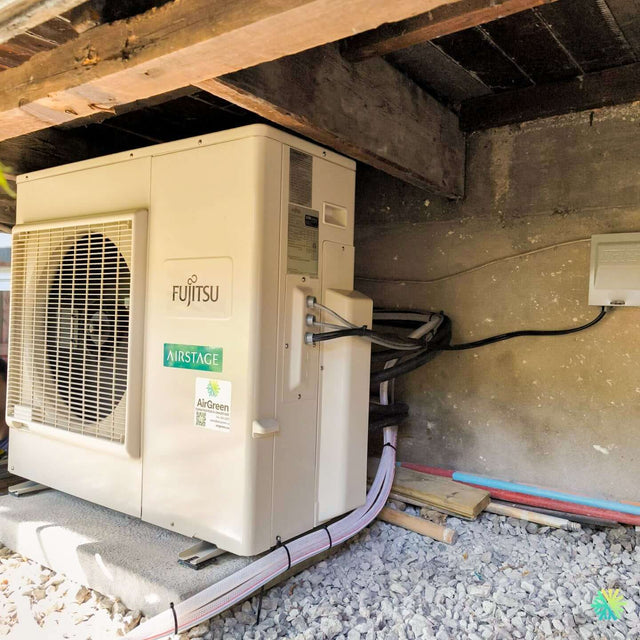
Fujitsu Airstage: reliable for well-insulated homes
We also observed that units with multi-stage inverter compressors handled temperature fluctuations better and minimized backup usage.
Grants and Winter Efficiency: Read the Fine Print
Some customers assume that qualifying for a grant means optimal performance year-round. That’s not always true. Programs like Hydro-Québec’s LogisVert are based on seasonal efficiency (SEER2 / HSPF2), not extreme cold performance at -35 °C.
We therefore recommend:
-
Verifying low-temp performance before purchasing
-
Requesting a custom energy analysis
-
Pairing the system with a properly sized backup heating element
Preparing Your Home for Future Cold Waves with a Complete HVAC Strategy
Winter 2026 reminded us that choosing a central heat pump alone isn’t enough. You also need to factor in insulation, heat distribution, backup systems, and usage habits.
At AirGreen, we turn every installation into a long-term solution:
-
Accurate thermal load assessments to prevent under-sizing
-
Carefully selected equipment suited for Québec’s extreme weather
-
7-day technical support during severe cold periods
We never install a central heat pump without confirming it’s capable of withstanding -35 °C cold snaps. Our clients sleep soundly — even when winter hits its hardest.
You made it to the end.Share it with someone it could help.
AirGreen Climatisation & Chauffage
From reading to your home.
An AirGreen advisor assesses your situation on site, free of charge, and gives you a quote within 24 hours.
- RBQ licence 5645-9605-01Subclasses 15.8, 15.10 and 16
- Free on-site estimateAn advisor assesses your needs
- Quote within 24 hoursClear and detailed
Contents
AirGreen glossary