
Central heat pumps
Can You Heat Your Home Solely with a Central Heat Pump at -35°C? Real Test in Laval
The gist
Extreme test in Laval: a 36,000 BTU Bosch BOVA central heat pump kept indoor temps at 21.5°C even at -35°C without backup. Discover what that means for your winter comfort and energy savings.
In detail
At AirGreen, we often receive a very legitimate question from our clients in Laval, Montréal, Longueuil, the North Shore, and the South Shore: is it truly possible to heat your entire home solely with a central heat pump when outdoor temperatures plunge to -35°C? To answer this, we decided to share a real-life case—a test conducted in extreme winter conditions in Laval, featuring the installation of a Bosch BOVA 36,000 BTU Inverter central heat pump in a single-family home built in the 1980s.
The Context: A Typical Laval Home Facing Extreme Cold
The residence is located in Laval-des-Rapides, a residential area where homes often have average insulation and a layout typical of Quebec constructions from the 1980s. The homeowner wanted to replace a 20-year-old electric furnace with a more ecological and cost-effective solution, all while avoiding any use of auxiliary heating.
After a complete heat load assessment, we recommended installing a Bosch BOVA 36,000 BTU Inverter central heat pump, running on the new eco-friendly refrigerant R-454B.
Technical Specifications of the Installed Equipment
-
Brand: Bosch
-
Model: BOVA 36,000 BTU Inverter – IDS Premium Series
-
Type: Central heat pump, two-piece (outdoor condenser + indoor evaporator)
-
Technology: Inverter (variable-speed compressor)
-
Refrigerant: R-454B (low GWP)
-
Heating capacity: down to -30°C without backup
-
Energy efficiency: SEER 20, HSPF 10.5
-
Eligible for rebates: Yes, Hydro-Québec LogisVert Program ($2,172 (at the rate then in effect))
The Challenge: Can We Fully Eliminate Backup Heating?
We deliberately disconnected the old backup system (electric furnace) to test the capacity of the central heat pump to operate on its own during the coldest days of winter. In Laval, in January, the temperature dropped to -34.7°C for an entire night. Despite the intense cold, the Bosch system maintained a stable indoor temperature of 21.5°C throughout the entire house, including the upper level.
Result: no need for the furnace, no drop in comfort, no complaints from the client.
Key Steps of the HVAC Installation
1. Heat Load Assessment
Before any installation, our team conducted a complete thermal analysis of the home, factoring in size, insulation, window types, and sun exposure.
2. Dismantling the Old System
We removed a 15 kW electric furnace. Part of the existing ductwork was preserved to integrate the new central heat pump more efficiently.
3. Installing the Bosch Heat Pump
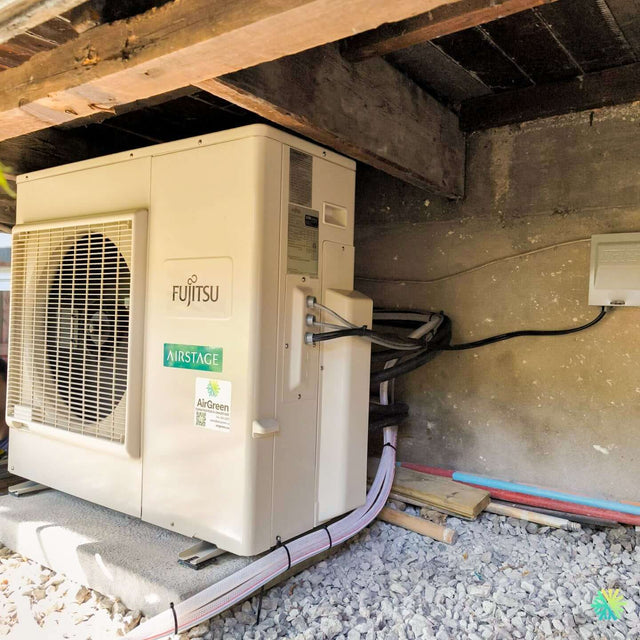
The outdoor condenser was placed on an elevated concrete slab with anti-vibration supports. The indoor evaporator was connected to the existing ducts, with the addition of electronic dampers for better airflow modulation.
4. Smart Programming and Testing
A Bosch smart thermostat was configured to optimize heating cycles, reduce energy spikes, and ensure constant comfort.
5. Real-Time Performance Monitoring
We installed a temperature sensor in the living room and an energy meter to track system performance over 30 days.
Real Data Collected
| Outdoor Temperature | Indoor Temperature | Daily Consumption (kWh) | Backup Activated |
|---|---|---|---|
| -12°C | 22°C | 17.6 | No |
| -20°C | 21.5°C | 23.4 | No |
| -35°C | 21.5°C | 26.7 | No |
Why Did This Heat Pump Perform So Well?
-
Inverter Technology: allows continuous and efficient modulation without major performance drops
-
R-454B Refrigerant: more efficient at low temperatures than R-410A
-
Well-integrated with existing ductwork: minimized pressure losses and ensured even distribution
-
Expert installation by our certified technicians, with a focus on duct insulation and precise airflow calibration
What Homeowners Should Know
1. Not all heat pumps are equal: Many models lose up to 50% of their capacity below -20°C. It’s critical to choose one rated for cold climates.
2. Installation plays a key role: Even the best equipment underperforms if poorly sized or improperly installed.
3. Rebates cover a large portion of the cost: In this case, the client received $2,172 (at the rate then in effect) from the LogisVert Program.
4. It is possible to heat 100% with electricity, without backup, but it requires careful planning.
Similar Installations Completed by AirGreen
-
Sainte-Thérèse: Installation of a Gree Flexx 60,000 BTU with modular plenum
-
Saint-Hubert: Replacing an oil system with a Goodman R-32 48,000 BTU central heat pump
-
Bois-des-Filion: Added a second evaporator to heat an uninsulated basement
Our Conclusion
Yes, it is absolutely possible to heat a home exclusively with a central heat pump even during extreme cold spells reaching -35°C — provided that you choose a high-performance system and have it installed by experienced professionals.
At AirGreen, we bring real field experience and in-depth knowledge of HVAC systems tailored for Quebec’s climate. Our approach is built around custom solutions, backed by concrete data and real customer feedback.
Considering switching to a central heat pump but unsure if it can handle Québec’s harsh winters?
Let us help. We offer a free quote including a thermal analysis, rebate estimate, and detailed installation plan anywhere in the Greater Montréal area, including Laval, Longueuil, the South Shore, and the North Shore.
You made it to the end.Share it with someone it could help.
Related questions
Can You Really Achieve a Return on Investment in Under 5 Years? Real Case StudiesTips to Benefit from LogisVert Grants Without Administrative ErrorsCentral Heat Pump + R-40 Insulation: The Winning Formula for a Zero-Waste HomeHow to Extend the Life of Your Central Heat Pump by 10 Years? Simple Habits to AdoptIs Annual Maintenance Really Worth It? Our Data Proves ItComplete AirGreen Checklist: Monthly, Seasonal, Annual Maintenance — Printable and PracticalCentral Heat Pump or Electric Baseboards + Wall-Mounted AC? We’ll help you decideWhat Is the Best Place to Install Your Outdoor Unit? Comparative Studies
AirGreen Climatisation & Chauffage
From reading to your home.
An AirGreen advisor assesses your situation on site, free of charge, and gives you a quote within 24 hours.
- RBQ licence 5645-9605-01Subclasses 15.8, 15.10 and 16
- Free on-site estimateAn advisor assesses your needs
- Quote within 24 hoursClear and detailed
Contents
AirGreen glossary