
Repair of a wall-mounted heat pump in Brossard

What we checked
Items tick as you read the diagnosis.
When an indoor wall unit runs but no longer provides the expected comfort
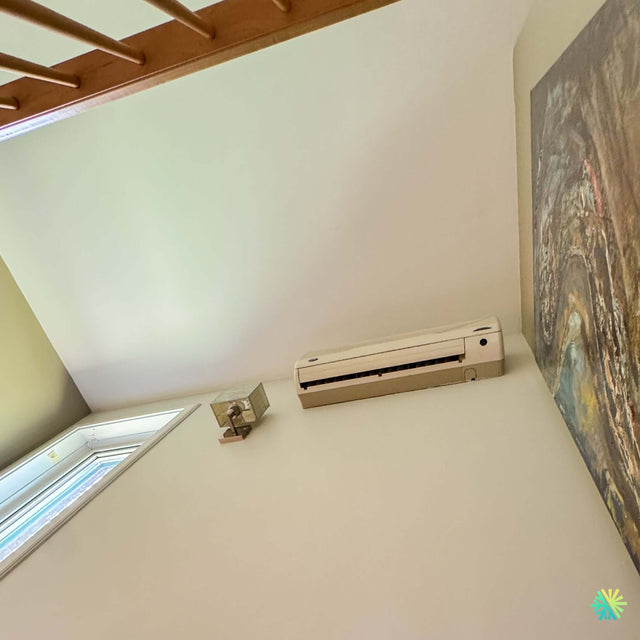
In Brossard, on the South Shore, our AirGreen team was called for a service call on a residential wall-mounted heat pump whose indoor unit was installed high up, between two windows, in a living room where comfort needed to be stable both for heating and cooling. The unit was visibly older, with a yellowed front panel from age, an elongated upper grille, a lower air outlet flap, and a small central panel displaying indicator lights. No manufacturer logo or exact model was clearly visible in the photo, but the configuration matched a mini-split type wall-mounted heat pump, probably of a standard residential capacity, often between 9,000 and 12,000 BTU depending on the room volume and year of manufacture.
The client contacted us because the unit no longer seemed to respond as before. The unit would turn on, a red light was visible, the lower flap appeared to be in operating position, but the room temperature did not properly follow the demand. Air was coming out, but with reduced efficiency. At times, the client felt the machine was running without actually heating or cooling the room as it used to.
This type of situation is common with older wall-mounted heat pumps. The system is not necessarily completely broken: it may still start, display indicator lights, and blow air. However, behind this appearance of normal operation, several problems may be hidden: clogged filters, dirty turbine, inaccurate temperature sensor, stuck flap, worn electronic board, partially blocked drain, lack of maintenance, intermittent communication with the outdoor unit, or performance drop related to the refrigerant circuit.
An old wall unit that required a methodical diagnosis
Upon our arrival, we first observed the entire installation. The indoor unit was installed near the ceiling, in a niche formed by the moldings and window frames. This position is common for a wall-mounted heat pump, but it imposes certain constraints: warm air can accumulate near the ceiling, temperature readings from the sensor can be influenced by stratification, and access for maintenance can become more difficult if the unit is very close to the moldings.
The appearance of the unit also indicated that it was a device that had already been in service for several years. For this type of machine, it is essential not to conclude too quickly that replacement is necessary. An old wall-mounted heat pump can still be useful if its compressor, electronic boards, and refrigeration circuit are functional. But it must be evaluated rigorously, because simply restarting it is not enough to confirm its real performance.
We therefore approached the service call by following a precise sequence:
- validating the symptom reported by the customer;
- observing the indicators and unit behavior;
- checking the remote control and selected modes;
- inspection of filters;
- visual inspection of the indoor evaporator;
- checking airflow;
- control of the motorized flap;
- testing heating and cooling response when conditions allow;
- listening to turbine noises;
- checking condensate drainage;
- assessment of possible refrigeration or electronic issues.
The goal was clear: to understand why the unit seemed to operate without delivering the expected efficiency.
Observed symptoms: operation present, weakened performance
The most important problem was not a total lack of power. The unit turned on. The power indicator was visible. This already ruled out certain scenarios such as a complete power outage, a tripped circuit breaker, or a total lack of communication with the indoor power supply.
However, a unit that is on is not automatically a high-performing unit. The customer had noticed several signs:
- weaker airflow than before;
- indoor temperature that was difficult to stabilize;
- slow response after setpoint change;
- feeling of lukewarm or insufficiently cold air depending on the mode;
- prolonged operation;
- shutdown or slowdown sometimes difficult to interpret;
- discomfort in the area directly served by the unit.
In a wall-mounted heat pump, these symptoms can stem from very different causes. A very dirty filter can give the impression of a major breakdown. A clogged indoor turbine can reduce airflow to the point of making the unit almost ineffective. An indoor sensor poorly influenced by heat accumulated on the ceiling can cause premature shutdowns. An aging electronic board can lead to irregular controls. An outdoor unit lacking maintenance can also limit the overall system capacity.
Internal inspection: filters, evaporator, and turbine
The first technical step was opening the indoor front panel to inspect the filters. On a wall-mounted heat pump, the filters are often the first point of restriction. When they are loaded with dust, hair, particles, and deposits, they limit the airflow through the evaporator. The system can then run longer, make more noise, produce less comfort, and even develop excessive condensation.
In this case, the general condition of the unit indicated that a deep cleaning was necessary. Even if the filters can be cleaned by the owner, the inside of the device often requires a more technical intervention. Dust lodges in the evaporator fins, in the cylindrical fan, around the condensate tray, and sometimes near the motorized flaps. A wall-mounted heat pump may look clean on the outside while being heavily soiled inside.
We checked:
- the condition of the filters;
- the presence of dust in the upper grille;
- the visual condition of the evaporator;
- the cleanliness of the fan;
- the free movement of the lower flap;
- the presence of odors or traces of moisture;
- the risk of abnormal condensation;
- the operation of the indoor fan at different speeds.
When the indoor fan is dirty, the customer may feel a drop in comfort without necessarily understanding why. The air still comes out, but in reduced volume. The system then works longer to achieve the same result, which increases wear and reduces efficiency.
Verification of the control and modes
Another important point concerned the settings. On older wall-mounted heat pumps, the remote control icons and modes can be confusing. A device can be in ventilation, dehumidification, or automatic mode while the customer thinks it is in heating or cooling. The automatic mode, especially on some older models, can cause irregular behavior if the sensor misinterprets the ambient temperature.
We therefore validated:
- the selected mode;
- the requested temperature;
- the ventilation speed;
- the position of the flap;
- the unit's response to commands;
- the consistency between the demand and the actual operation.
In an HVAC diagnosis, this type of check is essential. Replacing a part without confirming the settings can lead to a wrong conclusion. In Brossard, as in our service calls in Montreal, Laval, Longueuil, on the North Shore and the South Shore, we often see devices that seem defective when a wrong mode or an inappropriate setting amplifies the problem.
Technical cleaning and reconditioning of the indoor unit
After the inspection, we proceeded to restore the indoor unit. The intervention was adapted to the age of the device to clean effectively without unnecessarily stressing older plastics. On an aging wall-mounted heat pump, panels, clips, and flaps can become more fragile. Precision work is required.
The work performed included:
- filter cleaning;
- dusting of the intake grille;
- inspection and cleaning of the accessible evaporator;
- inspection of the indoor fan;
- cleaning of the air outlet areas;
- control of the motorized flap;
- validation of the condensate drain;
- function test after reassembly;
- observation of restored airflow.
Special attention was given to the condensate pan and drain. Even though the call mainly concerned a loss of performance, a partially clogged drain can become a serious problem, especially in cooling mode. Water can accumulate inside the indoor unit, cause odors, drip on the wall, or damage interior finishes. In a room with moldings and decorative elements, a water leak could have caused avoidable damage.
An HVAC repair that restored airflow and improved response to demand
After the service, we restarted the system and observed its behavior. The most notable improvement was in the airflow. The wall unit blew more consistently, with better distribution into the room. The response to commands was also more consistent.
Performance tests after service
We checked several elements before concluding the service call:
- unit starts without abnormal delay;
- response to remote control commands;
- variation between fan speeds;
- movement of the lower flap;
- blower stability;
- no obvious rubbing noise;
- no visible drainage;
- general behavior when heating or cooling is requested.
The customer noticed that the unit was more stable and that the air circulated better. In this type of service, the goal is not just to get the unit running for a few minutes. It is necessary to ensure the machine responds properly, that the initial symptom is improved, and that the customer understands the possible limits of an older device.
What this service taught us about the installation
This service call in Brossard illustrates an important point: a wall-mounted heat pump installed for several years can gradually lose efficiency without suddenly breaking down. The decline is sometimes gradual. The customer gets used to a bit less air, longer cycles, a room taking more time to reach the temperature, until the difference becomes too obvious.
The most common causes are:
- insufficient filter maintenance;
- accumulation in the turbine;
- dirty evaporator;
- partially blocked drain;
- less mobile flap;
- less accurate sensor;
- aging outdoor unit;
- system performance loss;
- prolonged use under difficult conditions.
At AirGreen, we recommend not waiting until the device stops working completely. A preventive service call can extend the life of a wall-mounted heat pump and avoid more costly repairs.
Mistakes to avoid with an older wall-mounted heat pump
During this service call, we also took the time to explain some common mistakes to the client.
Turning the temperature up to maximum thinking it will speed up heating
A wall-mounted heat pump doesn’t necessarily heat faster just because the thermostat is set very high. If the device is dirty or airflow is low, raising the setpoint doesn’t fix the root cause. It only prolongs operation and increases wear.
Closing doors or blocking airflow
The unit was installed in a central area, but air distribution depended on the room’s openness. Blocking circulation with closed doors, tall furniture, or thick curtains can reduce comfort.
Neglecting filters for several months
Filters must be cleaned regularly. A wall-mounted heat pump constantly draws air from the room. Dust accumulates quickly, especially in homes where windows are often open, where there are pets, or in heavily used rooms.
Ignoring small changes in noise
A turbine noise, rubbing, flap clicking, or irregular airflow can signal a worsening problem. Quick intervention can prevent premature replacement of some parts.
Recommendations given to the client
At the end of our service, we provided simple and useful recommendations:
- clean the filters about once a month during intense use periods;
- monitor the airflow at the unit’s outlet;
- avoid blocking the area in front of the air outlet flap;
- check for any damp smell in cooling mode;
- have the outdoor unit inspected if performance remains low despite indoor cleaning;
- schedule a full maintenance before periods of heavy use;
- contact us quickly if a warning light flashes or if the device stops repeatedly.
These tips apply to Brossard, but also to the entire Greater Montreal area. We regularly service wall-mounted heat pumps in Montreal, Laval, Longueuil, on the North Shore and South Shore, and indoor maintenance issues are among the most common causes of performance decline.
When to repair and when to replace?
In this case, repair and restoration were justified. The device could still operate, and the technical cleaning improved its performance. However, we also explained to the client that an older wall-mounted heat pump must be monitored. If breakdowns become frequent, if electronic parts are no longer available, if the outdoor unit shows signs of weakness, or if consumption increases without satisfactory comfort, replacement may become more cost-effective.
The right decision depends on several factors:
- approximate age of the system;
- availability of parts;
- repair cost;
- frequency of service calls;
- comfort level achieved after intervention;
- current energy efficiency;
- noise;
- reliability in heating and air conditioning.
Our approach is to provide a clear assessment. When repair makes sense, we repair. When replacement becomes more advantageous, we explain it with technical arguments, without pushing an unnecessary solution.
A reassuring and transparent customer experience
The client wanted to understand why a unit that turned on could still perform poorly. We took the time to show them the important elements: filters, airflow, damper, dust accumulation areas, and signs to watch for. This transparency is part of our way of working. A successful HVAC repair is not just about fixing a problem; it’s also about enabling the owner to better use their equipment.
After the intervention, the client had a cleaner, more responsive, and better-understood wall-mounted heat pump. The comfort of the room was improved, and the risks related to a neglected drain or an overly dirty turbine were reduced.
AirGreen, specialist in service calls for wall-mounted heat pumps in Brossard
This repair of a wall-mounted heat pump in Brossard demonstrates the importance of a complete diagnosis, especially when an older device continues to operate without delivering its original performance. By inspecting the indoor unit, filters, airflow, damper, drainage, and response to controls, we were able to identify the likely causes of the loss of comfort and restore the device to better condition.
Our AirGreen teams work on residential HVAC systems throughout Greater Montreal, including Montreal, Laval, Longueuil, the North Shore, and the South Shore. Whether it’s a wall-mounted heat pump that’s blowing less effectively, a warning light turning on, a heating problem, a water leak, a turbine noise, or a system that no longer responds properly, we always prioritize a precise method: listen to the symptom, inspect the device, test the components, fix what needs to be fixed, and clearly explain the result.

The same service at your place?
Cleaning, repair or maintenance: tell us about your unit and we schedule the visit.
- RBQ licence 5645-9605-01Subclasses 15.8, 15.10 and 16
- $5M liability insuranceOn every job
- 15+ yearsFamily-owned, based in Montréal