
Repair of a wall-mounted heat pump in Varennes

What we checked
Items tick as you read the diagnosis.
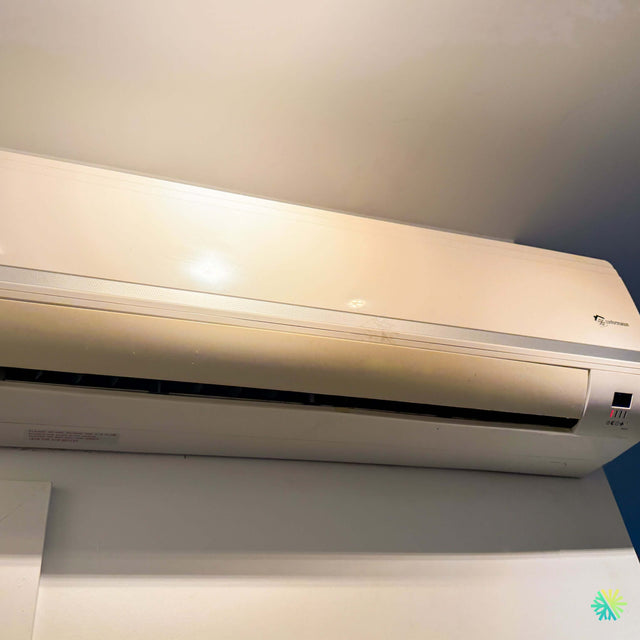
A wall-mounted heat pump losing its heating capacity in the middle of the cold season
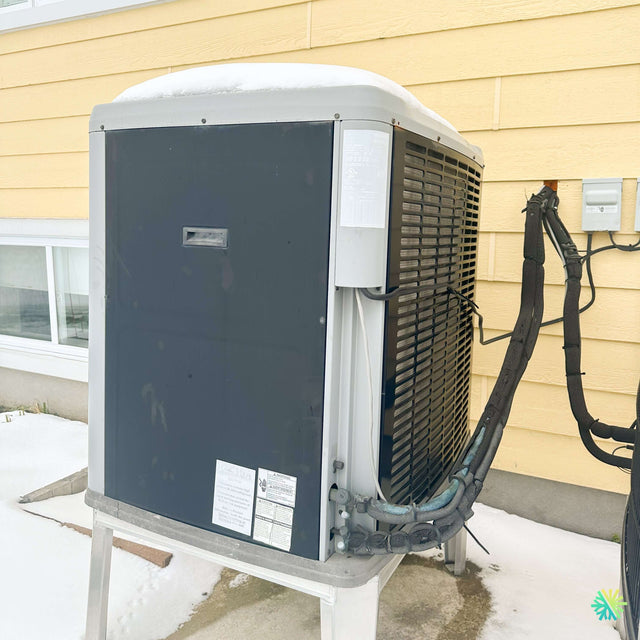
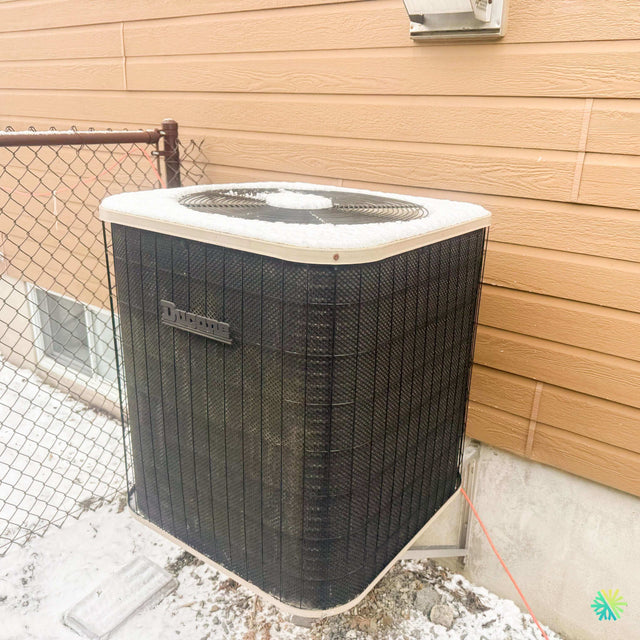
In Varennes, during a residential service call in winter, our AirGreen team worked on a wall-mounted heat pump installed on an outdoor wall mount, fixed above the foundation of a brick building. The context was typical of many homes on the South Shore: a compact outdoor unit exposed to wind, snow, freeze-thaw cycles, and rapid temperature changes.
The client had contacted us because their heat pump was no longer heating consistently. The indoor unit was still blowing air, but the perceived temperature in the room gradually decreased, especially in the evening. At times, the system seemed to start normally, then slowed down, went into defrost mode too frequently, or produced unusual noise outside. For a device supposed to provide a significant part of the heating, this type of symptom should never be ignored.
Upon our arrival, visual inspection of the installation gave us several important clues. The outdoor unit was well positioned on a wall mount, but its location made it particularly sensitive to snow accumulation around the base, moisture from the wall, and vibrations transmitted by the structure. The refrigerant lines and wiring ran through a vertical duct, with a visible drop toward the unit. In this type of setup, a thorough diagnosis must consider both the machine itself and its installation environment.
Symptoms reported by the client
The client described a series of progressive symptoms to us:
- significant drop in heat output from the wall-mounted heat pump;
- shorter operating cycles than usual;
- frequent defrosting of the outdoor unit;
- more noticeable vibration noise at startup;
- feeling that the machine is "struggling" without reaching the requested temperature;
- less stable performance when the outside temperature dropped below freezing point.
This type of problem can have several causes: lack of refrigerant, faulty sensor, unstable electronic board, weakened outdoor fan, clogged heat exchanger, partial blockage, poor condensate drainage, defrosting issue, or weakness in the power supply.
Our goal was therefore not to replace a part at random, but to precisely understand why the heat pump was no longer maintaining its performance.
Outdoor inspection: a demanding winter environment for the unit
The first step was to inspect the outdoor unit. On an installation like this, mounted on the wall with metal brackets, several elements must be carefully checked:
- clearance around the condenser;
- condition of the rear and side grille;
- presence of ice on the exchanger;
- stability of the wall mount;
- abnormal vibrations;
- condition of refrigeration fittings;
- pipe protection;
- drainage of water produced during defrost cycles.
We found that the unit was not completely blocked, but the accumulation of snow and surrounding humidity favored irregular ice formation. It was not a dramatic situation where the entire condenser was trapped in a block of ice, but rather a partial buildup that reduced heat exchange. In heating mode, a wall-mounted heat pump must extract heat from the outside air. If the exchanger breathes poorly, even partially, the compressor works harder, cycles become less efficient, and indoor temperature drops.
Defrost cycle check
The defrost cycle is essential on a wall-mounted heat pump used in Varennes, Montreal, Laval, Longueuil, on the North Shore or the South Shore. When it works properly, it allows the outdoor unit to melt the frost that naturally forms on the coil. When it triggers too often, not often enough, or incompletely, indoor comfort is quickly affected.
We therefore observed the device's operating sequence:
- compressor start-up;
- activation of the outdoor fan;
- ramp-up;
- indoor blowing temperature;
- outdoor sensor behavior;
- control board reaction;
- switch to defrost mode;
- return to heating mode.
The observed behavior indicated a problem with reading and managing defrosting. The unit tried to compensate but without maintaining stable logic. This could have been caused by a weakened outdoor sensor, a control board receiving incorrect information, or a dirty heat exchanger that distorted normal operating conditions.
Refrigeration and electrical diagnosis
After the visual inspection, we proceeded with technical checks. For this type of service call, it is important not to limit oneself to the observation “it’s not heating.” A reliable HVAC repair requires a complete system reading.
Our technicians checked:
- the electrical power supply;
- the startup voltage;
- the communication connections between the indoor and outdoor units;
- the sensor values;
- the behavior of the outdoor fan;
- the discharge temperature;
- signs of restriction or refrigerant shortage;
- the condition of the connections;
- the indoor supply air temperature;
- the machine’s response when heating is requested.
The pressure and temperatures measured did not indicate a major refrigerant leak. The device did not show typical symptoms of a nearly empty system: complete lack of heat, compressor quickly shutting off for protection, extreme and inconsistent frosting, or very unstable operation from the start. The main suspicion remained on the defrosting side, the outdoor heat exchange, and a reading component.
Targeted cleaning of the outdoor unit
Before replacing a part, we performed a targeted cleaning of the condenser. Even when a heat pump looks clean from a distance, the fins can hold dust, particles, fine leaves, compacted frost, or deposits invisible at first glance. In winter, this buildup becomes more problematic because moisture sticks more to cold surfaces.
We cleared the area around the unit, thoroughly cleaned the outdoor heat exchanger, checked the fins, and confirmed that the fan could move air properly. Special attention was given to the lower part of the unit, where defrost water can accumulate and refreeze if drainage is inadequate.
This cleaning immediately improved air circulation, but there was still an anomaly in the temperature reading of the outdoor unit.
Replacement of the defective outdoor sensor
After testing, the faulty component identified was an outdoor temperature sensor whose readings were unstable. This sensor plays an important role in the defrost logic. When it transmits incorrect information, the electronic board can trigger inappropriate cycles: too frequent, too short, or poorly synchronized.
We replaced the faulty sensor with a compatible part, then restarted the unit in heating mode. The behavior of the wall-mounted heat pump gradually stabilized. The operating sequence became more consistent: better temperature rise, more logical defrosting, less noise on restart, and more regular outdoor ventilation.
Reducing vibrations on the wall mount
The client had also noticed more noise at certain times. On an outdoor unit installed on a brick wall, vibrations can be amplified by the structure, especially if the isolation rubbers are worn, compressed, or poorly adjusted. So we checked the support points, wall mount fasteners, and the condition of the dampers.
We tightened the necessary fasteners and readjusted contact points to reduce vibration transmission. This type of intervention may seem minor, but it greatly improves the client’s experience, especially when the unit is installed near a bedroom, living room, or neighboring dwelling.
Performance tests after repair
Once the sensor was replaced and the outdoor unit cleaned, we performed a series of tests to confirm the repair was complete:
- continuous heating operation;
- indoor air discharge temperature;
- compressor stability;
- response of the outdoor unit;
- absence of abnormal noise;
- controlled defrost sequence;
- communication between units;
- return to consistent heating performance.
The result was clear: the heat pump heated much more steadily, without abnormal shutdowns or excessive defrosting. The client quickly noticed a difference in indoor comfort. The unit no longer felt like it was struggling without results.
What this repair in Varennes shows about maintaining wall-mounted heat pumps
A wall-mounted heat pump installed in Greater Montreal operates under demanding conditions. In Varennes as well as in Montreal, Laval, Longueuil, on the North Shore and the South Shore, the units have to deal with cold, humidity, snow, ice, crosswinds, and frequent defrost cycles. A small weakness can quickly become a comfort issue.
Why you shouldn't jump to conclusions about a refrigerant shortage
When a system heats less effectively, many owners immediately think of a refrigerant leak. It’s possible, but not always the case. In this intervention, the symptoms could have suggested a gas loss, but the diagnosis revealed another cause: an unstable outdoor sensor combined with reduced airflow due to winter conditions.
Filling a system without confirming the real cause would have been a costly mistake. A good HVAC repair always starts with measurements, not assumptions.
The importance of clearance around the outdoor unit
Even a high-performance heat pump can lose efficiency if the outdoor unit cannot breathe properly. In winter, snow should not accumulate too close to the condenser. The wall mount helps a lot because it keeps the unit above the ground, but it doesn’t solve everything. Wind-driven snow, ice formed after a thaw, or refreezing defrost water can disrupt operation.
To preserve the performance of a heat pump, it is recommended to regularly monitor:
- the space around the unit;
- the presence of ice under the unit;
- the condition of the rear grille;
- unusual noises;
- sudden changes in blowing temperature;
- the frequency of defrost cycles.
Common mistakes to avoid
During our service calls, we often see the same mistakes recurring. They can reduce the lifespan of a device or complicate a simple repair.
The first mistake is waiting too long. A heat pump that heats less, vibrates more, or constantly defrosts is already sending a signal. The longer the customer waits, the more the compressor, electronic board, or fan can be unnecessarily stressed.
The second mistake is blocking the outdoor unit with objects, snow, poorly installed protection, or a structure that is too close. A heat pump needs space to properly expel and draw in air.
The third mistake is cleaning the unit with an inadequate method. The condenser fins are fragile. Too aggressive cleaning can bend them and further reduce airflow. At AirGreen, we use an approach tailored to the type of device, its condition, and the season.
The fourth mistake is ignoring vibrations. A slight noise can sometimes reveal a weakened support, an unbalanced fan, or a part that is starting to move abnormally. On a brick wall, vibrations can become more noticeable over time.
An intervention that extends the device’s lifespan
In this specific case in Varennes, the repair not only restored comfort. It also helped reduce unnecessary strain on the compressor. A faulty sensor may seem like a small part, but its influence on the overall behavior of the machine is significant. By correcting this reading, the system can operate within its normal parameters.
Cleaning the exchanger, checking the defrost cycle, and adjusting vibrations completed the intervention. The client regained a wall-mounted heat pump that was quieter, more stable, and more efficient.
AirGreen’s role in residential HVAC repairs
At AirGreen, we approach every service call as a technical investigation. A breakdown can come from a component, but also from a combination of factors: installation, maintenance, weather, environment, device age, connection quality, drainage, electronic control, and usage habits.
Our field experience in Montreal, Laval, Longueuil, on the North Shore, the South Shore, and in cities like Varennes allows us to quickly recognize typical situations while avoiding hasty conclusions. Every machine deserves a complete diagnosis, especially when it provides heating in winter.
Final result: comfort restored and client reassured
At the end of the intervention, the wall-mounted heat pump was working again with stable heat output. The outside noise had been reduced, defrosting had returned to normal, and the indoor unit provided a more consistent temperature. The client was informed about signs to watch for in the coming weeks and best practices to follow during snowy periods.
This repair in Varennes clearly illustrates the importance of a professional, structured, and precise service. A wall-mounted heat pump is a high-performance device, but it must be diagnosed rigorously when its behavior changes. A good service call is not just about getting the machine running again: it’s about understanding the cause, fixing the problem, and ensuring reliable performance going forward.
The same service at your place?
Cleaning, repair or maintenance: tell us about your unit and we schedule the visit.
- RBQ licence 5645-9605-01Subclasses 15.8, 15.10 and 16
- $5M liability insuranceOn every job
- 15+ yearsFamily-owned, based in Montréal