Repair of an LG Wall-Mounted Heat Pump in Old Port
| Service | Repair | Unit | Wall-mounted heat pump |
|---|---|---|---|
| Brand | LG | Area | Vieux-Montréal (Ville-Marie) |
| Published | October 15, 2026 | Reading | 8 min |
Attachment 1 · job photo

An LG heat pump mounted high that was losing performance when the client needed it most
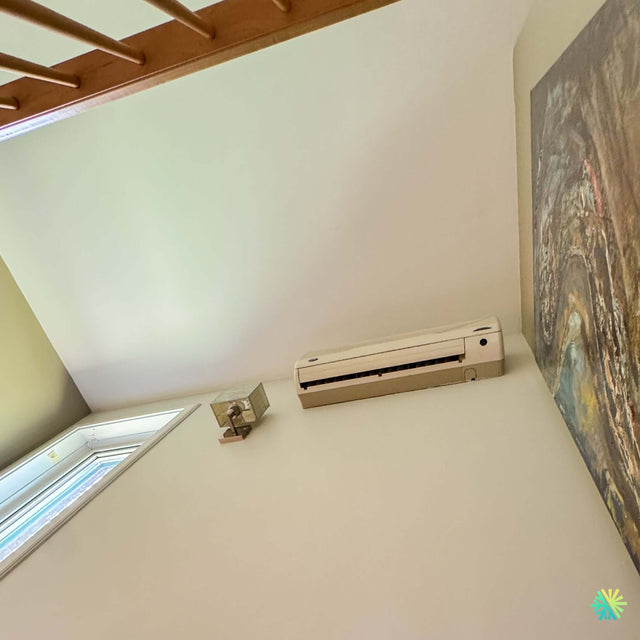
In the Old Port of Montreal, our AirGreen team responded to a service call for an LG wall-mounted heat pump, installed on an outdoor wall mount along a brick building. The client contacted us because the system no longer delivered the same level of comfort as before: the air conditioning seemed less effective, the unit ran longer, and some rooms remained uncomfortable despite normal thermostat or remote control settings.
The outdoor unit visible on site was an LG mini-split wall type, with a typical residential size capacity of about 12,000 to 18,000 BTU, depending on the associated indoor configuration and the nameplate checked during the intervention. Installed on a wall bracket, near a vertical pipe cover and a gutter downspout, this heat pump had a very common setup in Montreal urban neighborhoods: limited space, more technical working height, long vertical refrigerant line runs, and direct exposure to the elements.
This type of installation requires a precise diagnosis. An LG wall-mounted heat pump may seem to be working properly at first glance — fan running, compressor starting, indoor unit blowing — while experiencing performance loss due to reduced airflow, a small refrigerant leak, damaged line insulation, a sensor problem, unstable power supply, or dirt buildup on the outdoor coil.
Symptoms observed before our arrival
The client described a progressive situation to us. The unit was not completely out of service, but the performance had decreased. The heat pump would start, then run for a long time without quickly reaching the requested temperature. At times, the blown air seemed cool but not powerful enough to stabilize indoor comfort.
This type of symptom can have several causes:
- partial refrigerant loss;
- dirty outdoor coil;
- less efficient outdoor fan;
- weakened refrigeration fitting;
- damaged insulation on the suction line;
- unstable communication between the indoor and outdoor units;
- inaccurate temperature sensor;
- poor clearance or hot air recirculation around the condenser;
- intermittent electrical fault.
In an environment like the Old Port, outdoor HVAC systems are often exposed to urban dust, pollen, humidity, freeze-thaw cycles, as well as mechanical stresses related to installations on brick walls. All these factors can affect the performance of a wall-mounted heat pump.
Visual inspection of the LG outdoor unit
Our diagnosis began with a complete inspection of the outdoor unit. The unit was installed on a metal wall mount fixed to the building, which allowed freeing up floor space and protecting the heat pump from certain snow accumulations. However, an elevated installation requires a thorough check of stability, vibrations, connections, drainage, and protection of the refrigerant lines.
We checked:
Wall mounting and mechanical stability
An outdoor unit installed on a wall mount can transmit vibrations to the building if the supports are weakened, poorly leveled, or if the anti-vibration pads no longer function properly. In this case, we inspected the anchor points, the metal structure, and the unit’s base.
Stability was essential because excessive vibration can fatigue the refrigerant connections over time. Even a repeated microvibration over several seasons can contribute to a loss of tightness on certain connections.
The vertical pipe cover
The white cover installed on the facade protected the refrigerant lines, the communication wire, and possibly the drain depending on the interior passage. This detail is important: when a pipe cover extends over a long distance, it is necessary to ensure that the lines are not pinched, that the insulation remains continuous, and that water does not infiltrate at the passage points.
We paid special attention to the line exits near the outdoor unit, as this is often where insulation can deteriorate or connections become vulnerable.
The outdoor coil
The condenser coil is responsible for heat transfer. In cooling mode, it releases the heat extracted from the house to the outside. If it is clogged with dust, plant fibers, or urban debris, the unit can lose a significant part of its efficiency.
On this LG unit, the coil required technical cleaning. It was not just an aesthetic cleaning: the goal was to restore airflow through the fins and improve the system's capacity to reject heat.
Electrical and refrigerant diagnosis
After the visual inspection, we proceeded with technical checks. Reliable HVAC repair is never done solely based on sound impressions or quick observation. Measurements are necessary.
Verification of the electrical power supply
We checked the power supply to the outdoor unit, the general condition of the accessible circuit, and the system's response at startup. LG inverter-type heat pumps are sensitive to power quality and communication between units. Unstable voltage or weakened connection can cause intermittent shutdowns, error codes, or loss of modulation.
In this case, the power supply was stable enough to continue the refrigerant analysis, but accessible connections were checked to rule out a basic electrical problem.
Verification of the outdoor fan
The outdoor fan was observed during operation. We checked the speed, noise, smoothness of rotation, and absence of friction. A malfunctioning fan can raise system pressure and quickly reduce performance.
The fan was running, but heat exchange remained insufficient before cleaning, confirming the importance of treating the coil and checking the complete refrigerant behavior.
Analysis of pressures and temperatures
We then analyzed line temperatures, the temperature difference between return air and supply air inside, as well as the compressor's response during operation. This data helps distinguish a ventilation problem from a refrigerant issue.
The measurements indicated reduced performance, consistent with a combination of weakened heat transfer and a possible refrigerant imbalance. An inspection of the fittings was therefore necessary.
Detection of a weak point at the fittings
During the inspection of refrigeration fittings, our team looked for traces of oil, friction, or insulation deterioration. On a wall-mounted heat pump system, a small refrigerant leak can be hard to detect at first. The unit sometimes continues to operate, but its capacity gradually decreases.
In this case, a weak point was identified at an accessible connection. We proceeded with a targeted correction: securing the connection, checking for leaks, pressure testing when required, vacuuming, and restarting according to best practices. The goal was not to replace the unit but to restore the system’s normal capacity by correcting the real cause of the performance loss.
Technical cleaning and reconditioning
Once the refrigeration part was addressed, we performed appropriate cleaning of the outdoor condenser. Cleaning a wall unit should not be aggressive. Excessive pressure can damage the fins, reduce airflow, and create new problems. We therefore used a controlled method to remove dirt without damaging the coil.
We also checked the condition of the visible line insulation. Damaged insulation on the cold line can cause condensation, loss of efficiency, and less stable system behavior readings. The sections to monitor were reported to the customer.
A repair that restored comfort and avoided premature replacement
After the corrections, we restarted the LG heat pump and observed a full cycle. The device regained a more consistent response, with better cool air production inside and improved operational stability. The customer was able to see that the problem did not necessarily come from a major compressor failure, but rather from a combination of factors limiting performance.
What was corrected during the service call
Our intervention addressed several essential elements:
- Complete inspection of the LG outdoor unit;
- Checking the wall installation and vibrations;
- Checking the electrical supply;
- Checking the outdoor fan;
- Cleaning of the condenser coil;
- Inspection of refrigerant connections;
- Correction of a weak point in the circuit;
- Validation of operating temperatures;
- Restart and final test.
This comprehensive approach is especially important for wall-mounted heat pumps. Replacing a part without diagnosing the environment, connections, and heat transfer could have been more expensive without permanently solving the problem.
Mistakes to avoid with a wall-mounted heat pump installed high up
Waiting for the device to stop completely
A gradual loss of performance is already an important signal. The longer the customer waits, the more the compressor may have to work under difficult conditions.
Neglecting condenser cleaning
A dirty outdoor coil forces the unit to work harder. In Montreal, Laval, Longueuil, on the North Shore and the South Shore, outdoor units quickly accumulate dust, pollen, and seasonal debris.
Ignoring vibrations
An outdoor unit on a wall mount must remain stable. Repeated vibrations can affect the fittings and accelerate wear.
Touching fittings without proper equipment
A refrigerant circuit must be handled with the right tools. Improvised intervention can worsen a leak, contaminate the circuit, or damage the compressor.
Advice given to the client after the repair
At the end of the service, we explained to the client how to monitor the LG heat pump over the coming weeks:
- check if the blown air remains stable;
- note any new noises outside;
- watch for ice forming on the lines;
- keep the area around the unit clear;
- avoid modifying the pipe cover;
- schedule preventive maintenance before periods of intense heat;
- contact us quickly if performance decreases again.
These tips are simple but often help avoid more significant repairs. A well-maintained wall-mounted heat pump offers better comfort, more reasonable energy consumption, and a longer lifespan.
Why choose AirGreen for LG heat pump repair in the Old Port
This service at the Old Port of Montreal demonstrates the importance of local HVAC expertise. Urban installations present particular challenges: brick walls, high supports, restricted access, long refrigerant line runs, proximity to gutters, exposure to winds, and building aesthetic constraints.
At AirGreen, we work every week on wall-mounted heat pumps, wall air conditioners, central heat pumps, MultiZone systems, electric furnaces, and other residential HVAC equipment. Our approach is based on a complete diagnosis, targeted repair, and clear explanation to the client.
In this case, the LG heat pump did not need to be replaced. It required a thorough diagnosis, technical correction, and reconditioning. The result: a more stable system, improved comfort, and a client reassured about the actual condition of their equipment.