
Installation of a vänEE Air Exchanger in a condo in Ville-Marie (Montreal)
In a condo in Ville-Marie, AirGreen installs a suspended Air Exchanger vänEE in a technical closet, with insulated ducts and service access, for healthier air and better humidity control in Montreal.
Take a tour of the installation
Each number is a point we check on site. Switch between summer and winter to watch air and heat move.
Generic illustration of this type of installation, not a survey of this job site. Tap a number.
It removes stale air and brings in fresh air. The two airflows cross in the core without mixing.
It recovers part of the heat from the outgoing air to temper the incoming air. Depending on the model, it also manages humidity.
An outdoor hood, kept away from the exhaust so the house does not pull back the air it just removed.
Humid, stale air leaves through its own hood, fitted with a damper.
The ducts that connect to the outside are insulated to prevent condensation inside the house.
Stale air is drawn from humid rooms and fresh air is sent to living areas. The airflows are balanced.
It sets the mode and speed. You use it more when the house is humid or full of people.
Depending on the model and the season, the core produces condensation, removed through a drain with its loop.
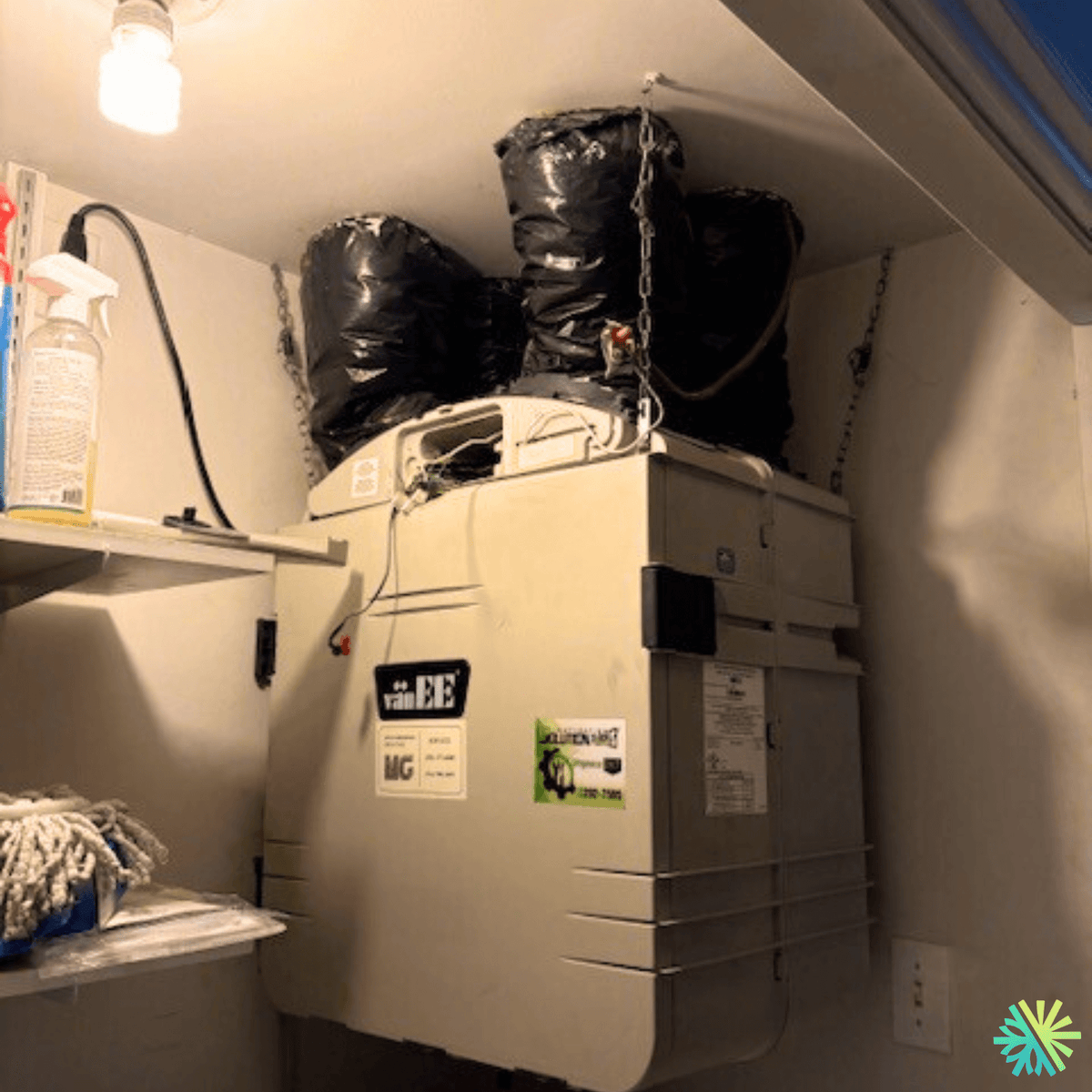
In many condos in Ville-Marie, indoor air quality depends on an often discreet but essential element: the air exchanger . The photo shows a typical installation in a utility closet : a unit suspended from the ceiling, connected to insulated ducts, designed to continuously renew the air while limiting heat loss in winter.
Machine type: air exchanger (residential ventilation)
The visible system is an air exchanger (often called HRV/ERV depending on the configuration). Its role is simple and crucial:
-
extract stale air (humidity, odors, CO₂) from rooms such as the bathroom, kitchen or laundry room,
-
bring in fresh, filtered air from outside,
-
and, depending on the technology, recover some of the heat to reduce the impact on heating — a real advantage in Quebec winters.
The brand supplied here is: Air Exchanger vänEE . The exact model is not clearly visible in the photo; therefore, we are deliberately cautious: this is a residential unit of this brand, installed in a standard condo configuration.
What the installation shows (concrete details and highlights)
Several visible elements indicate an installation designed for a limited space, typical of multi-unit residential buildings:
-
Suspended unit on chains : this is a good practice to limit vibrations and facilitate leveling.
-
Insulated flexible ducts (black sheathed): insulation helps reduce condensation and heat loss, especially when a section passes through a colder area.
-
Top service access : an open hood/access is visible, suggesting maintenance or adjustment (filters, electrical connection, control).
-
Technical room with shelves : this is clearly a mechanical closet , where maintenance ergonomics become an important factor (access to filters, clearance, drainage, connections).
At AirGreen, this is exactly the kind of situation where experience counts: in a condo, you can't "improvise" ventilation. It has to be efficient , quiet , easy to maintain , and visually clean .
Why an air exchanger is crucial in Ville-Marie
In city centers, condos are often very airtight, which is excellent for energy efficiency… but can trap moisture and pollutants . The result: condensation on windows, persistent odors, discomfort, a feeling of stuffiness, and sometimes even mold growth if humidity management is inadequate.
A properly sized and adjusted air exchanger generally allows:
-
more stable humidity (important in winter),
-
improved air quality on a daily basis,
-
a reduction in problems related to condensation,
-
and more consistent comfort, especially in the open spaces typical of condos.
Development, maintenance and reliability: what we prioritize at AirGreen
To ensure your vänEE Air Exchanger works correctly year after year, we focus on:
-
Flow calibration (balancing): essential to avoid excessive negative pressure and unwanted air infiltration.
-
Access to the filters and the heat exchanger core : regular maintenance keeps the system efficient and quiet.
-
Checking the connections and insulation of the ducts : to limit losses, noise and condensation.
-
Controlling operation in winter mode : because in Montreal, ventilation must remain stable even when it is very cold.
Conclusion
This Air Exchanger vänEE installation in Ville-Marie perfectly illustrates the reality of Montreal condos: a compact system, integrated into a small technical room, that must ensure reliable air renewal without compromising comfort. At AirGreen, we specialize in this type of equipment for installation, repair, maintenance, and optimization, with a clean, methodical approach tailored to the building's specific constraints.
The big day, step by step
The main steps of this kind of job at AirGreen. Every house has its quirks: the estimate brings them out.
We locate the wall for the two outdoor hoods, the unit's spot, service access and the drain.
The unit, its location and the price, in writing.
Hung or set level, with clear access to the filters and the core.
Fresh air intake and exhaust, kept apart and sealed.
The ones connected to the outside are insulated to prevent condensation inside the house.
Connected with its loop, when the unit needs one.
Installed where you will see it and use it.
Incoming and outgoing airflows are adjusted so the house is neither pressurized nor depressurized.
Speeds, filters, core: how to use it through the seasons.
- The on-site estimateWe locate the wall for the two outdoor hoods, the unit's spot, service access and the drain.
- The quoteThe unit, its location and the price, in writing.
- The unitHung or set level, with clear access to the filters and the core.
- The outdoor hoodsFresh air intake and exhaust, kept apart and sealed.
- The ductsThe ones connected to the outside are insulated to prevent condensation inside the house.
- The drainConnected with its loop, when the unit needs one.
- The wall controlInstalled where you will see it and use it.
- BalancingIncoming and outgoing airflows are adjusted so the house is neither pressurized nor depressurized.
- The walkthroughSpeeds, filters, core: how to use it through the seasons.
Four mistakes we do not make
Flip each card to see what we do instead.
Your own project, step by step
What to do, season by season
Three habits per season for this unit. They take a few minutes and prevent many calls.
- Clean the filters and core as the manufacturer specifies.
- Check the outdoor hoods: nests, debris, dampers.
- Lower the speed if the outdoor air gets humid.
- Adjust the speed to the humidity in the house.
- Check that the drain flows.
- Keep the outdoor hoods clear.
- Clean the filters before the closed-house season.
- Check the exhaust damper.
- Book a full cleaning if the unit has not had one in a long time.
- Clear snow from both outdoor hoods.
- Raise the speed if condensation appears on windows.
- Let the unit run: with the house closed, humidity builds up.
Is your home ready?
Check what applies at your place. A "no" is not a refusal: it is what we sort out during the estimate.
Four statements: true or false?
It all comes down to details you have just seen.
1. In an air exchanger, fresh air and stale air mix.
The two airflows cross in the core without mixing.
2. The two outdoor hoods must be kept apart.
Otherwise the exchanger pulls back the air it just removed.
3. An air exchanger can help with condensation on windows.
It renews the air and helps keep humidity in the right range.
4. An exchanger never needs maintenance.
Filters and core get dirty and need regular cleaning.
0 / 4 right answers
What people ask us about this kind of work
What does an air exchanger do?
Does fresh air cool the house in winter?
What speed should it run at?
Does an exchanger need cleaning?
What are the signs of poor ventilation?
HRV or ERV: what is the difference?
Should it run in winter?
Does AirGreen hold the required licences?
Is the estimate free?
No question matches. Write to us: we answer.
More jobs to see, near you
By town, by equipment or by region: browse more than 4,700 published projects.
Each dot: a town where AirGreen has published projects. The glowing dot: this job.
Every house has its constraints. We see them before we install.
The on-site estimate is free and the quote follows within 24 hours.
Text and photo: a real AirGreen Climatisation & Chauffage job. The diagrams are generic illustrations of the type of installation, not a survey of this job site. Sources of the added figures: airgreen.ca product pages (NEEP / AHRI performance), Hydro-Québec (Heat pumps page, LogisVert, read on 13 October 2026), Régie de l’énergie (rate D as of 1 April 2026).