
Installation of a GREE All Match Slim Duct R32 Ducted System with Insulated Ducts in the Attic in Delson, on the South Shore of Montreal
In Delson, AirGreen installs a GREE All Match Slim Duct R32 ducted system with insulated ducts in the attic: discreet comfort, balanced distribution, and neat HVAC installation.
- City
- Region
- Equipment
- Brand
- Challenges
- Published
The job on one screen
The article, chapter by chapter
A GREE ducted system installed in a demanding technical space in Delson
In Delson, on the South Shore, our AirGreen team completed a particularly interesting HVAC installation: the integration of a GREE ducted system, also called ducted conduit, ducted conduits, slim duct or ductable system, in an attic space already occupied by a wooden structure, blown insulation, and a duct network to be precisely organized.
This type of installation meets a very concrete need: to achieve uniform comfort in heating and air conditioning, without installing visible wall units in every room. For many homeowners in Delson, Candiac, Saint-Constant, La Prairie, Brossard, Longueuil, Montreal, Laval, on the North Shore and the South Shore, the ducted system represents a very interesting solution when you want to maintain a discreet interior finish while enjoying a modern and efficient heat pump.
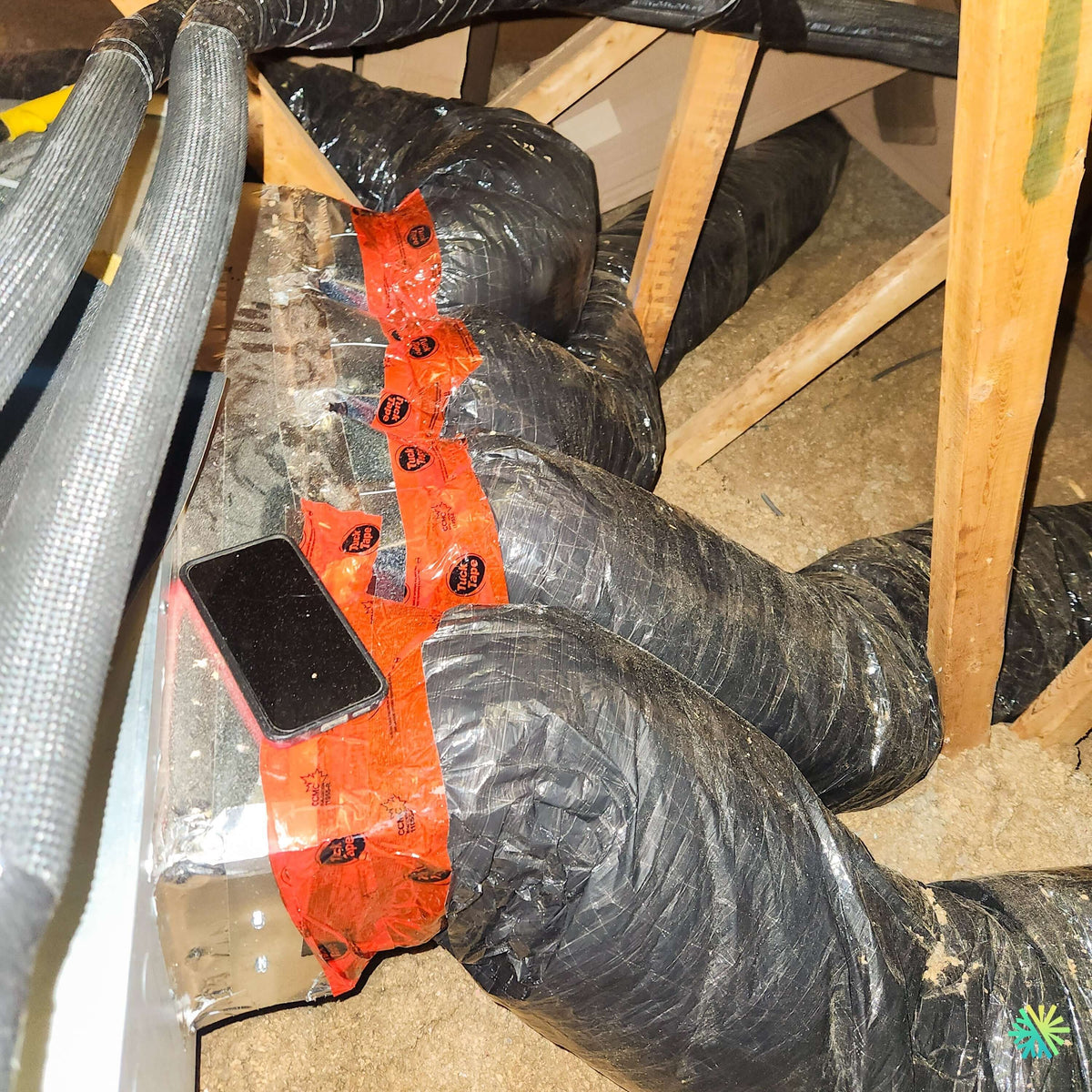
The photo of this project shows one of the most important parts of the project: the ductwork in the attic. You can see insulated flexible ducts, carefully sealed connections, transitions to the plenum, and integrated mechanical circulation between the joists and wooden studs. This is not the most visible part for the client on a daily basis, but it is precisely where the quality of the final comfort is determined. A ducted system can perform very well on paper; however, if the ducts are poorly sized, poorly sealed, or poorly oriented, the result can be noisy, uneven, or energy-consuming.
At AirGreen, we place great importance on this hidden part of the work. In an installation like this, every connection, every bend, every junction, and every duct path affects airflow, static pressure, and noise level.
Why choose a GREE ducted system rather than a traditional wall unit
A wall-mounted heat pump or a wall air conditioner remains an excellent solution for many homes. However, in some projects, the client seeks a more discreet and uniform distribution. That’s where a GREE All Match Slim Duct R32 system becomes very relevant.
The principle is simple: the indoor unit is hidden in a technical space, such as an attic, a false ceiling, or a mechanical area. The air is then distributed through ducts to different rooms. Instead of seeing a wall unit in the living room or bedroom, the customer only sees well-positioned supply and return grilles.
This approach is especially suitable for homeowners who want to:
- preserve the appearance of interior rooms;
- serve multiple zones with gentler distribution;
- avoid adding multiple wall units;
- improve comfort in distant bedrooms or spaces;
- integrate a modern solution into an already built house;
- reduce temperature differences between rooms.
In Delson, this project required meticulous installation, as the passage through the attic imposed significant physical constraints. The wooden structure, blown insulation, limited space, and existing or new ducts had to be considered before finalizing the route.
A GREE range suited for residential ducted projects
The GREE ducted systems available at AirGreen include several configurations: low static pressure models, high static pressure models, ductless duct systems, and GREE All Match Slim Duct R32 models. The capacities offered cover various residential needs and some larger projects, with common sizes like 9,000 BTU, 12,000 BTU, 18,000 BTU, 21,000 BTU, 24,000 BTU, 30,000 BTU, and 36,000 BTU, depending on the chosen series.
The choice of capacity is never made randomly. For a ducted installation, it is not enough to look at the house's area. You must also analyze:
- number of rooms to serve;
- length of the ducts;
- diameter of flexible ducts;
- insulation quality;
- ceiling height;
- pressure losses;
- the required static pressure;
- the location of the grilles;
- easy access for HVAC maintenance.
In this project in Delson, the goal was to install a system capable of delivering air efficiently through the network, without creating excessive noise or unnecessary restrictions. This is an important balance, especially in an attic where every foot of duct must be justified.
Working in the attic: a step that requires method and experience
The image clearly illustrates the reality of a ducted installation: the final comfort depends on work that the client almost never sees after the job is completed. The black insulated ducts, sealing tapes, connections, and plenum must be installed with precision.
In an attic, the challenges are many. Space is often limited. Technicians must work between roof trusses, avoid crushing the insulation, protect the ducts from overly tight bends, and maintain reasonable access to service components. A bend that is too sharp in a flexible duct can reduce airflow. A poorly sealed connection can cause losses. A duct that is too long or too compressed can harm performance.
For this installation in Delson, our team paid special attention to the following points:
Sealing the connections
The joints between the plenum and the ducts must be well sealed. A ducted system can lose some of its efficiency if the treated air escapes into the attic instead of being sent to the rooms. Sealing reduces losses, improves useful airflow, and contributes to energy performance.
Duct insulation
Ducts placed in an attic must be properly insulated. In summer, the attic can become very hot. In winter, it can be very cold. Poorly insulated ducts can lose some of the heating or cooling before the air even reaches the rooms. Insulation also helps limit condensation.
Respecting the bending radius
Flexible ducts must be installed with gentle curves. A curve that is too tight acts as a restriction. It increases static pressure and can reduce comfort in more distant rooms.
Future service access
Even if the system is discreet, it must not become inaccessible. A good HVAC project plans for future maintenance: drain inspection, connection checks, filter cleaning, or access to components depending on the configuration.
A discreet but technically precise solution for daily comfort
Static pressure: a technical detail that changes everything
In a ducted installation, static pressure is one of the most important parameters. It indicates the resistance the air must overcome to circulate through ducts, bends, grilles, and fittings. If the static pressure is too high for the chosen device, the system can become less efficient, noisier, and less comfortable.
The GREE range allows choosing between different system families, including low static pressure and high static pressure options. This distinction is essential. A small, short network with few outlets may suit low static pressure. A longer or more complex network may require a unit designed to push air further.
In Delson, the presence of several flexible ducts in the attic required serious consideration of airflow. Our task was to maintain effective distribution while avoiding unnecessary losses. A well-thought-out installation is not just about equipment; it’s also about design.
The role of the R-32 refrigerant and energy efficiency
The GREE All Match Slim Duct R32 models use recent technology suited for modern residential projects. The refrigerant R-32, available on some models in this range, meets current requirements for efficiency and performance. Depending on the selected models, some GREE units are also designed to offer good heating performance in cold weather, with capacities adapted to Quebec winters, sometimes down to about -30 °C depending on the configuration.
Eligibility for a subsidy, such as Hydro-Québec programs, always depends on the exact model, AHRI number, installed capacity, energy certification, and criteria in effect at the time of the application. At AirGreen, we verify this information before presenting a final offer. We also provide the necessary documents when the installed model is eligible, to help the client complete their application correctly.
This transparency is essential. A subsidy is not just a sales argument; it must be confirmed with the actual technical data of the installed system.
An installation that improves comfort without changing the appearance of the house
The great advantage of a ductable system lies in its integration. Inside, the grilles can be positioned to distribute air in important areas without disrupting the layout. For homeowners who care about their interior design, this solution is often much more elegant than multiplying wall units.
In Delson, the installed system delivers treated air through a network of insulated ducts, with an approach designed for daily comfort. The air can be distributed more subtly, which reduces the direct jet sensation often associated with some wall units. In bedrooms, corridors, or living areas, this softer distribution can improve the perception of comfort.
Common mistakes to avoid with ductable ducts
A ductable system can be excellent, but it requires professional installation. The most common errors are often hidden in the attic or false ceiling.
Installing ducts that are too long or too crushed
A compressed or poorly stretched flexible duct reduces airflow. Even a good device can lose efficiency if the air does not circulate properly.
Neglecting the air return
Good air supply must be accompanied by a properly sized air return. Without adequate return, the system can become noisy and less efficient.
Underestimating the importance of the drain
In cooling mode, the indoor unit produces condensate. This drainage must be reliable, accessible, and installed with an appropriate slope or pump. In an attic, a drain problem can cause significant damage if neglected.
Choosing the wrong type of static pressure
A low static pressure model is not suitable for all networks. A high static pressure model may be necessary when the configuration imposes more resistance.
Forgetting maintenance
Hidden systems must remain accessible. A well-designed project anticipates future needs, not just the initial installation.
The AirGreen approach to ducted projects
At AirGreen, we install HVAC systems in very varied contexts: single-family homes, condos, plexes, small businesses, renovations, and multi-unit projects. Ducted installations require particular expertise because they combine several trades: refrigeration, ventilation, electricity, duct design, insulation, drainage, and finishing.
Our status as a GREE Elite dealer allows us to work with in-depth knowledge of GREE products, including ducted systems, All Match Slim Duct R32 models, low and high static pressure configurations, as well as solutions adapted to the residential needs of Greater Montreal.
We also place great importance on the clarity of the offer. Before the start of work, the client must understand what is included, what is recommended, what could vary depending on the actual condition of the building, and how the system will be integrated. This way of working avoids unpleasant surprises and allows for a coherent installation from start to finish.
A project representative of current needs in Delson and on the South Shore
In Delson, many homeowners seek to improve their comfort without altering their home. Ducted systems respond very well to this trend. They allow for effective air conditioning in summer, efficient heating during much of the year, and a more discreet integration than traditional visible solutions.
This installation also shows why a technical visit is essential. In a photo, you see ducts, insulation, and a wooden structure. On site, our team mainly sees decisions to be made: where to route the ducts, how to minimize restrictions, how to protect the connections, how to ensure service access, and how to achieve balanced air distribution.
It is this precision that distinguishes a simply functional installation from a durable and comfortable one.
Practical advice for owners considering a ducted system
For an owner in Delson, Montreal, Laval, Longueuil, on the North Shore or the South Shore, a few tips can help avoid bad choices:
- request an analysis of the available space before choosing the model;
- validate the BTU capacity according to the building, not just the area;
- ensure that the ducts will be insulated when passing through an unconditioned space;
- confirm that the indoor unit will remain accessible for maintenance;
- check if the exact model may be eligible for a subsidy;
- favor a team capable of designing the duct network, not just installing the equipment.
A well-installed GREE ducted duct can transform the comfort of a home while remaining almost invisible. However, this result requires real design and execution work.
A neat result for invisible comfort
This project in Delson perfectly illustrates the benefits of a GREE ducted system: effective comfort, discreet air distribution, and technical integration in a space where every detail matters. The insulated ducts, sealed connections, and network planning result in a system better suited to the building’s reality.
For AirGreen, this type of project represents exactly what a successful HVAC installation should be: a solution chosen according to the client's needs, installed according to the building's constraints, and designed to last. Whether it’s a house in Delson, a condo in Montreal, a plex in Longueuil, a residence in Laval, a project on the North Shore, or a property on the South Shore, our goal remains the same: to offer a reliable, discreet, properly sized, and well-installed system.
The job tools
Two quick checks with real numbers: what heat costs, and what your current heaters add up to in BTU/h.
Conversion: 1 W = 3.412 BTU/h. An indication, not a load calculation: baseboards and furnaces are often stronger than the real need, and they can stay as backup. AirGreen confirms the capacity on site.
How the job unfolds
The main steps of this kind of job at AirGreen. Every house has its quirks: the estimate brings them out.
We look at the ducts, the current indoor module, the electrical panel and the planned spot for the outdoor unit.
The equipment combination, capacity and price, in writing. We check whether the combination qualifies for assistance programs.
Access protected, old unit disconnected and removed when it is being replaced.
Electric furnace or air handler, with its coil, connected to the supply and return ducts.
On a level base, raised above the snow, with free space all around.
Insulated, they enter through a sealed opening and run to the indoor coil.
Dedicated circuits, accessible disconnect, a thermostat that works with the heat pump and the backup heat.
Leak test, vacuum, start-up, airflow check and a test of both modes.
Filter, thermostat, backup heat in extreme cold: what to know before winter.
- The on-site estimateWe look at the ducts, the current indoor module, the electrical panel and the planned spot for the outdoor unit.
- The quoteThe equipment combination, capacity and price, in writing. We check whether the combination qualifies for assistance programs.
- Getting readyAccess protected, old unit disconnected and removed when it is being replaced.
- The indoor moduleElectric furnace or air handler, with its coil, connected to the supply and return ducts.
- The outdoor unitOn a level base, raised above the snow, with free space all around.
- The refrigerant linesInsulated, they enter through a sealed opening and run to the indoor coil.
- Electrical and thermostatDedicated circuits, accessible disconnect, a thermostat that works with the heat pump and the backup heat.
- Tests and start-upLeak test, vacuum, start-up, airflow check and a test of both modes.
- The walkthroughFilter, thermostat, backup heat in extreme cold: what to know before winter.
What we check on a job like this one
Each number is a point we check on site. Switch between summer and winter to watch air and heat move.
In summer, the outdoor unit rejects the house's heat outside.
Generic illustration of this type of installation, not a survey of this job site. Tap a number.
It captures or rejects heat outside. It sits on a level base, above the snow, with free space all around.
The insulated refrigerant lines enter the house through a sealed opening and run to the indoor coil.
A shut-off switch near the outdoor unit isolates it safely for service.
Sitting on the indoor module, it moves heat between the house air and the refrigerant.
Electric furnace or air handler: its fan pushes air through the ducts. The electric backup takes over in extreme cold.
Supply ducts bring air to the rooms; returns bring it back to the unit. Their condition matters as much as the unit's.
It protects the coil and the fan. A dirty filter cuts airflow, so it gets checked regularly.
It runs the heat pump and the backup heat. It must be compatible with the installed system.
Is your home ready?
Check what applies at your place. A "no" is not a refusal: it is what we sort out during the estimate.
Good habits, once the unit is in place
Six simple habits that keep the unit going. Your list stays on this device.
What to do, season by season
Three habits per season for this unit. They take a few minutes and prevent many calls.
- Check the indoor module's filter.
- Clear winter debris from the outdoor unit.
- Test cooling before the heat arrives.
- Check the filter more often in peak season.
- Keep registers and returns clear.
- Watch condensate drainage near the coil.
- Change or clean the filter.
- Test heating and backup heat before the cold.
- Book periodic maintenance.
- Clear snow around the outdoor unit.
- Store nothing in front of the indoor module.
- Note any unusual noise or smell and call us.
The right pages, at the right time
Four statements: true or false?
It all comes down to details you have just seen.
1. A central heat pump uses the house's ducts.
It connects to the existing ducts to heat and cool everywhere.
2. In extreme cold, electric backup heat can take over.
The indoor module (furnace or air handler) works with the heat pump and takes over in extreme cold.
3. The filter only gets changed when the unit breaks down.
A dirty filter cuts airflow. It gets checked regularly.
4. You can reuse the old unit's size without checking.
The house may have changed: insulation, windows, added rooms. Capacity is confirmed on site.
0 / 4 right answers
What people ask us about this kind of work
Can I keep my current ducts?
What happens in extreme cold?
Furnace, air handler, ducted: what is the difference?
Are there grants?
Do I need a permit?
How much can I save?
How is the LogisVert assistance calculated?
Will my current thermostat work?
Central or wall units: which one?
Does AirGreen hold the required licences?
Is the estimate free?
No question matches. Write to us: we answer.
More jobs to see, near you
By town, by equipment or by region: browse more than 4,700 published projects.
Each dot: a town where AirGreen has published projects. The glowing dot: this job.
An on-site estimate, the right capacity, the right equipment.
The on-site estimate is free and the quote follows within 24 hours.
Text and photo: a real AirGreen Climatisation & Chauffage job. The diagrams are generic illustrations of the type of installation, not a survey of this job site. Sources of the added figures: airgreen.ca product pages (NEEP / AHRI performance), Hydro-Québec (Heat pumps page, LogisVert, read on 13 October 2026), Régie de l’énergie (rate D as of 1 April 2026).