
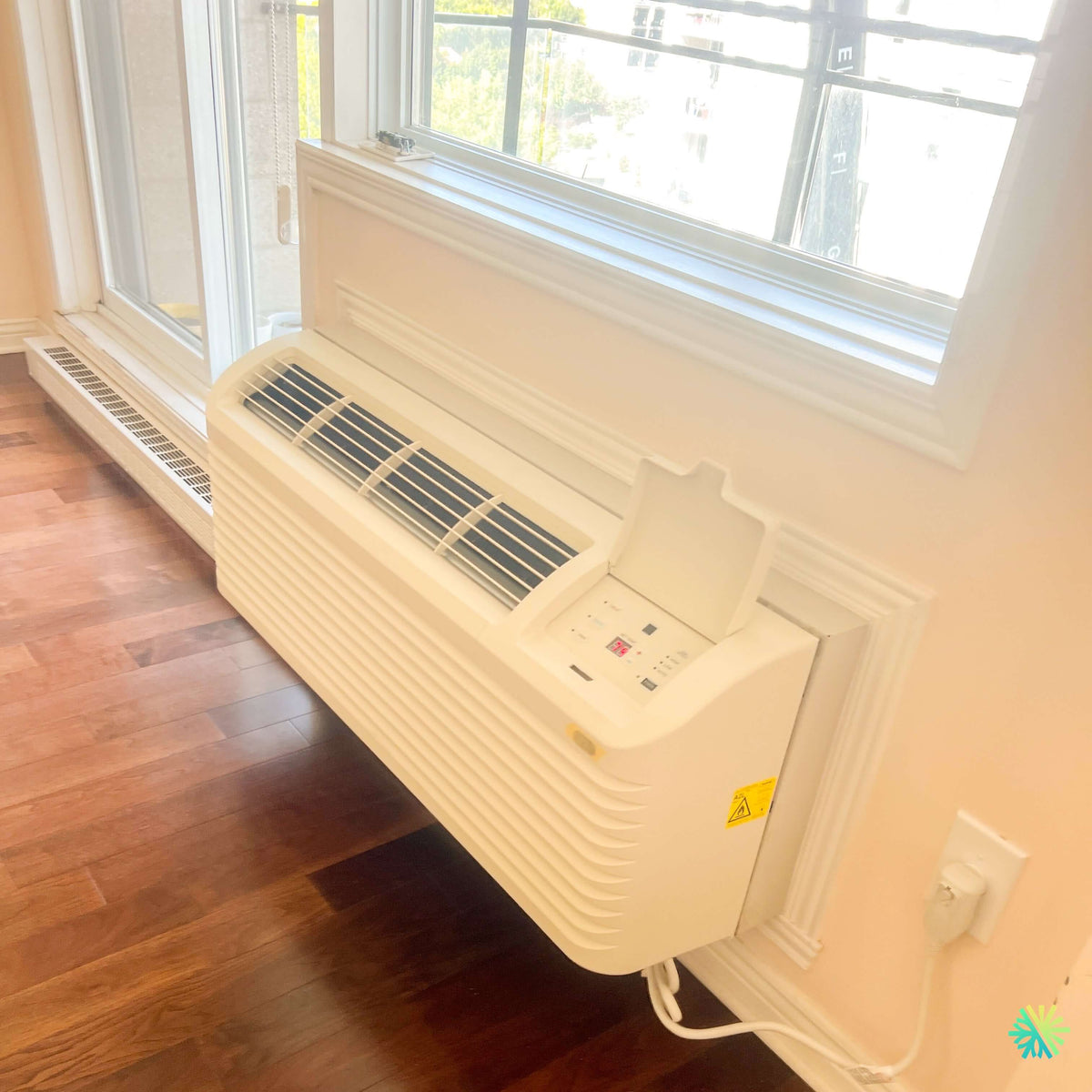
Installation of a FORESTAIR PTAC beneath a window in a residence in La Prairie, on the South Shore
Installation of a FORESTAIR PTAC beneath a large window in La Prairie: neat integration, a watertight sleeve, accessible controls, and safe management near an electric baseboard heater.
- City
- Region
- Equipment
- Brand
- Challenges
- Published
The job on one screen
The article, chapter by chapter
Precise integration into a narrow space between a large window, an electric baseboard heater, and a wood floor
This FORESTAIR PTAC installation in La Prairie featured a configuration typical of apartments and condominiums on the South Shore: a large window extending relatively low down the wall, a glass door leading to the balcony, an existing electric baseboard heater, and an indoor space where every centimetre had to be used intelligently.
We installed the unit directly below the window, in an opening through the exterior wall. This position allows the PTAC to reject heat outdoors without a separate condensing unit, while keeping the indoor front accessible for controls, filter cleaning, and maintenance.
In the photo, the result shows a white unit that blends well into the décor, despite the prominent trim around the window. The control panel is located on top, on the right side, beneath a lift-up cover. The supply grille occupies the upper-left section, while the large louvered front allows the airflow necessary for the system to operate.
The goal of this HVAC installation in La Prairie was not simply to place equipment in an existing opening. We had to create a stable, accessible system with a proper electrical connection, positioned so as not to compromise the window, wall covering, wood floor, or the operation of the electric baseboard heater.
Why a FORESTAIR PTAC was suitable for this location
A PTAC, or packaged terminal air conditioner, houses the components needed to cool a room in a single chassis. Depending on the exact model, it may also provide electric heating or operate as a heat pump.
Unlike a conventional wall-mounted heat pump, a PTAC does not include an indoor unit connected by refrigerant lines to a separate outdoor unit. It is inserted into a sleeve that passes directly through the building wall.
This configuration is particularly suitable for:
- condominiums;
- apartments;
- retirement residences;
- hotel rooms;
- multi-unit buildings;
- homes where installing a compressor on the balcony is restricted;
- buildings already constructed with wall openings for self-contained units.
In this residence in La Prairie, the unit could take advantage of direct access to the outdoors beneath the window. The balcony on the other side of the wall facilitated access to the outdoor grille while avoiding the addition of a separate unit on a wall-mounted or floor stand.
The PTAC also keeps the upper walls clear. No wall-mounted evaporator had to be installed above the window, and no exposed refrigerant piping was added inside the room.
An installation made more complex by decorative moldings
The visible wall surrounding the unit has several layers of molding. These elements add depth to the window’s trim, but they also reduce the flat surface available for integrating the PTAC.
We had to take into account:
- the height of the window’s lower framing;
- the thickness of the moldings;
- the depth of the unit;
- access to the control panel;
- the clearance required above the air outlet;
- the position of the sleeve in the wall;
- of the final appearance once the front panel is installed.
The PTAC could not be pushed too high against the molding, as the upper discharge grille must remain unobstructed. Conversely, an installation that was too low would have unnecessarily brought the unit closer to the floor and could have complicated cable management as well as cleaning the lower area.
The finished work maintains a visible gap between the top of the PTAC and the window frame. This clearance is important for airflow and for opening the cover that provides access to the controls.
A control panel that is accessible without moving the unit
The installed FORESTAIR model has an integrated control panel on the upper-right side. Its lift-up cover protects the buttons and display while allowing the occupant to easily adjust the temperature and operating mode.
This accessibility is essential. In some poorly planned installations, the controls end up too close to a shelf, molding, or piece of furniture. The owner then has to force open the cover or move objects every time they want to change a setting.
Here, the user can directly access:
- temperature setting;
- available cooling or ventilation modes;
- fan speed;
- turning the unit on and off;
- to the indicators displayed by the unit.
We also left the front panel unobstructed. It must be removable when a technician performs HVAC maintenance, inspects the filter, cleans the evaporator, or accesses the internal components.
The presence of an electric baseboard heater near the PTAC
A long electric baseboard heater is visible to the left of the unit, along the glass door and window. The coexistence of a PTAC and a baseboard heater must be carefully evaluated.
A baseboard heater warms air that naturally circulates from bottom to top. If a piece of furniture or another unit blocks its airflow, the local temperature may rise and heat distribution in the room may become less uniform.
During this project, we verified that:
- the PTAC's façade did not directly block the baseboard heater;
- warm air could continue to circulate;
- the power cords did not rest on a heated surface;
- the controls for both systems remained accessible;
- the two units could be used consistently during the cold season.
If the PTAC has a heating function, it is important to avoid conflicting settings. A baseboard heater set to a higher temperature than the PTAC may operate continuously and increase electricity consumption. We therefore explain to the customer how to coordinate the thermostats and determine which system should serve as the primary or supplemental heating source.
A visible, easily inspectable electrical connection
The PTAC's cord runs down the right side and reaches a wall outlet nearby. The connection remains visible, making it easier to inspect and preventing a cable from being crushed behind the unit.
Before any installation, we must confirm the precise electrical requirements on the rating plate. The brand and exterior appearance do not make it possible to determine with certainty:
- the required voltage;
- the minimum circuit ampacity;
- the circuit breaker capacity;
- the plug type;
- the presence of an electric heating element;
- the maximum heating output.
The complete model number and BTU capacity are not legible in the photo. We therefore do not assign them an approximate value. On site, we always check the rating plate before confirming circuit compatibility or replacing an existing unit.
This precaution prevents several common errors, including using an unsuitable outlet, an improperly sized circuit breaker, or an extension cord. A PTAC must be connected in accordance with the manufacturer's requirements and applicable electrical standards.
The wall sleeve: the component that determines installation quality
Behind the visible façade is an essential element: the sleeve passing through the wall. This metal frame supports the weight of the unit and forms the transition between the interior and exterior spaces.
During installation, we check several points.
The strength of the support
The sleeve must be firmly secured. An unstable support can cause vibrations, resonant noises, and premature wear of the components.
The slope toward the exterior
The PTAC produces condensation when cooling. A slight slope toward the exterior helps direct this water away from the interior wall and floor.
This inspection was particularly important in this residence because the wood flooring is directly beneath the unit. Repeated leakage could stain the wood, cause the boards to swell, or damage the lower trim.
Sealing around the opening
The perimeter of the sleeve must limit:
- air infiltration;
- water ingress;
- condensation inside the wall;
- insect entry;
- noise coming from the balcony;
- heat loss in winter.
In La Prairie, temperature variations, wind, and freeze-thaw cycles can worsen a sealing defect. A neglected seal can turn a functional installation into a source of discomfort near the window.
Compatibility with the FORESTAIR chassis
Even when two PTACs appear to have similar dimensions, their compatibility with an existing sleeve is not always guaranteed. The depth, exterior grille position, support points, and finishing accessories may vary.
We therefore verify actual compatibility before inserting the unit. Forcing a chassis into an unsuitable sleeve can reduce outdoor airflow, create vibrations, or prevent easy removal for maintenance.
The inspections that turn a simple replacement into a lasting HVAC installation
Commissioning and Airflow Inspection
After installing the FORESTAIR PTAC, we do not limit ourselves to confirming that the unit starts. A complete commissioning process makes it possible to quickly detect an issue that could go unnoticed during the first few minutes.
We check in particular:
- fan startup;
- compressor operation;
- the response of the control panel;
- the transition between the available modes;
- the different fan speeds;
- the temperature of the discharged air;
- the absence of abnormal mechanical noise;
- the absence of vibration against the window or trim;
- condensation behavior;
- the stability of the chassis in the sleeve.
The upper air outlet must remain completely unobstructed. In this installation, no sill, curtain, or piece of furniture blocks the grille. The air can therefore be directed toward the center of the room rather than remaining trapped against the wall.
The large window and solar heat gains
The visible window occupies a significant portion of the exterior wall. This glazed surface directly affects the cooling load.
A room may require a different capacity depending on:
- the window’s orientation;
- the number of hours of sunlight;
- the quality of the glazing;
- the presence of blinds;
- the frame’s airtightness;
- room area;
- ceiling height;
- the number of occupants;
- electrical appliances that produce heat.
That is why we do not select a PTAC solely based on floor area. An undersized unit could run continuously without reaching the requested temperature. An oversized unit could have short cycles, control humidity less effectively, and create uncomfortable temperature variations.
Sizing must be based on the room’s actual characteristics and the exact capacity of the selected FORESTAIR model.
Mistakes we avoid when installing a PTAC
Our experience in air conditioning and heating in Greater Montreal has enabled us to identify several common mistakes:
- choosing a unit based solely on its width;
- automatically reusing an old sleeve;
- neglecting the drainage slope;
- covering the joints with a simple decorative finish;
- blocking the outdoor grille with balcony furniture;
- installing curtains in front of the air return;
- pinching the cord behind the unit;
- plugging the PTAC into an extension cord;
- placing furniture too close to the front panel;
- forgetting about the coexistence of an electric baseboard heater;
- making the control panel inaccessible;
- announcing a subsidy without verifying the exact model.
In this installation in La Prairie, the open space in front of the unit facilitates air circulation and panel removal. The floor remains clear, the connection is accessible, and the upper grille can distribute air without immediate obstruction.
Recommended maintenance for the FORESTAIR PTAC
The performance of a PTAC depends heavily on the cleanliness of its filters and coils. The unit continuously draws in air from the room. Dust, pet hair, and particles can gradually reduce airflow.
Routine maintenance includes:
- removing and cleaning the filters;
- wiping the front panel;
- checking the air discharge grille;
- clearing the outdoor section;
- visually inspecting the cord;
- observing any unusual leakage;
- listening for new noises.
A professional HVAC maintenance service goes further with:
- cleaning the evaporator;
- inspecting the condenser;
- cleaning the condensation pan;
- clearing the water passages;
- checking the turbines;
- checking the sensors;
- inspecting the sleeve;
- checking the perimeter seal;
- checking the electrical components.
A reduction in performance, a persistent odor, a water leak, a noisy fan, or repeated shutdowns should be examined before the problem damages the floor or internal components.
PTAC, wall-mounted air conditioner, or central system
Each equipment category meets a different configuration.
A PTAC is well suited to rooms with a wall opening that require independent control. It does not require a duct network or a separate outdoor unit.
A wall-mounted air conditioner or wall-mounted heat pump can offer high seasonal efficiency and lower indoor noise levels, but requires an outdoor unit, refrigerant lines, a drain, and communication wiring.
The central system distributes air to several rooms but requires a duct network and more extensive work.
In a condominium, the choice may also be limited by the condominium association’s rules, the appearance of the facade, drilling approvals, and the available space on the balcony. We assess these constraints before recommending a solution.
Subsidies: verify before promising an amount
Eligibility for financial assistance programs always depends on the exact type of equipment, its certified performance, and the rules in effect when the application is submitted.
A FORESTAIR PTAC should not automatically be considered eligible for a subsidy simply because it provides cooling or has a heating function. We must verify:
- the complete model number;
- the category recognized by the program;
- the rated capacity;
- heating performance;
- the applicable certification;
- the building type;
- the installation address;
- the purchase date;
- the commissioning date.
This verification protects the customer from making a decision based on an amount that has not been confirmed.
AirGreen in La Prairie, Longueuil, and throughout Greater Montreal
At AirGreen, we perform HVAC installations, replacements, and maintenance in La Prairie, Longueuil, Candiac, Brossard, Montreal, Laval, on the South Shore, and the North Shore.
This project shows the importance of adapting the installation to the building. The FORESTAIR PTAC had to fit beneath a window, preserve the existing trim, remain accessible, coexist with an electric baseboard heater, and protect a wood floor from condensation risks.
Final quality depends on details that are not all visible once the panel is put back in place: sleeve compatibility, slope, sealing, electrical supply, grille clearance, and complete commissioning. These are precisely the elements we check to obtain a stable, user-friendly unit suited to the residence’s actual conditions.
How the job unfolds
The main steps of this kind of job at AirGreen. Every house has its quirks: the estimate brings them out.
We look at the outside wall, the window, the space in the room and the power supply.
The unit, the sleeve and the price, in writing.
Installed following the manufacturer's instructions, so water drains to the outside.
A dedicated connection matched to the unit's voltage and amperage.
The unit slides into the sleeve; the outdoor grille stays clear.
Start-up and a check of heating and cooling.
Controls, filter, what to keep clear.
- The on-site estimateWe look at the outside wall, the window, the space in the room and the power supply.
- The quoteThe unit, the sleeve and the price, in writing.
- The wall sleeveInstalled following the manufacturer's instructions, so water drains to the outside.
- The electrical workA dedicated connection matched to the unit's voltage and amperage.
- Unit and grilleThe unit slides into the sleeve; the outdoor grille stays clear.
- TestsStart-up and a check of heating and cooling.
- The walkthroughControls, filter, what to keep clear.
What we check on a job like this one
Each number is a point we check on site. Switch between summer and winter to watch air and heat move.
Generic illustration of this type of installation, not a survey of this job site. Tap a number.
All-in-one: it heats and cools from inside the room, with no separate outdoor unit.
A box that goes through the wall and holds the unit. It is installed following the manufacturer's instructions so water drains to the outside.
This is where the unit exchanges heat with the outdoor air. It must stay clear.
A dedicated connection matched to the unit's voltage and amperage.
On the unit or through a wall thermostat, depending on the model.
Under a window, the unit must leave curtains, sill and opening free, and let air move through the room.
Is your home ready?
Check what applies at your place. A "no" is not a refusal: it is what we sort out during the estimate.
Good habits, once the unit is in place
Six simple habits that keep the unit going. Your list stays on this device.
What to do, season by season
Three habits per season for this unit. They take a few minutes and prevent many calls.
- Clean the filter.
- Clear the outdoor grille.
- Test cooling.
- Clean the filter more often.
- Check water drainage.
- Let air move in front of the unit.
- Test heating.
- Check the seal around the sleeve.
- Book maintenance.
- Keep the outdoor grille free of snow.
- Do not cover the unit with a curtain.
- Note any unusual noise.
The right pages, at the right time
Four statements: true or false?
It all comes down to details you have just seen.
1. A PTAC needs a separate outdoor unit.
It is an all-in-one unit that goes through the wall.
2. The outdoor grille must stay clear.
That is where the unit exchanges heat with the outdoor air.
3. Any electrical outlet will do.
It needs a connection matched to its voltage and amperage.
4. A PTAC can heat and cool a room.
That is its job: all-in-one, under the window, through the wall.
0 / 4 right answers
What people ask us about this kind of work
What is a PTAC?
Where does it go?
What does it need electrically?
Can the existing sleeve be reused?
Does a PTAC cool the whole house?
Does AirGreen hold the required licences?
Is the estimate free?
No question matches. Write to us: we answer.
More jobs to see, near you
By town, by equipment or by region: browse more than 4,700 published projects.
Each dot: a town where AirGreen has published projects. The glowing dot: this job.
An on-site estimate, the right capacity, the right equipment.
The on-site estimate is free and the quote follows within 24 hours.
Text and photo: a real AirGreen Climatisation & Chauffage job. The diagrams are generic illustrations of the type of installation, not a survey of this job site. Sources of the added figures: airgreen.ca product pages (NEEP / AHRI performance), Hydro-Québec (Heat pumps page, LogisVert, read on 13 October 2026), Régie de l’énergie (rate D as of 1 April 2026).