
Installation of a MIDEA EVOX G3 electric furnace in a horizontal configuration in an attic in Oka, Laurentides
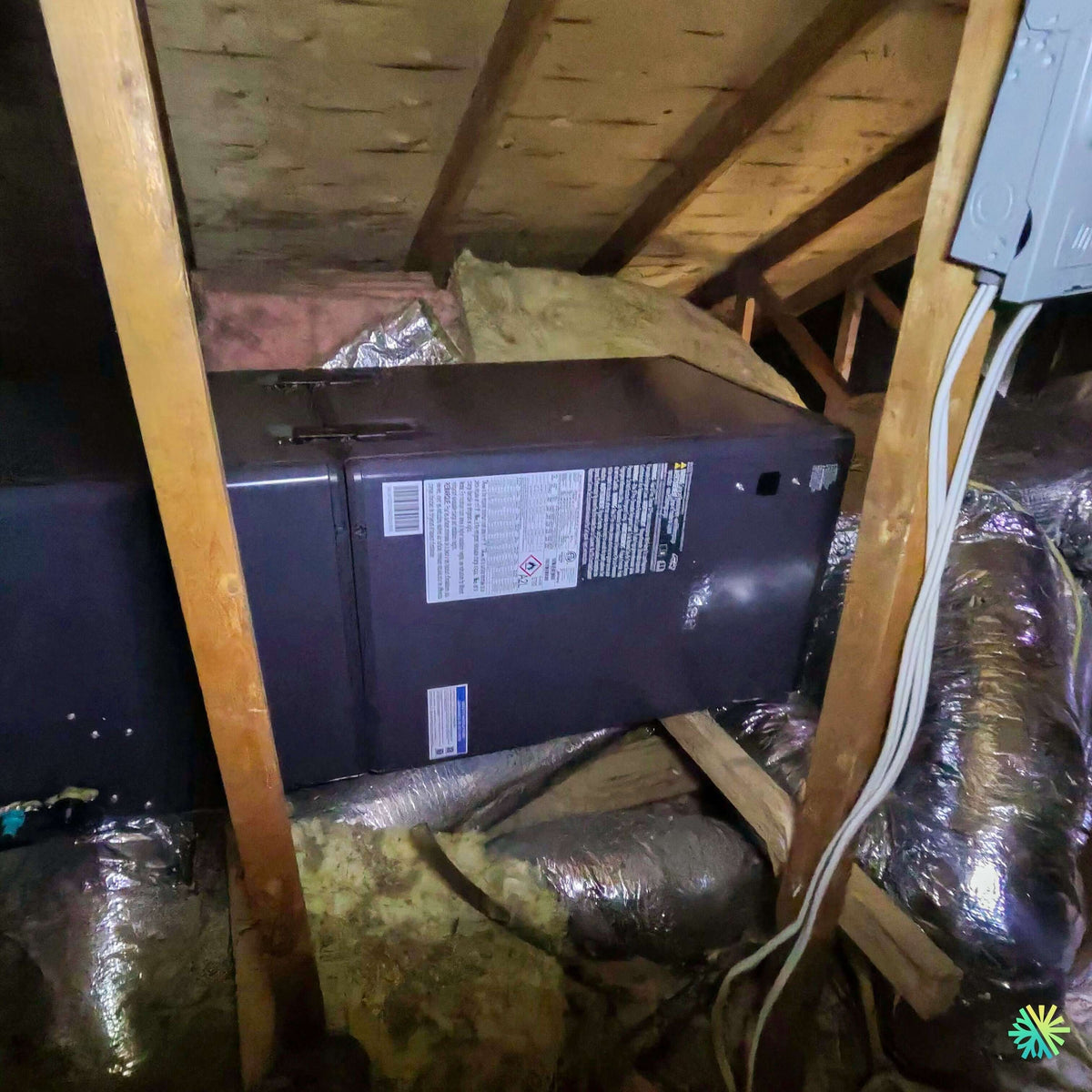
In Oka, AirGreen installs a MIDEA EVOX G3 electric furnace horizontally in a complex attic space, between the framing, insulation, and existing ductwork, with an integration designed for airflow and future maintenance.
Take a tour of the installation
Each number is a point we check on site. Switch between summer and winter to watch air and heat move.
In summer, the outdoor unit rejects the house's heat outside.
Generic illustration of this type of installation, not a survey of this job site. Tap a number.
It captures or rejects heat outside. It sits on a level base, above the snow, with free space all around.
The insulated refrigerant lines enter the house through a sealed opening and run to the indoor coil.
A shut-off switch near the outdoor unit isolates it safely for service.
Sitting on the indoor module, it moves heat between the house air and the refrigerant.
Electric furnace or air handler: its fan pushes air through the ducts. The electric backup takes over in extreme cold.
Supply ducts bring air to the rooms; returns bring it back to the unit. Their condition matters as much as the unit's.
It protects the coil and the fan. A dirty filter cuts airflow, so it gets checked regularly.
It runs the heat pump and the backup heat. It must be compatible with the installed system.
In Oka, the EVOX G3 had to adapt to the attic, the framing, and a well-established duct network
This MIDEA EVOX G3 electric furnace installation in Oka shows a very different reality from basement mechanical rooms, where one can work standing up with several feet of clearance around the equipment. Here, our AirGreen team had to work directly in an attic, amid the roof framing, insulation, and an existing network of flexible ducts.
The job-site photo immediately sums up the challenge: the MIDEA unit is positioned horizontally, between the trusses and wooden studs. Around the cabinet, several insulated ducts snake toward the different sections of the house. The available height quickly decreases beneath the roof slope, and access is far more restrictive than in a conventional mechanical room.
For this type of project, selecting a unit based solely on its BTU capacity would be a mistake. The cabinet’s shape, its ability to operate horizontally, the arrangement of the access panels, the refrigerant line routing, and the ability to connect the system to the existing ductwork are just as important.
This is precisely one of the interesting aspects of the MIDEA EVOX G3 : this central platform was designed to offer several installation orientations and to simplify moving it through difficult areas, particularly attics and basements. Midea documentation describes a modular, multiposition design intended precisely for this type of application.
A horizontal configuration that directly addresses the attic’s constraints
In a vertical installation, the unit primarily uses the available height. In this attic in Oka, this solution would have been much more difficult to implement because of the roof slope and framing.
We are therefore dealing here with a horizontal installation, clearly visible in the photo.
Midea documentation outlines several configurations, including:
- upflow;
- downflow;
- right horizontal;
- left horizontal;
- low-profile configurations for areas where height is limited.
The manufacturer also highlights a design called Block N Lock, making it easier to separate and reconfigure certain sections of the unit. Midea explicitly states that this design facilitates moving the unit through difficult areas such as attics and basements.
At the Oka site, this flexibility is therefore not a theoretical feature. It directly responds to the environment in which the equipment had to be integrated.
Working between the framing without sacrificing access to the system
When a central unit is installed in such a compact space, the question is not simply whether it can fit between two pieces of framing.
We must also think about what will happen several years after installation.
A central system contains components that may eventually require access:
- filter;
- fan;
- indoor coil;
- electronic controls;
- electrical connections;
- auxiliary heating;
- refrigerant lines;
- condensate drainage;
- diagnostic panels.
A unit that fits perfectly in the space but whose panels become impossible to remove is not a well-planned installation.
The photograph from Oka clearly shows why this consideration is important. The cabinet is surrounded by framing and ducts; it is therefore necessary to use the genuinely accessible areas intelligently rather than simply pushing the unit as far as possible beneath the roof slope.
The existing flexible ducts become an essential part of the project
Around the MIDEA EVOX G3, several insulated flexible ducts are visible.
These ducts form the air-transport network to the property's different rooms. In both heating and cooling, their condition directly affects the comfort achieved indoors.
In an attic, we pay particular attention to:
- crushed ducts;
- curves that are too tight;
- insufficiently supported sections;
- tears in the outer jacket;
- insulation losses;
- connections to the plenums;
- restrictions that may increase static pressure.
A heavily compressed flexible duct may appear properly installed from the outside while considerably reducing its internal diameter.
This is particularly important with a central electric furnace and heat pump equipped with a modern fan: the system may be capable of delivering the required airflow, but the duct network must still allow that air to circulate.
The insulation visible in the attic is not a minor detail
The photo also shows insulation around the work area.
In an attic, temperatures can become very different from those in the living space. In winter in Oka, this difference can be considerable; in summer, the temperature beneath the roof can also rise quickly.
Duct and refrigerant-line insulation therefore plays an important role.
An insufficiently insulated duct section can result in:
- heat losses in winter;
- heat gains in summer;
- condensation on certain cold surfaces;
- a reduction in overall efficiency;
- less uniform comfort at the registers.
When carrying out work in an attic, we must also avoid leaving insulation displaced around the installation. HVAC work should not create new areas of heat loss simply because access to the equipment was required.
EVOX G3: what “electric furnace” really means
In Quebec, the term electric furnace is commonly used for the indoor unit of a central system.
In the case of the MIDEA EVOX G3, the equipment is more precisely a central air handler that can be combined with an outdoor heat pump and an auxiliary electric heating package.
This distinction is important.
The heat pump can provide heating by transferring heat from outdoors, while the electric elements provide backup heat when the control strategy or thermal conditions require it.
For the EVOX G3, Midea provides a multistage auxiliary heating package capable of up to 25 kW, with options offered at 10, 15, and 25 kW depending on the application. The manufacturer also states that these stages allow the auxiliary output to be adjusted to temperature variations.
Installing the maximum available output is not automatically the best solution, however.
The choice must match:
- the home’s heat loss;
- the heat pump’s output;
- the electrical panel’s capacity;
- the wiring;
- the ductwork;
- the system’s control logic.
What capacity was installed in Oka?
The rating plate is visible in the photo, and the marking associated with A2L refrigerant can be distinguished. However, the complete model number is not clear enough for us to reliably determine the exact capacity of this particular unit.
We therefore prefer not to invent a tonnage from an insufficiently clear photograph.
The EVOX G3 product line described in Midea’s documentation nevertheless includes several capacities, ranging 18,000 to 54,000 BTU/h, depending on the indoor and outdoor combination. For the product line presented, the manufacturer reports performance of up to 19 SEER2, 12.5 EER2, 10.8 HSPF2 and a COP of up to 2.14 under the stated test condition.
The brochure’s technical table lists configurations of 18,000, 24,000, 30,000, 36,000, 48,000, and 54,000 BTU/h, among others, with different performance depending on the exact combination.
For a homeowner comparing quotes, this is an important distinction: “MIDEA EVOX G3” is not a capacity in itself.
Why we do not size an installation based solely on floor area
Saying that a house has a certain number of square feet is not enough to correctly determine the capacity of a central system.
We consider, among other factors:
- the insulation level;
- the windows;
- the amount of exterior wall;
- air infiltration;
- the building's exposure;
- the floor layout;
- the duct capacity;
- the airflow actually available in the ductwork;
- the heating load on the coldest days.
An oversized system can run unnecessarily short cycles or move too much air for the existing ducts. An undersized system can run continuously without properly meeting demand.
The Oka installation clearly illustrates this logic: when we see the complexity of the ductwork in the attic, it becomes obvious that tonnage cannot be selected independently of air distribution.
Why the EVOX G3 is particularly well suited to a central-system renovation in Oka
Up to 1.2 in. of static pressure, depending on the configuration
One of the most interesting technical features of the EVOX G3 is the Computational Constant Airflow 2.0.
According to Midea, this electronic fan management makes it possible to maintain airflow under different ductwork conditions and operate up to 1.2 in. of water column static pressure in the intended applications.
The manufacturer also mentions up to 60 air-volume adjustment levels.
This feature is particularly useful during a renovation when we need to retain a significant portion of the existing ductwork.
However, it never replaces an inspection of the ductwork.
If a duct is crushed, disconnected, or far too small, we do not rely on the furnace's electronics to hide the problem.
More even air distribution through the coil
Midea's documentation also describes an indoor design combining an M-Coil-type coil and a symmetrical fan.
According to the data presented by the manufacturer, this arrangement is intended to achieve a more uniform distribution of air through the coil than certain conventional designs.
In a central system, this balance is important because air must travel efficiently across the entire heat exchanger surface before being redistributed throughout the house.
A heat pump platform designed for cold climates
The EVOX range presented in the Midea document provides heat pump operation down to -30 °C.
The documentation specifically mentions sustained heating performance at very low temperatures on a three-ton system used for the manufacturer's testing.
At Oka and on the North Shore of Montreal, cold-weather performance is particularly relevant.
However, three elements must be distinguished:
- the system’s nominal capacity;
- the capacity actually available at low temperatures;
- the contribution of auxiliary electric heating.
This combination determines the system’s actual performance in January, not just the SEER2 value displayed for cooling.
R454B and the new generation of A2L equipment
On the photographed nameplate, the pictogram A2L is clearly visible.
The Midea brochure confirms that the R454B was selected for the EVOX range and indicates a global warming potential, or GWP, of 466.
For installation and service, this means that the procedures and equipment used must be suitable for this category of refrigerants.
Therefore, when replacing an older central heat pump, it is increasingly important to check not only the capacity of the new unit, but also:
- the refrigerant type;
- component compatibility;
- the piping;
- service methods;
- the requirements specific to the installed equipment.
Filtration: up to MERV 13 in the specified configurations
For the EVOX G3, Midea provides a filtration module compatible with filters of different thicknesses: 1, 2, or 4 inches, including MERV 13 in the corresponding configurations.
For an attic installation, however, filter accessibility becomes just as important as its effectiveness.
An excellent filter that no one can easily replace risks remaining in place far too long.
That is why we examine not only the theoretical filtration, but also how the owner or technician will be able to access the filter once the project is complete.
EVOX communication or 24 V thermostat
The EVOX G3 platform also offers several control options.
The documentation notably provides for:
- an Midea 485 communication mode;
- the dedicated Midea controller;
- certain configurations using a conventional 24 V thermostat;
- different integration options depending on the connected equipment.
Midea also indicates that the platform can identify the control mode being used.
With the corresponding communicating components, the manufacturer also provides scheduling, consumption monitoring, and diagnostics through its SmartHome app.
The most costly mistakes when installing a furnace in an attic
Our Oka project illustrates several mistakes that we systematically seek to avoid.
Installing the unit without planning for the next service visit
The fact that the unit fits in the attic does not guarantee that it is correctly positioned.
Crushing ducts to artificially create space
A flexible duct must not become the project’s compromise.
Leave the insulation displaced
Equipment access must not create a permanent area of heat loss.
Neglecting condensation
A central unit that provides cooling produces water. In an attic, a leak can cause damage before the occupants even notice it.
Choosing the auxiliary capacity without checking the electrical system
An electric heating assembly must be coordinated with the available electrical panel and power supply.
Confusing the performance of the range with that of the exact model
The maximum values of 19 SEER2 or 10.8 HSPF2 do not automatically apply to all EVOX G3 combinations. The exact combination must always be verified.
What about the LogisVert subsidy?
The brochure provided with the equipment describes several performance levels in the EVOX G3 range, but it does not by itself confirm a Quebec installation's eligibility for LogisVert.
The references to financial assistance in the document concern, among others, U.S. programs in California, New York State, and Oregon.
For an installation in Oka, eligibility must therefore be verified using the exact combination of the indoor and outdoor units, the applicable certification, and the program criteria in effect at the time of the application.
We avoid announcing a subsidy amount based solely on the name “EVOX G3,” because several capacities and combinations are available in this range.
This Oka project shows why installation matters just as much as the equipment
The photo of this MIDEA EVOX G3 installed horizontally in an attic in Oka does not show a perfectly empty mechanical room prepared for new construction.
It shows the reality of a renovation.
We have to work around the framing, insulation, existing ductwork, and limited space. We have to route the air without crushing the ducts, maintain access to the equipment, and adapt recent central technology to a building that existed long before it.
This is precisely the type of work where our experience in HVAC installation makes a difference.
At AirGreen, we carry out installations of electric furnaces, central heat pumps, and ducted systems to Oka, on Montreal's North Shore, in Montreal, Laval, Longueuil, and on the South Shore. Our approach is to examine the system as a whole: equipment, ductwork, airflow, auxiliary heating, insulation, refrigerant, controls, and service access.
In this project, the horizontal configuration of the MIDEA EVOX G3 allows the available space under the roof to be used efficiently while preserving the home's central ductwork.
And that is often where the true success of an installation lies: not only in the specification sheet for the new machine, but in how successfully we integrate it into the existing building.
The big day, step by step
The main steps of this kind of job at AirGreen. Every house has its quirks: the estimate brings them out.
We look at the ducts, the current indoor module, the electrical panel and the planned spot for the outdoor unit.
The equipment combination, capacity and price, in writing. We check whether the combination qualifies for assistance programs.
Access protected, old unit disconnected and removed when it is being replaced.
Electric furnace or air handler, with its coil, connected to the supply and return ducts.
On a level base, raised above the snow, with free space all around.
Insulated, they enter through a sealed opening and run to the indoor coil.
Dedicated circuits, accessible disconnect, a thermostat that works with the heat pump and the backup heat.
Leak test, vacuum, start-up, airflow check and a test of both modes.
Filter, thermostat, backup heat in extreme cold: what to know before winter.
- The on-site estimateWe look at the ducts, the current indoor module, the electrical panel and the planned spot for the outdoor unit.
- The quoteThe equipment combination, capacity and price, in writing. We check whether the combination qualifies for assistance programs.
- Getting readyAccess protected, old unit disconnected and removed when it is being replaced.
- The indoor moduleElectric furnace or air handler, with its coil, connected to the supply and return ducts.
- The outdoor unitOn a level base, raised above the snow, with free space all around.
- The refrigerant linesInsulated, they enter through a sealed opening and run to the indoor coil.
- Electrical and thermostatDedicated circuits, accessible disconnect, a thermostat that works with the heat pump and the backup heat.
- Tests and start-upLeak test, vacuum, start-up, airflow check and a test of both modes.
- The walkthroughFilter, thermostat, backup heat in extreme cold: what to know before winter.
What would it look like at your place?
Two quick checks with real numbers: what heat costs, and what your current heaters add up to in BTU/h.
Conversion: 1 W = 3.412 BTU/h. An indication, not a load calculation: baseboards and furnaces are often stronger than the real need, and they can stay as backup. AirGreen confirms the capacity on site.
Four mistakes we do not make
Flip each card to see what we do instead.
Your own project, step by step
What to do, season by season
Three habits per season for this unit. They take a few minutes and prevent many calls.
- Check the indoor module's filter.
- Clear winter debris from the outdoor unit.
- Test cooling before the heat arrives.
- Check the filter more often in peak season.
- Keep registers and returns clear.
- Watch condensate drainage near the coil.
- Change or clean the filter.
- Test heating and backup heat before the cold.
- Book periodic maintenance.
- Clear snow around the outdoor unit.
- Store nothing in front of the indoor module.
- Note any unusual noise or smell and call us.
Is your home ready?
Check what applies at your place. A "no" is not a refusal: it is what we sort out during the estimate.
Four statements: true or false?
It all comes down to details you have just seen.
1. A central heat pump uses the house's ducts.
It connects to the existing ducts to heat and cool everywhere.
2. In extreme cold, electric backup heat can take over.
The indoor module (furnace or air handler) works with the heat pump and takes over in extreme cold.
3. The filter only gets changed when the unit breaks down.
A dirty filter cuts airflow. It gets checked regularly.
4. You can reuse the old unit's size without checking.
The house may have changed: insulation, windows, added rooms. Capacity is confirmed on site.
0 / 4 right answers
What people ask us about this kind of work
Can I keep my current ducts?
What happens in extreme cold?
Furnace, air handler, ducted: what is the difference?
Are there grants?
Do I need a permit?
How much can I save?
How is the LogisVert assistance calculated?
Will my current thermostat work?
Central or wall units: which one?
Does AirGreen hold the required licences?
Is the estimate free?
No question matches. Write to us: we answer.
More jobs to see, near you
By town, by equipment or by region: browse more than 4,700 published projects.
Each dot: a town where AirGreen has published projects. The glowing dot: this job.
Every house has its constraints. We see them before we install.
The on-site estimate is free and the quote follows within 24 hours.
Text and photo: a real AirGreen Climatisation & Chauffage job. The diagrams are generic illustrations of the type of installation, not a survey of this job site. Sources of the added figures: airgreen.ca product pages (NEEP / AHRI performance), Hydro-Québec (Heat pumps page, LogisVert, read on 13 October 2026), Régie de l’énergie (rate D as of 1 April 2026).