
Installation of a GENERAL ELECTRIC Zoneline PTAC in La Présentation, Montérégie, in an existing wall sleeve
In La Présentation, AirGreen installs a GENERAL ELECTRIC Zoneline PTAC in an existing sleeve, inspecting the coil, drainage, electrical system, sealing, and A2L components.
- City
- Region
- Equipment
- Brand
- Challenges
- Published
The job on one screen
The article, chapter by chapter
A recessed replacement where wall preparation mattered just as much as the unit’s performance
At La Présentation, in Montérégie, our AirGreen team carried out the installation of a GENERAL ELECTRIC Zoneline PTAC in an existing wall opening. At first glance, the job might have seemed simple: remove the old unit, insert the new chassis, and reinstall the front panel. In practice, the success of such an HVAC installation depends on a series of checks that are visible neither in a brief quote nor once the unit has been closed up.
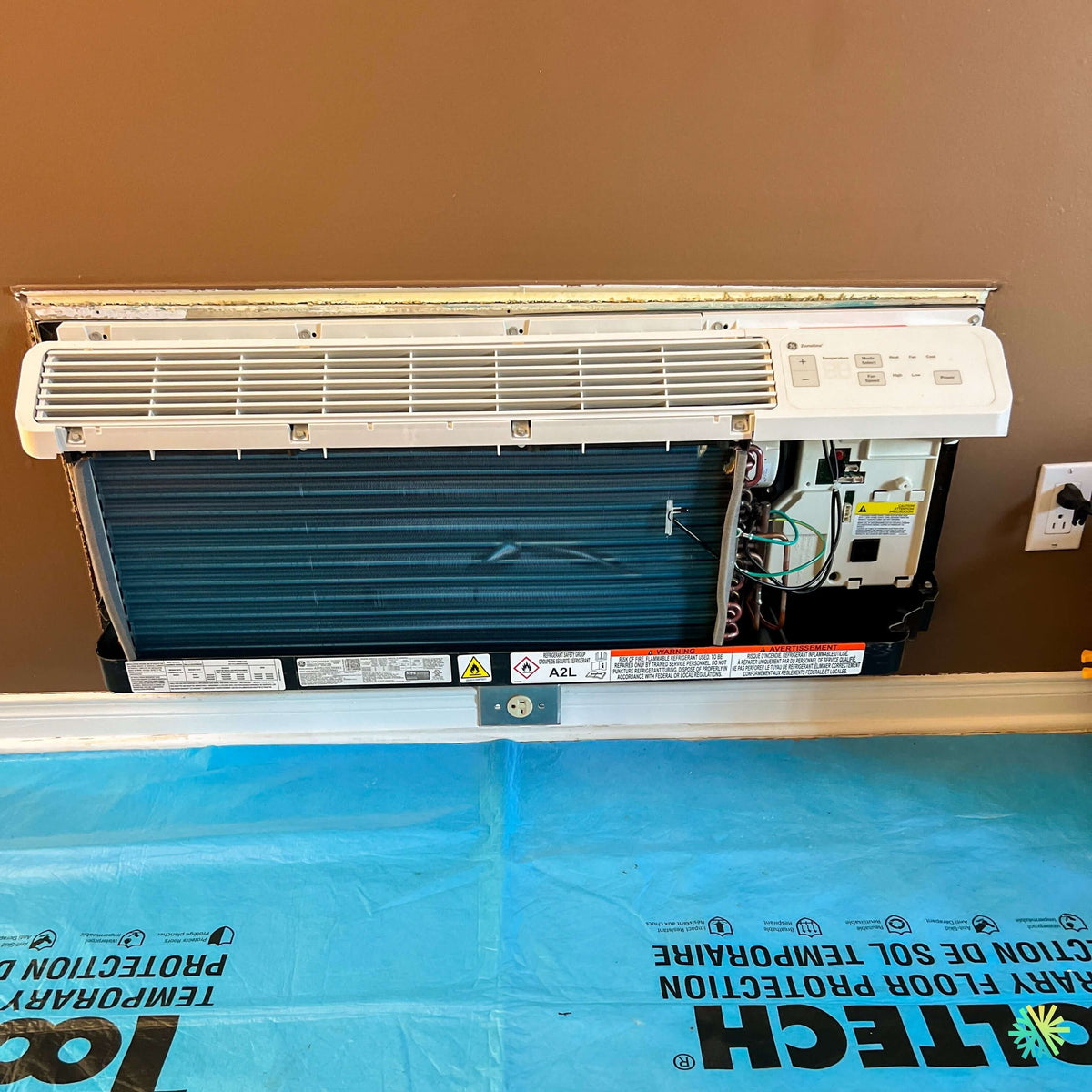
The photo taken during our work clearly shows this important step. The PTAC’s decorative front panel had been removed, revealing the large blue coil, refrigerant lines, electrical compartment, grounding wires, control panel, and safety labels. A protective sheet had been laid over the floor to protect the surface while handling the chassis and working around the opening.
The wall also had some particular features. The finish around the existing sleeve was uneven, especially in the upper section. Traces of old trim, sealant, and finishing materials were still visible. This situation is common when replacing a recessed unit installed several years earlier. The new PTAC must not only operate properly, but also be positioned to limit air infiltration, vibration, and the risk of water entering the building envelope.
Why a PTAC was suitable for this room
A PTAC, or packaged terminal air conditioner, combines the refrigeration circuit, fans, indoor coil, outdoor coil, and controls in a single unit that passes through the wall.
This design meets the needs of certain homes, rooms, offices, and standalone spaces, particularly when it is difficult to install a separate outdoor unit. Unlike a ductless split heat pump, the PTAC does not require refrigerant lines connecting two units located far apart.
At this property in La Présentation, the existing wall opening was a significant advantage. It made it possible to retain a compact solution without adding exposed piping to the façade or taking up a new outdoor location.
The benefits sought included the following:
- individual temperature control in the room;
- a unit that is accessible for cleaning and maintenance;
- an installation centered in an existing opening;
- the absence of a separate condenser on a wall-mounted bracket;
- direct air distribution through the upper grille;
- a suitable solution for a localized replacement.
The GENERAL ELECTRIC Zoneline has built-in controls on the upper-right part of the front panel. The user can select the temperature, operating mode, and fan speed directly on the unit. This simplicity is particularly useful in rental properties and rooms that need to operate independently from the rest of the building.
Exact model identification before commissioning
The GENERAL ELECTRIC Zoneline range includes several configurations. Two units bearing the Zoneline name may have different capacities, voltages, power consumption, and heating types.
In the photograph, the detailed information on the nameplate is not legible enough to confirm with certainty:
- the rated capacity in BTUs;
- the complete model number;
- the required voltage;
- the maximum current;
- the heating capacity;
- the exact type of refrigerant;
- the official energy efficiency rating.
We never infer this information solely from the appearance or dimensions of the cabinet. Before commissioning, our technicians consult the nameplate and the manufacturer’s documentation to confirm the unit’s electrical and mechanical compatibility.
This precaution is essential. A 208- or 230-volt PTAC, for example, must not be connected like a unit designed for a different voltage. The circuit breaker protection, outlet type, and circuit capacity must match the requirements of the exact model.
A clearly visible A2L warning
One of the notable features of the unit installed in La Présentation is the presence of a label A2L on the lower part of the chassis. This classification indicates the use of a mildly flammable refrigerant.
A compliant, properly installed unit is designed to operate safely. However, the A2L classification affects the methods used when a technician must work on the refrigeration circuit.
A repair or leak search must take into account, among other things:
- ventilation of the work area;
- the elimination of ignition sources;
- the use of appropriate tools;
- regulatory refrigerant recovery;
- the manufacturer’s procedures;
- the amount of refrigerant contained in the unit;
- the warnings displayed on the chassis.
The A2L label alone does not identify the exact refrigerant. We always check the nameplate before performing any work. This diligence prevents us from confusing different refrigerants that may share the same safety classification but require distinct operating parameters and procedures.
The wall sleeve: an often-overlooked component
The PTAC chassis is inserted into a wall sleeve, sometimes called a cabinet or sleeve. This structure passes through the wall and supports the unit. It also separates the indoor section from the portion exposed to outdoor conditions.
When replacing a unit, it is not enough to verify that the new unit can physically fit into the opening. We must also confirm that the sleeve:
- is not deformed;
- does not show significant corrosion;
- is securely attached to the structure;
- meets the required dimensions;
- allows adequate airflow outside;
- does not block the drainage openings;
- provides a slope that complies with the manufacturer’s requirements.
In this project, the visible finish above the unit indicated that particular attention had to be paid to the joint between the wall and the sleeve. Poor sealing in this area could allow cold air in winter, moisture, and wind-driven water to enter.
Sealing without trapping water
Sealing a PTAC requires a precise balance. The perimeter of the sleeve must prevent infiltration, but the designed water drainage paths must never be obstructed.
During air conditioning, moisture in the air condenses on the indoor coil. This water must be directed into the drain pan and discharged according to the unit’s design. If the slope is incorrect or an opening is blocked with sealant, water may flow back indoors.
Possible consequences include:
- a wet floor;
- damage to the baseboard;
- stains on the wall;
- corrosion in the chassis;
- persistent odors;
- water noises;
- an accumulation of damp dust.
We therefore inspected the cabinet base, drainage passages, and chassis position before closing the unit.
The blue coil inspected before closure
With the front panel removed, the large indoor coil is fully accessible. This step allows us to inspect a component that will become less visible once the unit is returned to its normal configuration.
We check several items:
-
Fin condition
Crushed fins reduce airflow and can impair heat exchange. -
Coil fastening
A poorly secured coil may vibrate or come into contact with the chassis. -
Sensor positioning
A displaced sensor can cause an inaccurate temperature reading. -
Wiring routing
No wire should rub against a sharp metal part or a moving component. -
The absence of shipping damage
The visible lines and connections are inspected before startup. -
Overall cleanliness
A new unit should not contain construction debris or forgotten packaging materials.
On the right side of the photograph, the copper lines and electrical components are visible. The green grounding wires must be properly secured, while the electrical compartment must remain protected before the front panel is put back in place.
Complete floor protection during the work
The large blue tarp installed in front of the unit is not merely an aesthetic detail. A PTAC is a relatively heavy and bulky piece of equipment. When it is removed from its sleeve or moved near a finished wall, it can damage the floor, baseboards, or furniture.
At AirGreen, we prepare the work area before any handling. Floor protection helps us:
- prevent scratches;
- collect small particles;
- minimize marks left by tools;
- protect the floor from residual water;
- temporarily remove certain components;
- keep the work area organized.
This method is particularly important when the installation takes place in an occupied home. Our work is not limited to the equipment's performance; it also includes protecting the surfaces and indoor environment.
The proximity of the wall outlet and electrical checks
A power outlet is visible to the right of the PTAC. Its proximity does not automatically mean that it powers the unit or that it is suitable for its electrical requirements.
Depending on the Zoneline version, the unit may require a specific connection, outlet, or circuit. We must verify:
- the available voltage;
- the circuit rating;
- the circuit breaker;
- the plug configuration;
- the polarity;
- the grounding;
- the condition of the outlet;
- the absence of overheating or discoloration.
The use of an extension cord or improvised adapter should be avoided. An air-conditioning and heating unit may require significant power, especially when it has an auxiliary electric heating element.
We also confirm that the cord cannot be pinched by the chassis or placed against a hot surface.
A methodical commissioning process to ensure comfort, quiet operation, and reliability
Tests performed before replacing the front panel
Once the unit is properly positioned, we carry out several tests. The front panel is replaced only after confirming that the main components are operating properly.
Fan test
We first activate the ventilation to check:
- the stability of the airflow;
- the operation of the speed settings;
- the absence of rubbing;
- the fan noise;
- the direction of the air at the upper outlet.
A vibration noise may come from the fan, but also from the sleeve, a mounting point, or a panel that is not properly engaged. It is easier to locate the source while the unit is still open.
Cooling test
When the indoor temperature allows for a reliable test, we check:
- the compressor starting;
- the drop in supply-air temperature;
- the controls’ response;
- the condition of the coil;
- condensate drainage;
- the absence of metallic noise;
- the stability of the cycle.
We also check whether outdoor air can circulate freely through the rear of the PTAC. A blocked outdoor grille reduces heat rejection capacity and increases operating pressure.
Heating test
When the model offers a heating mode, we verify:
- the production of warm air;
- switching between modes;
- the thermostat’s response;
- the absence of an abnormal electrical odor;
- the operation of the safety devices;
- the consistency of the ventilation.
A slight temporary odor may sometimes appear when a new heating element is started for the first time, but it should diminish quickly. A persistent odor or one accompanied by an unusual noise requires immediate inspection.
Reducing vibrations in the wall
A PTAC contains several mechanical components. Slight vibration is normal, but it should not be amplified by the building structure.
Common sources of noise include:
- an inadequately secured sleeve;
- a front panel that is not properly latched;
- a chassis touching a metal trim piece;
- a deformed exterior grille;
- a loose part;
- an uneven wall opening;
- a unit that is not properly seated in its cabinet.
In La Présentation, the visible irregularities around the old finish required particular attention. We ensure that the finishing materials do not rest directly on a vibrating part of the chassis.
This step makes a significant difference in a bedroom or living room. A unit may function properly from a cooling standpoint while becoming disruptive if vibrations are transmitted to the wall.
Recommended maintenance to maintain proper airflow
The front panel of the GENERAL ELECTRIC Zoneline must remain accessible. It must not be sealed to the wall or blocked by a permanent piece of furniture.
The filter should be inspected regularly. The frequency depends on how the room is used, whether there are pets, the amount of dust, and the operating time.
A clogged filter can cause:
- reduced airflow;
- increased energy consumption;
- less stable discharge-air temperature;
- coil icing;
- dust buildup;
- reduced comfort.
During professional HVAC maintenance, we can also clean the coil, inspect the condensate pan, clear the water passages, check the electrical connections, and examine the condition of the sleeve.
Avoid using a harsh chemical directly on the fins or bending them with a stiff brush. The electrical components located on the right side must also be protected from water.
Mistakes to avoid when replacing a PTAC
Replacing a PTAC in an existing opening involves several potential pitfalls.
Choosing a unit based solely on its width
Two chassis with similar dimensions are not necessarily compatible with the same sleeve. Air intakes, deflectors, and mounting points may vary.
Assuming the old electrical circuit is suitable
The voltage and amperage must be confirmed for the new model. A similar appearance does not guarantee the same electrical requirements.
Neglecting the finish around the perimeter
A trim piece can conceal a significant gap around the sleeve. Aesthetic appeal does not replace proper sealing.
Blocking drainage with sealant
Excessive use of silicone can trap water in the chassis.
Closing it up without performing a complete test
A misplaced wire, vibration, or drainage problem is much easier to correct before the front panel is permanently installed.
Blocking the front of the appliance
A curtain, sofa, or piece of furniture placed directly in front of the PTAC reduces airflow and interferes with temperature control.
Energy performance and eligibility for financial assistance
Actual performance depends on the exact model, capacity, condition of the wall opening, and how the appliance is used. A recent PTAC may offer better control and performance than an older, deteriorated appliance, but we cannot assign a precise energy rating without the complete model number.
Eligibility for a grant must not be assumed solely because the appliance has a heating or heat pump function. Financial assistance programs apply specific criteria concerning the equipment type, certifications, capacity, and building.
For this installation in La Présentation, no specific financial assistance was confirmed based on the information available. Before promising an amount, we always verify the complete model and the rules of the current program.
A result adapted to the building rather than a standardized installation
This project clearly illustrates our approach at AirGreen. We did not treat the GENERAL ELECTRIC Zoneline as a simple box to slide into an existing opening. We took the sleeve, wall finish, electrical supply, drainage, A2L refrigerant safety, noise, and future maintenance access into account.
This approach is the same for our projects in Montreal, Laval, Longueuil, the North Shore, and the South Shore. Buildings vary, even when the appliances appear identical. An opening may be slightly deformed, an old sleeve may have been improperly sealed, an outlet may not match the new model, or the exterior section may be partially obstructed.
A durable HVAC installation relies on these details. When the front panel is finally put back in place, the customer sees an appliance neatly integrated into the wall. Behind this facade, however, are numerous checks that ensure its operation, safety, and long-term maintenance.
How the job unfolds
The main steps of this kind of job at AirGreen. Every house has its quirks: the estimate brings them out.
We look at the outside wall, the window, the space in the room and the power supply.
The unit, the sleeve and the price, in writing.
Installed following the manufacturer's instructions, so water drains to the outside.
A dedicated connection matched to the unit's voltage and amperage.
The unit slides into the sleeve; the outdoor grille stays clear.
Start-up and a check of heating and cooling.
Controls, filter, what to keep clear.
- The on-site estimateWe look at the outside wall, the window, the space in the room and the power supply.
- The quoteThe unit, the sleeve and the price, in writing.
- The wall sleeveInstalled following the manufacturer's instructions, so water drains to the outside.
- The electrical workA dedicated connection matched to the unit's voltage and amperage.
- Unit and grilleThe unit slides into the sleeve; the outdoor grille stays clear.
- TestsStart-up and a check of heating and cooling.
- The walkthroughControls, filter, what to keep clear.
What we check on a job like this one
Each number is a point we check on site. Switch between summer and winter to watch air and heat move.
Generic illustration of this type of installation, not a survey of this job site. Tap a number.
All-in-one: it heats and cools from inside the room, with no separate outdoor unit.
A box that goes through the wall and holds the unit. It is installed following the manufacturer's instructions so water drains to the outside.
This is where the unit exchanges heat with the outdoor air. It must stay clear.
A dedicated connection matched to the unit's voltage and amperage.
On the unit or through a wall thermostat, depending on the model.
Under a window, the unit must leave curtains, sill and opening free, and let air move through the room.
Is your home ready?
Check what applies at your place. A "no" is not a refusal: it is what we sort out during the estimate.
Good habits, once the unit is in place
Six simple habits that keep the unit going. Your list stays on this device.
What to do, season by season
Three habits per season for this unit. They take a few minutes and prevent many calls.
- Clean the filter.
- Clear the outdoor grille.
- Test cooling.
- Clean the filter more often.
- Check water drainage.
- Let air move in front of the unit.
- Test heating.
- Check the seal around the sleeve.
- Book maintenance.
- Keep the outdoor grille free of snow.
- Do not cover the unit with a curtain.
- Note any unusual noise.
The right pages, at the right time
Four statements: true or false?
It all comes down to details you have just seen.
1. A PTAC needs a separate outdoor unit.
It is an all-in-one unit that goes through the wall.
2. The outdoor grille must stay clear.
That is where the unit exchanges heat with the outdoor air.
3. Any electrical outlet will do.
It needs a connection matched to its voltage and amperage.
4. A PTAC can heat and cool a room.
That is its job: all-in-one, under the window, through the wall.
0 / 4 right answers
What people ask us about this kind of work
What is a PTAC?
Where does it go?
What does it need electrically?
Can the existing sleeve be reused?
Does a PTAC cool the whole house?
Does AirGreen hold the required licences?
Is the estimate free?
No question matches. Write to us: we answer.
More jobs to see, near you
By town, by equipment or by region: browse more than 4,700 published projects.
Each dot: a town where AirGreen has published projects. The glowing dot: this job.
An on-site estimate, the right capacity, the right equipment.
The on-site estimate is free and the quote follows within 24 hours.
Text and photo: a real AirGreen Climatisation & Chauffage job. The diagrams are generic illustrations of the type of installation, not a survey of this job site. Sources of the added figures: airgreen.ca product pages (NEEP / AHRI performance), Hydro-Québec (Heat pumps page, LogisVert, read on 13 October 2026), Régie de l’énergie (rate D as of 1 April 2026).